Expanding into new markets has never been more achievable. Businesses can now hire skilled professionals across borders, build remote teams, and enter new regions faster than ever before. But before hiring internationally, one key question often comes up:
Should you choose a PEO or an EOR?
Both models help companies manage employment, payroll, benefits, and HR operations. However, they work in very different ways. Choosing the right one can affect your hiring speed, compliance exposure, costs, and long-term growth plans.
In this guide, we explain PEO vs EOR, the key differences, costs, benefits, and when each model makes the most sense. We’ll also look at how companies use an Employer of Record (EOR) to hire in growth markets such as Malaysia without setting up a local entity.
Content Outline
Key Summary
PEO Supports Existing Local Entities
A PEO helps businesses manage HR, payroll, and benefits when they already have a registered company in a specific country.
EOR Enables Global Hiring Without Entities
An EOR allows companies to legally hire employees in another country without setting up a local business first.
Legal Employer Structure Is the Key Difference
PEO uses a co-employment model, while an EOR becomes the legal employer and handles full employment compliance.
EOR Is Faster for Market Entry
Businesses can hire quickly in new countries using an EOR without waiting for legal entity setup or registration processes.
PEO Strengthens Internal HR Operations
PEOs are ideal for companies looking to improve payroll systems, employee benefits, and HR support within an established market.
EOR Reduces Expansion Complexity
An EOR manages payroll, contracts, and compliance in multiple countries, making international hiring more scalable and efficient.
Choice Depends on Growth Stage
Companies with existing entities benefit from PEOs, while those expanding into new markets or testing regions benefit more from EOR solutions.
What Is a PEO?
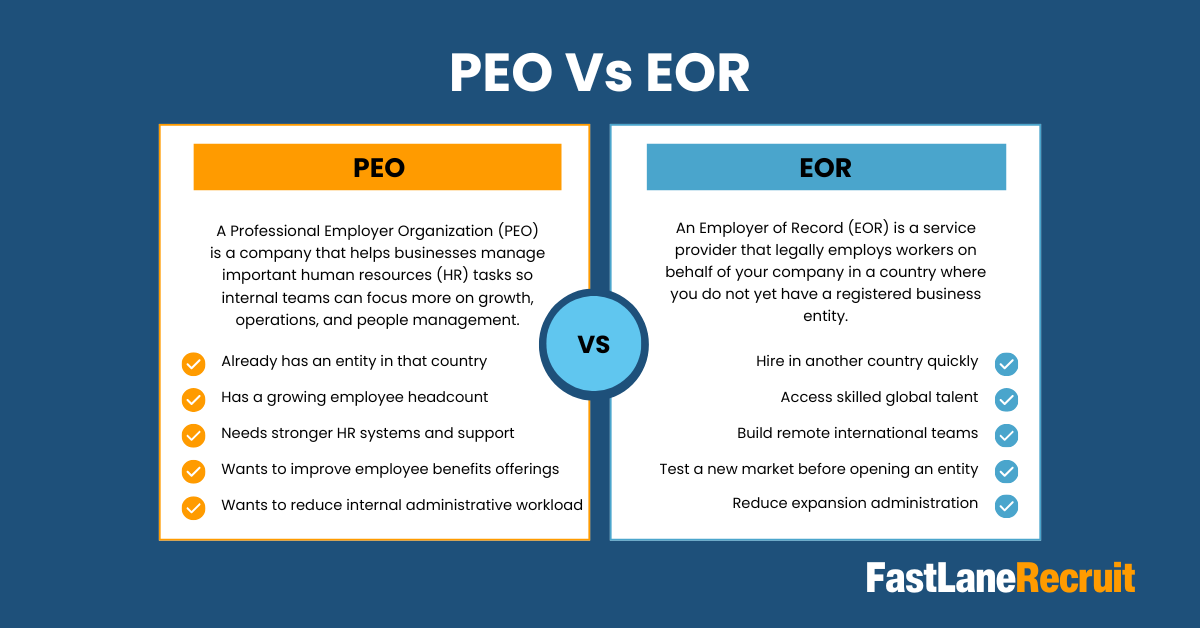
A Professional Employer Organization (PEO) is a company that helps businesses manage important human resources (HR) tasks so internal teams can focus more on growth, operations, and people management.
Think of a PEO as an experienced HR partner that supports your company behind the scenes with day-to-day employment administration.
Common Services a PEO Provides
A PEO can assist with a wide range of HR functions, including:
- Payroll administration – calculating salaries, processing payroll, and issuing payslips on time
- Employee benefits – helping manage medical coverage, retirement plans, leave programs, and other employee benefits
- HR support – guidance on workplace policies, employee handbooks, and HR best practices
- Tax filings – handling payroll tax reporting and required submissions
- Workers’ compensation coordination – supporting workplace injury insurance administration where required
- Compliance guidance – helping businesses stay aligned with employment laws and regulations
- Onboarding support – assisting with new hire paperwork, documentation, and HR setup
How a PEO Works
With a PEO, your business still remains the main employer. You continue to control:
- Hiring decisions
- Employee roles and responsibilities
- Daily supervision
- Performance management
- Company culture
- Promotions and compensation strategy
The PEO supports the employment administration side through a co-employment arrangement. This means the PEO helps manage certain HR and payroll responsibilities, while your company continues leading the workforce.
Example
Imagine your company has opened an office in the United States and hired 15 employees.
Your management team handles:
- Recruiting staff
- Setting goals
- Managing performance
- Leading projects
The PEO helps with:
- Running monthly payroll
- Managing health benefits enrollment
- Filing payroll taxes
- Supporting HR compliance
- Handling onboarding paperwork for new hires
This allows your leadership team to spend less time on administration and more time growing the business.
When Businesses Usually Choose a PEO
A PEO is often a good option when a company:
- Already has a legally registered business entity in that country
- Has a growing employee headcount
- Needs stronger HR systems and support
- Wants to improve employee benefits offerings
- Wants to reduce internal administrative workload
Example: Growing in Malaysia
If a foreign company already has a registered company in Malaysia and plans to hire a local team, a PEO may help manage:
- Payroll processing
- EPF and SOCSO administration
- HR documentation
- Employee onboarding
- Ongoing HR support
This can make local team management more efficient while the business focuses on expansion.
Also Read: EOR Services: A Game Changer for Startup Growth
What Is an EOR?
An Employer of Record (EOR) is a service provider that legally employs workers on behalf of your company in a country where you do not yet have a registered business entity.
In simple terms, an EOR allows your business to hire employees in another country without needing to open a local company first.
This is especially useful for businesses expanding internationally, building remote teams, or hiring talent in new markets quickly.
How an EOR Works
The EOR becomes the official legal employer on paper, while your company remains responsible for the employee’s day-to-day work.
Your company still controls:
- Job responsibilities
- Daily management
- Team goals
- Work schedules
- Performance reviews
- Training and development
- Project direction
The EOR manages the formal employment side, ensuring the employee is hired and managed according to local labor laws.
What an EOR Typically Manages
An EOR usually handles the key employment administration tasks, including:
- Locally compliant employment contracts – contracts aligned with the country’s labor laws
- Payroll processing – paying salaries accurately and on time
- Statutory contributions and taxes – managing required employer and employee contributions
- Benefits administration – coordinating leave entitlements, insurance, and mandatory benefits
- Employment law compliance – helping ensure employment practices meet local regulations
- Termination processes – handling offboarding based on country-specific legal requirements
- HR documentation and onboarding – managing employee records and new hire setup
Example
Imagine a company based in Europe wants to hire a software developer in Malaysia, but does not have a Malaysian company entity.
Instead of spending months setting up a local company, the business uses an EOR.
The EOR can:
- Issue a Malaysian-compliant employment contract
- Register payroll requirements
- Process monthly salary payments
- Manage EPF, SOCSO, and tax contributions
- Provide compliant onboarding support
Meanwhile, the company manages the employee’s daily work, meetings, targets, and team collaboration.
This allows the business to hire faster and start operations sooner.
Why Businesses Use an EOR
An EOR is commonly chosen by businesses that want to:
- Hire in another country quickly
- Access skilled global talent
- Build remote international teams
- Test a new market before opening an entity
- Reduce expansion administration
- Manage compliance more confidently
- Hire one employee or a small team without large setup costs
Example: Hiring in Malaysia
Malaysia is a popular hiring destination for international companies due to its skilled multilingual workforce and strong business environment.
A business may use an EOR to hire Malaysian professionals in areas such as:
- Technology
- Customer service
- Finance
- Marketing
- Operations
- Shared services
Without an EOR, the company may first need to establish a legal entity, open payroll accounts, and manage statutory registrations.
With an EOR, hiring can often begin much faster.
When an EOR Makes the Most Sense
An EOR is often the right solution when a company:
- Has no local entity in the target country
- Wants to hire immediately
- Is entering multiple countries
- Needs flexibility during expansion
- Wants to focus on growth rather than administration
Think of an EOR as a Fast Market Entry Solution
For many businesses, an EOR is a practical first step into a new country. It allows them to build a local team, understand the market, and grow operations before deciding whether to establish their own company later.
PEO vs EOR: Quick Comparison Table
| Category | PEO | EOR |
| Legal Employer | Shared/co-employment model | EOR is legal employer |
| Need Local Entity? | Usually yes | No |
| Best For | Companies with existing entities | Global expansion and cross-border hiring |
| Payroll & HR Admin | Yes | Yes |
| Compliance Support | Shared responsibility | EOR handles employment compliance |
| Hiring Speed | Moderate | Fast |
| Multi-country Hiring | Limited unless multiple entities exist | Strong solution |
| Scalability | Good for established markets | Strong for new markets |
The Biggest Difference: Entity Requirement
When comparing a PEO vs EOR, the most important difference often comes down to one question:
Do you already have a legal business entity in the country where you want to hire?
For many companies, this is the deciding factor because setting up a local entity can take time, resources, and ongoing administration.
Choose a PEO If You Already Have a Registered Company
A PEO is generally best suited for businesses that already have an established legal entity in the country where they plan to hire employees.
That means your business has already completed steps such as:
- Company registration
- Tax registration
- Banking setup
- Local payroll setup
- Required licenses (if applicable)
- Employer registrations
Once your entity is ready, a PEO can help support the employment and HR side of operations.
Example
Imagine your company has already opened a subsidiary in Malaysia.
You now want to hire 20 employees and would like support with:
- Payroll processing
- EPF and SOCSO administration
- HR policies
- Employee benefits
- Onboarding systems
- Compliance guidance
In this case, a PEO may be a practical option because your company already has the legal structure in place.
The PEO helps streamline HR operations while your business remains the employer.
Choose an EOR If You Do Not Have a Local Entity
An Employer of Record (EOR) is often the better solution when you want to hire employees in another country without setting up a company first.
Instead of waiting months to register a business, the EOR uses its existing local entity to legally employ workers on your behalf.
Your company can then focus on:
- Hiring talent
- Building teams
- Entering new markets
- Growing revenue
- Testing expansion opportunities
Example
A software company in Germany wants to hire a customer support manager in Malaysia quickly.
If the company chooses to establish its own Malaysian entity first, it may need to handle:
- Company incorporation
- Tax registrations
- Corporate bank accounts
- Payroll setup
- Statutory registrations
- Ongoing compliance administration
This process can take time.
Instead, using an EOR allows the company to hire the employee sooner while the EOR manages the formal employment requirements.
Why This Matters for Growing Businesses
For startups, SMEs, and expanding companies, speed matters.
Waiting months to complete entity setup may delay:
- Revenue opportunities
- Product launches
- Market expansion plans
- Hiring critical talent
- Customer support coverage
Using an EOR can often reduce these delays and simplify expansion.
PEO vs EOR: When to Choose
| Situation | Better Fit |
| You already have a registered company locally | PEO |
| You want to hire before opening a company | EOR |
| You need HR support for an existing office | PEO |
| You want fast market entry with minimal setup | EOR |
Long-Term Strategy Many Companies Use
Many businesses start with an EOR when entering a new country.
Once the team grows and operations become stable, they may later establish their own entity and transition to a PEO or internal HR model.
Example Growth Path
- Hire the first few employees through EOR
- Test market demand
- Build local operations
- Register the local entity later
- Move to PEO or in-house HR support if needed
This gives companies flexibility while reducing upfront complexity.
If you already have a legal entity, a PEO can strengthen HR operations.
If you want to hire internationally without setting up a company first, an EOR is often the faster and more practical route.
Also Read: Employers of Record – What You Need to Know!
PEO vs EOR: Cost Comparison
When comparing a PEO vs EOR, many businesses focus first on monthly service fees. While fees are important, the real cost difference usually goes beyond the invoice price.
Your total cost can depend on factors such as:
- Number of employees you plan to hire
- Which country you are hiring in
- Salary levels and benefits packages
- Payroll complexity
- Compliance requirements
- Whether you need to set up a legal entity
- Internal HR resources already available
- Long-term expansion plans
Because of this, the lowest monthly fee is not always the most cost-effective option.
Quick Cost Comparison Table
| Cost Area | PEO | EOR |
| Entity Setup Costs | Required if no entity exists | Not required |
| Monthly Service Fees | Per employee or % of payroll | Usually per employee monthly fee |
| HR Admin Savings | High | High |
| Expansion Costs | Higher when entering multiple countries | Often more efficient for global hiring |
| Compliance Risk Costs | Shared responsibility | Reduced through provider support |
1. Entity Setup Costs
This is often the biggest hidden cost in international expansion.
With a PEO
A PEO usually works best when your company already has a registered legal entity in the country where you want to hire.
If no entity exists, you may first need to pay for:
- Company incorporation
- Legal documentation
- Tax registrations
- Payroll registration
- Banking setup
- Accounting support
- Ongoing company maintenance
These upfront and recurring costs can add up.
With an EOR
An EOR already has a local entity, so you can hire employees without going through company registration first.
That means:
- No incorporation delay
- No setup legal fees
- No separate payroll registrations upfront
- Faster hiring timeline
Example: If a UK business wants to hire two employees in Malaysia, setting up a company immediately may not be the most efficient first step. An EOR can allow hiring to begin while market demand is being tested.
2. Monthly Service Fees
PEO Pricing
PEOs often charge:
- A per-employee monthly fee, or
- A percentage of payroll
Because the company remains the employer, pricing may also depend on payroll volume and services selected.
EOR Pricing
EORs commonly charge a fixed monthly fee per employee. This may include:
- Employment contract setup
- Payroll administration
- Statutory contributions management
- HR administration
- Compliance support
Which Is Better?
If you already have an entity and a larger local workforce, a PEO may be efficient.
If you are hiring in a new country with only a few employees, an EOR may offer stronger overall value.
3. HR Administration Savings
Both PEO and EOR models can significantly reduce internal HR workload.
This may save time spent on:
- Payroll processing
- Employee paperwork
- Benefits coordination
- Tax submissions
- Onboarding administration
- Employment documentation
Example
Instead of hiring an internal payroll specialist for one overseas market, a company may use an EOR to manage these functions more efficiently.
4. Expansion Costs
Using a PEO Across Multiple Countries
If your company wants to hire in several countries, a PEO model may require multiple entities in each market first.
That could mean:
- Separate registrations
- Different accountants
- Local legal advisors
- Multiple payroll systems
- More administration
Using an EOR Across Multiple Countries
An EOR can often support hiring in several countries through one provider platform.
This can simplify:
- Multi-country hiring
- Consolidated invoicing
- Standardized onboarding
- Faster market entry
Example: A SaaS company hiring in Malaysia, Singapore, and the UAE may find an EOR more practical during early expansion stages.
5. Compliance Risk Costs
Compliance costs are not always visible until a problem happens.
These may include:
- Payroll filing penalties
- Incorrect tax contributions
- Non-compliant employment contracts
- Termination disputes
- Missed statutory benefits obligations
With a PEO: Your company usually retains significant employer responsibility, so risk remains shared.
With an EOR: The EOR manages formal employment compliance, helping reduce administrative risk exposure.
Real-World Scenario Comparison
Scenario A: Hire 2 Employees in Malaysia
A company wants:
- 1 sales manager
- 1 operations executive
Opening a company immediately may create unnecessary cost and setup time.
Often better fit: EOR
Scenario B: Hire 40 Employees in Malaysia with Long-Term Office Plan
The business already has strong local revenue plans and wants a permanent operation.
Often better fit: Entity + PEO or internal HR
Practical Tip
If you are hiring one to ten people in a new country, an EOR is often more efficient than establishing an entity immediately.
It allows your business to:
- Start hiring sooner
- Reduce setup burden
- Test the market first
- Scale gradually
- Decide later if entity formation makes sense
Cost Decision Guide
| Business Situation | Often More Cost-Effective |
| Hiring 1–10 people in new country | EOR |
| Testing new market | EOR |
| Immediate hiring needed | EOR |
| Existing entity with growing local team | PEO |
| Large long-term domestic workforce | PEO |
The best option is not always the one with the lower monthly fee. It is the one that best matches your hiring stage, expansion goals, and internal resources.
For early international hiring, an EOR often reduces total cost and complexity.
For established operations with an existing entity, a PEO can strengthen long-term HR efficiency.
Also Read: How to Hire an Offshore Accountant in Malaysia
When Should You Choose a PEO?
A PEO may be a strong fit if your company:
- Already has a local registered business
- Wants stronger HR systems and support
- Needs help managing payroll and benefits
- Is hiring mainly in one country
- Wants to improve employee experience through benefits programs
When Should You Choose an EOR?
An EOR is often the better option if your business:
- Wants to hire internationally quickly
- Is testing a new market before full expansion
- Wants to avoid entity setup delays
- Needs local employment compliance support
- Is building a distributed remote workforce
- Plans to hire in several countries at once
Why Many Businesses Start with an EOR First
An EOR can serve as a smart first step before committing to a full entity setup.
Common growth path:
- Hire the first employee in the new market
- Validate demand and operations
- Build a local team
- Decide whether to establish an entity later
This approach can improve speed while keeping expansion flexible.
Risks to Avoid When Hiring Internationally
Hiring internationally opens access to global talent and new markets, but it also introduces legal, payroll, and compliance responsibilities that differ by country. Without the right structure, businesses may face avoidable risks that affect cost, compliance, and employee experience.
Below are the key risks to watch out for when hiring across borders.
- Using non-compliant contractor arrangements
- Missing tax or social contribution requirements
- Using generic employment contracts
- Ignoring termination rules
- Delayed payroll in local currency
- Inconsistent benefits packages
International hiring rules differ by country, so relying on local expertise helps reduce compliance risks and improves hiring efficiency.
Working with structured solutions like PEO or Employer of Record (EOR) support can help businesses manage:
- Payroll compliance
- Employment contracts
- Statutory contributions
- Local HR practices
Hiring globally is a strong growth strategy, but success depends on getting compliance, payroll, and employment structure right from the start. With the right setup, businesses can scale internationally with more confidence and fewer operational risks.
Also Read: How to Build an Offshore Accounts Payable Team in Malaysia
How to Choose Between PEO vs EOR
Choosing between a PEO vs EOR becomes much easier when you focus on your current business stage, hiring goals, and expansion plans. Instead of comparing features alone, the key is to understand what problem you are trying to solve, building internal HR strength or entering new markets quickly.
Here are five practical questions to guide your decision.
1. Do we already have a legal entity there?
This is the most important starting point.
- If your company already has a registered entity in the country, a PEO can help manage HR, payroll, and compliance more efficiently.
- If you do not have a local entity, an EOR allows you to hire legally without setting one up first.
Why this matters
Setting up a legal entity can take time and administrative effort, so many companies prefer starting with an EOR when entering a new country.
2. How fast do we need to hire?
Hiring urgency plays a big role in your decision.
- PEO: Suitable when you already have infrastructure and can follow standard hiring timelines
- EOR: Designed for faster hiring in new markets without waiting for entity setup
Example
If a company wants to hire a developer in Malaysia within a few weeks, an EOR is often the faster route compared to registering a local entity first.
3. How many countries are involved?
Your geographic expansion strategy also matters.
- PEO: Better for one country or established domestic operations
- EOR: Ideal for multi-country or global hiring strategies
Why this matters
Managing multiple entities across different countries can become complex. An EOR helps centralize international hiring under one structure.
4. Do we need deep HR support or market entry support?
Think about whether your priority is internal HR efficiency or global expansion.
- PEO: Focuses on strengthening HR operations for an existing workforce
- EOR: Focuses on enabling international hiring and market entry without setup delays
Simple distinction
- PEO = HR optimization for established operations
- EOR = expansion and international hiring enablement
5. Are we testing a market or making a long-term commitment?
Your business intention should guide your structure choice.
- Testing a new market: EOR is often more practical and flexible
- Long-term established presence: PEO or local entity may be more suitable
Example
A company exploring demand in Southeast Asia may start with an EOR before deciding to open a local office later.
Final Decision Guideline
As a simple rule of thumb:
- If speed, flexibility, and international reach matter most → EOR is usually the stronger option
- If you already have a local entity and need structured HR support → PEO is a good fit
Both PEO and EOR models support business growth, but they serve different stages of expansion. The right choice depends on whether your focus is building local HR operations or entering new markets quickly and efficiently.
Also Read: How to Hire an Offshore Operations Coordinator in Malaysia
Why Businesses Choose FastLaneRecruit EOR Services
Expanding into new markets like Malaysia or the wider Southeast Asia region can be a major growth opportunity, but it also comes with important employment, payroll, and compliance requirements. For many companies, setting up a local entity before hiring can slow down expansion plans.
This is where FastLaneRecruit’s Employer of Record (EOR) services help simplify the process.
With FastLaneRecruit, businesses can build teams in Malaysia and beyond without needing to establish a legal entity first. This allows companies to focus on growth while local employment responsibilities are handled in a structured and compliant way.
What Businesses Can Do with FastLaneRecruit EOR
Hire Malaysian talent without setting up a local entity first: Companies can quickly access skilled professionals in Malaysia without going through the time and administrative steps required to incorporate a local business.
Run compliant payroll and statutory contributions: FastLaneRecruit helps manage local payroll processing and statutory obligations in line with Malaysian regulations, including contributions such as:
- Employees Provident Fund
- SOCSO
- Inland Revenue Board of Malaysia
Access local hiring knowledge: Businesses benefit from on-the-ground understanding of Malaysia’s employment practices, salary expectations, and hiring norms, helping improve recruitment decisions and offer competitiveness.
Onboard employees faster: Instead of waiting for company setup processes, employment can begin sooner with locally compliant contracts and onboarding handled through the EOR structure.
Reduce administrative workload: Tasks such as payroll coordination, employment documentation, and compliance tracking are managed externally, allowing internal teams to focus on core business operations.
Expand confidently into Southeast Asia: Businesses can test new markets, scale teams gradually, and grow regional presence without committing immediately to full entity establishment.
How This Supports Business Growth
Using an EOR model like FastLaneRecruit allows companies to:
- Enter new markets faster
- Reduce operational setup complexity
- Maintain compliance with local employment laws
- Build distributed teams more efficiently
- Focus internal resources on strategy and growth
For companies looking to hire in Malaysia or expand across Southeast Asia, FastLaneRecruit provides a practical way to access talent quickly while ensuring employment is handled in line with local requirements. This makes international expansion more flexible, efficient, and easier to manage from day one.
Frequently Asked Questions
Is an EOR better than a PEO?
Not always. It depends on your business goals. If you already have an entity, a PEO may be suitable. If you want to hire abroad quickly, an EOR is often more practical.
Can a small business use an EOR?
Yes. Many startups and SMEs use EOR services to access global talent without creating overseas entities.
Can I hire in Malaysia without opening a company?
Yes, many businesses use an EOR solution to legally employ staff in Malaysia.
Is EOR only for large enterprises?
No. EOR solutions are widely used by startups, growth companies, and global enterprises alike.
Conclusion
There is no one-size-fits-all answer in the PEO vs EOR debate.
A PEO is ideal for businesses that already have local entities and want stronger HR support. An EOR is ideal for companies that want to hire globally, move quickly, and reduce expansion complexity.
If your business is exploring talent in Malaysia or Southeast Asia, an EOR can be one of the fastest and most practical ways to begin.
Ready to Hire in Malaysia?
FastLaneRecruit’s EOR services help businesses hire, onboard, and manage Malaysian employees compliantly and efficiently, without the need to establish a local entity first.
Contact FastLaneRecruit today to explore your Malaysia hiring strategy.