
As businesses continue to face rising labour costs, talent shortages, and increasing compliance requirements, accounting outsourcing services in the Philippines have become a strategic solution for organisations worldwide. Accounting outsourcing services in the Philippines have evolved from a simple cost-reduction strategy into a long-term workforce solution. Today, from bookkeeping and payroll management to financial reporting and tax preparation, Philippine accounting professionals support companies across Australia, Singapore, Hong Kong, Malaysia, the United Kingdom, Canada, and the United States.
The Philippines is no longer viewed merely as a cost-saving destination. Today, it is recognised as a global accounting talent hub, offering highly educated professionals, strong English proficiency, international accounting expertise, and scalable workforce solutions.
This guide explores the benefits, costs, hiring options, and best practices for accounting outsourcing services in the Philippines in 2026, helping business leaders determine the most effective approach for building a high-performing finance team.
Content Outline
Key Summary
Access to Skilled Accounting Talent
The Philippines offers a large pool of qualified accounting professionals with experience in bookkeeping, payroll, financial reporting, taxation, and international accounting standards, making it easier for businesses to find the expertise they need.
Significant Cost Savings
Outsourcing accounting functions to the Philippines allows companies to reduce labour, recruitment, office, and operational costs while maintaining high-quality financial support.
Wide Range of Accounting Services
Businesses can outsource various accounting functions, including bookkeeping, accounts payable and receivable, payroll processing, financial reporting, tax support, audit preparation, and financial analysis.
Greater Flexibility and Scalability
Offshore accounting teams can be scaled up or down quickly to support business growth, seasonal demand, acquisitions, and expansion into new markets.
Dedicated Offshore Teams Are Growing in Popularity
Many organisations now prefer dedicated offshore staffing models because they provide greater control, stronger collaboration, and better integration with internal finance teams than traditional outsourcing arrangements.
Employer of Record (EOR) Simplifies Hiring
An EOR solution enables businesses to hire accounting professionals in the Philippines legally and quickly without setting up a local entity, reducing compliance risks and administrative burdens.
Malaysia Offers an Alternative Talent Strategy
In addition to the Philippines, Malaysia has emerged as a strategic location for finance and accounting talent due to its multilingual workforce, mature business environment, and strong regional connectivity.
What Are Accounting Outsourcing Services in the Philippines?
Accounting outsourcing services involve delegating accounting and finance functions to qualified professionals based in the Philippines.
Businesses can outsource individual tasks or establish dedicated offshore accounting teams.
Common outsourced accounting functions include:
- Bookkeeping
- Accounts payable
- Accounts receivable
- Payroll processing
- Financial reporting
- Tax preparation support
- Audit preparation
- Management accounting
- Financial planning and analysis
- CFO support services
- ERP and accounting software administration
Unlike traditional outsourcing models, many companies now prefer dedicated offshore staffing arrangements that provide direct control over accounting professionals while benefiting from lower operational costs.
Why the Philippines Has Become a Global Accounting Outsourcing Hub
Large Pool of Qualified Accounting Professionals
The Philippines produces thousands of accounting graduates every year from reputable universities.
Many professionals hold credentials such as:
- Certified Public Accountant (CPA)
- Chartered Accountant equivalents
- ACCA qualifications
- Xero certifications
- QuickBooks certifications
This provides businesses access to a deep talent pool across junior, mid-level, and senior finance positions.
Strong English Communication Skills
English is one of the country’s official languages.
Accounting professionals communicate effectively with international stakeholders, reducing misunderstandings and improving collaboration between offshore and onshore teams.
Familiarity with International Accounting Standards
Many Philippine accountants work with:
- IFRS
- US GAAP
- Australian Accounting Standards
- Singapore Financial Reporting Standards
This experience allows offshore accountants to integrate quickly into global finance operations.
Mature Outsourcing Infrastructure
The Philippines has developed one of the world’s most established outsourcing industries, supported by:
- Modern business districts
- Reliable telecommunications
- Government support for BPO investments
- Remote work capabilities
- Data security frameworks
Key Benefits of Accounting Outsourcing Services Philippines
Significant Cost Savings
Companies typically reduce accounting staffing costs compared with local hiring in Australia, Singapore, Hong Kong, the UK, and North America.
Savings may include:
- Salaries
- Recruitment costs
- Office expenses
- Training costs
- Employee benefits
- Technology investments
Access to Specialised Accounting Talent
Businesses gain access to professionals with expertise in:
- Tax accounting
- Management accounting
- Payroll administration
- Financial analysis
- Audit support
- ERP implementation
Faster Business Scalability
Accounting teams can be expanded quickly without lengthy local recruitment cycles.
This flexibility is especially valuable during:
- Business expansion
- Acquisitions
- Seasonal growth
- New market entry
Increased Productivity
By outsourcing routine accounting functions, internal teams can focus on:
- Business strategy
- Revenue generation
- Financial planning
- Operational improvements
How Much Do Accounting Outsourcing Services Cost in the Philippines in 2026?
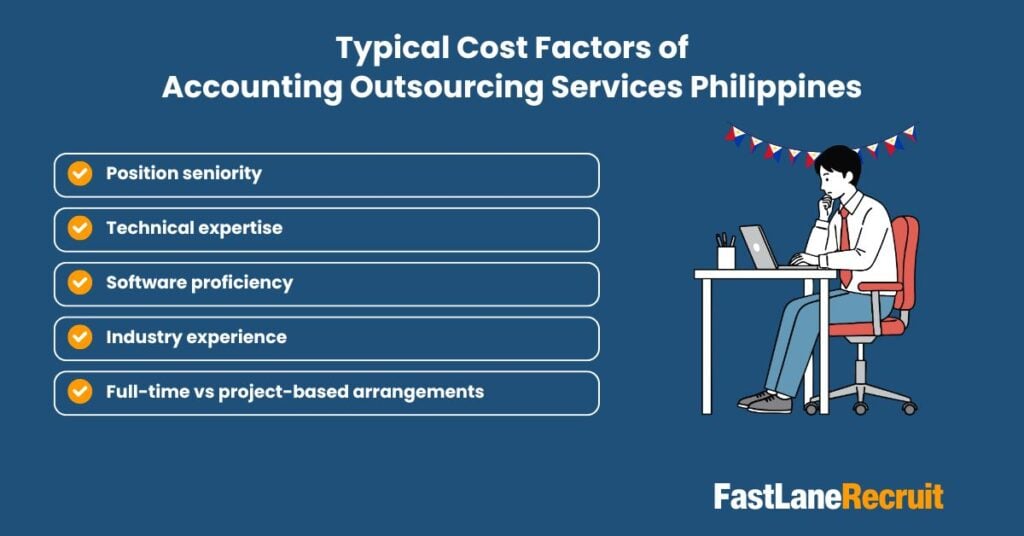
Typical Cost Factors
Pricing depends on:
Common Roles Businesses Outsource
Bookkeeper
Responsibilities:
- Transaction recording
- Reconciliation
- Invoice processing
Junior Accountant
Responsibilities:
- Financial reporting support
- Payroll administration
- Accounts payable and receivable
Senior Accountant
Responsibilities:
- Month-end closing
- Compliance reporting
- Tax support
Financial Analyst
Responsibilities:
- Budgeting
- Forecasting
- KPI reporting
Accounting Manager
Responsibilities:
- Team oversight
- Strategic reporting
- Finance operations management
Also Read: Average Salary in the Philippines 2026: Complete Hiring & Salary Guide for Global Employers
Hiring Options for Accounting Talent in the Philippines
Traditional Outsourcing Provider
Advantages:
- Ready-made service delivery
- Minimal management responsibility
Challenges:
- Less control over staff
- Shared resources
- Limited cultural integration
Direct Hiring Through Local Entity
Advantages:
- Full control
Challenges:
- Local company setup requirements
- Compliance obligations
- Payroll administration
- HR management burden
Employer of Record (EOR) Solution
Advantages:
- Hire legally without entity setup
- Faster market entry
- Reduced compliance risks
- Full-time dedicated employees
- Simplified payroll and benefits administration
This model has become increasingly popular among international businesses seeking accounting talent without establishing a Philippine entity.
Also Read: Recruitment Costs in 2026: The True Cost of Hiring and How Businesses Can Reduce It
EOR vs Company Incorporation: Which Is Better for Hiring Accounting Talent?
When EOR Is the Better Option
An Employer of Record solution is often preferable when:
- Hiring fewer than 20 employees
- Testing a new market
- Building a remote finance team
- Requiring rapid deployment
- Avoiding incorporation costs
When Company Incorporation Makes Sense
Entity establishment may be appropriate when:
- Significant local operations are planned
- Revenue generation occurs within the country
- Large-scale workforce expansion is expected
For many SMEs and growing businesses, EOR offers a faster and more cost-efficient route to accessing accounting talent.
Challenges of Accounting Outsourcing and How to Avoid Them
Communication Gaps
Solution: Implement structured reporting processes and collaboration tools.
Data Security Concerns
Solution: Use secure cloud accounting systems and strict access controls.
Hiring the Wrong Talent
Solution: Partner with experienced accounting recruitment specialists who understand technical finance requirements.
Lack of Process Documentation
Solution: Create standard operating procedures before onboarding offshore teams.
How to Build a High-Performing Offshore Accounting Team
Building a high-performing offshore accounting team requires more than simply hiring remote accountants. Success depends on careful planning, clear processes, strong communication, and the right talent strategy. When structured properly, an offshore accounting team can improve efficiency, reduce costs, and provide scalable support for growing businesses.
Step 1: Define Accounting Functions to Outsource
Before recruiting offshore staff, identify which accounting functions can be effectively handled remotely. Not every task needs to remain in-house.
Common functions suitable for offshore accounting teams include:
- Bookkeeping and transaction processing
- Accounts payable and accounts receivable management
- Bank reconciliations
- Payroll administration
- Financial reporting
- Management accounting
- Tax preparation support
- Audit preparation and documentation
- Budgeting and forecasting assistance
Example:
A growing e-commerce company may outsource bookkeeping, invoice processing, and monthly reconciliations while retaining strategic financial planning and CFO-level decision-making internally.
Clearly defining responsibilities from the start helps avoid duplication of work and ensures offshore employees understand their scope of duties.
Step 2: Identify Required Qualifications and Software Expertise
The effectiveness of your offshore accounting team largely depends on hiring professionals with the right skills, certifications, and technical knowledge.
Consider requirements such as:
- Accounting degrees or professional qualifications
- CPA, ACCA, CA, CMA, or equivalent certifications
- Industry-specific experience
- Knowledge of international accounting standards
- Tax and compliance expertise
- Strong English communication skills
Software proficiency is equally important. Depending on your business, team members may need experience with:
- Xero
- QuickBooks Online
- NetSuite
- Sage
- SAP
- Microsoft Dynamics
- HubSpot integrations
- Payroll platforms
- Expense management systems
Example:
A company using Xero and Dext should prioritise candidates with hands-on experience in both systems to minimise onboarding time and training costs.
Step 3: Develop Reporting Structures
A clear reporting framework is essential for accountability and operational efficiency.
Determine:
- Who offshore staff report to
- Approval workflows
- Escalation procedures
- Communication channels
- Decision-making authority
Well-defined reporting structures help offshore employees understand expectations and reduce confusion when handling financial matters.
Example:
An offshore Accounts Payable Officer may report directly to a Finance Manager, while monthly financial reports are reviewed by the Financial Controller and CFO.
Regular meetings and structured reporting schedules help maintain alignment across teams operating in different locations.
Step 4: Establish Performance Metrics
Measuring performance ensures accountability and helps maintain service quality across the offshore team.
Key performance indicators (KPIs) may include:
- Invoice processing turnaround time
- Accuracy rates
- Reconciliation completion timelines
- Month-end closing speed
- Compliance adherence
- Error reduction rates
- Stakeholder satisfaction scores
- Productivity metrics
Example:
A business may set a target that 95% of supplier invoices must be processed within 48 hours while maintaining an accuracy rate above 99%.
Tracking performance allows managers to identify training needs and continuously improve operational efficiency.
Step 5: Partner with a Specialised Accounting Recruitment Provider
Finding qualified accounting professionals can be challenging without local market knowledge. Partnering with a specialised offshore accounting recruitment provider can significantly streamline the hiring process.
A reputable recruitment partner can assist with:
- Talent sourcing
- Skills assessments
- Technical testing
- Background verification
- Salary benchmarking
- Employment compliance
- Workforce management
Example:
Instead of spending months recruiting independently, a business can leverage an accounting staffing provider to access pre-vetted accountants with relevant industry and software experience.
This reduces hiring risks and accelerates team deployment.
Step 6: Implement Onboarding and Training Programs
A structured onboarding process helps offshore employees integrate quickly and become productive faster.
Your onboarding program should include:
- Company introduction and culture training
- Role-specific responsibilities
- Accounting policies and procedures
- Compliance requirements
- Software training
- Security protocols
- Communication guidelines
Ongoing professional development is equally important.
Training may cover:
- New accounting standards
- Software updates
- Industry regulations
- Internal process improvements
- Leadership development
Example:
A finance team using Xero may conduct quarterly training sessions to ensure offshore staff remain updated on platform enhancements and best practices.
Continuous learning helps improve retention and long-term team performance.
Step 7: Scale Strategically as Business Needs Evolve
One of the biggest advantages of offshore accounting teams is scalability. As your business grows, your accounting function should expand in a structured manner.
Rather than hiring large teams immediately, consider scaling gradually based on operational requirements.
Growth stages may include:
| Business Stage | Offshore Accounting Support |
| Startup | Bookkeeper |
| Small Business | Bookkeeper + Accounts Assistant |
| Growing Company | Full Accounting Team |
| Mid-Sized Enterprise | Accountants + Financial Analysts |
| Large Organisation | Dedicated Offshore Finance Department |
Example:
A startup may initially hire one offshore bookkeeper. As transaction volume increases, additional specialists such as payroll officers, management accountants, and financial analysts can be added to support growth.
Strategic scaling allows businesses to control costs while ensuring sufficient financial support at every stage of expansion.
Building a high-performing offshore accounting team requires careful workforce planning, clear operational structures, and access to skilled accounting professionals. By defining outsourcing objectives, hiring the right talent, implementing robust performance management systems, and investing in training, businesses can create a scalable offshore accounting function that delivers long-term efficiency, cost savings, and financial accuracy.
Why Malaysia Matters for Accounting Talent Strategy
While the Philippines is widely recognised for accounting outsourcing talent, many global businesses are considering Malaysia as one of the best options.
Malaysia has emerged as a strong hiring base for finance and accounting professionals due to its:
- Mature shared services ecosystem
- Strong multilingual talent pool (English, Mandarin, Bahasa Malaysia)
- Competitive salary structure compared to Singapore and Hong Kong
- Established regulatory and corporate framework
- Strategic location within ASEAN for regional HQ operations
Unlike pure outsourcing destinations, Malaysia is increasingly used by companies as a regional talent deployment hub, particularly for finance and accounting roles that require closer integration with business operations.
FastLaneRecruit focuses specifically on helping companies hire and employ accounting professionals in Malaysia, enabling businesses to build compliant, scalable finance teams without unnecessary structural complexity.
Why Businesses Choose FastLaneRecruit for Accounting Talent Solutions
Building an offshore accounting team requires more than simply filling vacancies.
Businesses need access to qualified professionals who can integrate seamlessly into existing workflows, support compliance requirements, and contribute to long-term growth objectives.
FastLaneRecruit helps businesses access experienced accounting and finance professionals in Malaysia through flexible talent solutions designed for international employers.
Our solutions help businesses:
- Access professional accounting talent
- Reduce recruitment timelines
- Build dedicated offshore teams
- Navigate employment compliance requirements
- Scale finance operations efficiently
- Support regional and global expansion plans
Whether you need a bookkeeper, accountant, financial analyst, or accounting manager, FastLaneRecruit provides tailored recruitment solutions aligned with your business goals.
Get in touch with us today to start building the best accounting team for your business.
CONCLUSION
Accounting outsourcing services in the Philippines continue to provide businesses with an effective way to access skilled accounting professionals, reduce operating costs, and scale finance operations efficiently.
As competition for accounting talent intensifies globally, companies that leverage offshore accounting teams gain a significant advantage in cost management, operational flexibility, and business growth.
By partnering with an experienced recruitment provider such as FastLaneRecruit, businesses can build dedicated accounting teams while minimising recruitment challenges and compliance risks.
Frequently Asked Questions
Why is the Philippines popular for accounting outsourcing?
The Philippines offers qualified accounting professionals, strong English proficiency, competitive labour costs, and extensive experience supporting international businesses.
How much can businesses save by outsourcing accounting to the Philippines?
Savings vary depending on role and location but are often substantial compared with local hiring markets.
Can Philippine accountants work with international accounting standards?
Yes. Many professionals have experience with IFRS, US GAAP, Australian standards, and Singapore reporting requirements.
Is outsourcing accounting suitable for SMEs?
Yes. SMEs often benefit from reduced costs, access to specialised expertise, and improved scalability.
What accounting roles can be outsourced?
Businesses commonly outsource bookkeeping, payroll, accounts payable, accounts receivable, financial reporting, tax support, and financial analysis functions.
Should I use an EOR or set up a company in the Philippines?
For most businesses hiring a small to medium-sized accounting team, an EOR solution offers a faster and lower-risk option than establishing a local entity.