
Expanding a startup globally sounds exciting until it’s time to actually hire. You find the perfect developer in Malaysia, a sales lead in Singapore, or a customer support specialist in the Philippines, but then reality sets in. Each country has its own labor laws, payroll systems, tax rules, employee benefits, and compliance requirements.
For most startups, setting up a legal entity in every new market is expensive, slow, and distracting. It pulls focus away from what really matters: building the product, growing revenue, and scaling the team. This is where employer of record services become a true game-changer.
An Employer of Record (EOR) allows startups to legally hire employees in other countries without setting up a local company. The EOR becomes the official legal employer on paper, while your company continues to manage the employee’s day-to-day work, performance, and goals.
In simple terms, EOR removes the legal and administrative barriers of global hiring so startups can focus on growth instead of paperwork. Today, it is one of the fastest and most efficient ways for startups to scale internationally while staying lean, compliant, and agile.
Content Outline
Key Summary
Global Hiring Without Legal Entities
EOR services let startups hire talent in countries like Malaysia, Singapore, and Australia without opening a local company or branch office.
Faster Market Expansion
Startups can enter new markets in days or weeks instead of months by skipping company registration, banking setup, and tax approvals.
Reduced Legal and Compliance Risk
Employer of Record providers ensure compliance with local labor laws, reducing risks like misclassification, tax errors, and invalid contracts.
Lower Operational Burden for Startups
Founders avoid spending time on payroll, HR administration, and legal compliance, allowing more focus on product, growth, and customers.
Predictable and Scalable Costs
Unlike setting up entities with hidden legal and administrative expenses, EOR services offer clearer, more predictable pricing structures.
Better Employee Experience and Retention
Employees receive compliant contracts, timely payroll, and statutory benefits, creating trust, stability, and improved retention rates.
Malaysia as a Strategic Hiring Hub
Malaysia offers skilled talent, cost efficiency, and strong time zone alignment, making it a smart location for EOR-based global hiring expansion.
What Are Employer of Record (EOR) Services?
Employer of Record (EOR) services are a simple way for companies to hire employees in another country without setting up a local business there.
In normal hiring, if you want to employ someone overseas, you usually need to open a legal entity (such as a branch or subsidiary), register for taxes, follow local labor laws, and run payroll in that country. With an Employer of Record service, you skip all of that. Instead, the EOR becomes the official legal employer of the worker in that country, while you remain fully in control of how they work on a daily basis.
In simple terms: The EOR handles the legal and administrative side of employment, while you manage the actual work, goals, and team performance.
What the EOR takes care of
An EOR acts as your local HR and legal partner in another country. They manage all key employment responsibilities, including:
- Employment contracts that comply with local labor laws
- Payroll processing and salary payments in local currency
- Tax calculation, withholding, and filings with local authorities
- Mandatory employee benefits such as insurance, leave, or pensions (depending on the country)
- HR administration and employee records
- Legal and regulatory compliance for employment
- Employee onboarding and offboarding processes
This removes the need for your company to understand or manage complex employment rules in each country.
What you still control
Even though the EOR is the legal employer, your company retains full control over the employee’s work.
You still manage:
- Daily tasks and responsibilities
- Performance expectations and goals
- Reporting structure and team alignment
- Work processes and collaboration
- Company culture and communication style
- Business priorities and direction
Nothing changes in how you lead your team. The structure only changes how employment is handled legally.
A simple way to understand it
Think of it like this:
You are the manager of the team’s work.
The EOR is responsible for all employment paperwork, payroll, and legal compliance behind the scenes.
In other words:
You lead the work. The EOR handles the employment infrastructure.
Also Read: How to Build an Offshore Accounts Payable Team in Malaysia
Why Startups Use EOR Services in 2026
Today’s startups are no longer built with a local mindset. From the very beginning, many founders are thinking globally. Instead of hiring only within their own country, they are looking for the best talent wherever it exists in the world.
This shift is driven by three major realities: access to talent, cost efficiency, and the need to operate across time zones.
Startups now hire developers in Eastern Europe, designers in Asia, marketers in Europe, and support teams across multiple regions. The goal is simple: build the strongest team possible, not just the closest one.
However, while global hiring sounds ideal, it comes with real operational challenges that many early-stage companies are not ready to handle.
The reality of international hiring
Hiring across borders is not as simple as signing a contract and starting work. Each country has its own legal and administrative system that governs employment.
Startups quickly run into challenges such as:
- Different employment laws in every country
- Complex tax systems and payroll regulations
- Mandatory benefits that vary by location
- Legal requirements for contracts and termination processes
- Restrictions on how contractors can be used
Even one mistake in these areas can lead to compliance issues or financial penalties.
Key challenges startups face when hiring globally
1. Different employment laws in every country
Every country has its own rules around working hours, leave entitlements, probation periods, termination conditions, and employee protections. What is standard in one country may be illegal in another.
2. Tax and payroll complexity
Running payroll internationally requires understanding local tax rates, social contributions, currency payments, and reporting obligations. This quickly becomes overwhelming without local expertise.
3. Contractor misclassification risk
Many startups try to simplify global hiring by using contractors instead of employees. However, if a contractor is managed like a full-time employee, companies risk misclassification, which can lead to fines and legal disputes.
4. Long timelines to set up foreign entities
Setting up a legal entity in another country can take months. It often involves lawyers, accountants, government approvals, and ongoing compliance setup before hiring can even begin.
5. High legal and administrative costs
Maintaining foreign entities requires continuous spending on compliance, audits, payroll systems, and local administration. For startups, this can quickly become expensive and inefficient.
Why this changes how startups think about hiring
Because of these challenges, startups are increasingly rethinking how they expand internationally. Instead of building legal infrastructure in every country, they are looking for a faster and more flexible solution.
This is where employer of record services become a strategic advantage.
Rather than treating EOR as just an HR outsourcing tool, startups now see it as a way to:
- Enter new markets faster
- Hire global talent without legal complexity
- Test new regions with lower risk
- Scale teams without heavy infrastructure
- Stay compliant without building in-house legal teams
The shift in mindset
In 2026, successful startups are not asking “Where should we open a company?”
They are asking:
“How quickly can we hire the right people in any market we choose?”
This is why employer of record services are no longer just an operational convenience. They have become a core part of how modern startups scale globally, reduce risk, and stay competitive in fast-moving markets.
Also Read: How to Hire and Manage Remote Assistants in Malaysia
EOR vs Setting Up a Legal Entity
When a startup wants to hire internationally, there are two main options:
- Use Employer of Record (EOR) services
- Set up a local legal entity (such as a subsidiary or branch office)
Both approaches allow you to hire employees in another country, but they are very different in terms of speed, cost, risk, and long-term commitment.
Key Differences Explained
1. Time to hire
Employer of Record Services:
Hiring can begin in a matter of days or weeks because the EOR already has a legal presence in the country. Once the candidate is selected, onboarding can move quickly.
Local Entity Setup:
Setting up a company in a new country is a slow process. It often involves government registration, bank account setup, tax registration, and legal approvals, which can take several months before you can legally hire anyone.
2. Upfront cost
Employer of Record Services:
Costs are typically predictable and lower upfront. You pay a service fee per employee instead of investing in legal infrastructure.
Local Entity Setup:
Requires significant upfront investment, including legal fees, accounting setup, office registration, and compliance costs. These expenses can be substantial even before hiring your first employee.
3. Legal compliance
Employer of Record Services:
The EOR takes responsibility for staying compliant with local employment laws, tax rules, and statutory requirements. This reduces the burden on your internal team.
Local Entity Setup:
Your company is fully responsible for compliance. This often requires hiring local legal experts, HR teams, or consultants to manage ongoing obligations.
4. Payroll setup
Employer of Record Services:
Payroll is already established. The EOR manages salary payments, tax deductions, and local reporting on your behalf.
Local Entity Setup:
You must build and manage your own payroll system for each country, including integrations, banking arrangements, and compliance reporting.
5. Flexibility
Employer of Record Services:
Highly flexible. You can quickly scale teams up or down, test new markets, or adjust hiring plans without long-term infrastructure commitments.
Local Entity Setup:
Less flexible. Once a legal entity is established, maintaining it involves fixed costs and administrative obligations, even if hiring slows down.
6. Best use case
Employer of Record Services:
Ideal for startups, fast-growing companies, and businesses testing new markets or hiring globally for the first time.
Local Entity Setup:
Better suited for large, established companies planning long-term operations in a specific country with a significant workforce.
Simple takeaway
For startups that need speed, flexibility, and low risk, Employer of Record services are often the smarter first step.
They allow you to enter new markets quickly, hire global talent without legal complexity, and focus your resources on growth instead of administrative setup.
A local entity becomes more relevant later, once your presence in a country is stable and long-term.
Also Read: How to Hire an Offshore Accountant in Malaysia
7 Benefits of Employer of Record Services for Startups
Employer of Record (EOR) services are not just about hiring internationally. For startups, they solve some of the biggest operational, legal, and financial challenges that come with global expansion.
Here’s a deeper look at the key benefits and why so many startups rely on EOR services to scale.
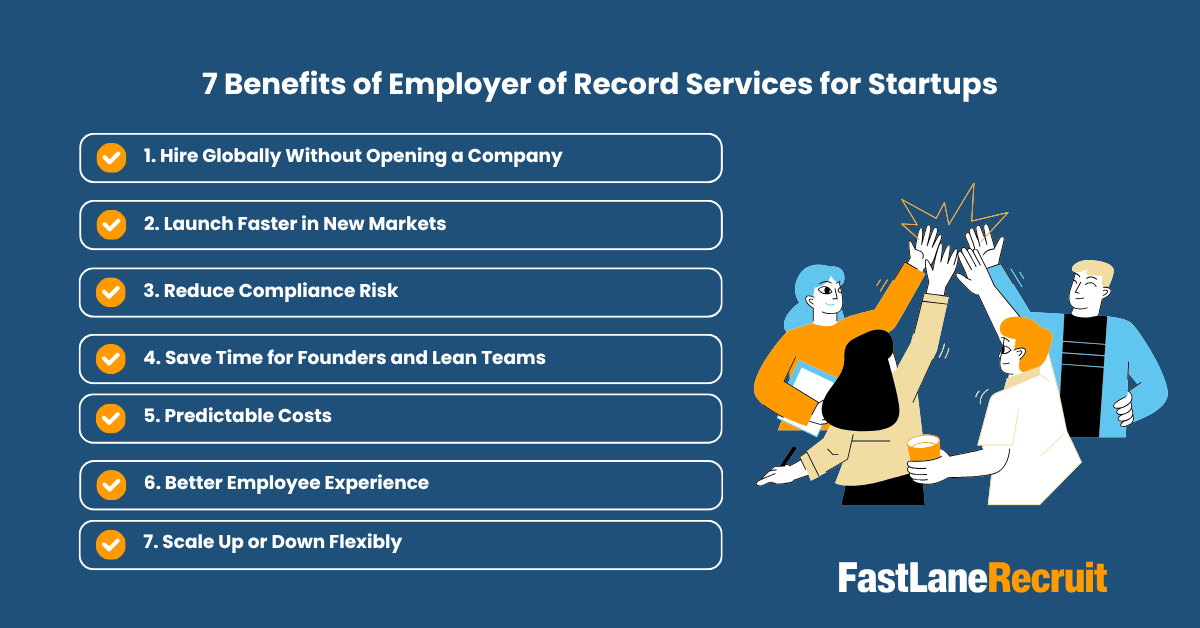
1. Hire Globally Without Opening a Company
One of the biggest barriers to international hiring is the need to set up a local legal entity in each country.
If you want to hire talent in Malaysia, Hong Kong, Australia, or any other market, the traditional route would require registering a company, hiring local advisors, and managing ongoing compliance obligations.
With Employer of Record services, this step is no longer necessary.
The EOR already has a legal presence in the country and becomes the official employer on paper, allowing you to hire talent immediately.
This removes the need for:
- Subsidiary or branch setup
- Local tax registration
- Legal incorporation processes
The result is simple: you can expand your team globally without opening multiple companies.
2. Launch Faster in New Markets
Speed is critical for startups. Many companies lose valuable momentum while waiting for legal structures to be approved before they can hire.
Traditional expansion often involves:
- Company registration delays
- Opening local bank accounts
- Legal documentation and approvals
- Setting up payroll systems
With EOR services, these barriers are removed.
Startups can quickly:
- Hire their first employee in a new country
- Test demand in a new market
- Build a small local presence for sales or support
- Enter regions before competitors do
This ability to move quickly often determines whether a startup succeeds or misses an opportunity.
3. Reduce Compliance Risk
International employment laws are complex and constantly changing. Even small mistakes can create serious legal and financial consequences.
Common compliance risks include:
- Incorrect or non-compliant employment contracts
- Missed or incorrect payroll tax filings
- Misclassification of employees as contractors
- Improper termination procedures
- Failure to provide mandatory benefits
A reliable Employer of Record helps reduce these risks by ensuring all employment practices follow local labor laws and regulations.
This gives startups peace of mind when hiring across multiple countries.
4. Save Time for Founders and Lean Teams
Startups typically operate with small teams and limited resources. Managing global HR, payroll, and legal requirements internally is not practical.
Without EOR support, founders often spend time dealing with:
- Payroll administration
- Legal compliance issues
- HR documentation
- Country-specific employment rules
With EOR services, these responsibilities are handled externally, allowing teams to stay focused on what matters most.
Founders can concentrate on:
- Building and improving the product
- Acquiring and serving customers
- Driving revenue growth
- Fundraising and strategy
- Hiring core talent
This shift in focus is often a major productivity unlock for startups.
5. Predictable Costs
Setting up and maintaining legal entities in multiple countries often leads to unpredictable and hidden costs.
These may include:
- Legal and incorporation fees
- Accounting and audit expenses
- Ongoing compliance filings
- Payroll system setup and maintenance
- Local HR or legal advisors
These costs can add up quickly, especially for early-stage companies.
Employer of Record services simplify this by offering more predictable pricing structures, making it easier for startups to plan and manage budgets.
Also Read: How to Build an Offshore Data Entry Team in Malaysia
6. Better Employee Experience
Attracting and retaining top talent requires more than just a job offer. Employees expect a smooth, professional, and compliant working experience.
A good EOR helps deliver this by ensuring:
- Proper, locally compliant employment contracts
- Timely and accurate salary payments
- Statutory benefits and protections are provided
- Structured onboarding and offboarding processes
- Ongoing HR support when needed
This improves trust between employees and the company, which often leads to higher retention and stronger team satisfaction.
7. Scale Up or Down Flexibly
Startup growth is rarely linear. Hiring needs can change quickly based on funding, market conditions, or product direction.
At different stages, startups may need to:
- Hire rapidly after raising investment
- Pause hiring during uncertain periods
- Test new markets with small teams
- Expand or reduce headcount quickly
Managing this through multiple legal entities is complex and restrictive.
EOR services provide flexibility, allowing startups to adjust their workforce without the long-term commitments and administrative burden of maintaining foreign entities.
Summary
Employer of Record services give startups a practical way to scale globally without the complexity of traditional international expansion.
They help companies move faster, stay compliant, control costs, and focus on growth while building a flexible and scalable global team.
EOR vs Contractors: When Should Startups Switch?
Many startups begin their global hiring journey by working with freelancers or independent contractors. This approach is attractive in the early stages because it is fast, flexible, and often more affordable than hiring full-time employees.
However, as the startup grows, this model can start to create legal, operational, and compliance risks. What works in the beginning may no longer be suitable once the team becomes more structured or deeply integrated into the business.
At this point, many companies begin transitioning to Employer of Record (EOR) services to create a more stable and compliant employment structure.
Why startups start with contractors
Contractors are often the first step for startups because:
- They are quick to hire and onboard
- There is no need to set up a legal entity
- Costs are generally lower upfront
- They offer flexibility for short-term projects
- They are useful for testing new markets or roles
This makes contractors a practical solution for early experimentation and rapid execution.
However, this flexibility comes with limitations.
When contractor arrangements become risky
As startups scale, the line between “contractor” and “employee” can become unclear. Many compliance issues arise when contractors are treated like full-time employees in practice.
Risk increases when:
- The contractor works full-time hours for your company
- You set their daily schedule or working hours
- They report directly into your internal team structure
- They perform core, long-term business functions
- They rely on your company as their primary source of income
In these cases, many jurisdictions may consider the relationship to be employment rather than contracting.
This can lead to legal exposure, fines, or backdated employment obligations.
Also Read: How to Hire an Offshore Operations Coordinator in Malaysia
Key signs it is time to switch to EOR services
Startups should consider moving from contractors to employer of record services when the relationship becomes more permanent or structured.
1. The role is full-time and ongoing
If the worker is essentially functioning as a full-time team member, they are no longer a short-term contractor. An EOR structure is more appropriate for formal employment.
2. You manage their work directly
If you are assigning tasks, managing performance, and integrating them into your team like an employee, the arrangement starts to resemble employment rather than independent contracting.
3. The role is core to your business
Contractors are best suited for non-core or project-based work. If the person is building your product, managing customers, or driving revenue, they are likely a core team member who should be formally employed.
4. You want long-term retention
Contractor relationships are often transactional. If your goal is to retain talent long term, offer stability, and build loyalty, an EOR model provides a more structured and secure setup.
5. You need stronger IP and confidentiality protection
Employees under formal employment contracts (managed through an EOR) typically come with clearer intellectual property ownership, confidentiality clauses, and legal protections compared to contractors.
6. Local contractor laws are unclear or restrictive
Some countries have strict rules about contractor usage. Misclassification laws can vary significantly, and in some regions, the risk of non-compliance is high without a proper legal structure.
Why EOR provides a safer alternative
Switching to Employer of Record services helps startups move from an informal workforce model to a compliant and structured employment setup.
An EOR ensures:
- Proper employee classification under local law
- Legally compliant employment contracts
- Correct payroll, taxes, and benefits handling
- Reduced risk of misclassification penalties
- More stable long-term employment relationships
Simple takeaway
Contractors are useful for early flexibility, but they are not always built for scale.
When a contractor begins functioning like a full-time employee, an Employer of Record structure becomes the safer, more compliant, and more sustainable option for startups expanding globally.
Also Read: How to Hire Recruiting Coordinators in Malaysia
Why Malaysia Is a Smart Hiring Destination for Global Companies
Malaysia is quickly emerging as one of the most attractive hiring hubs in Asia for startups and global companies. As businesses expand beyond their home markets, Malaysia offers a strong balance of talent quality, affordability, and operational efficiency, making it an ideal location for building remote or regional teams.
When combined with employer of record services, companies can hire in Malaysia quickly and compliantly without needing to establish a local entity.
1. Skilled, English-Friendly Workforce
One of Malaysia’s biggest advantages is its strong and diverse talent pool. The country produces graduates and professionals who are well-prepared for global business environments.
Key industries where Malaysia offers strong talent include:
- Software development and engineering
- Finance and accounting
- Customer support and shared services
- Digital marketing and content roles
- Business operations and administration
- Global business process outsourcing (BPO)
In addition, English is widely used in business and education, which makes communication with international teams smooth and efficient.
This reduces onboarding friction and helps global companies integrate Malaysian talent into distributed teams quickly.
2. Cost-Effective Hiring Without Compromising Quality
Compared to many Western countries and even some regional tech hubs, Malaysia offers more competitive salary expectations while still maintaining strong professional standards.
For startups and scaling companies, this creates a strategic advantage:
- Lower overall hiring costs
- Access to highly capable professionals
- Better budget efficiency for team expansion
- Ability to hire multiple roles within the same budget
This balance of affordability and quality makes Malaysia especially attractive for companies looking to scale lean operations while maintaining performance standards.
3. Strong Time Zone Advantage for Asia-Pacific Operations
Malaysia’s time zone (GMT+8) makes it highly compatible with many key business regions across Asia-Pacific.
It offers strong working overlap with:
- Singapore
- Hong Kong
- China
- Australia
- Southeast Asia markets
It also provides partial overlap with European working hours, which supports global collaboration across distributed teams.
This makes Malaysia a practical choice for companies that need real-time communication across regions without extreme time zone gaps.
4. Growing Digital Economy and Business Ecosystem
Malaysia is actively investing in its digital economy, innovation landscape, and outsourcing capabilities. Government-led initiatives and private sector growth have helped strengthen its position as a regional business hub.
Key developments include:
- Expansion of the digital economy ecosystem
- Growth in tech startups and innovation hubs
- Increased investment in shared services and outsourcing
- Strong focus on fintech, e-commerce, and digital transformation
As a result, Malaysia continues to attract both multinational companies and fast-growing startups looking to build regional capability centers or distributed teams.
5. Ideal Market for Employer of Record (EOR) Hiring
One of the most practical advantages of hiring in Malaysia is how well it works with employer of record services.
For global companies, the biggest challenge is often not finding talent, but legally employing them without setting up a local entity.
With an EOR model in Malaysia, companies can:
- Hire employees without opening a Malaysian entity
- Stay compliant with local labor laws and tax regulations
- Manage payroll and statutory contributions correctly
- Onboard talent quickly and efficiently
- Reduce administrative and legal overhead
This makes Malaysia not only a talent-rich market, but also a highly accessible one for international companies that want to move quickly.
Summary
Malaysia stands out as a strategic hiring destination because it combines:
- A skilled and English-speaking workforce
- Cost-efficient hiring opportunities
- Strong regional time zone alignment
- A growing digital and business ecosystem
- Easy access through employer of record services
For global companies looking to expand into Asia, Malaysia offers a practical, scalable, and low-friction way to build high-quality teams without the complexity of setting up a local entity.
Also Read: How to Build an Offshore Corporate Services Team in Malaysia
How FastLaneRecruit Helps Global Companies Hire in Malaysia
FastLaneRecruit supports startups and global companies in hiring top talent in Malaysia through reliable employer of record services. Our goal is to make international hiring simple, compliant, and fast, without the need for companies to set up a local legal entity.
Instead of dealing with complex employment laws, payroll systems, and regulatory requirements on your own, FastLaneRecruit acts as your operational partner in Malaysia. We handle the legal and administrative side of employment so you can focus on building and scaling your team.
This is especially valuable for companies expanding into Malaysia for the first time, or those testing the market before committing to a long-term regional setup.
What We Do for Your Malaysia Hiring Needs
Our Employer of Record (EOR) solution is designed to cover the full employment lifecycle, ensuring every stage of hiring is compliant and seamless.
Hiring employees in Malaysia legally
We enable you to hire full-time employees in Malaysia without establishing a local entity. FastLaneRecruit becomes the legal employer while you manage your team’s day-to-day work.
Locally compliant employment contracts
We prepare employment contracts that align with Malaysian labor laws and statutory requirements. This ensures your hires are properly classified and legally protected from day one.
Payroll processing
We manage accurate and timely payroll execution, including salary payments in local currency. This helps ensure employees are paid correctly and on schedule every month.
Statutory contributions and tax handling
Malaysia has specific statutory obligations such as EPF, SOCSO, and tax deductions. We handle these contributions and filings in full compliance with local regulations.
HR administration
We take care of essential HR processes, including employee records, documentation, and administrative support throughout the employment lifecycle.
Smooth onboarding support
From offer acceptance to first-day onboarding, we ensure a structured and compliant onboarding experience so employees can start working quickly and confidently.
Ongoing employment compliance guidance
Employment regulations can change over time. We provide continuous support to ensure your workforce remains compliant with Malaysian labor laws and regulatory updates.
Why Global Companies Choose FastLaneRecruit
Companies choose FastLaneRecruit not just for hiring support, but for clarity, speed, and confidence when expanding into Malaysia.
Startup-friendly approach
We understand the pace and flexibility startups need. Our processes are designed to support fast decision-making and agile hiring.
Fast response times
We prioritize speed and efficiency so you can move quickly when you find the right talent.
Regional expertise
With deep knowledge of the Malaysia hiring landscape, we help you navigate local employment requirements with ease.
Practical hiring support
We focus on real-world execution rather than theory, ensuring your hiring process is smooth from start to finish.
Malaysia market knowledge
Our understanding of local talent trends, salary expectations, and compliance requirements helps you make informed hiring decisions.
Built for Simple and Scalable Expansion
Whether you are hiring your first employee in Malaysia or building a larger regional team, FastLaneRecruit provides a scalable solution that grows with your business.
By combining employer of record services in Malaysia with hands-on local expertise, we help global companies expand faster, reduce risk, and stay focused on growth instead of administrative complexity.
Frequently Asked Questions
Is an Employer of Record legal?
Yes. EOR models are widely used globally when structured properly and managed compliantly.
Is EOR cheaper than setting up an entity?
For many startups, yes, especially when hiring a small team or testing a market.
Can I manage the employee directly?
Yes. You manage daily work, goals, and performance. The EOR handles legal employment administration.
How fast can I hire through an EOR?
Often much faster than entity setup, depending on country and role.
Can I hire employees in Malaysia through an EOR?
Yes. Malaysia is a strong market for EOR hiring and remote team expansion.
Conclusion
Global growth no longer requires opening companies in every country.
With the right employer of record services, startups can hire internationally, stay compliant, move faster, and focus on scaling the business.
For founders trying to balance growth with efficiency, EOR is no longer just an option; it is a competitive advantage.
Expand into Malaysia the Smart Way
If you are ready to hire talent in Malaysia without setting up a local entity, FastLaneRecruit can help. Talk to our team today and start building your Malaysia team with confidence.