
Hiring an Operations Coordinator is a big step for any growing business. This role keeps daily operations running smoothly, aligns teams, and helps leaders focus on growth instead of logistics. For global companies, Malaysia has become a strategic location to engage skilled Operations Coordinators who can support regional or international operations efficiently.
In this guide, we’ll walk you through how to hire an offshore Operations Coordinator in Malaysia, what skills to look for, how to evaluate candidates, and how FastLaneRecruit can help simplify the process through compliant hiring solutions.
Content Outline
Key Summary
Understand the Role Clearly
Operations Coordinators manage daily tasks, align teams, and ensure processes, documentation, and communications run smoothly across departments and regions.
Why Malaysia is a Strategic Choice
Malaysia offers multilingual talent, strong English proficiency, experience supporting global teams, and a stable, business-friendly environment.
Define the Right Skills
Look for technical skills (project management tools, ERP systems, reporting software) and soft skills (communication, problem-solving, organization) to support international operations.
Structured Interview Approach
Assess candidates through scenario-based questions, focusing on operational management, collaboration, adaptability, and problem-solving across time zones.
Comply with Local Employment Laws
Ensure adherence to Malaysian regulations including employment contracts, EPF/SOCSO/EIS contributions, tax obligations, leave entitlements, and termination procedures.
Choose the Best Hiring Model
Options include direct local entity, third-party staffing, or Employer of Record (EOR). EOR offers fast, compliant hiring without setting up a local office.
Onboard Effectively for Success
Provide clear working hours, reporting lines, structured SOPs, regular check-ins, and encourage continuous learning to maximize efficiency and contribution.
What Does an Operations Coordinator Do?
An Operations Coordinator helps keep a business running smoothly every day. Their main role is to make sure people, processes, and information are well organised and working together efficiently. They support teams by coordinating tasks, tracking progress, and ensuring nothing falls through the cracks.
In many organisations, the Operations Coordinator acts as a central point of contact. They connect different departments, work closely with managers, and communicate with vendors or external partners to ensure daily operations stay on track.
Common Responsibilities of an Operations Coordinator
An Operations Coordinator may be responsible for:
- Coordinating daily tasks and schedules
Making sure work is planned properly, deadlines are clear, and team members know their priorities. - Supporting projects and monitoring progress
Assisting project managers by tracking timelines, following up on action items, and helping teams stay aligned. - Managing documentation and workflows
Preparing reports, maintaining records, updating standard operating procedures (SOPs), and keeping systems organised. - Communicating across teams and partners
Sharing updates, resolving issues, and ensuring smooth communication between internal teams and external stakeholders. - Improving processes and efficiency
Identifying delays or gaps in workflows and suggesting practical improvements to help teams work more effectively.
Operations Coordinators in Offshore and Regional Roles
For offshore roles, Operations Coordinators in Malaysia often support APAC regional teams or global headquarters. They work across different time zones, systems, and cultures, helping international teams stay connected and organised. These professionals are commonly involved in coordinating regional operations, preparing reports for overseas managers, and supporting cross-border projects.
Because of their strong communication skills and familiarity with international business practices, Malaysian Operations Coordinators are well-suited to supporting global operations while maintaining consistency and operational clarity.
Also Read: Why Businesses Outsource Corporate Services Functions
Why Hire an Operations Coordinator in Malaysia?
Malaysia is widely recognised as one of Asia’s leading hubs for operations, shared services, and regional support teams. Many multinational companies choose Malaysia to support their day-to-day operations because of its strong talent base, business-ready infrastructure, and experience working with international organisations.
For global businesses looking to strengthen coordination and operational efficiency, hiring an Operations Coordinator in Malaysia offers both capability and reliability.
Key Reasons Global Businesses Choose Malaysia
- Strong English proficiency and multilingual capabilities
Malaysian professionals are generally fluent in English and often speak additional languages such as Mandarin, Malay, and other regional languages. This makes communication smoother when working with international teams, clients, and vendors. - Familiarity with international business processes
Operations Coordinators in Malaysia are commonly trained in global workflows, reporting standards, and professional tools. Many have experience supporting multinational companies and understand how to work within structured, process-driven environments. - Proven experience supporting regional and global teams
Malaysia is home to many regional headquarters and shared service centres. As a result, Operations Coordinators are experienced in coordinating across departments, countries, and time zones, especially within the Asia-Pacific region. - Stable business environment with clear employment regulations
Malaysia offers a well-established legal and employment framework. Clear labour regulations help international companies engage talent with confidence and consistency when the right hiring structure is in place. - Favourable time zone coverage
Malaysia’s time zone aligns well with Asia-Pacific markets and provides partial working-hour overlap with Europe. This makes it easier for Operations Coordinators to support regional operations and communicate with global headquarters.
Strong Government Support for Talent Development
Malaysia’s talent ecosystem is actively supported by government-linked organisations such as:
- Malaysia Digital Economy Corporation (MDEC) – supports digital skills development and global business services
- TalentCorp Malaysia – focuses on building a future-ready workforce and supporting international employers
These initiatives help ensure that Malaysian professionals continue to develop relevant skills, making them well-prepared to support global operations.
Also Read: Why Malaysia Is a Corporate Services Hub for Regional Operations
Step 1: Clearly Define the Role Scope
Before starting your search, clarify what success looks like for your Operations Coordinator.
Common Role Variations
| Level | Focus Area |
| Junior | Scheduling, reporting, administrative coordination |
| Mid-level | Process improvement, vendor coordination, project support |
| Senior | Cross-team leadership, workflow optimisation, compliance support |
Define whether the role will focus more on internal coordination, vendor management, or process improvement.
Step 2: Skills to Look for in a Malaysian Operations Coordinator
Technical Skills
- Microsoft Excel, Word, and reporting tools
- Project management platforms (Asana, Trello, Monday)
- ERP or operations systems (SAP, NetSuite, Oracle – depending on scope)
- Documentation and SOP management
- Virtual collaboration tools (Teams, Slack, Zoom)
Soft Skills
- Clear written and verbal communication
- Strong organisation and time management
- Problem-solving mindset
- Attention to detail
- Ability to work independently with remote teams
These skills are especially important when supporting overseas stakeholders.
Step 3: Interviewing Offshore Operations Coordinators
Interviewing an offshore Operations Coordinator requires more than reviewing technical skills. A well-structured interview helps you understand how candidates think, communicate, and handle real operational challenges, especially when working with international teams.
Because offshore roles often involve remote collaboration, cross-time-zone coordination, and independent decision-making, your interview should focus on both practical experience and working style.
Use a Structured Interview Approach
A consistent interview structure makes it easier to compare candidates fairly and identify those who can adapt to your business environment. Focus on real examples rather than theoretical answers, and encourage candidates to explain how they approach tasks and problems.
Also Read: How to Build an Offshore Corporate Services Team in Malaysia
Sample Interview Questions
Operations & Process Management
These questions help assess how candidates manage workflows and improve efficiency.
- Can you describe a process you helped improve and the outcome?
Look for clear steps taken, measurable improvements, and lessons learned. - How do you prioritise tasks when multiple teams need support at the same time?
Strong candidates should demonstrate planning, communication, and decision-making skills.
Communication & Collaboration
Since Operations Coordinators work closely with different teams, communication skills are critical.
- How do you coordinate with teams working in different time zones?
Listen for experience with scheduling, documentation, and asynchronous communication. - Can you share an example of resolving a cross-team issue?
This reveals how the candidate handles conflict, aligns expectations, and maintains relationships.
Adaptability and Problem-Solving
Offshore operations often involve changing priorities and unexpected challenges.
- How do you handle sudden changes in priorities?
Look for flexibility, calm decision-making, and the ability to re-plan quickly. - What tools or methods help you stay organised in fast-moving environments?
Strong answers often include task management tools, clear documentation, and structured workflows.
Tip for Global Employers
When interviewing offshore Operations Coordinators in Malaysia, pay close attention to communication clarity, accountability, and comfort working independently. These traits often make the biggest difference in long-term success.
Step 4: Compliance and Employment Considerations in Malaysia
When hiring an Operations Coordinator in Malaysia, it’s important to follow local employment laws and statutory requirements. These regulations are designed to protect both employers and employees and ensure fair, transparent working arrangements. For overseas companies, understanding and managing compliance can be one of the more complex parts of hiring.
Below are the key areas you need to be aware of.
Employment Contracts
All employees in Malaysia must be engaged under a valid employment contract. This contract should clearly outline job responsibilities, working hours, compensation, benefits, notice periods, and termination terms. Contracts must comply with Malaysian labour laws and should be aligned with the Employment Act 1955, especially for employees within the covered salary thresholds.
A well-drafted contract helps set clear expectations and reduces the risk of disputes later on.
Statutory Contributions
Employers in Malaysia are required to make monthly statutory contributions on behalf of their employees. These include:
- Employees Provident Fund (EPF) – retirement savings contributions
- Social Security Organisation (SOCSO) – social security protection
- Employment Insurance System (EIS) – unemployment support
Both employer and employee contributions apply, and amounts are calculated based on the employee’s salary. These payments must be made on time to remain compliant.
Income Tax Requirements
Employers are responsible for handling monthly tax deductions and reporting employee income to the Inland Revenue Board of Malaysia (LHDN). This includes submitting accurate payroll records and annual income statements.
Failing to comply with tax obligations can result in penalties, so proper payroll management is essential.
Also Read: Labour Law, Payroll & Compliance in Malaysia for Corporate Services Officer
Leave Entitlements and Termination Guidelines
Malaysian labour laws specify minimum standards for employee benefits, including:
- Annual leave
- Sick leave
- Public holidays
- Notice periods for resignation or termination
Termination must be handled carefully and in accordance with legal guidelines to avoid disputes or claims. Proper documentation and fair processes are important, especially for performance-related exits.
Example: Hiring an Offshore Operations Coordinator
A global company based in the UK wants to hire a Malaysia-based Operations Coordinator to support its APAC operations. Without a local entity, the company would need to:
- Draft a Malaysia-compliant employment contract
- Register with EPF, SOCSO, and EIS
- Manage monthly payroll and statutory contributions
- Ensure correct tax reporting and leave administration
To avoid these complexities, the company engages an Employer of Record (EOR). The EOR legally employs the Operations Coordinator in Malaysia, manages all statutory obligations, and ensures full compliance, while the UK company oversees day-to-day work and performance.
Key Takeaway for Global Businesses
Compliance in Malaysia is manageable, but it requires local knowledge and ongoing administration. Partnering with a compliant hiring solution can help reduce risk, save internal resources, and allow your team to focus on operational goals rather than legal processes.
Step 5: Hiring Models for Malaysian Operations Coordinators
When hiring an Operations Coordinator in Malaysia, global companies can choose from several hiring models. The right option depends on your business goals, timeline, and internal resources. Understanding these models helps you select a structure that supports both growth and compliance.
Common Hiring Approaches
| Hiring Approach | Best For | Key Considerations |
| Direct local entity | Building long-term, in-country teams | Requires company registration, ongoing compliance, and local HR management |
| Third-party staffing | Short-term or project-based support | Less control over hiring, limited scalability |
| Employer of Record (EOR) | Fast, compliant international hiring | No local entity required |
Direct Local Entity
Setting up a local company in Malaysia allows you to hire employees directly and build a permanent team. This option is usually suitable for organisations with a long-term presence in the country and the resources to manage local legal, payroll, and HR requirements.
However, establishing a local entity takes time and requires ongoing administration, including tax filings, statutory contributions, and regulatory compliance. For companies testing a new market or hiring a small team, this approach may be more complex than necessary.
Also Read: Corporate Services Officer Salary Guide 2026
Third-Party Staffing or Agencies
Third-party staffing providers can supply Operations Coordinators for short-term assignments or specific projects. This model works well when immediate support is needed for a limited period.
The trade-off is reduced flexibility and control. Talent may be assigned based on availability rather than long-term fit, and scaling or transitioning staff into permanent roles can be challenging.
Employer of Record (EOR)
An Employer of Record (EOR) is a popular option for global companies that want to hire Operations Coordinators in Malaysia quickly and compliantly, without setting up a local entity.
Under an EOR model:
- The EOR becomes the legal employer in Malaysia
- The Operations Coordinator works exclusively for your business
- The EOR manages employment contracts, payroll, taxes, and statutory contributions
- You retain full control over daily tasks, performance, and reporting
This model is ideal for companies expanding into Asia, building regional support teams, or hiring their first employee in Malaysia.
Why Many Global Companies Choose an EOR
An EOR model allows businesses to engage Malaysian professionals legally while reducing administrative burden and compliance risk. It provides flexibility to scale teams up or down and enables faster hiring compared to entity setup.
For Operations Coordinators supporting global operations, an EOR offers a practical and compliant way to build capability without delaying business growth.
Example: Supporting Global Operations from Malaysia
A Europe-headquartered SaaS company was preparing to expand its customer base across the Asia-Pacific (APAC) region. As customer onboarding volumes increased, internal teams in Europe began facing operational bottlenecks, particularly around coordination, reporting, and cross-team communication.
To address this, the company hired an Operations Coordinator based in Malaysia to provide regional operational support while remaining closely aligned with headquarters.
Scope of the Role
The Malaysia-based Operations Coordinator was responsible for:
- Coordinating APAC customer onboarding activities across sales, finance, and customer support teams
- Tracking onboarding progress and ensuring documentation and system updates were completed accurately
- Preparing regular operational and performance reports for headquarters
- Acting as a central point of contact between APAC stakeholders and European leadership
Working in a time zone closer to APAC customers allowed the coordinator to respond quickly to queries and keep onboarding workflows moving without delay.
Also Read: Recruiting Coordinator Salary Guide 2026
Cross-Functional Collaboration
The coordinator worked daily with:
- Sales teams to confirm contract details and handovers
- Finance teams to ensure invoicing and compliance checks were completed on time
- Customer support teams to align onboarding schedules and resolve issues early
This cross-functional coordination reduced miscommunication and eliminated handover gaps between departments.
Measurable Impact
Within a few months, the company experienced:
- Faster customer onboarding turnaround times across APAC
- Improved visibility into onboarding status through consistent reporting
- Fewer operational delays and follow-ups for European teams
- Better alignment between regional teams and global headquarters
Business Outcome
By placing operational coordination in Malaysia, the SaaS company created a scalable support function that allowed headquarters to focus on product development and market expansion. The model proved cost-effective, efficient, and easy to scale as the company continued growing in new regions.
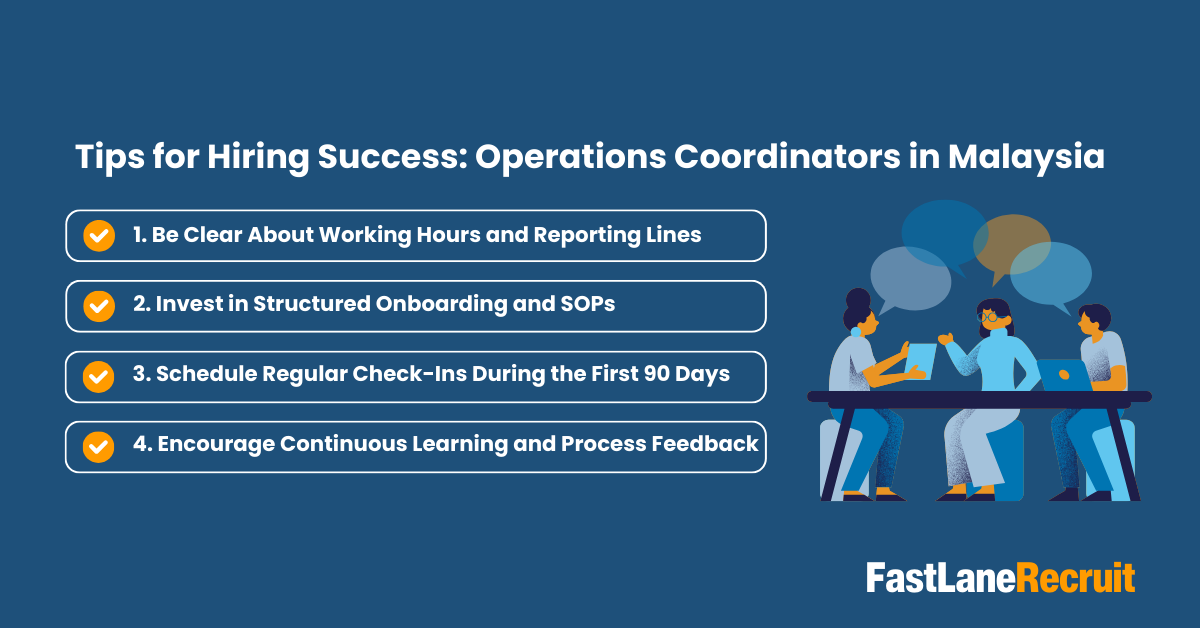
Tips for Hiring Success: Operations Coordinators in Malaysia
Hiring a skilled Operations Coordinator is only the first step. Ensuring their success and maximizing the value they bring to your global operations, requires thoughtful onboarding, clear expectations, and ongoing support. Here are some practical tips to help you get the best results.
1. Be Clear About Working Hours and Reporting Lines
For offshore roles, clarity around working hours, availability, and reporting structure is essential. Since Malaysian Operations Coordinators may be supporting teams across APAC or Europe, explicitly define:
- Core working hours and time zone expectations
- Who the coordinator reports to for daily tasks and performance reviews
- Points of contact for cross-functional communication
Example: If the coordinator supports both APAC and European teams, set overlapping hours with each region to allow real-time collaboration while maintaining clear priorities.
2. Invest in Structured Onboarding and SOPs
A well-planned onboarding process accelerates productivity and reduces mistakes. Provide:
- A structured orientation covering company culture, policies, and expectations
- Standard Operating Procedures (SOPs) for recurring tasks
- Access to tools, systems, and internal documentation
Example: Provide the coordinator with a checklist of daily, weekly, and monthly tasks, along with workflow diagrams for customer onboarding or reporting. This helps them understand processes quickly and maintain operational consistency.
3. Schedule Regular Check-Ins During the First 90 Days
Frequent touchpoints during the initial period help identify challenges early and reinforce alignment with company goals. Consider:
- Weekly one-on-one meetings with their manager
- Bi-weekly cross-team syncs for broader collaboration
- Feedback sessions to address questions or process improvements
Example: Schedule short weekly meetings during the first three months to review task progress, clarify expectations, and discuss any obstacles. This builds confidence and ensures the coordinator integrates smoothly with global teams.
4. Encourage Continuous Learning and Process Feedback
Operations Coordinators who can identify inefficiencies and propose solutions add significant value. Encourage a culture of continuous improvement by:
- Inviting suggestions on how workflows could be optimized
- Providing access to training, certifications, or industry resources
- Recognizing contributions to process enhancements
Example: A coordinator might notice a repetitive reporting task that can be automated. By sharing the idea and implementing a solution, they improve efficiency for the entire team while demonstrating initiative.
Key Takeaway
Success in hiring an offshore Operations Coordinator goes beyond qualifications; it relies on clear communication, structured onboarding, regular support, and a culture that values feedback and growth. By applying these tips, you ensure the coordinator can operate efficiently, support global teams effectively, and contribute to the company’s long-term success.
A Simpler Way: Hire Through FastLaneRecruit’s EOR Service
Engaging an Operations Coordinator in Malaysia doesn’t have to be complicated. For global companies, managing local compliance, payroll, and HR obligations can be time-consuming and risky. FastLaneRecruit’s EOR (Employer of Record) Service provides a simplified, fully compliant solution that lets you hire Malaysian talent quickly and efficiently.
How FastLaneRecruit’s EOR Service Works
With an EOR, FastLaneRecruit becomes the legal employer of your operations coordinators in Malaysia, handling all statutory obligations and employment compliance. Meanwhile, the coordinator works exclusively for your business, performing day-to-day operational tasks and supporting your global teams.
Benefits of Using FastLaneRecruit
- Quick Access to Talent
Hire Operations Coordinators in Malaysia without waiting to set up a local entity or navigate complex labour laws. FastLaneRecruit streamlines the hiring process so you can get the right candidate onboard faster. - Full Compliance with Local Laws
The EOR ensures that employment contracts, statutory contributions (EPF, SOCSO, EIS), taxes, and leave entitlements comply with Malaysian regulations. This reduces legal risk and provides peace of mind. - Reduced Administrative Workload
Payroll processing, benefits administration, and statutory reporting are managed by FastLaneRecruit. Your HR team can focus on strategic initiatives instead of paperwork. - Focus on Core Operations
By letting FastLaneRecruit handle HR, payroll, and compliance, your managers and teams can concentrate on operational efficiency, customer onboarding, and process improvements. - Scalable and Flexible
Whether you’re building a small regional support team or expanding across multiple countries, the EOR model allows you to scale your workforce up or down without the burden of entity management.
Example Scenario
A US-based tech company wanted a Malaysia-based Operations Coordination team to support APAC operations, including regional reporting and customer onboarding. Instead of establishing a local office, the company used FastLaneRecruit’s EOR service.
- Result: The operation coordination team was onboarded in less than five weeks, fully compliant with Malaysian employment laws, and integrated seamlessly with the global team. The headquarters could focus on strategy and growth while daily operational tasks ran smoothly.
Key Takeaway
For global businesses, an EOR is a practical, compliant, and cost-effective alternative to entity setup or third-party staffing. FastLaneRecruit’s service enables you to hire top Malaysian Operations Coordinators quickly while reducing risk, administrative burden, and operational overhead.
Conclusion
Hiring an offshore Operations Coordinator in Malaysia can significantly strengthen your operational capabilities when done thoughtfully. With the right role definition, structured interviews, and compliant hiring model, Malaysian professionals can become trusted partners in your global operations.
Whether you’re hiring your first international Operations Coordinator or scaling an existing team, FastLaneRecruit is here to help you move forward with confidence.
Ready to Hire Your Malaysian Operations Coordinator?
Streamline your global operations and build a high-performing operations coordination team in Malaysia without the hassle of local compliance. FastLaneRecruit’s Employer of Record (EOR) service makes it simple to hire skilled Operations Coordinators quickly, efficiently, and fully in line with Malaysian employment laws.
- Hire faster: Get top talent onboard in weeks, not months
- Stay compliant: We handle contracts, payroll, taxes, and statutory obligations
- Focus on growth: Let your team concentrate on operations while we manage HR and administration
- Scale easily: Expand your regional team without setting up a local entity
Don’t let administrative hurdles slow your expansion. Partner with FastLaneRecruit today and start building your Malaysian operations team with confidence.