
A Practical Guide for Global Businesses
Managing accounts payable can quickly become overwhelming as your business grows. More vendors. More invoices. More compliance requirements. More pressure on internal finance teams.
For many global companies, building an offshore Accounts Payable (AP) team in Malaysia has become a strategic way to improve efficiency, maintain compliance, and support scalable growth.
In this guide, we’ll walk you through:
- Why Malaysia is a strong destination for offshore AP teams
- What an offshore AP team actually handles
- Step-by-step process to build your team
- Common challenges and how to manage them
- When to use an Employer of Record (EOR) instead
Let’s dive in.
Content Outline
Key Summary
Understand Offshoring vs Outsourcing
Offshoring gives you a dedicated Accounts Payable team that works exclusively for your company, offering greater control, integration, and long-term scalability compared to outsourcing.
Malaysia Offers a Strong Regulatory Environment
Malaysia follows internationally aligned accounting standards and operates under a stable financial framework, making it a secure location for finance operations.
Access Globally Certified Finance Professionals
Malaysian AP professionals often hold certifications such as ACCA, CPA, and CIMA, ensuring high-quality accounting expertise and strong English communication skills.
Offshore AP Teams Improve Efficiency
A structured offshore Accounts Payable team can reduce invoice processing time, improve vendor relationships, and streamline month-end closing processes.
Compliance Must Be Properly Managed
Hiring in Malaysia requires adherence to employment laws, payroll regulations, tax filings, EPF, and SOCSO contributions, making compliance planning essential.
Infrastructure and Communication Drive Success
Secure systems, documented workflows, defined KPIs, and regular communication ensure productivity, data security, and strong team alignment.
Employer of Record (EOR) Simplifies Expansion
Using an EOR allows you to hire Malaysian Accounts Payable Officers without setting up a local entity, while ensuring full compliance and faster team deployment.
Offshoring vs Outsourcing: What’s the Difference?
What Is Offshoring?
Offshoring means building your own dedicated team in another country.
In this model:
- The team works exclusively for your company.
- You manage their daily tasks and performance.
- They follow your internal systems, policies, and reporting structure.
- They become an extension of your in-house team.
For example, if you build an offshore Accounts Payable team in Malaysia, those AP officers work only for your company. You decide how invoices are processed, which tools are used, and how vendor communication is handled.
You maintain operational control while benefiting from global talent.
What Is Outsourcing?
Outsourcing means hiring a third-party service provider to manage certain tasks or functions on your behalf.
In this structure:
- The service provider manages the staff.
- They follow their own processes and systems.
- You receive the final output or deliverables.
- The team may be serving multiple clients at the same time.
For example, if you outsource accounts payable, you hand over invoice processing to an external firm, and they handle everything internally before sending reports back to you.
You gain convenience, but you have less direct control over how the work is done.
Also Read: Offshore Vs Local: Accountants 2025 Salary Benchmark Report (Australia Vs Malaysia Edition)
Side-by-Side Comparison
| Area | Offshoring | Outsourcing |
| Team Ownership | Dedicated to your company | Managed by third-party provider |
| Process Control | You control workflows and tools | Provider controls processes |
| Integration | Fully integrated with your team | Operates separately |
| Long-Term Scalability | Easier to scale strategically | Depends on provider capacity |
| Customization | High level of customization | Limited flexibility |
Which Is Better for Accounts Payable?
If your goal is:
- Stronger internal control
- Alignment with your company’s finance policies
- Long-term team building
- Greater transparency
- Custom reporting and workflows
Then offshoring is usually the better option.
Accounts payable is a core financial function. It affects vendor relationships, cash flow, and compliance. Having a dedicated offshore team in Malaysia allows you to maintain oversight while expanding your finance capacity.
Malaysia offers a strong regulatory framework, skilled finance professionals, and reliable infrastructure, making it well-suited for building an offshore Accounts Payable team that feels fully integrated with your global operations.
In short:
Outsourcing gives you convenience.
Offshoring gives you control and scalability.
Why Build an Offshore Accounts Payable Team in Malaysia?
Malaysia has developed into one of Southeast Asia’s most reliable financial outsourcing destinations. Here’s why global companies are choosing it.
1. Strong Financial and Regulatory Framework
Malaysia follows internationally aligned accounting standards through the Malaysian Financial Reporting Standards (MFRS), issued by the Malaysian Accounting Standards Board.
The country’s regulatory environment is overseen by Bank Negara Malaysia, ensuring financial system stability.
You can also explore official government investment guidance via Malaysia Digital Economy Corporation and Malaysian Investment Development Authority.
These institutions provide a stable foundation for foreign businesses building finance operations in Malaysia.
Also Read: Building a High-Performing Offshore Accounting Team in Malaysia (Singapore Edition)
2. Globally Recognized Accounting Talent
Many Malaysian professionals hold internationally recognized certifications such as:
- ACCA
- CPA
- CIMA
Malaysia also consistently ranks high in English proficiency within Asia, making collaboration with US, UK, Australian, and European companies seamless.
3. Time Zone Advantage
Malaysia’s time zone overlaps well with:
- Australia
- Singapore
- Middle East
- Partial overlap with UK mornings
- US late evening support
This allows for extended processing hours, faster invoice cycles, and improved month-end closing timelines.
4. Operational Efficiency and Cost Optimization
Instead of expanding high-cost in-house teams, businesses can:
- Reduce operational costs
- Scale AP headcount flexibly
- Improve invoice turnaround times
- Free internal finance leaders to focus on strategy
A structured offshore AP team can significantly improve processing speed and reduce bottlenecks in vendor payments.
What Does an Offshore Accounts Payable Team Handle?
Here’s what your Malaysian AP team can manage:
| Function | Description | Business Impact |
| Invoice Processing | Verify, code, and enter vendor invoices | Faster payment cycles |
| Vendor Management | Maintain supplier records and communication | Strong vendor relationships |
| Payment Processing | Prepare payment runs and reconcile transactions | Improved cash flow control |
| Expense Tracking | Monitor company expenses | Better budgeting accuracy |
| Reconciliation | Match invoices to POs and bank statements | Reduced discrepancies |
| Reporting | Generate AP aging reports and dashboards | Data-driven decisions |
If structured properly, your offshore AP team becomes an extension of your finance department.
Also Read: Building a High-Performing Offshore Accounting Team in Malaysia (Hong Kong Edition)
Step-by-Step: How to Build an Offshore AP Team in Malaysia
Step 1: Define Your Goals
Start with clarity:
- Do you want faster processing?
- Lower operational overhead?
- Stronger compliance controls?
- 24-hour invoice coverage?
Set measurable KPIs such as:
- Invoice processing time
- Error rate percentage
- Days Payable Outstanding (DPO)
- Vendor satisfaction metrics
Step 2: Choose Your Structure
There are generally two models:
| Model | Description | Best For |
| Dedicated Team | You hire and manage your own AP staff in Malaysia | Long-term scaling |
| Functional Model | A provider performs specific AP tasks | Short-term support |
For growing companies, a dedicated offshore AP team offers more control and continuity.
Step 3: Ensure Legal Employment Compliance
Hiring employees in Malaysia requires compliance with:
- Employment Act 1955
- Local payroll regulations
- Tax filings with the Inland Revenue Board (LHDN)
- EPF and SOCSO contributions
You can verify employment regulations through official government portals like:
- Inland Revenue Board of Malaysia
- Employees Provident Fund
This is where many global businesses face complexity.
Step 4: Implement Secure Infrastructure
Accounts payable deals with sensitive financial data.
Best practices include:
- Two-factor authentication for accounting systems
- Encrypted document sharing
- Role-based system access
- Regular audit reviews
- Documented SOPs
Security must be part of your foundation, not an afterthought.
Step 5: Establish Clear Communication Protocols
To avoid common offshore challenges:
- Schedule weekly finance sync meetings
- Use project management tools (Asana, Trello, ClickUp)
- Maintain documented AP workflows
- Set defined response time expectations
Strong communication directly improves productivity and reduces rework.
Also Read: Building a High-Performing Offshore Accounting Team in Malaysia (Australia Edition)
Step 6: Train and Integrate
Even experienced AP professionals need alignment with your internal systems.
Create:
- Recorded SOP walkthroughs
- Invoice coding guidelines
- Escalation workflows
- Vendor communication templates
Integration ensures your offshore team feels like part of your organization, not separate from it.
Common Challenges (And How to Solve Them)
| Challenge | Solution |
| Communication gaps | Structured meeting schedules + documentation |
| Data security concerns | Encryption + access controls + audits |
| Quality control | Defined KPIs + performance reviews |
| Cultural differences | Cross-team onboarding sessions |
With the right structure, these are manageable and often minimal.
Direct Hiring vs Employer of Record (EOR)
Setting up a legal entity in Malaysia takes time, administrative effort, and compliance oversight.
An alternative is partnering with an Employer of Record (EOR).
An EOR:
- Legally employs your Malaysian AP staff on your behalf
- Manages payroll, tax filings, statutory contributions
- Ensures compliance with local labor laws
- Reduces setup risk and administrative burden
- Allows faster team deployment
This means you maintain operational control while the EOR manages employment compliance.
Example: Offshore AP Team Scenario
A UK-based SaaS company processing 5,000 invoices monthly:
| Before Offshore | After Offshore AP Team in Malaysia |
| 7-day invoice processing | 2–3 days average processing |
| High overtime costs | Balanced distributed workload |
| Vendor payment delays | On-time structured payment runs |
| Finance team overloaded | Strategic finance focus |
The result? Improved efficiency, better vendor relationships, and smoother financial reporting.
Tips for Building a High-Performing Offshore Accounts Payable Team
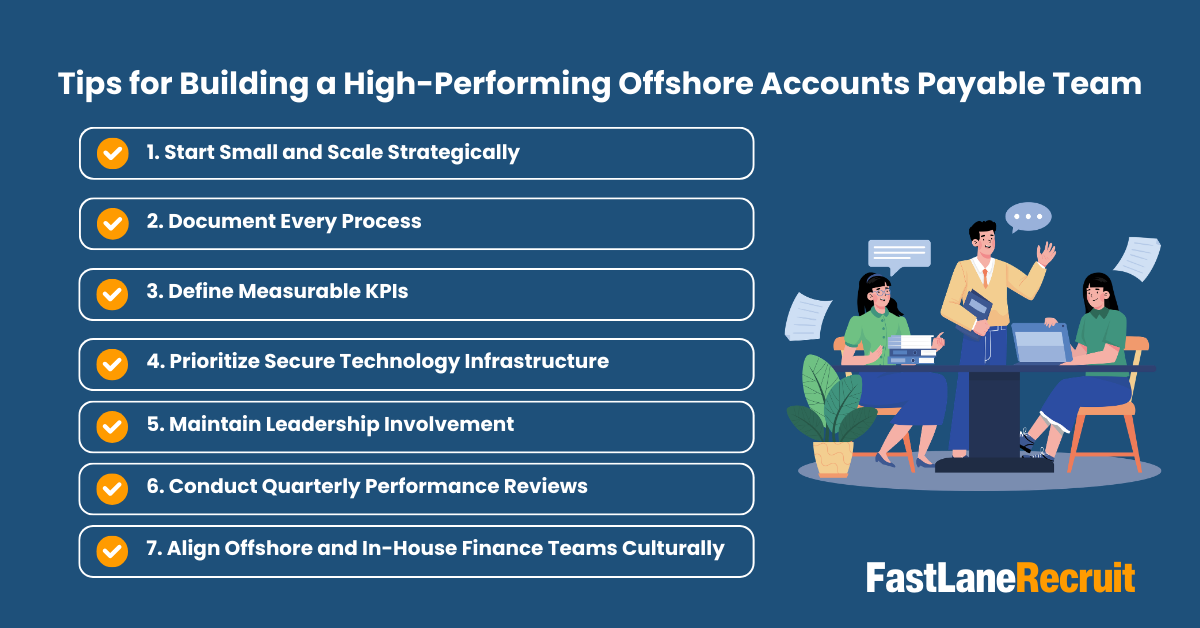
Building an offshore AP team in Malaysia is not just about hiring skilled professionals. It’s about creating the right structure, expectations, and systems so the team performs consistently over time. Here’s how to do it effectively.
1. Start Small and Scale Strategically
It’s tempting to move your entire Accounts Payable function offshore immediately. But a phased approach works better.
Start with:
- A specific function (e.g., invoice processing or vendor reconciliation)
- A manageable invoice volume
- Clearly defined workflows
This allows you to:
- Test communication processes
- Identify bottlenecks
- Refine documentation
- Measure performance accurately
Once processes are stable and KPIs are met, you can gradually expand responsibilities and team size.
2. Document Every Process
Clear documentation reduces errors and dependency on individuals.
Create:
- Step-by-step invoice processing guides
- Payment approval workflows
- Escalation procedures
- Vendor communication templates
- Month-end closing checklists
Well-documented Standard Operating Procedures (SOPs) ensure:
- Consistency in output
- Faster onboarding for new hires
- Reduced miscommunication
- Easier performance monitoring
When processes are written down clearly, your offshore team can operate confidently and independently.
3. Define Measurable KPIs
Performance should be tracked with data, not assumptions.
Common Accounts Payable KPIs include:
- Average invoice processing time
- Invoice error rate
- Days Payable Outstanding (DPO)
- Percentage of on-time payments
- Vendor dispute resolution time
Clear KPIs:
- Set expectations from day one
- Make performance measurable
- Support continuous improvement
- Encourage accountability
When everyone understands what success looks like, results improve.
4. Prioritize Secure Technology Infrastructure
Accounts Payable involves sensitive financial information. Security must be embedded into your systems.
Best practices include:
- Two-factor authentication (2FA) for accounting platforms
- Encrypted document sharing tools
- Role-based access control
- Audit logs for tracking activities
- Secure cloud-based accounting software
A secure technology framework protects:
- Vendor data
- Financial records
- Company cash flow integrity
- Your business reputation
Security is not optional, it’s foundational.
5. Maintain Leadership Involvement
Offshore teams perform best when leadership stays engaged.
This doesn’t mean micromanaging. It means:
- Holding regular check-ins
- Reviewing KPI dashboards
- Providing feedback
- Sharing company updates
- Recognizing achievements
When offshore AP teams feel included in the bigger company vision, motivation and accountability improve significantly.
Leadership visibility builds trust.
6. Conduct Quarterly Performance Reviews
Performance reviews should not only happen when problems arise.
Quarterly reviews allow you to:
- Evaluate KPI performance
- Identify skill gaps
- Adjust workloads
- Set improvement targets
- Plan promotions or expanded roles
These reviews also provide space for feedback from the offshore team, helping improve processes on both sides.
Consistent reviews create a culture of improvement, not reaction.
7. Align Offshore and In-House Finance Teams Culturally
Even highly skilled teams can struggle without cultural alignment.
Encourage:
- Cross-team introductions
- Joint finance meetings
- Shared communication channels
- Knowledge-sharing sessions
- Collaborative problem-solving
Treat your offshore AP team as an extension of your internal department, not as a separate unit.
When both teams share goals, systems, and accountability, performance becomes seamless.
Why Consistency Matters
High performance is not built overnight. It comes from:
- Clear structure
- Measurable goals
- Secure systems
- Strong communication
- Ongoing leadership support
When these elements are consistently applied, your offshore Accounts Payable team in Malaysia can operate with the same reliability and efficiency as your in-house team, while supporting scalable global growth.
Also Read: Types Of Accounting Services That Can Be Outsourced
Is Malaysia the Right Choice for Your Offshore AP Team?
Malaysia offers:
- Internationally aligned accounting standards
- Strong English-speaking finance professionals
- Stable regulatory environment
- Time zone advantages
- Government-backed digital economy initiatives
For global companies looking to improve AP efficiency without operational disruption, Malaysia presents a strong strategic option.
Conclusion
Building an offshore Accounts Payable team in Malaysia is not just about cost optimization. It’s about creating a structured, scalable, and compliant finance function that supports business growth.
With the right processes, technology, and regulatory structure in place, your Malaysian AP team can become a reliable extension of your global finance operations.
However, setting up and managing employment compliance independently can be complex.
Simplify the Process with FastLaneRecruit’s Employer of Record (EOR) Service
If you want to hire Malaysian Accounts Payable Officers without establishing a local entity, FastLaneRecruit’s Employer of Record service provides a streamlined solution.
We handle:
- Legal employment setup
- Payroll and statutory contributions
- Tax compliance
- Employment contracts
- Ongoing HR administration
You focus on managing performance and results. We handle compliance and administration.
Ready to build your offshore Accounts Payable team in Malaysia with confidence?
Contact FastLaneRecruit today to explore how our EOR solution can support your global expansion.