As Malaysia continues to attract foreign investment and international expansion, employers are increasingly faced with an important workforce decision of hiring under Contract vs Permanent Employment Malaysia.
The answer is not always straightforward.
Contract employees provide flexibility and cost control, while permanent employees offer workforce stability, stronger retention, and long-term organizational growth. Choosing the wrong employment model can lead to compliance risks, talent shortages, unnecessary costs, and even unfair dismissal claims.
This guide explains the differences between contract vs permanent employment Malaysia, the legal considerations employers must understand, and how to determine the most suitable hiring model for your business.
Content Outline
Key Summary
Contract Employment Is Intended for Fixed-Term Work
Contract employment is commonly used for temporary assignments, project-based roles, seasonal demands, or positions with a clearly defined end date.
Permanent Employment Provides Long-Term Stability
Permanent employees are hired without a predetermined end date, offering greater job security and long-term career development opportunities.
Employment Status Depends on Actual Working Arrangements
Malaysian courts evaluate the true nature of the employment relationship rather than relying solely on the title or wording of an employment contract.
Repeated Renewals Can Create Permanent Employment Risks
Employers should be cautious when renewing fixed-term contracts multiple times, as employees may be deemed permanent if the role effectively becomes ongoing.
Contract Hiring Offers Greater Workforce Flexibility
Fixed-term contracts allow businesses to manage short-term projects, fluctuating workloads, and temporary staffing needs with lower long-term commitments.
Permanent Hiring Supports Sustainable Growth
Permanent employees contribute to stronger retention, succession planning, workforce stability, and overall business continuity.
EOR Services Simplify Hiring in Malaysia
Global companies can hire contract or permanent employees in Malaysia without establishing a local entity by using Employer of Record (EOR) services that manage employment compliance, payroll, and statutory obligations.
Understanding Employment Types in Malaysia
Before deciding which model suits your organization, it is important to understand how Malaysian employment arrangements are structured.
Generally, employment relationships fall into two categories:
Contract Employment
Contract employment refers to an arrangement with:
- A fixed start date
- A predetermined end date
- A project-specific objective
- Temporary business requirements
The employment relationship ends automatically upon expiration of the agreed term unless renewed.
Common examples include:
- IT implementation projects
- Maternity leave replacement
- Seasonal hiring
- Business expansion initiatives
- Short-term consulting assignments
Permanent Employment
Permanent employment refers to an ongoing employment relationship without a predetermined end date.
Employees remain employed until:
- Resignation
- Retirement
- Termination for just cause
- Mutual separation
Permanent employment is typically used for roles critical to ongoing business operations.
Examples include:
- Finance managers
- HR personnel
- Sales executives
- Operations managers
- Customer service teams
Also Read: Malaysia Employment Act 1955
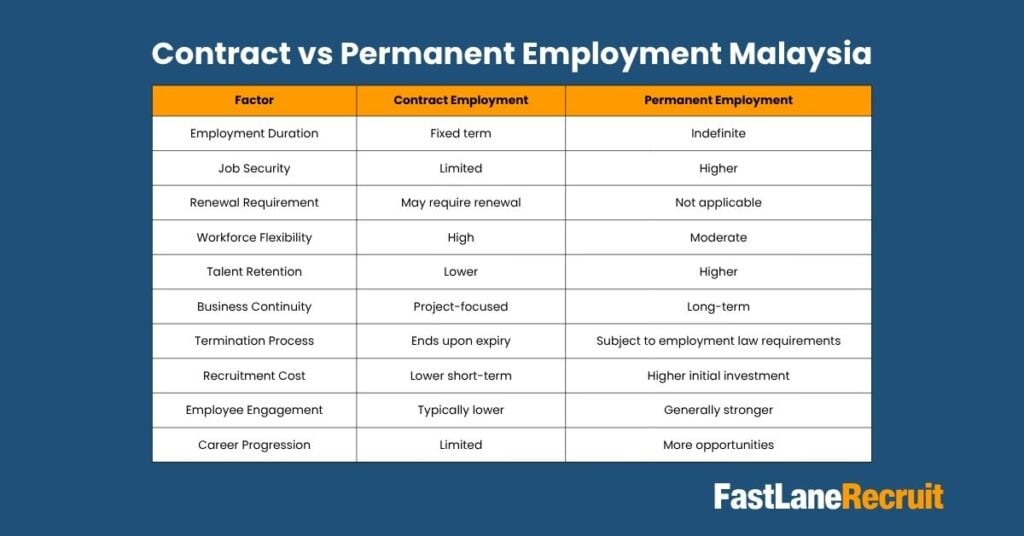
Contract vs Permanent Employment Malaysia: Key Differences
What Malaysian Employment Law Says About Fixed-Term Contracts
Many employers mistakenly assume that simply labeling an agreement as a fixed-term contract automatically makes it legally valid.
This is not always true.
Malaysian Industrial Court decisions consistently emphasize that the court examines the substance of the employment relationship rather than the wording of the contract.
Employers should ask:
- Is the work genuinely temporary?
- Is the role tied to a specific project?
- Does the business require the role indefinitely?
- Have multiple renewals created an expectation of continued employment?
If a contract employee performs ongoing business functions for many years under repeated renewals, the court may determine that the employee is effectively permanent.
When Is Contract Employment Appropriate?
Contract hiring works best when employers need flexibility.
Project-Based Work
Businesses frequently require specialists for:
- ERP implementation
- Digital transformation
- Software migration
- Market expansion projects
Once the project concludes, the employment relationship naturally ends.
Seasonal Demand
Industries such as:
- Retail
- Logistics
- Hospitality
- E-commerce
often experience temporary surges requiring short-term workforce support.
Temporary Replacement
Contract employees can fill roles during:
- Maternity leave
- Extended medical leave
- Sabbaticals
- Temporary vacancies
Budget Constraints
Organizations uncertain about long-term headcount needs may use contract arrangements while assessing future workforce requirements.
When Permanent Employment Is the Better Choice
Permanent hiring is generally preferable when the role supports ongoing business operations.
Core Business Functions
Roles responsible for:
- Revenue generation
- Customer management
- Financial control
- Compliance
- Human resources
typically benefit from permanent employment structures.
Talent Retention
Permanent employees often demonstrate:
- Greater loyalty
- Stronger engagement
- Improved productivity
- Lower turnover
Leadership Development
Businesses investing in succession planning usually require permanent employees who can grow into leadership positions.
Cost Comparison: Contract vs Permanent Employment Malaysia
Many employers focus only on salary costs.
However, the true cost of employment extends beyond monthly payroll.
Contract Employment Costs
Potential advantages:
- Lower long-term commitments
- Flexible workforce scaling
- Reduced retrenchment exposure
- Easier project budgeting
Potential disadvantages:
- Frequent recruitment cycles
- Knowledge loss
- Lower employee commitment
- Increased onboarding costs
Permanent Employment Costs
Potential advantages:
- Stronger retention
- Institutional knowledge preservation
- Reduced recruitment frequency
- Improved organizational culture
Potential disadvantages:
- Longer commitment
- Higher workforce planning requirements
- Greater termination obligations
Hiring Remote Employees in Malaysia: Contract or Permanent?
Many foreign companies entering Malaysia struggle with this decision.
If the employee performs a long-term role supporting business growth, permanent employment is often the preferred option.
However, foreign companies frequently face challenges such as:
- Local employment compliance
- Payroll administration
- Tax registrations
- Statutory contributions
- Employment contracts
This is where an Employer of Record (EOR) solution becomes valuable.
An EOR enables businesses to legally hire employees in Malaysia without establishing a local company while ensuring compliance with local labor laws.
Also Read: 10 Best Employer of Record (EOR) Services To Consider in 2026
Common Employer Mistakes When Using Contract Employment
Repeated Contract Renewals: Renewing contracts continuously over several years may create legal risks.
Using Fixed-Term Contracts for Permanent Roles: If the role is ongoing and business-critical, contract structures may be challenged.
Poor Documentation: Unclear employment terms often lead to disputes.
Ignoring Compliance Requirements: Contract employees may still be entitled to statutory protections under Malaysian law.
How to Choose the Right Hiring Model
Ask yourself these questions:
Is the work temporary or ongoing?
Temporary work generally supports contract employment.
Ongoing operational work usually supports permanent employment.
Is flexibility a priority?
Contract arrangements provide greater workforce agility.
Is retention important?
Permanent employment is usually more effective for retaining key talent.
Does your company have a legal entity in Malaysia?
If not, an Employer of Record can simplify compliant hiring.
Why Many Global Companies Use Employer of Record Services in Malaysia
An Employer of Record helps companies:
- Hire employees quickly
- Avoid entity setup costs
- Stay compliant with Malaysian labor laws
- Manage payroll and statutory contributions
- Reduce administrative burdens
- Expand into Malaysia faster
This is especially useful for:
- Startups
- Technology companies
- Remote-first organizations
- International employers testing the Malaysian market
Partner with FastLaneRecruit for Compliant Hiring in Malaysia
Whether you need contract employees, permanent staff, or a fully compliant Employer of Record solution, FastLaneRecruit helps businesses hire confidently in Malaysia.
Through FastLaneRecruit’s Malaysia Employer of Record service, companies can:
- Hire employees without establishing a local entity
- Manage payroll and statutory contributions
- Maintain compliance with Malaysian employment regulations
- Support both contract and permanent hiring needs
- Expand into Malaysia quickly and efficiently
Speak with the FastLaneRecruit team today to determine the most suitable workforce strategy for your business expansion plans.
Final Thoughts
There is no universally superior option between contract and permanent employment in Malaysia.
The right choice depends on your business objectives, workforce strategy, budget, compliance requirements, and growth plans. That’s why you need to talk with specialists like FastLaneRecruit before making important decisions.
Contract employment offers flexibility and scalability. Permanent employment supports retention and long-term organizational success.
For many global employers entering Malaysia, combining strategic hiring decisions with Employer of Record services provides the most efficient path to compliant expansion and workforce growth.
Frequently Asked Questions
What are the main differences between contract and permanent employment in Malaysia?
Contract employment has a fixed duration and typically ends upon expiry of the agreed term. Permanent employment continues indefinitely until resignation, retirement, or lawful termination.
What are the key differences between contract and permanent employment in Malaysia?
The primary differences involve employment duration, job security, workforce flexibility, retention, and termination procedures. Contract roles offer flexibility, while permanent roles provide long-term stability.
Which companies in Malaysia offer contract employment with benefits similar to permanent roles?
Many multinational corporations, technology firms, financial institutions, and shared service centers provide contract employees with competitive benefits. The exact benefits vary by employer and contract structure.
What are the typical contract durations offered by top Malaysian employers?
Most fixed-term contracts range from 3 months to 24 months. Project-based contracts may extend longer depending on business requirements.
Are there recruitment agencies in Malaysia specializing in contract jobs?
Yes. Many recruitment firms specialize in contract staffing, project hiring, executive search, and contingent workforce solutions. Employers often engage recruitment partners when scaling teams quickly or filling specialized positions.
Can a contract employee become a permanent employee in Malaysia?
Yes. Many employers convert high-performing contract employees into permanent employees based on business needs and workforce planning.
Can foreign companies hire employees in Malaysia without setting up a company?
Yes. An Employer of Record (EOR) service allows foreign businesses to legally employ workers in Malaysia without establishing a local legal entity.