
Companies want to understand how to legally hire employees, enter the Malaysian market, and operate in compliance with local regulations.
However, incorporation is not the only option. Many companies evaluating expansion into Malaysia are now comparing two distinct models:
- Company incorporation (setting up a legal entity in Malaysia)
- Employer of Record (EOR) (hiring employees without forming a legal entity)
Both approaches are legally valid but serve very different strategic purposes. The right choice depends on factors such as speed, cost, operational control, compliance burden, and long-term business goals.
This guide provides a structured comparison of both models based on Malaysian regulatory frameworks, including the Companies Act 2016 and SSM requirements, as well as modern hiring practices used by global companies.
Content Outline
Key Summary
Company Incorporation Provides Full Business Control
Company incorporation in Malaysia is a formal legal setup under SSM that gives businesses full ownership, operational control, and a permanent market presence. However, it also requires ongoing compliance, regulatory filings, and administrative management.
EOR Enables Faster Market Entry
An Employer of Record (EOR) allows companies to hire employees in Malaysia without establishing a local entity, making it a faster and more cost-effective option for market entry and team expansion.
The Right Choice Depends on Business Goals
Incorporation is ideal for companies planning long-term operations, local invoicing, and regional growth, while EOR is better suited for rapid hiring, market testing, and flexible expansion.
EOR Reduces Compliance Burdens
EOR providers manage employment contracts, payroll, tax compliance, and statutory contributions such as EPF, SOCSO, and EIS, helping businesses minimize legal and compliance risks.
Many Companies Start with EOR Before Incorporating
A common expansion strategy is to use EOR for quick market entry and workforce deployment, then establish a local entity once operations are proven and ready to scale.
EOR Is Often the Most Practical Entry Strategy
For organizations prioritizing speed, flexibility, and lower upfront investment, EOR offers a simpler and more efficient path into the Malaysian market than immediate company incorporation.
What Is Company Incorporation in Malaysia?
Company incorporation in Malaysia refers to the legal process of registering a business entity with the Companies Commission of Malaysia (SSM) under the Companies Act 2016. Once incorporated, the business becomes a separate legal entity capable of entering contracts, hiring employees, and conducting commercial activities.
The most common structure used by foreign investors and SMEs is the Private Limited Company (Sdn. Bhd.).
Legal structure requirements
To incorporate a company in Malaysia, the following requirements generally apply:
- At least one director who is ordinarily resident in Malaysia
- At least one shareholder (individual or corporate entity)
- A registered office address in Malaysia
- Appointment of a licensed company secretary within 30 days of incorporation
- Compliance with SSM filing and statutory obligations
These requirements ensure that every incorporated company has a local governance structure and is accountable under Malaysian corporate law.
Types of business entities in Malaysia
Malaysia offers several entity structures depending on business intent:
- Private Limited Company (Sdn. Bhd.) – standard for commercial operations
- Branch Office – extension of a foreign parent company
- Representative Office – non-commercial presence for market research
- Company Limited by Guarantee – typically for non-profit organizations
Among these, Sdn. Bhd. is the most widely used for operational businesses due to its flexibility and tax advantages.
Company Incorporation Process in Malaysia
The incorporation process is regulated by SSM and is increasingly digitized through online systems.
1: Company name search and approval
The proposed company name must be submitted to SSM for approval. The name must be unique, compliant with naming guidelines, and not misleading or restricted.
2: Preparation of incorporation documents
Key information required includes:
- Business activity description
- Director and shareholder details
- Share capital structure
- Registered office address
3: Submission to SSM
Once documentation is complete, the incorporation application is submitted through SSM’s MyCoID system or registered service providers.
4: Company registration approval
Upon approval, the company is officially incorporated and issued a registration certificate.
5: Post-incorporation compliance
After incorporation, companies must complete several mandatory steps:
- Appointment of company secretary
- Registration with tax authorities (LHDN)
- Opening a corporate bank account
- Setting up payroll and statutory contributions
- Maintaining statutory registers and filings
While incorporation itself may be completed in a short timeframe, full operational readiness requires additional administrative setup and ongoing compliance.
Real Cost of Company Incorporation in Malaysia
While incorporation may appear low-cost at the start, the real cost includes both setup and ongoing operational expenses.
Initial setup costs
Typical incorporation-related expenses include:
- Company name reservation and registration fees
- Company secretary setup fees
- Legal documentation and filing
- Registered office setup
Ongoing mandatory costs
After incorporation, companies must maintain:
- Company secretary fees (annual)
- Accounting and bookkeeping services
- Statutory filings and compliance reporting
- Tax filings with LHDN
- Payroll administration (if hiring employees)
- Audit requirements (depending on company size)
Hidden operational costs
Many businesses underestimate:
- Time spent on compliance management
- Hiring HR/payroll staff
- Risk of penalties for non-compliance
- Banking and administrative setup delays
Key insight
Incorporation is not just a registration cost, it is a continuous compliance cost structure.
What Is Employer of Record (EOR) in Malaysia?
An Employer of Record (EOR) is a third-party service provider that legally employs workers on behalf of a foreign company. While the EOR becomes the formal employer for legal and compliance purposes, the client company retains full operational control over the employee’s day-to-day work.
The EOR model allows companies to hire in Malaysia without establishing a local entity.
How EOR works
Under an EOR arrangement:
- The EOR becomes the legal employer of record
- The EOR manages payroll, tax, and statutory contributions
- The client company manages employee tasks and performance
- Employment contracts comply with Malaysian labor laws
What EOR typically covers
- Employment contract administration
- Payroll processing
- Tax deductions and filings
- EPF, SOCSO, and EIS contributions
- Compliance with Employment Act 1955 and related regulations
- HR administrative support
This structure significantly reduces legal and administrative burdens for companies entering a new market.
Also Read: Top 15 Employer of Record (EOR) Services in Malaysia
Real Cost of EOR in Malaysia
Unlike incorporation, EOR operates on a transparent per-employee pricing model.
Core cost structure
- Monthly fee per employee
- Payroll processing included
- Statutory compliance included
- HR administration included
What EOR eliminates
- Company registration costs
- Company secretary fees
- Accounting setup
- Legal entity maintenance
- Compliance penalties risk
- HR infrastructure costs
Key insight
EOR converts fixed business overhead into predictable operational cost per hire.
Company Incorporation vs EOR in Malaysia: Real Cost Comparison
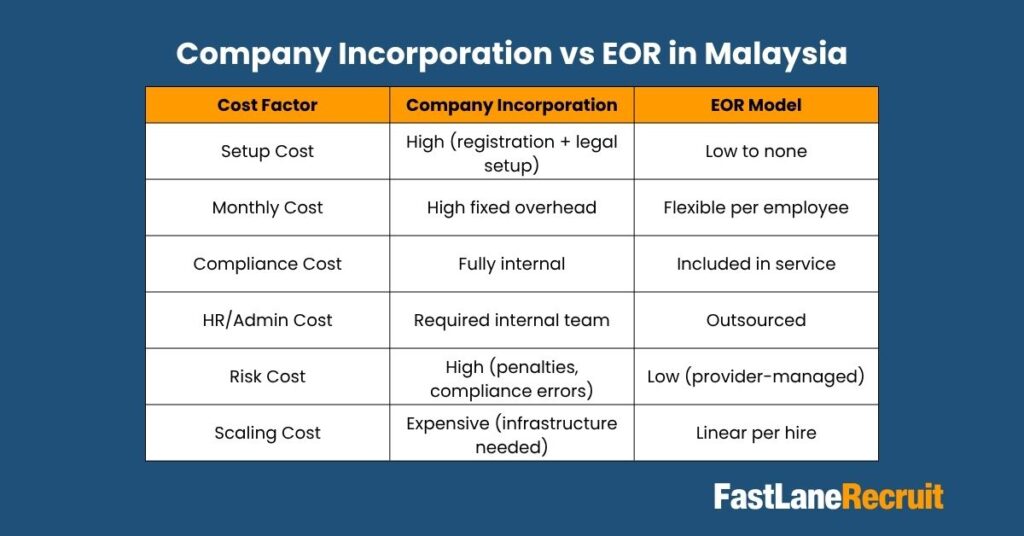
Company Incorporation vs EOR in Malaysia: Key Differences
1. Setup speed
Company incorporation typically requires several days to weeks depending on documentation, approvals, and post-registration setup.
EOR enables hiring within days because no entity formation is required.
Conclusion: EOR is significantly faster for market entry.
2. Legal requirements
Company incorporation requires compliance with SSM, including local directorship, company secretary appointment, and ongoing statutory filings.
EOR removes the need to establish a legal entity, as the EOR assumes employer responsibilities.
Conclusion: EOR reduces legal complexity.
3. Cost structure
Company incorporation involves:
- Registration fees
- Company secretary fees
- Accounting and audit costs
- Compliance and administrative overhead
Also Read: How to Establish an Offshore Company in Malaysia
EOR involves:
- Monthly service fee per employee
- No entity maintenance costs
- No need for local corporate infrastructure
Conclusion: EOR is more cost-efficient for small teams or market testing phases.
4. Operational control
Company incorporation provides full control over contracts, invoicing, banking, and business operations.
EOR provides operational control over employees but not legal entity ownership.
Conclusion: Incorporation is better for full-scale operations.
5. Compliance responsibility
With incorporation, the company is fully responsible for legal, tax, and employment compliance.
With EOR, compliance responsibilities are handled by the EOR provider.
Conclusion: EOR reduces compliance risk significantly.
6. Scalability
Company incorporation is more suitable for long-term scaling and regional expansion.
EOR is ideal for rapid hiring and market entry without long-term commitment.
Conclusion: Both models support scalability but at different stages of growth.
When Should You Choose Company Incorporation?
Company incorporation is recommended when you:
- are establishing a long-term presence in Malaysia
- need to issue invoices locally
- require full legal entity control
- plan to build a large operational team
- intend to expand regionally from Malaysia
Incorporation is typically a strategic step once the business has validated market demand.
When Should You Choose EOR in Malaysia?
EOR is the preferred option when you:
- need to hire employees quickly in Malaysia
- are testing market demand before full entry
- want to avoid setting up a legal entity
- build remote or distributed teams
- require to minimize compliance and administrative workload
EOR is widely used by international companies entering Southeast Asia due to its speed and simplicity.
Strategic Hiring Approach: EOR First, Incorporation Later
A growing number of global companies follow a phased approach:
Phase 1: Market entry using EOR
Companies hire talent quickly without incorporating a legal entity.
Phase 2: Market validation
Businesses evaluate performance, demand, and operational requirements.
Phase 3: Incorporation
Once the market is proven, companies establish a local entity for long-term operations.
This approach reduces upfront risk and avoids unnecessary legal and administrative costs.
Why Many Companies Prefer EOR Over Incorporation
While incorporation remains necessary for full-scale operations, many companies now prefer EOR during early-stage expansion because it:
- Eliminates setup delays
- Reduces legal and administrative burden
- Manageable cost structure
- Enables faster hiring
- Minimizes compliance risk
- Supports flexible market entry strategy
For many global employers, EOR is no longer just an alternative, it is the preferred first step into new markets.
FastLaneRecruit EOR Services
If your goal is to hire employees in Malaysia quickly without setting up a legal entity, FastLaneRecruit provides a fully compliant Employer of Record (EOR) solution.
FastLaneRecruit manages:
- Employment contracts compliant with Malaysian law
- Payroll processing and tax compliance
- EPF, SOCSO, and EIS contributions
- HR administration and statutory reporting
- End-to-end employment lifecycle management
This allows companies to focus on operations and growth while eliminating legal and administrative complexity. Contact us today to get started in Malaysia with professional support.
Conclusion
Company incorporation in Malaysia is the correct choice for long-term business establishment and full operational control. However, it comes with regulatory obligations, setup time, and ongoing compliance requirements.
Employer of Record offers a faster, lower-risk alternative that enables companies to hire immediately without forming a legal entity.
For most businesses entering Malaysia, the most efficient strategy is to start with EOR and transition to incorporation once the market is validated and scaling requires a permanent structure.
FAQ: Company Incorporation in Malaysia
How do I incorporate a company in Malaysia?
You must register your company with the Companies Commission of Malaysia (SSM), obtain name approval, submit incorporation documents, and complete post-registration compliance requirements such as tax registration and company secretary appointment.
How to register a private limited company in Malaysia?
A private limited company (Sdn. Bhd.) is registered through SSM by submitting director and shareholder details, business activity information, and a registered Malaysian address.
What are the steps for company incorporation in Malaysia?
The steps include name search and approval, submission of incorporation documents, SSM approval, and post-incorporation compliance setup including tax and banking registration.
Which online services can help with company incorporation in Malaysia?
Company incorporation services are offered by corporate service providers, including company secretarial firms. Employer of Record providers such as FastLaneRecruit also assist businesses by offering alternative hiring solutions without incorporation.
Can I incorporate a company remotely in Malaysia?
Yes. The incorporation process can be initiated online through SSM systems or authorized service providers. However, post-incorporation compliance still requires local regulatory management.