Business Process Outsourcing (BPO) services have become an essential part of how modern companies operate and grow. Instead of handling every business function internally, organizations now delegate specific processes to external service providers to improve efficiency, access specialized skills, and scale faster across markets.
Today, BPO services are used by startups, SMEs, and large multinational companies across industries such as technology, finance, healthcare, retail, and logistics. Whether it is customer support, payroll processing, IT support, or marketing operations, outsourcing allows businesses to focus on their core strengths while experienced partners handle routine or specialized tasks.
In this guide, we will explain what BPO is, how it works, the different types of BPO services, key benefits and risks, and how global businesses can choose the right outsourcing model.
Content Outline
Key Summary
What BPO Services Mean
Business Process Outsourcing (BPO) is when companies delegate non-core business tasks to external experts to improve efficiency and focus on growth.
Core vs Non-Core Business Functions
Core functions drive revenue (like product development), while non-core functions such as payroll, customer support, and data entry can be outsourced.
How BPO Works in Practice
BPO follows a structured process: identify tasks, choose a provider, define workflows, integrate systems, and continuously monitor performance.
Types of BPO Services
BPO includes front-office (customer support), back-office (HR and finance), IT services, KPO (analysis and research), and creative services.
Location-Based Outsourcing Models
Companies choose between offshore (global talent access), nearshore (regional proximity), and onshore (same country) depending on cost, control, and collaboration needs.
Key Benefits of BPO Services
BPO helps businesses improve efficiency, access specialized talent, scale faster, reduce operational complexity, and expand into global markets.
Risks and Management Strategies
Common risks include data security, communication gaps, performance tracking, and vendor dependency, all manageable through clear processes and governance.
What Is Business Process Outsourcing (BPO)?
Business Process Outsourcing (BPO) simply means hiring an external company to take care of certain business tasks or operations that your company would normally do internally.
Instead of building a large in-house team for every function, businesses work with specialized service providers who already have the people, systems, and experience to handle those tasks efficiently.
These outsourced tasks are usually not the company’s main focus, but they are still important for day-to-day operations. That is why they are often called non-core business activities.
What are “non-core” activities?
Non-core activities are the supporting tasks that help a business run smoothly, but they are not directly related to the company’s main product or service.
For example:
- A clothing brand’s core business is designing and selling fashion products, not answering customer emails or managing payroll.
- A software company’s core business is building software, not handling IT helpdesk tickets or processing invoices.
These supporting functions still matter, but they do not define what the business sells or delivers to customers.
In Simple Terms:
Business Process Outsourcing services allow companies to assign certain business functions to external experts. These experts are trained to handle those tasks efficiently, using proven systems and experience.
This helps businesses:
- Operate more smoothly
- Save time on routine work
- Access skilled professionals without building large internal teams
- Focus their energy on growth, innovation, and customer experience
Also Read: EOR Services: A Game Changer for Startup Growth
How BPO works in real business situations
To understand it more clearly, here are simple real-world examples:
1. Retail company outsourcing customer support
A retail business may receive hundreds or thousands of customer inquiries every day. Instead of hiring a large internal support team, they work with a BPO provider that handles:
- Customer emails and chats
- Order tracking questions
- Returns and refund support
This helps the retail company focus on product sourcing, marketing, and sales growth.
2. Tech company outsourcing HR and payroll
A growing technology company may not want to manage payroll calculations, tax compliance, and employee records internally.
Instead, they outsource HR-related tasks such as:
- Salary processing
- Employee onboarding documentation
- Leave and attendance management
This ensures employees are paid correctly and on time, without the company needing a large HR department.
3. Global brand outsourcing IT support or data entry
Large companies often operate across multiple countries. They may outsource:
- IT helpdesk support for employees
- Data entry and document management
- System maintenance and monitoring
This ensures round-the-clock support without needing internal teams in every region.
How Do BPO Services Work?
BPO services work through a structured partnership between a company (the client) and an external service provider (the BPO company). Instead of simply “handing over tasks,” it is a carefully planned process where both sides agree on what will be done, how it will be done, and how performance will be measured.
The goal is to make business operations more efficient, consistent, and scalable while allowing the company to focus on its core activities.
Here is how the process typically works in a more detailed and practical way:
1. Identifying business functions to outsource
The first step is for a company to review its internal operations and identify which tasks can be handled externally.
These are usually tasks that are:
- Repetitive and time-consuming
- Operational or administrative in nature
- Not directly linked to core business strategy
- Require specialized skills that may not exist in-house
Common examples include customer support, payroll processing, data entry, IT support, or HR administration.
At this stage, businesses also evaluate:
- Where internal teams are spending too much time
- Which tasks slow down growth or decision-making
- Which processes can be standardized and documented
The outcome of this step is a clear list of tasks that can be safely and effectively outsourced.
2. Selecting a BPO provider
Once the scope of work is clear, the next step is choosing the right outsourcing partner.
This is an important decision because the provider becomes an extension of the business.
Companies usually evaluate providers based on:
- Industry experience and specialization
- Track record and client portfolio
- Data security and compliance standards
- Communication quality and responsiveness
- Technology and systems used
- Ability to scale with business needs
A strong BPO provider should not only complete tasks but also understand business goals and industry requirements.
3. Defining processes and expectations
After selecting a provider, both parties work together to clearly define how the work will be done.
This step ensures alignment and avoids confusion later.
It usually includes:
- Detailed workflow documentation
- Standard operating procedures (SOPs)
- Service Level Agreements (SLAs)
- Key Performance Indicators (KPIs)
- Communication methods (email, Slack, meetings, etc.)
- Reporting frequency and formats
For example, if customer support is outsourced, the agreement may define:
- Maximum response time
- Customer satisfaction targets
- Escalation procedures for complex issues
This stage is critical because it sets clear expectations for performance and accountability.
Also Read: Employers of Record – What You Need to Know!
4. Execution and integration
Once everything is set up, the BPO provider begins delivering services as part of the company’s extended team.
At this stage, integration happens across systems and workflows.
This may include:
- Access to business tools and software
- Training on company processes and brand guidelines
- Integration with CRM, HR systems, or accounting tools
- Setting up communication channels between teams
Even though the provider is external, they function as part of the company’s daily operations.
For example:
A support agent from a BPO team may respond to customer emails using the company’s official system and tone of voice, just like an in-house employee would.
5. Performance monitoring and optimization
After operations begin, the focus shifts to monitoring performance and improving efficiency over time.
Companies track results using:
- Regular performance reports
- Dashboards and analytics tools
- Service Level Agreements (SLAs)
- Quality assurance reviews
Key metrics often include:
- Response time
- Accuracy of work
- Customer satisfaction scores
- Productivity levels
- Task completion rates
This step is ongoing. Businesses and BPO providers regularly communicate to:
- Improve processes
- Fix gaps or inefficiencies
- Adjust workflows based on business growth
- Ensure service quality remains consistent
In simple terms
BPO services work like this:
A company identifies tasks it doesn’t need to handle internally, partners with a specialized provider, sets clear rules and expectations, integrates the provider into its systems, and continuously monitors performance to ensure quality and efficiency.
This structured approach allows businesses to operate more smoothly while focusing on growth, strategy, and customer experience.
Types of BPO Services
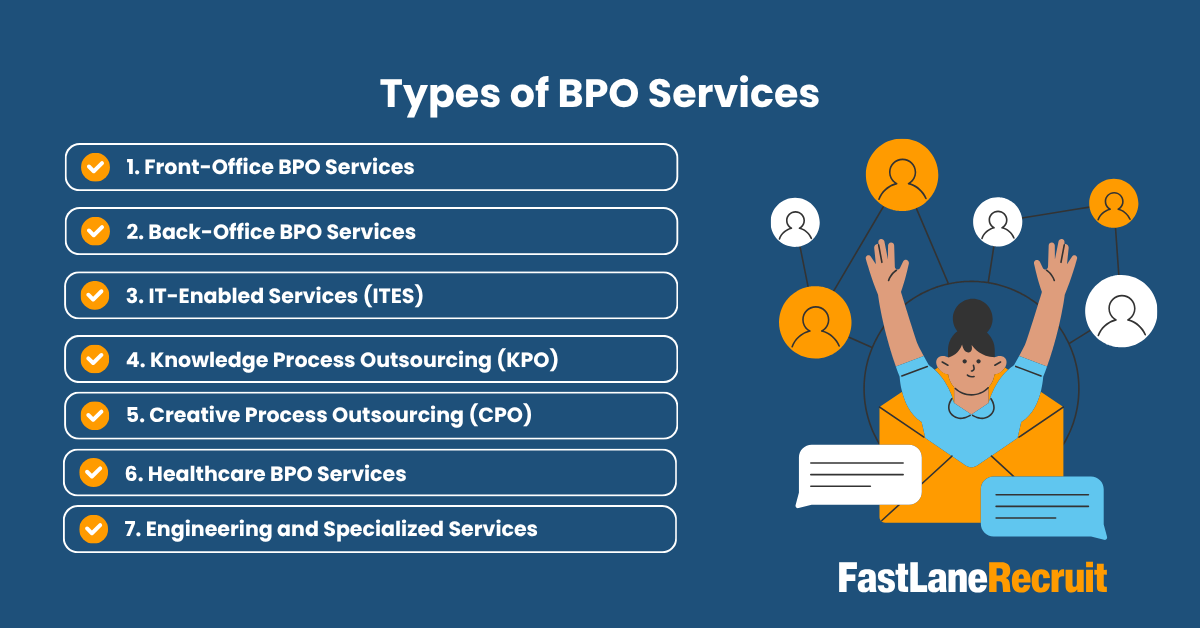
BPO services can be grouped into several categories based on function and specialization.
1. Front-Office BPO Services
These involve direct interaction with customers.
Examples:
- Customer support
- Sales support
- Live chat assistance
- Marketing and lead generation
These services help companies improve customer experience and engagement.
2. Back-Office BPO Services
These support internal business operations.
Examples:
- Payroll processing
- Human resources management
- Data entry and document processing
- Accounting and bookkeeping
Back-office services help improve operational efficiency and reduce administrative workload.
3. IT-Enabled Services (ITES)
These focus on technology-driven business support.
Examples:
- Technical support
- Software maintenance
- Network management
- Helpdesk services
4. Knowledge Process Outsourcing (KPO)
KPO involves high-skill, knowledge-based work requiring expertise and analysis.
Examples:
- Financial analysis
- Legal research
- Market research
- Data analytics
KPO is often used by companies needing strategic insights and advanced research capabilities.
Also Read: How to Hire an Offshore Accountant in Malaysia
5. Creative Process Outsourcing (CPO)
CPO focuses on creative and digital content services.
Examples:
- Graphic design
- Video editing
- Content writing
- Digital marketing campaigns
6. Healthcare BPO Services
These support healthcare organizations in administrative and operational tasks.
Examples:
- Medical billing
- Insurance claims processing
- Patient support services
7. Engineering and Specialized Services
Some companies also outsource technical and engineering tasks.
Examples:
- CAD design
- Structural engineering support
- 3D modeling
Types of BPO Based on Location
BPO services are also categorized based on where the service provider is located in relation to the client company. This is an important factor because location affects communication, cost structure, time zones, cultural alignment, and overall collaboration.
Choosing the right location model helps businesses balance efficiency, control, and operational convenience.
There are three main types: offshore, nearshore, and onshore BPO.
1. Offshore BPO
Offshore BPO refers to outsourcing business processes to a service provider located in a different country, often far away from the client’s home country.
This is one of the most commonly used BPO models globally.
Example:
A company based in the United States outsourcing customer support or back-office operations to countries in Asia such as the Philippines, India, or Malaysia.
Why businesses choose offshore BPO:
- Access to a large global talent pool
- Ability to scale teams quickly
- Availability of specialized skills in certain regions
- Operational flexibility across time zones
Key considerations:
Offshore outsourcing often requires managing:
- Time zone differences
- Cultural and communication differences
- Strong digital collaboration tools for coordination
Despite these challenges, offshore BPO remains popular because it allows companies to build large, skilled teams efficiently across global markets.
2. Nearshore BPO
Nearshore BPO means outsourcing business processes to a neighboring or nearby country, usually within the same or similar time zone.
Example:
A company in the United States outsourcing services to countries like Mexico or Canada.
Why businesses choose nearshore BPO:
- Easier communication due to similar working hours
- Better cultural alignment compared to distant regions
- Faster response times for collaboration and feedback
- Reduced travel and coordination complexity when in-person meetings are needed
Key considerations:
While nearshore outsourcing improves communication and convenience, the cost difference compared to offshore locations may be smaller. Businesses often choose this model when real-time collaboration is important.
Also Read: How to Build an Offshore Accounts Payable Team in Malaysia
3. Onshore (Domestic) BPO
Onshore BPO refers to outsourcing business processes to a service provider within the same country.
Example:
A company in New York outsourcing payroll services to a provider in California.
Why businesses choose onshore BPO:
- No time zone differences
- Easier communication and collaboration
- Strong alignment with local laws, regulations, and compliance requirements
- Easier quality control and supervision
Key considerations:
Onshore BPO offers the highest level of control and simplicity, but it may come with higher operating costs compared to offshore or nearshore options.
Simple comparison overview
| Type of BPO | Location | Key Strength | Common Use Case |
| Offshore BPO | Different country (far away) | Global talent access and scalability | Customer support, IT services, back-office operations |
| Nearshore BPO | Nearby country | Better communication and time zone alignment | Shared services, tech support, collaborative projects |
| Onshore BPO | Same country | Strong compliance and easy coordination | Finance, regulated industries, sensitive operations |
In simple terms
- Offshore BPO is about working with teams in distant countries to access global talent and efficiency.
- Nearshore BPO focuses on nearby countries for easier communication and smoother collaboration.
- Onshore BPO keeps everything within the same country for maximum control and regulatory alignment.
Each model serves different business needs, and companies often choose based on budget, complexity of work, and level of collaboration required.
Benefits of BPO Services
Business Process Outsourcing (BPO) services offer more than just task delegation. When used strategically, they can help businesses improve efficiency, reduce operational complexity, and scale more effectively across different markets.
Below are the key benefits explained in a clearer and more practical way:
1. Improved operational focus
One of the biggest advantages of BPO services is that they allow businesses to focus on what truly drives growth.
Instead of spending time on repetitive or administrative tasks, internal teams can concentrate on:
- Product development and innovation
- Sales and revenue growth
- Business strategy and expansion
- Customer experience and retention
For example, a software company that outsources payroll and IT support can dedicate more resources to improving its product rather than managing daily administrative work.
This shift in focus often leads to faster growth and better long-term decision-making.
2. Access to specialized talent
BPO services give companies access to professionals who already have the right skills, experience, and training for specific tasks.
Instead of spending months recruiting, onboarding, and training new employees, businesses can quickly tap into:
- Customer service specialists
- Finance and accounting experts
- IT and technical support teams
- Marketing and digital professionals
- Data analysts and researchers
This is especially useful for companies entering new industries or scaling quickly, where building an in-house team from scratch can take significant time and resources.
It also helps ensure that tasks are handled by people who specialize in that function, improving quality and consistency.
3. Operational efficiency
BPO providers are designed to handle specific processes at scale, which often leads to more efficient workflows compared to in-house teams managing multiple responsibilities.
They typically use:
- Established processes and SOPs
- Industry-standard tools and systems
- Trained teams focused on specific functions
- Continuous performance monitoring
As a result, businesses benefit from:
- Faster turnaround times
- Fewer operational errors
- More consistent output quality
- Better resource utilization
In many cases, outsourcing allows companies to improve service delivery without increasing internal workload.
Also Read: How to Hire an Offshore Operations Coordinator in Malaysia
4. Scalability
Scalability is one of the most important advantages of using BPO services.
Business needs are not always constant. Demand can increase during peak seasons or slow down during quieter periods.
With BPO services, companies can:
- Quickly scale teams up during high demand
- Reduce team size when workload decreases
- Avoid long-term hiring commitments for temporary needs
- Adjust operations without restructuring internal departments
For example, an e-commerce business may need additional customer support staff during holiday seasons. Instead of hiring permanent employees, they can scale their outsourced team temporarily.
This flexibility helps businesses stay agile and cost-efficient.
5. Global business expansion
BPO services also play a key role in helping companies expand into new international markets.
When entering a new country, businesses often face challenges such as:
- Language barriers
- Local regulations and compliance requirements
- Cultural differences in customer expectations
- Lack of local market knowledge
BPO providers help bridge these gaps by offering:
- Multilingual customer support
- Local market expertise
- Familiarity with regional business practices
- Time-zone coverage for global operations
For example, a company expanding into Southeast Asia can use a regional BPO partner to handle local customer support and ensure smoother market entry.
This reduces risk and allows companies to expand faster with better local alignment.
In summary
BPO services provide a combination of efficiency, flexibility, and strategic advantage. They help businesses:
- Focus on core growth activities
- Access skilled professionals quickly
- Improve operational performance
- Scale without heavy internal restructuring
- Expand into global markets more confidently
When used correctly, BPO becomes not just a cost-efficient solution but a long-term growth strategy for modern businesses.
Common Risks in BPO and How to Manage Them
While Business Process Outsourcing (BPO) services offer many advantages, they also come with certain risks that businesses should understand before outsourcing. The good news is that most of these risks can be effectively managed with the right planning, communication, and partner selection.
Below are the most common challenges and how companies typically handle them.
1. Data security concerns
When businesses outsource processes, they often need to share sensitive information such as customer data, financial records, employee details, or internal business systems. This naturally creates concerns around data security.
Potential risks:
- Unauthorized access to confidential information
- Data breaches or cyberattacks
- Improper handling of sensitive business data
- Differences in data protection laws across countries
How to manage it:
To reduce risk, companies should:
- Sign strong legal agreements such as NDAs (Non-Disclosure Agreements)
- Work only with providers that follow international security standards (such as ISO certifications)
- Ensure compliance with relevant regulations (for example GDPR for EU-related data)
- Use secure systems, encrypted communication tools, and restricted access controls
A reliable BPO provider should treat data protection as a core priority, not an afterthought.
2. Communication challenges
Since BPO providers may operate in different countries or time zones, communication can sometimes become a challenge.
Potential risks:
- Delayed responses due to time zone differences
- Misunderstanding of instructions or expectations
- Language or cultural differences affecting clarity
- Lack of real-time collaboration
How to manage it:
Businesses can improve communication by:
- Setting clear communication channels (email, Slack, Zoom, project tools)
- Establishing overlapping working hours where possible
- Providing detailed process documentation and SOPs
- Scheduling regular meetings and progress updates
- Using simple, structured instructions to avoid confusion
Strong communication practices are essential for smooth collaboration between internal teams and external providers.
3. Performance monitoring
Once outsourcing begins, businesses need to ensure that work is being delivered at the expected quality and within agreed timelines.
Potential risks:
- Inconsistent service quality
- Delays in task completion
- Lack of visibility into day-to-day performance
- Difficulty tracking productivity across remote teams
How to manage it:
Companies should establish clear performance measurement systems such as:
- Key Performance Indicators (KPIs)
- Service Level Agreements (SLAs)
- Regular performance reports and dashboards
- Quality assurance reviews and audits
It is also helpful to define measurable outcomes such as:
- Response time for customer support
- Accuracy of data entry
- Task completion deadlines
- Customer satisfaction scores
With clear metrics in place, performance becomes transparent and manageable.
4. Vendor dependency
Relying too heavily on a single outsourcing provider can create long-term operational risks.
Potential risks:
- Business disruption if the vendor faces issues
- Reduced flexibility in changing providers
- Over-dependence on one system or workflow
- Limited bargaining power over time
How to manage it:
To reduce dependency risk, businesses can:
- Diversify providers for different functions if needed
- Maintain internal documentation of all outsourced processes
- Ensure knowledge transfer is included in contracts
- Regularly review vendor performance and alternatives
- Avoid locking critical operations into a single vendor without exit planning
A balanced outsourcing strategy ensures that businesses remain flexible and in control.
In summary
BPO services can significantly improve business efficiency, but like any operational model, they require proper management.
By addressing key risks such as:
- Data security
- Communication gaps
- Performance tracking
- Vendor dependency
Companies can build a more stable and successful outsourcing strategy.
With the right structure in place, BPO becomes a reliable long-term solution rather than a potential operational risk.
Also Read: Recruitment Agencies in Malaysia: Guide to Local Recruitment
How to Choose the Right BPO Provider
When selecting a BPO service provider, businesses should evaluate:
| Factor | What to Look For |
| Experience | Industry expertise and track record |
| Security | Data protection and compliance standards |
| Communication | Clear reporting and responsiveness |
| Scalability | Ability to grow with your business |
| Cost structure | Transparent and predictable pricing |
| Technology | Use of modern tools and systems |
A strong BPO partner should act as an extension of your internal team rather than just an external vendor.
Why Businesses Use BPO Services Globally
Across industries and regions, Business Process Outsourcing (BPO services) has become an important part of how companies operate and grow. From startups to multinational corporations, outsourcing is no longer just about reducing workload; it is now a strategic approach to improving efficiency, accessing global talent, and staying competitive in rapidly changing markets.
As businesses expand internationally, they often face challenges such as rising operational complexity, talent shortages, and the need to deliver faster, more consistent services. BPO helps solve many of these challenges in a structured and scalable way.
Below are the key reasons why businesses continue to adopt BPO services worldwide:
- Improve service quality
- Reduce operational complexity
- Access global expertise
- Increase the speed of execution
- Maintain competitiveness in fast-changing markets
According to global outsourcing research, business process outsourcing continues to grow as companies prioritize agility and efficiency in their operations.
Also Read: When Should a Business Outsource Accounting?
Malaysia as an emerging BPO destination
In recent years, Malaysia has become an increasingly attractive location for Business Process Outsourcing services in Asia. Its strategic position in Southeast Asia, multilingual workforce, and strong digital infrastructure make it a competitive choice for global companies.
Why Malaysia is attractive for BPO services:
- Multilingual talent pool
Professionals in Malaysia often speak English, Malay, and other regional languages, making communication with global markets easier. - Strong digital economy support
Government initiatives such as the Malaysia Digital Economy Blueprint (MyDIGITAL) and support from agencies like the Malaysia Digital Economy Corporation (MDEC) continue to strengthen the country’s outsourcing ecosystem. - Skilled workforce in business services
Malaysia has a growing pool of professionals in finance, IT, customer service, and shared services operations. - Strategic location in Asia-Pacific
Its time zone and connectivity make it suitable for companies serving both Asian and Western markets.
Common outsourced functions in Malaysia include:
- Finance and accounting shared services
- Customer support and multilingual contact centers
- IT support and system management
- Human resource operations
Conclusion
Business Process Outsourcing has evolved far beyond traditional call centers. Today, it is a strategic business model that supports everything from customer service and finance to IT, marketing, and advanced analytics.
When implemented correctly, BPO services help companies streamline operations, access global talent, and scale efficiently while maintaining focus on core business growth.
However, choosing the right outsourcing model and partner is essential to ensure long-term success.
EOR in Malaysia: A Strategic Hiring Alternative to Traditional BPO
While traditional BPO services focus on outsourcing specific tasks or processes, many global companies are now adopting a more strategic model called Employer of Record (EOR).
FastLaneRecruit offers EOR services in Malaysia, allowing companies to hire full-time employees legally without setting up a local entity.
Why EOR is a strong alternative to traditional BPO:
- Full control over dedicated employees
- Simplified legal and payroll compliance
- Faster market entry in Malaysia
- Direct integration into your internal team
- Reduced administrative burden while maintaining workforce control
Unlike traditional BPO models where tasks are outsourced, EOR allows businesses to build and manage their own team in Malaysia while the EOR provider handles compliance, HR administration, and payroll responsibilities.
For companies looking to expand into Asia with more control and long-term stability, EOR in Malaysia through FastLaneRecruit provides a strategic and scalable workforce solution.
Ready to Build Your Team in Malaysia with More Control and Less Complexity?
If you are exploring ways to expand your global workforce beyond traditional outsourcing, Employer of Record (EOR) in Malaysia offers a more strategic and flexible approach. Instead of outsourcing tasks, you gain the ability to build your own dedicated team while staying fully compliant with local employment laws.
With FastLaneRecruit, you can hire and manage full-time employees in Malaysia without setting up a local entity, making it faster and easier to enter the market while maintaining full operational control.
Whether you are scaling operations, entering new Asian markets, or strengthening your regional presence, EOR gives you the structure to grow with confidence and stability.
Take the next step with FastLaneRecruit: Build your Malaysia team the smarter way, legally, efficiently, and with complete workforce control.
Connect with FastLaneRecruit today to explore how EOR in Malaysia can support your business expansion strategy.