

Hiring an independent contractor can give businesses access to specialized skills without building a permanent team. But contractors may also need access to sensitive information, including customer data, pricing, source code, financial information, product plans, intellectual property, and internal processes.
An NDA for contractors, or non-disclosure agreement, establishes clear confidentiality obligations around that information. It can help a business define what is confidential, how the information may be used, who can access it, and what happens when the contractor relationship ends.
For international engagements, however, an NDA is only one part of the picture. Businesses should also consider contractor classification, local requirements, the underlying services agreement, data protection obligations, payment arrangements, and whether the relationship is genuinely independent or should instead be structured as employment.
This guide explains what businesses should know before using an NDA for contractors and how to choose the appropriate workforce model.
Content Outline
Key Summary
An NDA protects confidential business information
A contractor NDA can establish contractual obligations regarding information such as trade secrets, customer data, financial information, software, product plans, pricing, and business strategies.
The NDA should be specific
A strong NDA should clearly define confidential information, permitted uses, exclusions, security obligations, duration, and what happens to information when the engagement ends.
An NDA is not a substitute for a contractor agreement
An NDA focuses primarily on confidentiality. The broader contractor agreement should address services, fees, deliverables, intellectual property, termination, status, and other commercial terms.
International contractors require additional consideration
The applicable law, data protection requirements, contractor classification rules, and enforceability of contractual provisions can vary by country.
Contractor management and EOR serve different purposes
A genuine independent contractor may require contractor management support, while a worker who should be an employee may be better suited to an Employer of Record (EOR) arrangement.
What Is an NDA for Contractors?
An NDA for contractors is a confidentiality agreement between a business and an independent contractor that establishes rules for protecting non-public information shared during an engagement.
The agreement generally restricts the contractor from using or disclosing confidential information except for the purpose for which it was provided.
For example, a software developer may receive access to:
- Source code and technical documentation
- Product roadmaps
- Customer information
- Internal systems
- Security procedures
- Pricing information
- Business plans
A marketing contractor may instead receive:
- Marketing strategies
- Campaign plans
- Customer lists
- Sales data
- Product launch information
- Brand materials
- Internal performance data
The NDA should reflect the actual information and access involved in the engagement rather than treating every piece of company information as confidential.
An NDA may be unilateral, where only the business is disclosing confidential information, or mutual, where both parties expect to exchange confidential information.
Why Do Independent Contractors Need an NDA?
Independent contractors often work outside the company’s normal employment structure and may work with multiple clients.
That makes it important to establish clear contractual expectations before providing access to sensitive information.
Protect confidential business information
An NDA can help protect information such as:
- Trade secrets
- Intellectual property
- Customer and supplier information
- Financial data
- Pricing models
- Product specifications
- Source code
- Business strategies
- Marketing plans
- Internal processes
Control how information is used
The agreement can specify that confidential information may only be used to perform the agreed services.
For example, a contractor hired to develop software may need access to source code but should not use that information for an unrelated project or disclose it to another client.
Establish post-engagement obligations
Confidentiality obligations may continue after the contractor relationship ends, subject to the applicable law and the terms of the agreement.
The NDA can also address the return or deletion of confidential materials when the engagement finishes.
Create clearer expectations
An NDA gives both parties a written understanding of what information is protected and how it should be handled.
This is particularly valuable when contractors work remotely or across multiple jurisdictions.
What Should an NDA for Contractors Include?
A contractor NDA should be tailored to the actual engagement. Common provisions include the following.
1. Identify the Parties
Clearly identify:
- The company’s legal name
- The contractor’s legal name or business entity
- Relevant addresses or registered details
- The effective date
- The relationship between the parties
Correct identification matters when maintaining contractual records or enforcing an agreement.
2. Define Confidential Information
The NDA should explain what qualifies as confidential information.
Depending on the engagement, this may include:
| Category | Examples |
| Business information | Strategies, plans, forecasts and operating procedures |
| Financial information | Budgets, pricing, revenue and financial projections |
| Customer information | Customer lists, account details and business requirements |
| Technical information | Source code, designs, systems and documentation |
| Product information | Roadmaps, specifications and unreleased features |
| Intellectual property | Proprietary processes, inventions and technical materials |
| Marketing information | Campaign plans, market research and launch strategies |
The definition should be sufficiently clear for the contractor to understand what they are expected to protect.
3. Define Permitted Use
The NDA should explain why the contractor is receiving the information.
For example:
Confidential information may be used only as necessary to perform the services agreed between the company and contractor.
This helps prevent confidential information from being used outside the intended project.
4. Include Confidentiality Exceptions
A well-structured NDA generally distinguishes confidential information from information that is already publicly available or otherwise legitimately known.
Common exclusions may include information that:
- Is already publicly available
- Was lawfully known before disclosure
- Was independently developed without using confidential information
- Was lawfully received from another source without a confidentiality obligation
- Must be disclosed under applicable law or legal process
The precise wording should be reviewed according to the applicable jurisdiction.
5. Address Data Security
If the contractor will access personal, customer, financial, payment, health, employee, or other regulated information, confidentiality alone may not be enough.
The engagement may also require specific data protection and security obligations.
Consider addressing:
- Access controls
- Password and authentication requirements
- Approved systems
- Device security
- Data storage
- Data transfers
- Security incident reporting
- Data deletion
Additional data-processing documentation may also be necessary depending on the information and jurisdiction.
6. Set the Confidentiality Period
The agreement should specify how long confidentiality obligations apply.
Some information may require protection for a defined period, while trade-secret protection may be subject to different legal treatment.
Avoid simply copying a standard duration into every contractor NDA. The appropriate period can depend on the information, engagement, and applicable law.
7. Address Return or Deletion of Information
When the engagement ends, the company should know what happens to its confidential information.
The NDA may require the contractor to:
- Return company documents
- Delete electronic copies
- Remove access to company systems
- Return company equipment
- Confirm deletion where appropriate
This should also align with the company’s data-retention and legal-record requirements.
8. Address Subcontractors and Third-Party Access
If the contractor is permitted to use subcontractors, the agreement should establish whether those individuals may access confidential information and what protections apply.
A contractor should not automatically be assumed to have unrestricted authority to share the company’s confidential information with another party.
9. Specify Governing Law and Dispute Resolution
Cross-border engagements can involve more than one jurisdiction.
The agreement may therefore address:
- Governing law
- Jurisdiction
- Dispute resolution
- Applicable courts or arbitration arrangements
However, selecting a governing law in a contract does not necessarily eliminate the impact of mandatory local laws. International agreements should be reviewed based on the jurisdictions involved.
Also Read: Hiring Contractors vs Employees: How to Determine Worker Classification Correctly
NDA vs Contractor Agreement: What’s the Difference?
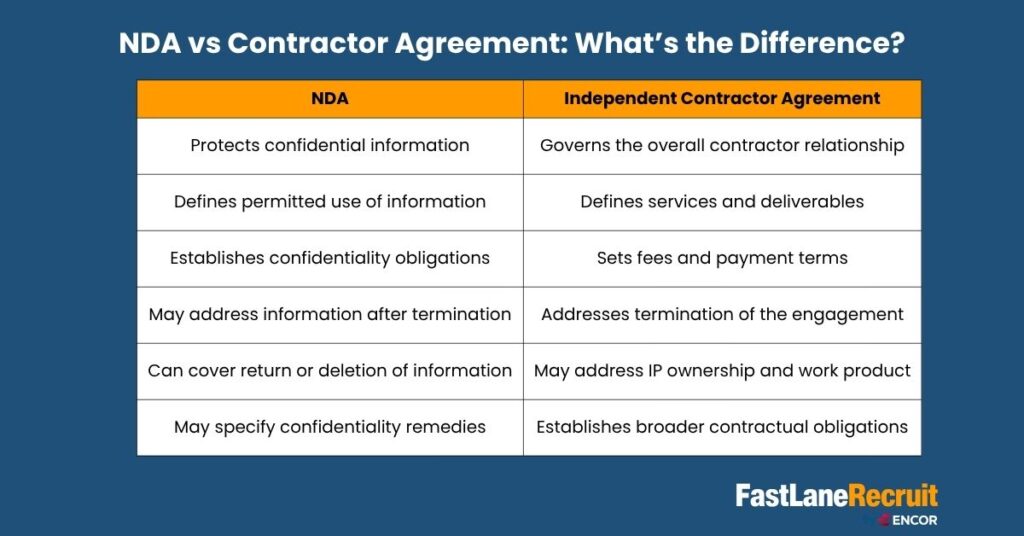
An NDA and an independent contractor agreement serve different purposes.
| NDA | Independent Contractor Agreement |
| Protects confidential information | Governs the overall contractor relationship |
| Defines permitted use of information | Defines services and deliverables |
| Establishes confidentiality obligations | Sets fees and payment terms |
| May address information after termination | Addresses termination of the engagement |
| Can cover return or deletion of information | May address IP ownership and work product |
| May specify confidentiality remedies | Establishes broader contractual obligations |
A contractor NDA can be a standalone document or confidentiality provisions can be incorporated into a broader contractor agreement.
The important point is that an NDA does not replace the underlying agreement governing the services.
The wider contractor agreement should address the commercial relationship, while the NDA should provide appropriate confidentiality protections.
NDA vs EOR: Which One Does Your Business Need?
An NDA answers a confidentiality question.
An EOR answers an employment and workforce-structure question.
They are therefore not substitutes.
Use an NDA when:
- A genuine independent contractor needs access to confidential information
- You need contractual confidentiality obligations
- The contractor is providing defined services
- The relationship remains genuinely independent
Consider contractor management or Contractor of Record support when:
- You engage contractors internationally
- You need support with contractor documentation
- Contractor onboarding and payment administration are becoming complex
- You need a more structured process for managing international contractor engagements
Consider EOR when:
- The worker should actually be an employee
- The business needs a local employment arrangement
- The company does not have its own entity in the worker’s country
- Local employment, payroll and statutory obligations need to be managed through an EOR structure
FastLaneRecruit distinguishes contractor arrangements from employment arrangements: contractor management is intended for genuine independent contractors, while EOR services support employees who need to be employed locally.
Also Read: When to Use an Employer of Record: 7 Signs Your Business Needs an EOR
When Should You Ask a Contractor to Sign an NDA?
In many situations, the safest operational approach is to establish confidentiality obligations before the contractor receives sensitive information.
This is particularly relevant when the contractor will access:
- Customer databases
- Source code
- Product roadmaps
- Financial information
- Pricing
- Business strategies
- Internal systems
- Proprietary processes
- Unreleased products
A practical onboarding workflow is:
Identify information → Determine access → Prepare agreement → Sign NDA → Grant appropriate access → Monitor and manage access → Offboard and retrieve/delete information
This connects the NDA to the company’s broader contractor-management process rather than treating it as an isolated document.
What Are Common Mistakes When Using Contractor NDAs?
Using a generic NDA without reviewing the engagement
A template may not reflect the contractor’s actual work, information access, or jurisdiction.
Defining everything as confidential
An overly broad definition may create uncertainty. The agreement should clearly communicate what information requires protection.
Forgetting post-engagement obligations
Confidentiality should not automatically end when the project ends if the business still has legitimate reasons to protect certain information.
Ignoring subcontractors
If contractors can delegate work, the business should understand who may access its confidential information.
Treating an NDA as a non-compete
An NDA primarily protects confidential information. It should not automatically be treated as a restriction preventing a contractor from working for other clients.
Ignoring worker classification
An NDA does not make someone an independent contractor.
Worker classification depends on the actual relationship and applicable local rules. If the business controls the relationship in a way that resembles employment, the company should assess whether an employment structure or EOR arrangement is more appropriate.
How International Contractor NDAs Differ
Hiring across borders adds another layer of complexity.
A contractor may be located in one country, the company may be incorporated in another, and confidential information may be stored or accessed in a third.
Businesses should therefore consider:
Local legal requirements
Contractual provisions may be interpreted differently depending on the relevant jurisdiction.
Data protection
If the contractor processes personal data, privacy and cross-border data-transfer requirements may apply in addition to confidentiality obligations.
Contractor classification
An NDA does not determine whether someone is legally an independent contractor.
The actual working relationship should be assessed against the applicable local framework.
Intellectual property
Where contractors create software, designs, content, inventions, or other work product, the business should separately consider appropriate IP ownership and assignment provisions.
Cross-border enforcement
A contract involving multiple countries should be reviewed for governing law, dispute resolution and practical enforceability.
For these reasons, international contractor agreements should not rely solely on a one-size-fits-all NDA template.
NDA for Contractors Checklist
Before giving an independent contractor access to confidential information, businesses should check:
- Both parties are correctly identified
- The project or purpose is clearly described
- Confidential information is properly defined
- Permitted use is established
- Appropriate exclusions are included
- Security obligations match the information being accessed
- Subcontractor access is addressed
- Confidentiality duration is established
- Return or deletion requirements are clear
- Governing law and dispute provisions have been considered
- IP ownership is addressed in the appropriate agreement
- Worker classification has been assessed
- Required data protection documentation is in place
- Signed agreements are securely retained
This checklist should be adapted to the actual engagement and applicable jurisdiction rather than treated as a universal legal template.
Why Businesses Choose FastLaneRecruit
Managing a single contractor can be straightforward. Managing contractors across several countries is different.
Businesses may need to coordinate contracts, onboarding, documentation, payments, classification considerations, local requirements and offboarding while maintaining consistent internal processes.
FastLaneRecruit provides international contractor management support for businesses working with independent contractors, including assistance with agreements, onboarding, payments, documentation and offboarding. Where a worker should be employed rather than engaged as an independent contractor, FastLaneRecruit also provides EOR solutions for eligible international employment arrangements.
Contractor Management for Genuine Independent Contractors
FastLaneRecruit can help businesses organize international contractor engagements while maintaining a structured approach to:
- Contractor documentation
- Onboarding
- Agreements
- Payment administration
- Contractor records
- Offboarding
- Country-specific requirements
The objective is not simply to process contractors. It is to help businesses establish a more organized international workforce process.
EOR for International Employees
If the working relationship is more appropriately structured as employment, FastLaneRecruit’s EOR model provides a different solution.
Through EOR, FastLaneRecruit can support the local employment process, including employment contracts, payroll, statutory requirements and related employment administration, allowing businesses to hire internationally without establishing their own local entity for each supported market.
Our Supported Markets
FastLaneRecruit supports international workforce arrangements across:
Malaysia, Singapore, Hong Kong, China, India, Philippines, Taiwan, Vietnam, Australia, United Kingdom, Switzerland, UAE, Saudi Arabia, Qatar
Availability and the appropriate workforce model can depend on the country, worker status and specific engagement.
Choose the Right Workforce Model Before You Hire
An NDA is an important part of protecting confidential information, but it should sit within a broader workforce and compliance strategy.
If you are engaging a genuine independent contractor:
Use an appropriate contractor agreement and confidentiality framework, and consider contractor management support when international administration becomes complex.
If the worker should be an employee:
Consider an EOR arrangement rather than attempting to structure the relationship as an independent contractor.
If you are unsure:
Assess the actual working relationship, country-specific requirements and intended engagement before deciding which model to use.
FastLaneRecruit can help businesses evaluate their international hiring requirements and determine whether contractor management or EOR services may be the more appropriate route.
Protect Your Business While Building Your Global Team
Hiring internationally should not mean choosing between flexibility and responsible workforce management.
Whether you are engaging an independent contractor for a specific project or building a long-term international team, the right structure can help you manage confidentiality, documentation, payments and local employment requirements more effectively.
Talk to FastLaneRecruit about your international workforce needs. Our team can help you explore contractor management and EOR options across supported markets and identify a practical hiring structure for your business.
For more precise local tax law, labor agreement, and legal advice, book a Free Consultation with our Experts.
Frequently Asked Questions About NDA for Contractors
What is an NDA for contractors?
An NDA for contractors is a confidentiality agreement that establishes how an independent contractor must handle confidential information received during a business engagement.
Do independent contractors need an NDA?
Not every contractor engagement requires a standalone NDA. However, an NDA or appropriate confidentiality provisions can be important when a contractor needs access to proprietary, sensitive, personal, technical, financial, or customer information.
Should a contractor sign an NDA before starting work?
Where confidential information will be shared, businesses generally benefit from establishing confidentiality obligations before providing access. The timing and legal requirements should be determined according to the engagement and applicable law.
Is a contractor NDA the same as a confidentiality agreement?
In most business contexts, the terms are used interchangeably. “NDA” means non-disclosure agreement, while “confidentiality agreement” describes the same general purpose: establishing contractual obligations around confidential information.
Can an NDA protect intellectual property?
An NDA can protect confidential information relating to intellectual property, but it does not necessarily determine who owns work created by a contractor. IP ownership should be addressed through appropriate contractual provisions.
Can an NDA stop a contractor from working for another company?
An NDA primarily protects confidential information and does not automatically prevent a contractor from working for another client. Any restriction on outside work or competition raises separate contractual and legal considerations and should be reviewed under applicable law.
Is an NDA enough when hiring an international contractor?
Usually, an NDA addresses only confidentiality. International contractor engagements may also require appropriate agreements, classification analysis, tax and payment processes, data protection measures, and local compliance considerations.
What happens if a contractor becomes an employee?
If the contractor relationship changes into an employment relationship, the business should review the contractual and workforce structure rather than relying on the original contractor arrangement.
Where an employee needs to be hired in a country where the business does not have its own entity, an EOR may provide a suitable employment structure, depending on the country and circumstances.