
Expanding into Portugal can give businesses access to skilled professionals without immediately building a permanent local workforce. For project-based work, specialist expertise, or an initial market test, working with an independent contractor can be a practical option.
However, an independent contractor arrangement is more than signing a service agreement and paying an invoice. Businesses need to consider the contractor’s legal status, registration, tax and Social Security obligations, invoicing requirements, and whether the actual working relationship remains genuinely independent.
For employers, the key question is not simply how to hire an independent contractor in Portugal, but whether an independent contractor is the right engagement model for the role.
This guide explains how independent contractor arrangements work in Portugal, what employers should consider before engaging a contractor, and when contractor management or an Employer of Record (EOR) may provide a more appropriate solution.
Content Outline
Key Summary
Independent contractors operate independently
In Portugal, a self-employed worker (trabalhador independente) carries out professional activity without being subject to an employment contract or an equivalent employment relationship. Independent activity can include professional and technical services, among other activities.
Registration and tax compliance matter
A contractor who regularly provides services generally needs to open their activity with the Portuguese Tax Authority (Finanças), select the appropriate activity classification, and comply with applicable tax and Social Security requirements.
Contractors have their own invoicing responsibilities
Independent contractors generally issue invoices or electronic receipts for their services and are responsible for meeting applicable tax obligations. VAT treatment depends on the activity, circumstances, and applicable exemption or taxation regime. For 2026, Portugal’s domestic VAT exemption threshold under Article 53 is €15,000 in annual turnover, subject to the applicable conditions.
Classification should reflect the actual relationship
Calling someone a contractor does not by itself make the arrangement independent. Employers should assess how the relationship operates in practice, including the contractor’s autonomy, responsibilities, working arrangements, and degree of dependence.
Contractor and EOR are different solutions
Contractor management is designed for genuine independent contractor relationships. An EOR is designed for employees who need to be employed locally. Choosing between the two should depend on the actual working relationship and the company’s long-term workforce requirements.
What Is an Independent Contractor in Portugal?
An independent contractor is a self-employed professional who provides services independently rather than working under an employment contract.
The Portuguese Social Security system describes self-employed workers as individuals carrying out professional activity without being subject to an employment contract or legally equivalent arrangement. Services can include scientific, literary, artistic, technical, commercial, and other professional activities.
The term trabalhador independente is commonly used in Portugal. A contractor may also operate as a freelancer or service provider, depending on the nature and structure of the activity.
For employers, the distinction between an employee and an independent contractor is important because the two models involve different responsibilities.
| Area | Independent Contractor | Employee |
| Relationship | Independent service relationship | Employment relationship |
| Contract | Service/contractor agreement | Employment contract |
| Work structure | Greater professional autonomy | Employer-directed work |
| Payment | Typically based on agreed services or fees | Salary/wages |
| Invoicing | Contractor generally invoices or issues applicable receipts | Employer processes payroll |
| Social Security | Contractor generally manages own contributions, subject to applicable rules | Employer manages employment-related contributions |
| Employment benefits | Not generally the same as employees | Governed by employment law and contract |
| Employer entity | May be possible without establishing a local employing entity, depending on the arrangement | Local employment structure required |
The practical distinction is therefore not simply what the contract says. Businesses should ensure that the working relationship genuinely reflects an independent service arrangement.
How to Set Up an Independent Contractor in Portugal
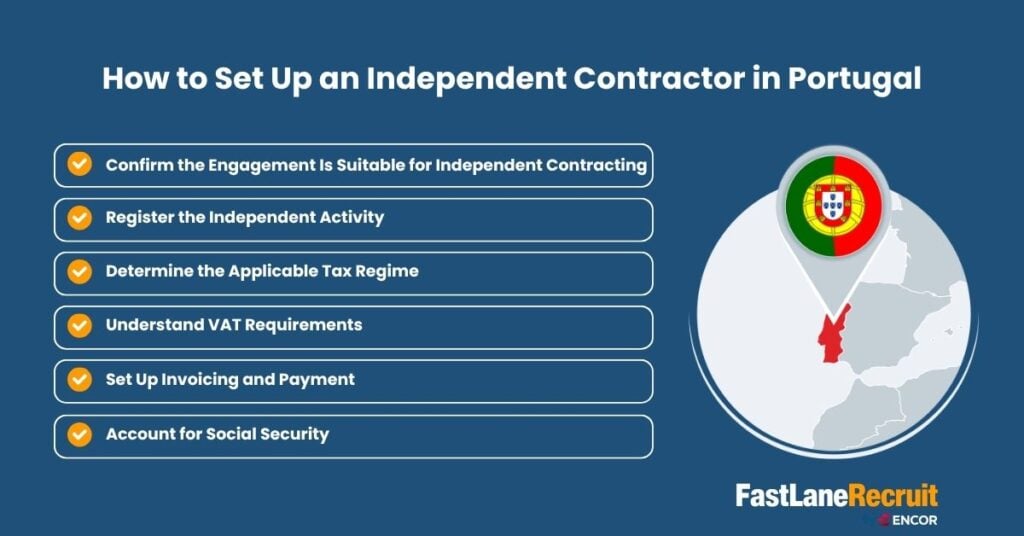
If a professional is genuinely operating as an independent contractor, several administrative and compliance steps may apply.
1. Confirm the Engagement Is Suitable for Independent Contracting
Before discussing registration or payment, determine whether the role can genuinely be performed as an independent service relationship.
Consider:
- Does the contractor control how the work is performed?
- Is the engagement based on defined services or deliverables?
- Does the individual operate an independent professional activity?
- Can the contractor exercise professional autonomy?
- Is the contractor responsible for their own business administration?
- Does the arrangement avoid characteristics normally associated with employment?
The more the business controls the person’s work as it would an employee, the more carefully the classification should be reviewed.
Employer decision point: If the role is effectively a full-time employee position, an employment model may be more appropriate than an independent contractor arrangement.
2. Register the Independent Activity
For regular independent activity, the contractor generally needs to open their activity with the Portuguese Tax Authority (Finanças).
The contractor must select the appropriate activity classification, including the relevant CAE or applicable professional classification. Portugal’s government guidance states that individuals carrying out more than an isolated act generally need to open activity with the Tax Authority.
The activity can generally be opened online through the Portal das Finanças or in person through the relevant tax services.
When activity is opened with the Tax Authority, information is communicated automatically to Social Security for the applicable registration process.
3. Determine the Applicable Tax Regime
Independent contractors need to understand how their professional income will be taxed.
Portugal provides different accounting and taxation arrangements, including:
- Simplified regime: commonly used by individuals starting independent activity, with taxation based on applicable income coefficients.
- Organised accounting: requires a certified accountant and is mandatory where estimated annual income exceeds the applicable €200,000 threshold, although individuals below that threshold may also choose it.
The appropriate regime depends on the contractor’s circumstances and professional activity.
4. Understand VAT Requirements
VAT treatment should be assessed before the contractor begins invoicing.
Portugal has different VAT rates and exemptions depending on the service, location, and applicable rules. For 2026, the Article 53 small-business exemption applies where annual turnover is below €15,000 and the other legal conditions are satisfied.
If the contractor is not exempt, VAT may need to be charged and subsequently reported to the Portuguese Tax Authority.
Employer consideration: The company’s finance team should confirm whether the contractor’s invoices contain the required information and whether VAT treatment is appropriate for the specific transaction, particularly for cross-border services.
5. Set Up Invoicing and Payment
Independent contractors generally need to issue the appropriate invoice, invoice-receipt, or electronic receipt for services provided.
The agreement should clearly establish:
- Scope of services
- Deliverables
- Fees and payment currency
- Payment schedule
- Invoice requirements
- Reimbursable expenses
- Payment method
- Intellectual property ownership
- Confidentiality
- Termination provisions
- Applicable law and dispute provisions
Clear documentation helps both parties understand their commercial responsibilities and reduces unnecessary payment disputes.
6. Account for Social Security
Independent contractors generally have their own Social Security obligations.
Portugal’s current Social Security guidance states that self-employed workers are responsible for their own contributions, with payments generally made monthly. The standard contribution rate for independent workers is currently 21.4%, with the contribution base calculated according to the applicable rules for relevant income.
There are also specific rules for economically dependent contractors and contracting entities.
This matters to employers because a company may have additional Social Security obligations in certain circumstances. Portuguese Social Security identifies a contracting entity as a person or company that, in the relevant year, obtains at least 50% of the independent worker’s total activity value; additional rules and thresholds determine whether a contribution becomes payable.
Businesses should therefore avoid assuming that an independent contractor relationship automatically means there are no employer-side compliance considerations.
How Do Independent Contractors Get Paid in Portugal?
Independent contractors are generally paid against invoices or applicable electronic receipts rather than through employee payroll.
A typical process is:
- The business and contractor agree on the scope and fee.
- The contractor performs the agreed services.
- The contractor issues the appropriate invoice or receipt.
- The business verifies the invoice.
- The business makes payment according to the agreed payment terms.
- The contractor handles applicable tax and Social Security obligations.
For international businesses, payment administration can become more complicated when multiple contractors operate across different currencies, countries, and compliance environments.
A structured contractor-management process can help centralise documentation, payment administration, onboarding, and offboarding.
Independent Contractor Taxes in Portugal
Tax obligations depend on the contractor’s circumstances, activity, income, VAT status, and tax regime.
Key areas can include:
IRS
Professional income from independent activity generally falls under Category B income for Portuguese personal income tax purposes.
VAT
The contractor must determine whether VAT applies to the services and whether an exemption is available.
For 2026, the Article 53 exemption threshold is €15,000 in annual turnover, subject to the relevant conditions.
Social Security
Independent workers generally have Social Security contribution obligations. Portugal’s current guidance states that contributions are generally paid monthly, with the payment window running from the 10th to the 20th of the month for the previous month’s contributions.
Cross-Border Services
Additional rules may apply where the contractor provides services to businesses in other EU countries or outside the EU. Portuguese government guidance specifically addresses reporting and VAT requirements for services supplied internationally.
Important: Tax treatment can depend on the contractor’s individual circumstances and the nature and location of the services. Employers should obtain Portuguese tax advice where the position is unclear.
What Employers Should Include in an Independent Contractor Agreement
A strong contractor agreement should establish a genuine commercial service relationship and clearly define the parties’ responsibilities.
Essential contract provisions
| Contract area | What to clarify |
| Scope of work | Services, deliverables and responsibilities |
| Fees | Rate, currency and payment schedule |
| Invoicing | Required documentation and invoice timing |
| Term | Start date, duration and renewal |
| Independence | Contractor’s professional autonomy |
| Confidentiality | Protection of business and client information |
| Intellectual property | Ownership and permitted use of work product |
| Data protection | Responsibilities for personal and business data |
| Expenses | Which expenses can be reimbursed |
| Termination | Notice and termination conditions |
| Liability | Responsibility for agreed obligations |
| Disputes | Applicable dispute-resolution mechanism |
A contract should accurately reflect the relationship in practice. A document that describes someone as an independent contractor while the actual working arrangement operates like employment can create classification risk.
How to Avoid Independent Contractor Misclassification in Portugal
Misclassification is one of the most important risks employers should assess before engaging an independent contractor.
Why classification matters
If a contractor relationship is found to function as an employment relationship, the business may face additional obligations relating to employment rights, taxes, Social Security, and other statutory requirements.
Businesses should therefore assess the actual working relationship, not rely solely on contractual terminology.
Contractor classification checklist
Before engaging a contractor, ask:
- Is the individual genuinely operating an independent business or professional activity?
- Are services defined around outputs, expertise, or agreed deliverables?
- Does the contractor have meaningful autonomy over how services are delivered?
- Does the business avoid unnecessary employee-style supervision?
- Is the contractor’s remuneration structured as service fees rather than employee salary?
- Does the contractor maintain the independence expected of a service provider?
- Does the written agreement accurately reflect the actual arrangement?
- Is the arrangement commercially appropriate for the role?
No checklist can determine classification in every situation. The facts and applicable Portuguese rules should be reviewed where there is uncertainty.
Independent Contractor vs EOR in Portugal: Which Is Right for Your Business?
This is often the most important decision for an international employer.
Choose independent contractor engagement when:
- The individual genuinely operates independently.
- The work is project-based or service-based.
- The contractor maintains professional autonomy.
- The relationship does not resemble employment.
- Your business needs specialist expertise without creating an employee position.
Consider an EOR when:
- The individual will function as a full-time employee.
- The business will exercise significant day-to-day control.
- The role is ongoing and integrated into the company’s organisation.
- You need a formal employment relationship.
- You want to hire without establishing your own local employing entity where an EOR is available.
- Contractor classification creates uncertainty or unnecessary compliance exposure.
Contractor vs EOR at a glance
| Consideration | Independent Contractor | EOR |
| Worker status | Independent professional | Employee |
| Engagement | Service relationship | Employment relationship |
| Best suited for | Genuine independent work | Ongoing employee roles |
| Payroll | Contractor manages own invoicing/payment process | EOR manages payroll |
| Employment benefits | Generally not employee benefits | Local employee benefits and statutory entitlements |
| Local entity | May not require client entity, depending on arrangement | EOR provides local employment structure |
| Compliance focus | Contractor classification and service relationship | Employment, payroll and statutory compliance |
| Best for | Projects, specialists and genuine independent services | Long-term or employee-like roles |
The key is to choose the model based on how the person will actually work, not simply which structure appears faster or cheaper.
Also Read: When to Use an Employer of Record: 7 Signs Your Business Needs an EOR
Can You Use Contractor Management Instead of an EOR?
Yes, when the worker is genuinely an independent contractor.
Contractor management and EOR solve different problems.
Contractor management supports the administration of genuine independent contractor relationships, which may include onboarding, agreements, documentation, invoicing, payments, and offboarding.
EOR is designed for employees. The EOR becomes the local legal employer while the client manages the employee’s day-to-day work and performance.
FastLaneRecruit supports both approaches as part of its international workforce solutions, helping businesses evaluate whether contractor management or EOR is more appropriate for the planned engagement.
How FastLaneRecruit Can Support Your Contractor Strategy
Managing an international contractor does not end when the agreement is signed.
FastLaneRecruit provides contractor management support for businesses working with international contractors, including assistance with onboarding, contractor agreements, documentation, invoicing, payment administration, and compliance-related processes, depending on the country and engagement arrangement.
For businesses that need an employee rather than an independent contractor, FastLaneRecruit’s EOR services provide a different workforce model. An EOR can employ the worker locally on behalf of the client while supporting employment contracts, payroll, statutory requirements, and ongoing employment administration.
This creates a practical decision path:
Genuine independent contractor → Contractor Management
Employee relationship → EOR
Uncertain classification → Review the engagement before proceeding
Why Businesses Choose FastLaneRecruit
Contractor and EOR support under one workforce strategy
Businesses do not always need the same engagement model for every country or role. FastLaneRecruit supports businesses with contractor management and EOR solutions so they can choose an approach based on the actual workforce requirement.
Structured contractor administration
We can support key contractor processes, including onboarding, contractual administration, documentation, invoicing, payment coordination, and related administration.
A practical alternative when employment is more appropriate
If a contractor relationship evolves into a full-time employee arrangement, FastLaneRecruit can support the transition to an EOR employment model where available.
Multi-market workforce support
FastLaneRecruit supports international workforce requirements across selected markets in Asia Pacific, Europe, and the Middle East & Africa, including:
Malaysia, Singapore, Hong Kong, China, India, Philippines, Taiwan, Vietnam, Australia, United Kingdom, Switzerland, UAE, Saudi Arabia, Qatar
This allows businesses to develop a broader workforce strategy rather than managing every country through disconnected providers.
Ready to Engage Talent in Portugal?
Choosing the right workforce model before hiring can help your business avoid unnecessary administrative complexity and reduce potential classification and compliance risks.
Whether you need to manage a genuine independent contractor or determine whether an EOR employment model is more appropriate, FastLaneRecruit can help you plan the right approach for your international workforce.
Talk to FastLaneRecruit about your contractor or EOR requirements and find the right hiring model for your business.
Book a Free Consultation with an Expert.
Frequently Asked Questions About Independent Contractors in Portugal
What is an independent contractor in Portugal?
An independent contractor, commonly referred to as a trabalhador independente, provides professional services independently rather than under an employment contract. Portuguese Social Security recognises independent professional activities including service provision and various professional and commercial activities.
How do I set up an independent contractor in Portugal?
For regular independent activity, the individual generally needs to open their activity with the Portuguese Tax Authority, select the appropriate activity classification and tax regime, and comply with applicable tax and Social Security obligations.
Do independent contractors in Portugal pay tax?
Yes. Independent professionals generally have tax obligations on their professional income, including IRS requirements. VAT may also apply depending on the activity and applicable exemption or taxation rules.
Do independent contractors in Portugal pay Social Security?
Generally, yes. Independent workers have their own Social Security contribution obligations, subject to applicable exemptions and special circumstances. The current standard contribution rate for independent workers is 21.4%, with the contribution base determined under the applicable rules.
Can a foreigner work as an independent contractor in Portugal?
The requirements depend on nationality and immigration status. Portuguese government guidance states that third-country nationals generally need an appropriate visa or residence authorisation to carry out independent activity in Portugal.
What are “recibos verdes”?
“Recibos verdes” are electronic receipts used by independent professionals in Portugal to document income from services. They form part of the administrative and tax framework for independent activity.
Does hiring an independent contractor mean my company has no Portuguese compliance obligations?
Not necessarily. Depending on the relationship and the contractor’s economic dependence on the business, a company may have obligations as a contracting entity under Portuguese Social Security rules.
Should I hire a contractor or employee in Portugal?
It depends on the actual role. Independent contracting may be suitable for genuinely independent, project-based or specialist services. If the individual will work as an integrated, ongoing employee under the company’s direction, an employment model may be more appropriate.
Can an EOR replace an independent contractor arrangement?
An EOR is not simply a substitute for every contractor. It is an employment model. If the worker should properly be an employee, an EOR can provide a local employment structure without requiring the client to establish its own local entity, where the EOR supports that jurisdiction.
Can FastLaneRecruit help me decide between contractor management and EOR?
Yes. FastLaneRecruit supports both contractor management and EOR solutions. We can help businesses assess the intended workforce arrangement and determine which service may be more appropriate based on the role, engagement structure, country, and business requirements.