
Hiring an independent contractor in the Netherlands can give businesses access to specialised talent without immediately establishing a local entity. But the flexibility of contracting comes with an important responsibility: the working relationship must genuinely operate as an independent engagement.
For employers, the question is therefore bigger than how to onboard an independent contractor in the Netherlands. You also need to determine whether the arrangement is genuinely independent, understand the registration and tax considerations, document the engagement properly, and know when an employment model may be more appropriate.
This guide explains the key steps, compliance considerations, and decision points for businesses hiring contractors in the Netherlands, including when an Employer of Record (EOR) may provide a more suitable route.
Content Outline
Key Summary
An independent contractor must genuinely operate independently
In the Netherlands, calling someone a contractor does not by itself make them self-employed. The actual working relationship matters, including how the work is organised and performed. Dutch authorities can assess whether an arrangement is really an employment relationship.
ZZP is not a legal business structure
The term ZZP’er (zelfstandige zonder personeel) generally describes a self-employed professional without employees. It is not itself a legal form. A contractor may, for example, operate through a sole proprietorship (eenmanszaak) or another legal structure.
Registration and tax obligations matter
A contractor starting a business in the Netherlands generally needs to consider registration with the Netherlands Chamber of Commerce (KVK), VAT, income tax, business records, and other obligations relevant to their activities. KVK passes registration details to the Netherlands Tax Administration (Belastingdienst).
Contractor classification is an employer concern too
Businesses engaging contractors share responsibility for ensuring that the relationship is genuinely independent. A contractor agreement alone cannot eliminate the risk if the practical working relationship resembles employment.
EOR can be the better option when the role is actually employment
If the person will work as an integrated member of your team under an employment relationship, an EOR can provide a compliant employment structure without requiring your business to establish its own Dutch employing entity.
What Is an Independent Contractor in the Netherlands?
An independent contractor in the Netherlands is a self-employed professional who provides services to a client independently rather than entering into an employment relationship with that client.
The Dutch term ZZP’er is commonly used for a self-employed professional without employees. However, ZZP is a description of a working status rather than a legal business structure.
A genuine contractor relationship will generally involve meaningful independence in how the services are delivered.
Independent Contractor vs Employee
| Factor | Independent Contractor | Employee |
| Working relationship | Independent service relationship | Employment relationship |
| Control | Greater autonomy over how work is performed | Employer directs and supervises work |
| Business risk | Contractor generally carries business risk | Employer generally carries employment risk |
| Payment | Usually invoices for services | Paid through payroll |
| Benefits | Generally not entitled to employee benefits as an employee | Covered by applicable employment protections |
| Business administration | Contractor manages business records and tax affairs | Employer handles payroll administration |
| Other clients | Independence and ability to serve other clients can support contractor status | Exclusivity may be more characteristic of employment |
| Compliance responsibility | Contractor and client must structure the relationship appropriately | Employer is responsible for employment obligations |
The distinction is based on the substance of the relationship, not simply the label used in the contract.
How to Set Up an Independent Contractor in the Netherlands
For employers, setting up a contractor relationship should begin before the first invoice is issued. The engagement should be assessed from both a contractual and operational perspective.
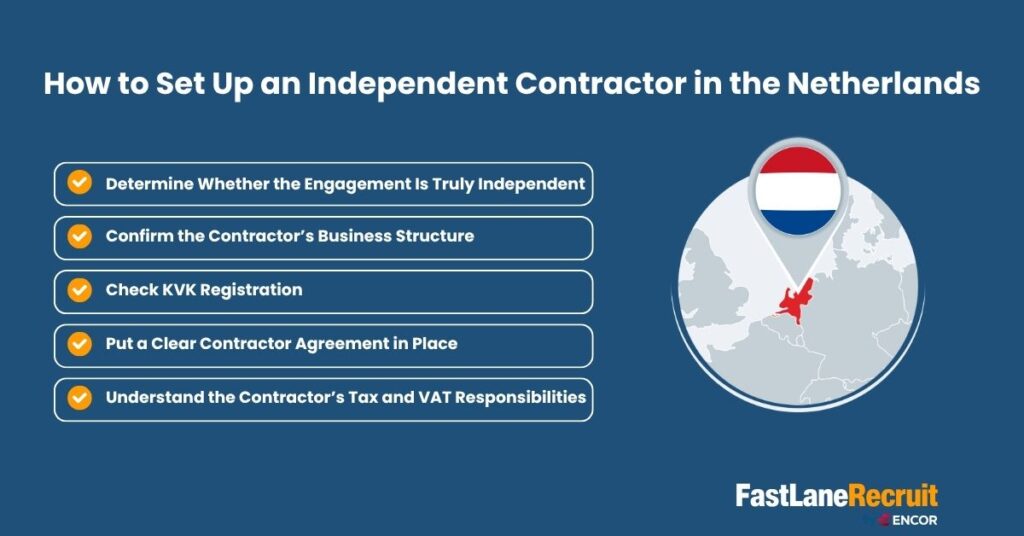
1. Determine Whether the Engagement Is Truly Independent
Start by reviewing the proposed working arrangement.
Consider:
- Who determines how the work is performed?
- Does the contractor have meaningful autonomy?
- Can the contractor determine how and when services are delivered?
- Does the contractor operate as an independent business?
- Does the contractor work for multiple clients where appropriate?
- Who provides the tools and resources?
- Is the contractor taking genuine business risk?
- Is the individual integrated into your organisation like an employee?
- Does the engagement involve ongoing employee-like supervision?
The Dutch authorities focus on the actual relationship rather than relying solely on the wording of a contract.
Employer consideration: If the role requires fixed employee-style supervision, integration into your organisation and ongoing direction over how the work is performed, reassess whether an employment arrangement is more appropriate.
2. Confirm the Contractor’s Business Structure
A ZZP’er is not a specific legal form.
Many self-employed professionals operate as a sole proprietorship (eenmanszaak), although other structures may be possible depending on the individual’s circumstances. The chosen structure affects matters such as registration, taxation and liability.
As an employer, verify the contractor’s business details and ensure the contracting party is clearly identified in your agreement.
3. Check KVK Registration
Businesses operating in the Netherlands generally need to consider registration in the KVK Business Register.
For applicable businesses, KVK passes registration information to the Netherlands Tax Administration. The contractor may subsequently receive information about their VAT registration and tax obligations.
For an employer onboarding a Dutch contractor, useful documentation can include:
- Legal/business name
- KVK registration details
- VAT identification details where applicable
- Business address
- Contracting entity
- Scope of services
- Invoicing information
- Relevant insurance information
4. Put a Clear Contractor Agreement in Place
A written agreement should clearly describe the commercial relationship.
Depending on the engagement, it should address:
- Services and deliverables
- Fees and invoicing
- Payment terms
- Project or engagement period
- Intellectual property
- Confidentiality
- Data protection
- Liability
- Insurance
- Termination provisions
- Substitution or subcontracting arrangements where relevant
- Responsibilities of each party
However, the contract should reflect how the relationship actually works.
Important: A contract describing someone as an independent contractor does not automatically prevent an employment relationship from being found if the engagement operates like employment in practice.
5. Understand the Contractor’s Tax and VAT Responsibilities
Independent contractors generally manage their own business administration and tax affairs.
Depending on the circumstances, this can include:
- Income tax
- VAT
- Invoicing
- Business expense records
- Accounting records
- VAT returns
- Income tax returns
Business.gov.nl notes that entrepreneurs may need to file income tax and VAT returns and maintain business records that support their tax reporting. VAT treatment can also depend on the nature of the service and where the customer is located.
For employers: Do not assume that calling an individual a contractor automatically removes all Dutch payroll or employment-related exposure. Classification should be assessed separately from invoicing and VAT arrangements.
What Is the Wet DBA and Why Does It Matter to Employers?
The Wet Deregulering Beoordeling Arbeidsrelaties (Wet DBA) is central to the Netherlands’ approach to assessing employment relationships.
The key issue is whether a person who is presented as self-employed is actually working under conditions that amount to employment.
Dutch government guidance specifically warns businesses about false self-employment, where a person is formally engaged as a freelancer but the circumstances indicate an employment relationship.
Why Contractor Classification Matters
A contractor arrangement can become higher risk when the individual:
- Works under extensive day-to-day direction
- Is closely integrated into the client’s organisation
- Performs work in a way similar to employees
- Has limited entrepreneurial independence
- Has little meaningful control over how services are delivered
- Is effectively treated as part of the regular workforce
The exact assessment depends on the circumstances of the relationship.
Enforcement Has Become More Important
The Dutch Tax Administration’s enforcement moratorium ended on 1 January 2025, meaning businesses should not treat contractor classification as a low-priority compliance issue. Current guidance continues to emphasise the importance of assessing the real working relationship.
For employers engaging contractors in 2026, this means classification should be considered before onboarding and throughout the engagement, particularly when responsibilities, supervision or working arrangements change.
How Can Employers Reduce Independent Contractor Compliance Risks?
A strong contractor compliance process should continue after the contract is signed.
Review the relationship before engagement
Ask whether the proposed role genuinely requires an independent business relationship or whether the business actually needs an employee.
Define deliverables rather than employee-style duties
Where appropriate, structure the engagement around:
- Defined services
- Deliverables
- Project objectives
- Commercial terms
- Milestones
- Contractor autonomy
Preserve genuine independence
The practical working environment should remain consistent with the independent relationship.
Avoid creating an arrangement that looks like ordinary employment simply because the contract uses contractor terminology.
Review long-term engagements
A contractor relationship that changes substantially over time should be reassessed.
For example, a project-based specialist may gradually become:
- Permanently embedded in one team
- Managed like an employee
- Subject to fixed employee-style hours
- Performing the same ongoing function as internal employees
- Dependent on one client
These changes can create a reason to reconsider the appropriate engagement model.
Can a Foreign Company Hire an Independent Contractor in the Netherlands?
Yes, a foreign business may engage a contractor in the Netherlands, but the cross-border nature of the arrangement does not remove the need to assess Dutch requirements.
The business should consider:
- Where the contractor is resident
- Where services are performed
- Contractor business registration
- VAT treatment
- Tax responsibilities
- Applicable contractual rules
- Worker classification
- Immigration or work-right requirements where relevant
- Potential employment or permanent-establishment considerations
For cross-border services, VAT treatment can vary according to whether the customer is a business or private individual and where the customer is established.
Practical takeaway: A foreign company should not assume that paying a Dutch contractor against an invoice automatically makes the relationship compliant.
Also Read: Employer of Record in the US: Complete Guide to Hiring Without a Legal Entity
When Should You Use an Independent Contractor Instead of an EOR?
This is one of the most important decisions for an employer expanding into the Netherlands.
An Independent Contractor May Be Appropriate When:
A contractor model may make sense when:
- The work is genuinely independent
- The engagement is project-based or assignment-based
- The contractor controls how the services are delivered
- The individual operates an independent business
- The relationship does not resemble employment
- The commercial arrangement is appropriately documented
An EOR May Be More Appropriate When:
Consider an Employer of Record when:
- The worker will function as an employee
- You want to hire a full-time team member
- The worker will be integrated into your organisation
- You need an employment contract rather than a service agreement
- You do not have a Dutch employing entity
- You want support with local payroll and employment administration
- You need a compliant route to hire before establishing your own entity
An EOR becomes particularly relevant when the company’s operational needs and the worker’s actual relationship no longer fit genuine independent contracting.
Also Read: When to Use an Employer of Record: 7 Signs Your Business Needs an EOR
Independent Contractor vs EOR in the Netherlands
| Consideration | Independent Contractor | EOR |
| Legal relationship | Independent service relationship | Employment relationship through EOR |
| Worker status | Self-employed | Employee |
| Local entity required for client | Generally not necessarily | EOR provides the local employment structure |
| Payroll | Contractor manages own tax/payment administration | EOR manages employment payroll |
| Employee benefits | Not provided as an employee | Administered according to applicable employment terms |
| Employer compliance | Client must assess classification and engagement | EOR manages the local employment framework |
| Best suited for | Genuine independent/project work | Employees and ongoing roles |
| Main consideration | Correct classification | Correct employment setup |
| Scalability | Useful for genuinely independent engagements | Useful for expanding employee teams without immediate entity setup |
Decision rule: If you need an independent business to deliver a defined service, contractor engagement may be appropriate. If you need an employee to work as part of your organisation, an EOR is usually the more relevant model.
When Should a Business Move From Contractor to EOR?
A contractor-to-EOR transition may be worth considering when the nature of the role changes.
Look for signals such as:
- The contractor becomes a long-term core team member.
- Your managers increasingly direct the individual’s daily work.
- The person works primarily or exclusively for your business.
- The role becomes part of your normal organisational structure.
- You need employee benefits or formal employment protections.
- You want a stable full-time workforce in the Netherlands.
- The contractor relationship is becoming difficult to distinguish from employment.
- You want a more structured payroll and HR process.
The objective should not be to use an EOR simply to avoid contractor rules. The objective is to choose an employment model that accurately reflects the actual relationship.
How FastLaneRecruit Can Support Independent Contractor and EOR Hiring
Expanding into the Netherlands does not have to mean choosing between speed and compliance.
FastLaneRecruit can support businesses evaluating the right workforce model, whether the requirement is a genuinely independent contractor engagement or an employee relationship that is better suited to an EOR solution.
Independent Contractor Support
Where an independent contractor model is appropriate, FastLaneRecruit can help businesses navigate the practical requirements involved in engaging international talent and managing contractor relationships.
This can help employers establish a more structured approach to:
- Contractor onboarding
- Engagement documentation
- Contractor payments
- Workforce administration
- Cross-border hiring processes
- Contractor-to-employee considerations
Employer of Record Services
When the role should be structured as employment, FastLaneRecruit’s EOR model provides a route to hire without requiring the client to immediately establish its own local employing entity.
Our EOR services can support areas such as:
- Local employment arrangements
- Employment contracts
- Payroll administration
- Statutory compliance
- Employee onboarding
- Benefits administration
- Ongoing HR support
- Offboarding
This allows your business to focus on managing the employee’s role and performance while FastLaneRecruit supports the employment administration.
Why Businesses Choose FastLaneRecruit
International hiring becomes more complex when every country requires a different approach to employment, payroll and compliance.
FastLaneRecruit provides workforce solutions across: Malaysia, Singapore, Hong Kong, China, India, Philippines, Taiwan, Vietnam, Australia, United Kingdom, Switzerland, UAE, Saudi Arabia, Qatar
This multi-market coverage can be particularly useful for companies hiring across several jurisdictions and looking for a consistent partner for international workforce management.
One Partner for Different Hiring Needs
Your workforce strategy may change as your business grows.
You may begin with:
Independent contractor
↓
Contractor management
↓
Need for a permanent employee
↓
EOR employment
↓
Potential local entity
FastLaneRecruit can help businesses evaluate the appropriate route at different stages rather than forcing every hire into the same model.
Netherlands Contractor Hiring: Employer Checklist
Before engaging an independent contractor, confirm the following:
Worker classification
- Is the individual genuinely independent?
- Does the working arrangement reflect contractor status?
- Have you assessed potential false self-employment risk?
Business verification
- Is the contractor’s business properly registered where required?
- Have you verified relevant KVK and VAT details?
- Is the contracting entity clearly identified?
Contract
- Are services and deliverables clearly defined?
- Are fees and payment terms documented?
- Are confidentiality and IP provisions addressed?
- Are liability and termination terms clear?
Operational relationship
- Does the contractor retain meaningful autonomy?
- Is the contractor being managed like an employee?
- Does the practical relationship match the written agreement?
Ongoing compliance
- Will the relationship be reviewed if circumstances change?
- Is the engagement still genuinely independent?
- Would an EOR or employment model now be more appropriate?
Choose the Right Netherlands Hiring Model
Setting up an independent contractor in the Netherlands is not simply a matter of signing an agreement and receiving invoices. The most important question is whether the actual relationship supports genuine self-employment.
For project-based and genuinely independent work, contractor engagement can provide flexibility. For roles that function as employment, continuing to classify the worker as a contractor can create unnecessary compliance exposure.
If you are expanding into the Netherlands and are unsure whether to engage a contractor, convert an existing contractor to employment, or use an Employer of Record, FastLaneRecruit can help you evaluate the right route.
Talk to FastLaneRecruit
Planning to hire in the Netherlands?
Get expert support for your contractor and EOR hiring strategy. FastLaneRecruit can help you build a compliant, practical workforce solution without adding unnecessary complexity to your international expansion.
Book a Free Consultation with an Expert and discuss your Netherlands hiring requirements with FastLaneRecruit.
Frequently Asked Questions About Independent Contractors in the Netherlands
What is an independent contractor called in the Netherlands?
A self-employed professional without employees is commonly referred to as a ZZP’er, short for zelfstandige zonder personeel. However, ZZP is not itself a legal business structure.
Do independent contractors in the Netherlands need to register with KVK?
Businesses that meet the relevant registration requirements generally register with the Netherlands Chamber of Commerce (KVK). KVK then passes the registration information to the Netherlands Tax Administration.
Can a foreign company hire an independent contractor in the Netherlands?
A foreign company can engage a Dutch contractor, but it should assess the contractor’s business status, VAT and tax considerations, the location where services are performed, and whether the relationship is genuinely independent.
What is false self-employment in the Netherlands?
False self-employment occurs when someone is formally engaged as a freelancer or contractor but the actual relationship has the characteristics of employment. Dutch guidance warns both clients and contractors to ensure that the relationship is genuinely independent.
Is the contractor agreement enough to prove independent status?
No. The contract is important, but the actual working relationship also matters. If the day-to-day arrangement operates like employment, simply describing the individual as a contractor does not remove the classification risk.
When should I use an EOR instead of an independent contractor?
An EOR may be more appropriate when the worker will function as an employee, particularly when they are integrated into your organisation, receive ongoing direction from your managers and perform an ongoing role rather than an independent service assignment.
Can FastLaneRecruit help with contractor and EOR hiring?
Yes. FastLaneRecruit supports businesses with international workforce solutions, including independent contractor support and Employer of Record services. If you are unsure which model fits your Netherlands hiring plans, we can help you evaluate the appropriate approach.
Can I hire in the Netherlands without establishing a local company?
An EOR can provide a local employment structure for eligible hires without requiring your business to establish its own Dutch employing entity immediately. Whether contractor engagement, EOR or entity establishment is appropriate depends on the actual workforce model and business requirements.