
Hiring independent contractors can give businesses access to specialized talent without creating a traditional employment relationship. But once contractors work across borders, the arrangement can become more complex: contracts, payments, worker classification, tax obligations, documentation, and local requirements can all vary by jurisdiction.
Understanding what an independent contractor is, how the relationship differs from employment, and when a contractor arrangement may no longer be appropriate can help businesses choose the right workforce model.
Content Outline
Key Summary
An independent contractor is not an employee
An independent contractor is generally a self-employed individual or business that provides services to a client under a commercial arrangement rather than an employment relationship. The contractor typically has greater independence over how the work is performed. However, the legal classification depends on the actual working relationship, not simply the title used in a contract. For example, the IRS considers factors involving behavioral control, financial control, and the type of relationship when determining U.S. worker status.
A contractor agreement defines the relationship
An independent contractor agreement normally sets out the scope of services, deliverables, payment terms, responsibilities, confidentiality, intellectual property, termination terms, and other conditions.
Contractor taxes depend on the country
There is no single worldwide independent contractor tax rate. Tax treatment can depend on the contractor’s country, tax residence, business structure, income, and the nature and location of the services.
For example, in the United States, independent contractors are generally treated as self-employed and may have self-employment tax and income-tax obligations.
Contractor or employee is a business decision with compliance implications
A contractor model may work well when the individual genuinely operates independently. If the business controls the person’s work in a way that resembles employment, an employee arrangement may be more appropriate.
For international employees, an Employer of Record (EOR) can provide an employment structure in supported countries without requiring the client to establish its own local employing entity.
What Is an Independent Contractor?
An independent contractor is a self-employed person or business engaged to provide specific services to another organization without becoming its employee.
Contractors commonly provide professional, technical, creative, consulting, project-based, or specialized services. Depending on the engagement, they may work with multiple clients, determine how they complete their work, use their own equipment or resources, and invoice the client for agreed services.
The defining issue, however, is independence.
A business should not rely solely on the label “independent contractor.” Worker-classification rules generally examine the substance of the relationship, including the degree of control and independence involved. The IRS, for example, states that classification depends on the facts and circumstances rather than simply how the worker is paid or what the contract calls them.
Common characteristics of an independent contractor
| Factor | Independent contractor |
| Relationship | Commercial/service relationship |
| Control | Generally greater independence over how work is performed |
| Payment | Often paid by project, milestone, hour, or agreed fee |
| Benefits | Usually does not receive employee benefits from the client |
| Equipment | May provide their own tools or resources |
| Clients | May work with multiple businesses |
| Taxes | Generally responsible for their own tax obligations |
| Agreement | Services and commercial terms are documented in a contractor agreement |
These characteristics are general indicators, not a universal legal test. Requirements differ by country and sometimes by state, province, or employment regime.
What Is an Independent Contractor vs Employee?
The difference between an independent contractor and an employee primarily concerns the nature of the working relationship and the degree of control and independence.
An employee generally works within an employment relationship in which the employer has greater rights to direct how the work is performed. An independent contractor generally provides services as an independent business or professional.
In the U.S., the IRS considers behavioral control, financial control, and the type of relationship when determining classification.
Independent Contractor vs Employee: Key Differences
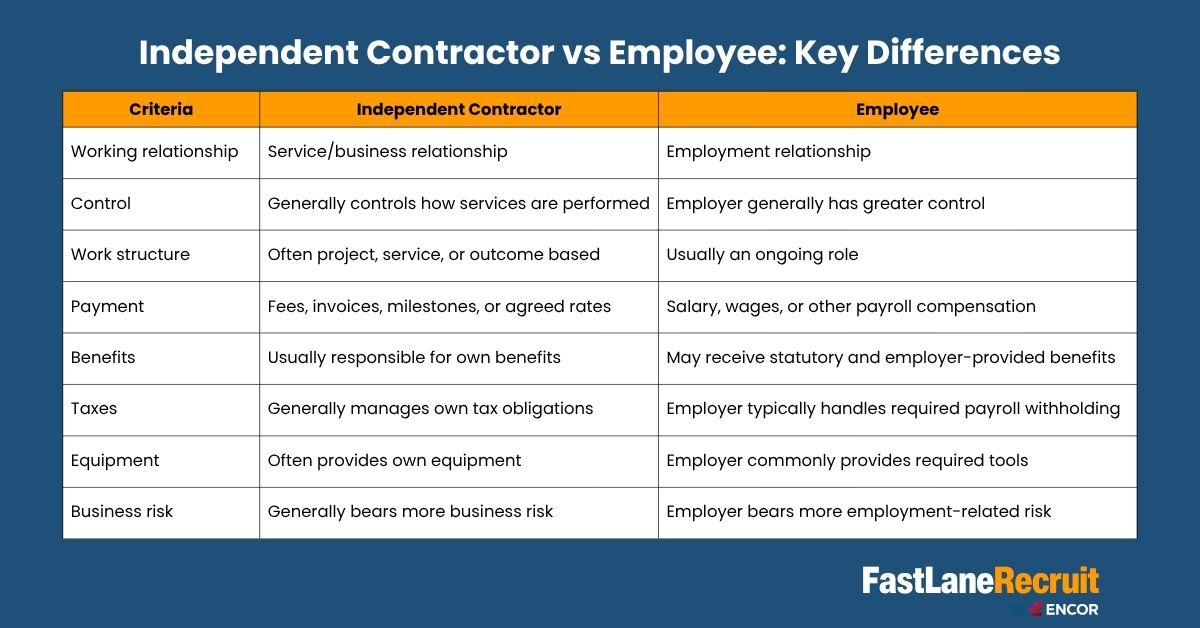
| Criteria | Independent Contractor | Employee |
| Working relationship | Service/business relationship | Employment relationship |
| Control | Generally controls how services are performed | Employer generally has greater control |
| Work structure | Often project, service, or outcome based | Usually an ongoing role |
| Payment | Fees, invoices, milestones, or agreed rates | Salary, wages, or other payroll compensation |
| Benefits | Usually responsible for own benefits | May receive statutory and employer-provided benefits |
| Taxes | Generally manages own tax obligations | Employer typically handles required payroll withholding |
| Equipment | Often provides own equipment | Employer commonly provides required tools |
| Business risk | Generally bears more business risk | Employer bears more employment-related risk |
Why the distinction matters
Misclassifying an employee as an independent contractor can create tax, employment, and regulatory exposure.
The IRS states that if a business incorrectly treats an employee as an independent contractor without a reasonable basis, it may become liable for employment taxes.
For international hiring, the consequences can extend beyond payroll taxes. Businesses may also need to consider local employment protections, social contributions, statutory benefits, termination rules, and other country-specific requirements.
Decision point: If the worker functions like an employee, changing the label on the agreement may not solve the underlying classification issue.
What Is an Independent Contractor Agreement?
An independent contractor agreement is a written contract between a business and an independent contractor that defines the services, commercial terms, responsibilities, and conditions of the engagement.
A well-structured agreement helps both parties understand what is being delivered, how payment works, who owns the resulting work, and how the relationship can be changed or terminated.
What should an independent contractor agreement include?
Depending on the engagement and jurisdiction, a contractor agreement may cover:
1. Scope of work
Clearly define the services, responsibilities, deliverables, and expected outcomes.
2. Payment terms
Specify the fee, currency, invoicing process, payment schedule, milestones, and reimbursable expenses.
3. Term and termination
State when the engagement begins, how long it is expected to continue, and the circumstances under which either party can end it.
4. Confidentiality
Protect confidential business, customer, technical, financial, and commercial information.
5. Intellectual property
Clarify ownership and permitted use of work created during the engagement.
6. Independent status
Document the intended contractor relationship and relevant responsibilities, while recognizing that the agreement itself does not determine legal classification.
7. Compliance responsibilities
Address applicable tax, regulatory, licensing, data-protection, or other requirements where relevant.
Does an independent contractor agreement make someone a contractor?
No.
The agreement is important evidence of the intended relationship, but classification is generally determined by the actual circumstances.
If a business exercises the level of control associated with employment, simply inserting “independent contractor” into the contract may not prevent a classification challenge.
What Is the Tax Rate for an Independent Contractor?
There is no single independent contractor tax rate that applies worldwide.
The answer depends on the jurisdiction and the contractor’s circumstances. Businesses hiring contractors internationally should consider both the contractor’s tax obligations and the client’s own withholding, reporting, and regulatory responsibilities.
U.S. example: independent contractor taxes
In the United States, an independent contractor is generally treated as self-employed. Self-employed individuals may have to pay self-employment tax and income tax and may need to make estimated tax payments.
For U.S. tax purposes, the self-employment tax rate is generally 15.3%, subject to the applicable Social Security wage base, additional Medicare tax rules, deductions, and other provisions. This is separate from federal income tax, which depends on taxable income and filing circumstances.
Businesses should therefore avoid presenting 15.3% as an independent contractor’s total tax rate.
International contractors
Tax treatment can become more complicated when the contractor and client are in different countries.
Potential considerations include:
- Contractor’s tax residence
- Source of income
- Local income tax
- Social-security obligations
- Withholding requirements
- Tax treaties
- Reporting requirements
- Permanent establishment considerations
- Whether the worker is genuinely an independent contractor
For example, U.S. rules can impose specific withholding requirements for certain payments to nonresident alien contractors, including a statutory 30% rate in some circumstances unless an exemption or treaty provision applies.
Important: U.S. tax treatment should not be applied automatically to contractors working in Malaysia, Singapore, China, India, the UK, or other jurisdictions. Local rules need to be assessed based on the actual engagement.
What Are the Risks of Misclassifying an Independent Contractor?
Worker classification is one of the most important issues to assess before engaging contractors internationally.
A business can face problems when an arrangement is described as contracting but operates substantially like employment.
Common risk areas
- Backdated employment taxes or social contributions
- Payroll or withholding obligations
- Statutory benefits
- Employment protections
- Penalties or interest
- Termination-related claims
- Documentation issues
- Local regulatory exposure
The exact consequences depend on the country and applicable law.
Warning signs that a contractor arrangement may need review
Consider reassessing the arrangement if the business:
- Controls the worker’s daily schedule and working methods
- Requires the worker to operate like a permanent internal employee
- Provides extensive employee-style benefits
- Restricts the worker from serving other clients without a legitimate business reason
- Controls the tools, processes, and methods of work
- Places the individual in an ongoing role rather than a genuine independent service arrangement
These are not universal legal tests, but they can indicate that professional classification advice is warranted.
How to Choose Between an Independent Contractor and an Employee
The right workforce model depends on the actual nature of the work, level of control, duration of the engagement, business objectives, and applicable local laws.
An independent contractor may be appropriate when:
- The engagement is genuinely independent.
- The worker provides specialized services or defined deliverables.
- The contractor retains meaningful control over how the work is performed.
- The arrangement is structured as a commercial service relationship.
- The contractor manages their own applicable tax and business obligations.
An employee may be more appropriate when:
- The person is becoming part of the core team.
- The company controls their work and working processes.
- The role is ongoing rather than project-based.
- The business expects employee-style availability and integration.
- Local law treats the arrangement as employment.
What if the employee is in another country?
This is where an Employer of Record can become relevant.
If the individual should be an employee but the business does not have a local employing entity, an EOR can provide a local employment structure in supported markets.
FastLaneRecruit’s EOR model supports employment contracts, payroll, statutory requirements, benefits coordination, and related employment processes, depending on the country.
Also Read: Hiring Contractors vs Employees: How to Determine Worker Classification Correctly
Contractor Management vs EOR: Which Model Do You Need?
Contractor management and EOR services solve different workforce requirements.
| Contractor Management | Employer of Record | |
| Worker type | Genuine independent contractor | Employee |
| Legal relationship | Contractor/service relationship | Local employment relationship |
| Main focus | Contracts, onboarding, payments, administration | Employment, payroll, statutory obligations |
| Best suited for | Independent service providers | Employees working internationally |
| Local entity required by client | Not necessarily | EOR can provide the local employing structure |
| Classification requirement | Worker must genuinely qualify as a contractor | Designed for an employment relationship |
| FastLaneRecruit support | Contractor management / CoR support | EOR services |
FastLaneRecruit provides contractor-management support for international contractor arrangements, including contractor onboarding, agreements, invoicing, payments, documentation, and compliance-related processes depending on the country and engagement.
For workers who should be employees, FastLaneRecruit’s EOR service provides an alternative to establishing the client’s own local employing entity in supported markets.
The key decision is not simply “contractor or EOR.” It is whether the worker is genuinely a contractor or should be employed.
When Should You Consider an EOR Instead of a Contractor?
An EOR may be worth considering when:
You need a long-term employee
If the individual has become an integral part of your business and performs an ongoing role, an employment structure may be more appropriate than continuing a contractor arrangement.
You need to hire internationally
If your preferred candidate is located in another country where you do not have an employing entity, an EOR can provide a route to local employment.
You are entering a new market
An EOR can allow businesses to build an initial team without immediately establishing their own local entity, subject to the country and specific circumstances.
You are concerned about classification
If the actual relationship resembles employment, continuing to label the individual as a contractor can create unnecessary risk. A review of the appropriate employment model may be warranted.
You want to convert a contractor to an employee
FastLaneRecruit also supports contractor-to-employee conversion through its EOR model across supported markets.
Also Read: International Independent Contractor: How US Companies Hire Global Talent Legally
How FastLaneRecruit Supports International Contractors and Employees
International workforce management does not have to mean choosing one model for every worker.
FastLaneRecruit supports businesses with both contractor management and EOR solutions, helping companies align their workforce structure with the nature of the engagement.
Contractor Management
For genuine independent contractor relationships, FastLaneRecruit can support processes such as:
- Contractor onboarding
- Contractor agreements
- Documentation
- Invoice administration
- Payment coordination
- Offboarding
- Compliance-related processes
The exact support depends on the country and engagement structure.
Employer of Record
Where the workforce requires an employment relationship, FastLaneRecruit’s EOR service can support:
- Local employment contracts
- Employee onboarding
- Payroll administration
- Statutory contributions
- Benefits coordination
- Ongoing employment administration
- Country-specific employment requirements
An EOR can allow businesses to employ workers in supported countries without first establishing their own local employing entity.
Why Businesses Choose FastLaneRecruit
One workforce partner across multiple markets
FastLaneRecruit supports international workforce requirements acrossMalaysia, Singapore, Hong Kong, China, India, Philippines, Taiwan, Vietnam, Australia, United Kingdom, Switzerland, UAE, Saudi Arabia, Qatar, subject to applicable service and country requirements.
Contractor and employee models
Businesses do not always need the same engagement model for every country or worker. FastLaneRecruit supports both contractor-management arrangements and EOR employment structures, helping businesses evaluate the model that fits the actual workforce relationship.
International employment without immediate entity setup
For eligible employment arrangements, our EOR model provides a local employment structure without requiring the client to establish its own local employing entity first.
Localized employment administration
Employment rules, payroll requirements, statutory contributions, and benefits differ between jurisdictions. FastLaneRecruit supports country-specific employment processes rather than treating international hiring as a one-size-fits-all exercise.
A practical route from contractor to employee
A contractor arrangement may make sense at one stage of a company’s growth and become less suitable as the relationship develops. FastLaneRecruit can support eligible contractor-to-employee transitions through EOR services.
Ready to Choose the Right International Hiring Model?
Whether you need to manage a genuine independent contractor or employ a team member overseas, choosing the correct workforce structure early can help reduce administrative complexity and avoid unnecessary classification risks.
FastLaneRecruit can help you evaluate the practical options across contractor management and EOR employment.
Talk to FastLaneRecruit About Your Global Workforce
Tell us where your worker is located, how the relationship will operate, and whether you plan to engage the person as a contractor or employee.
Book a Free Consultation with FastLaneRecruit to discuss the appropriate international workforce solution for your business.
Frequently Asked Questions About Independent Contractors
What is an independent contractor?
An independent contractor is a self-employed individual or business that provides services to a client without being an employee. The contractor generally has greater independence over how the work is performed, although the exact legal test depends on the jurisdiction and circumstances.
What is an independent contractor vs employee?
The key distinction is the nature of the working relationship and the degree of control and independence. Employees generally operate within an employment relationship, while genuine independent contractors provide services independently. Classification rules vary by jurisdiction.
What is an independent contractor agreement?
An independent contractor agreement is a written contract that defines the services, deliverables, payment terms, responsibilities, intellectual-property rights, confidentiality requirements, and other conditions of a contractor engagement.
Does a contractor agreement guarantee independent-contractor status?
No. The actual working relationship matters. A contract that calls someone a contractor does not automatically override applicable worker-classification rules.
What is the tax rate for an independent contractor?
There is no universal tax rate. Tax obligations depend on the contractor’s country, tax residence, income, business structure, and other circumstances. In the U.S., self-employed individuals may owe self-employment tax in addition to income tax.
Do independent contractors pay their own taxes?
Generally, independent contractors are responsible for managing their own applicable tax obligations. However, withholding and reporting responsibilities can also apply to the business engaging them depending on the jurisdiction and circumstances.
Can I hire an independent contractor in another country?
Yes, businesses can engage contractors internationally, but they need to assess the applicable contractor-classification, tax, payment, documentation, and regulatory requirements in the relevant country.
What happens if my contractor is actually an employee?
The consequences depend on the jurisdiction but can include tax liabilities, statutory contributions, penalties, employment claims, and other regulatory exposure. A business should review questionable classifications before continuing the arrangement.
Can FastLaneRecruit help manage international contractors?
Yes. FastLaneRecruit provides contractor-management support across selected international markets, including assistance with contractor onboarding, agreements, documentation, invoicing, payments, and related processes depending on the engagement and country.
Can FastLaneRecruit help if I should hire the contractor as an employee?
Yes. If the worker should be employed rather than engaged as an independent contractor, FastLaneRecruit can support eligible employment arrangements through its EOR services in supported countries.
Can I hire an employee without setting up a local company?
In supported circumstances, an EOR can provide a local employment structure without requiring the client to establish its own local employing entity. FastLaneRecruit provides EOR services across selected markets in Asia Pacific, Europe, and the Middle East & Africa.