

Expanding into a new country can turn a single hire into a complex employment decision. Before an international employee starts work, businesses may need to address local employment contracts, payroll, taxes, statutory benefits, compliance, and ongoing HR administration.
Papaya Global and Remote both provide global employment solutions, including Employer of Record (EOR) services, but they approach global workforce management differently. Papaya Global positions its platform around payroll, payments, workforce management and EOR, while Remote places a strong emphasis on global employment, EOR, payroll and contractor management.
So, which option fits your business?
This Papaya Global vs Remote comparison examines the areas that matter when selecting an international employment provider, including EOR services, global payroll, pricing, country coverage, compliance, contractor management and business requirements.
Content Outline
Key Summary
Papaya Global combines EOR, payroll and payments
Papaya Global operates a broader workforce infrastructure covering EOR, payroll, contractor management and global payments. Its current website states that its platform supports workforce operations across 180+ countries.
Remote focuses strongly on global employment
Remote provides EOR, global payroll and contractor management. Its current pricing information states that its EOR service allows companies to employ staff in 90+ countries without establishing their own local entity.
EOR pricing should not be compared by headline price alone
Papaya Global currently lists EOR from $499 per employee per month, while Remote lists EOR at $699 per employee per month on its current pricing pages. These are provider-published prices, but the actual employment cost can also depend on country-specific statutory costs, benefits, payroll requirements, immigration, currency conversion and other services.
Country count is only one part of an EOR comparison
A provider may advertise broad country coverage while the actual delivery model, legal employer structure, payroll process and support arrangements vary by country. Businesses should verify the exact employment model for every country they plan to enter.
The right EOR depends on your workforce model
A business hiring several employees in a country where it has no legal entity may prioritize EOR and employment compliance. A company consolidating payroll and payments across multiple existing entities may have different requirements.
An EOR comparison should include the exit strategy
Before signing, consider what happens if you establish your own entity later, move employees between countries, change payroll providers or end the employment relationship.
Papaya Global vs Remote at a Glance
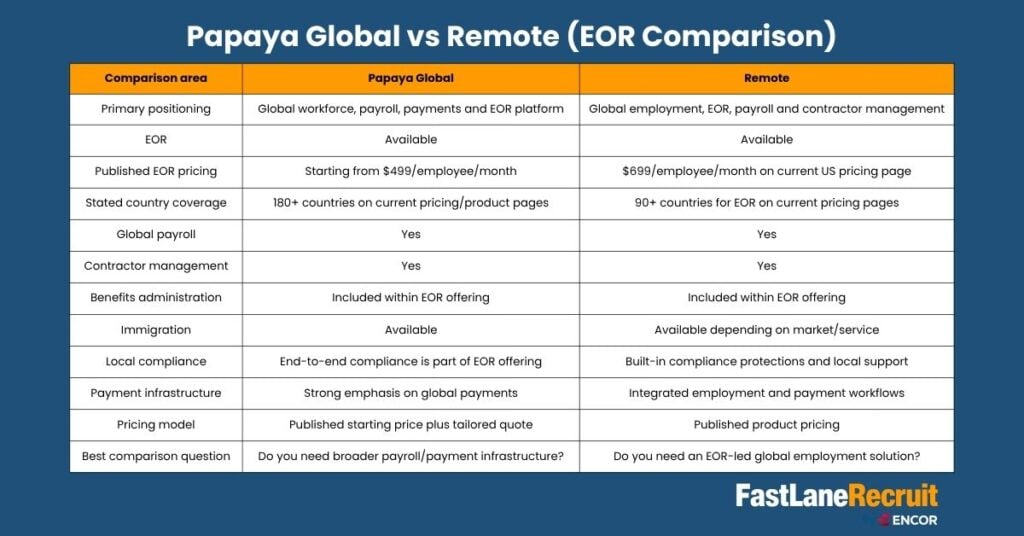
| Comparison area | Papaya Global | Remote |
| Primary positioning | Global workforce, payroll, payments and EOR platform | Global employment, EOR, payroll and contractor management |
| EOR | Available | Available |
| Published EOR pricing | Starting from $499/employee/month | $699/employee/month on current US pricing page |
| Stated country coverage | 180+ countries on current pricing/product pages | 90+ countries for EOR on current pricing pages |
| Global payroll | Yes | Yes |
| Contractor management | Yes | Yes |
| Benefits administration | Included within EOR offering | Included within EOR offering |
| Immigration | Available | Available depending on market/service |
| Local compliance | End-to-end compliance is part of EOR offering | Built-in compliance protections and local support |
| Payment infrastructure | Strong emphasis on global payments | Integrated employment and payment workflows |
| Pricing model | Published starting price plus tailored quote | Published product pricing |
| Best comparison question | Do you need broader payroll/payment infrastructure? | Do you need an EOR-led global employment solution? |
Important: Pricing and country coverage can change. Papaya Global’s current pricing page states EOR starts at $499 per employee/month and includes hiring in 180+ countries, while Remote currently lists $699 per employee/month and 90+ EOR countries. Verify the exact commercial terms for your target countries before signing a contract.
What Is the Difference Between Papaya Global and Remote?
The biggest difference is not simply the number of countries or the monthly EOR fee. It is how each platform fits into your global workforce operating model.
Papaya Global presents a broader infrastructure for payroll, payments, EOR, contractors and workforce management. Its current platform includes Workforce OS, Contingent OS and Payments OS.
Remote centers its offering around global employment, including EOR, international payroll and contractor management. Its EOR service is designed for companies that want to hire employees in countries where they do not have a local entity.
For a business evaluating the two, the important questions are:
- Do you need an EOR primarily for international hiring?
- Do you already operate legal entities in some countries?
- Do you need to consolidate payroll from multiple countries?
- How important are global payment capabilities?
- Which countries will you hire in?
- What level of local HR and compliance support do you require?
- What will your total cost be after benefits, statutory contributions and additional services?
Papaya Global vs Remote: EOR Comparison
What does an Employer of Record do?
An Employer of Record legally employs workers on behalf of a client in a country where the client may not have its own local entity.
Depending on the jurisdiction and service agreement, an EOR typically supports:
- Local employment contracts
- Payroll processing
- Tax withholding and statutory deductions
- Social contributions
- Mandatory employee benefits
- Employment compliance
- Onboarding and offboarding
- Employment documentation
- Local HR administration
- Certain immigration services
The client generally retains responsibility for the employee’s day-to-day work, role, performance and business management.
Papaya Global EOR
Papaya Global’s current EOR offering includes payroll, benefits, immigration services, country-specific contracts, statutory payments, local compliance and liability coverage. Its current pricing page states that its EOR service starts at $499 per employee per month.
Papaya Global also describes EOR as part of a broader workforce platform rather than an isolated employment product.
Remote EOR
Remote’s EOR service allows companies to employ staff without establishing a local entity in the countries covered by its EOR offering. Its current pricing page lists EOR at $699 per employee per month and highlights local payroll, compliance protections, localized benefits and dedicated local support.
What to verify before choosing an EOR
Do not evaluate an EOR only by its headline country count.
Ask:
- Who is the legal employer in the target country?
- Is the employing entity owned, operated or partner-supported?
- Who is responsible for payroll calculations?
- Who handles statutory filings?
- What employee benefits are included?
- What happens when local employment law changes?
- Who handles employee termination?
- What costs are passed through to the client?
- What support is available locally?
- Can employees transition to the client’s own entity later?
Papaya Global vs Remote: Global Payroll Comparison
Payroll becomes more complicated as companies add countries because each jurisdiction can have different:
- Payroll calendars
- Tax rules
- Social security contributions
- Statutory benefits
- Reporting requirements
- Currency requirements
- Payslip rules
- Year-end reporting obligations
Papaya Global places significant emphasis on consolidated global payroll and payments, describing its platform as a way to manage payroll, payments, compliance and reporting across 180+ countries.
Remote also offers international payroll for organizations that already have legal entities abroad and need centralized payroll infrastructure. Its current pricing page separates Global Payroll from EOR.
Which payroll model should you consider?
| Business situation | Key requirement |
| You have no local entity | EOR |
| You already have a local entity | Global payroll |
| You operate entities across many countries | Payroll consolidation |
| You have employees and contractors | Multi-worker management |
| You are entering a new market | EOR + local compliance |
| You plan to establish your own entity later | EOR-to-entity transition planning |
The important distinction is that EOR and global payroll are not interchangeable.
If you already own an entity, you may need payroll infrastructure rather than an EOR. If you do not have a legal entity, an EOR can provide the employment infrastructure needed to hire locally without immediately establishing one.
Papaya Global vs Remote: Pricing Comparison
Pricing is one of the most searched aspects of a Papaya Global vs Remote comparison, but headline prices should be treated as starting points rather than the complete cost of international employment.
Current published EOR pricing
| Provider | Published EOR price | Pricing context |
| Papaya Global | From $499/employee/month | Starting price |
| Remote | $699/employee/month | Published EOR price |
Papaya Global’s current pricing page states that EOR starts at $499 per employee/month. Remote’s current pricing page lists $699 per employee/month.
What can affect your total EOR cost?
The actual cost of employing someone internationally may include more than the platform fee:
- Employer social contributions
- Statutory benefits
- Private benefits
- Payroll taxes
- Currency conversion
- Immigration
- Security deposits where applicable
- Additional payroll runs
- Country-specific services
- Employee termination costs
- Exceptional HR services
- Implementation or migration services
For this reason, businesses should request an all-in cost breakdown rather than comparing only the monthly EOR subscription.
Questions to ask about EOR pricing
Before signing, ask each provider:
- Is the quoted price a starting price or fixed list price?
- Which statutory employer costs are additional?
- Are benefits included?
- Are FX costs included?
- Are onboarding and offboarding included?
- Are additional payroll runs charged separately?
- Are immigration services included?
- Are there minimum employee commitments?
- What happens to pricing when headcount increases?
- What happens if an employee leaves?
Also Read: How to Switch Your EOR Provider
Papaya Global vs Remote: Country Coverage
Country coverage matters when selecting an international employment provider, but coverage should always be evaluated at the country level.
Papaya Global currently advertises 180+ countries across its workforce platform, while its Papaya Direct page distinguishes between countries where it operates local entities and locations where it works with in-country specialists.
Remote’s current EOR pricing page states that companies can hire in 90+ countries without establishing a local entity.
Why country coverage alone is not enough
A useful EOR country assessment should examine:
- Legal employer structure
- Employment contract requirements
- Payroll processing
- Tax registration
- Social security
- Statutory benefits
- Termination requirements
- Immigration
- Employee support
- Local HR expertise
- Data protection requirements
Practical tip: If you already know your target countries, ask the EOR provider to confirm the exact delivery model and all-in costs for those countries in writing.
Compliance and Risk: What Should Businesses Check?
International employment creates regulatory responsibilities that vary by jurisdiction.
An EOR can reduce the administrative burden, but businesses should not assume that using an EOR automatically removes every legal, tax or permanent-establishment consideration.
Key compliance areas
Employment law
The employment relationship must follow applicable local employment requirements.
Payroll compliance
Salary calculations, tax withholding, social contributions and statutory reporting need to be handled correctly.
Employee benefits
Mandatory benefits can differ significantly between countries.
Worker classification
Businesses using contractors should assess whether the relationship genuinely qualifies as independent contracting under local law.
Permanent establishment
An employee working in another country can create tax considerations depending on the facts, including the employee’s role, activities and local rules. EOR should therefore be evaluated as part of a broader international expansion strategy.
Data protection
Global workforce platforms handle sensitive employee information, so security controls, access management and applicable data-protection obligations should be reviewed during procurement.
Contractor Management: Papaya Global vs Remote
EOR is designed primarily for employees. Contractor management addresses a different employment model.
Both Papaya Global and Remote provide contractor-related solutions, but companies should distinguish between:
- Contractor management
- Contractor of Record
- Employer of Record
- Global payroll
Why the distinction matters
A contractor may be incorrectly classified if the actual working relationship resembles employment.
Before engaging international contractors, businesses should consider:
- Local classification rules
- Contract terms
- Control and supervision
- Working hours
- Exclusivity
- Payment arrangements
- Intellectual property
- Tax obligations
- Misclassification exposure
If the business actually needs an employee, using contractor management simply because it appears cheaper can create compliance risk.
Papaya Global vs Remote: Which Is Right for Your Business?
Rather than asking which provider is universally better, evaluate which model aligns with your workforce requirements.
| If your priority is… | What to investigate |
| Hiring employees without a local entity | EOR coverage and legal-employer structure |
| Managing existing entities | Global payroll capabilities |
| Consolidating international payroll | Payroll reporting and data consolidation |
| Managing global payments | Currency, payment rails and transaction costs |
| Hiring across several countries | Country-specific EOR availability |
| Protecting employee experience | Benefits and local HR support |
| Controlling employment risk | Compliance responsibilities and contractual liability |
| Scaling internationally | Implementation, support and pricing at scale |
| Eventually establishing your own entity | EOR-to-entity transition options |
Before making a decision
Create a short EOR procurement checklist covering:
- Target countries
- Number of employees
- Hiring timeline
- Employee salary levels
- Required benefits
- Payroll requirements
- Immigration needs
- Contractor population
- Existing HRIS/payroll systems
- Expected expansion over the next 12–24 months
This will give you a more meaningful comparison than a generic feature checklist.
Questions to Ask Before Choosing one
A product demonstration should answer operational questions, not just show dashboards.
Employment
- Who is the legal employer?
- What entity employs workers in each target country?
- Who signs the employment agreement?
Payroll
- Who calculates payroll?
- Who handles tax and statutory filings?
- How are payroll corrections handled?
- What happens when payroll information changes after the cutoff?
Benefits
- Which benefits are mandatory?
- Which benefits are included?
- Can employees receive localized benefit options?
Compliance
- Who monitors changes in employment legislation?
- What happens if a local regulation changes?
- What compliance liability is contractually assumed by the provider?
Pricing
- What is the complete monthly cost?
- Which costs are passed through?
- Are FX charges included?
- Are off-cycle payroll runs charged?
- What are the termination costs?
Support
- Who supports employees?
- What are the support hours?
- Are local experts available?
- What are the response-time commitments?
Also Read: 10 Best Employer of Record (EOR) Services To Consider in 2026
Why Businesses Choose FastLaneRecruit
Choosing an EOR is not only about finding a platform with the largest country count. Businesses also need a practical partner that understands their target markets, employment requirements and growth plans.
FastLaneRecruit supports international employment across: Malaysia, Singapore, Hong Kong, China, India, Philippines, Taiwan, Vietnam, Australia, United Kingdom, Switzerland, UAE, Saudi Arabia, Qatar.
EOR support for international hiring
FastLaneRecruit can help businesses employ talent internationally without requiring them to immediately establish their own local entity in the supported market.
Our EOR solutions can help businesses manage key employment requirements such as:
- Local employment
- Payroll administration
- Employee onboarding
- Employment documentation
- Statutory compliance
- Employee benefits
- HR administration
- International workforce expansion
A practical alternative to comparing platforms alone
Every international hiring situation is different.
A company hiring one employee in Singapore has different requirements from a company building a 20-person team across Malaysia, Vietnam and the UAE.
That is why the most useful EOR assessment starts with your actual expansion plan.
FastLaneRecruit can help you assess:
- Which employment model fits your situation
- Whether EOR is appropriate for your target market
- What local employment requirements need to be considered
- How payroll and benefits should be structured
- What information you should request from an EOR provider
- How to plan an international hiring process
Choose an EOR Based on Your Expansion Plan
The right international employment solution should fit where you are hiring today and where you plan to expand tomorrow.
A useful Papaya Global vs Remote comparison can help you understand the market, but the final decision should be based on your actual countries, workforce structure, compliance requirements and total employment cost.
If you are evaluating EOR options for Malaysia, Singapore, Hong Kong, China, India, the Philippines, Taiwan, Vietnam, Australia, the UK, Switzerland, the UAE, Saudi Arabia or Qatar, FastLaneRecruit can help you assess your international hiring requirements and determine the appropriate employment approach.
Ready to Hire Internationally?
Talk to FastLaneRecruit about your global hiring plans.
Our EOR specialists can help you understand the employment model, local requirements, payroll considerations and practical steps involved in hiring internationally—so you can expand your team without adding unnecessary administrative complexity.
Book a Free Consultation with FastLaneRecruit.
Frequently Asked Questions About Papaya Global vs Remote
Is Papaya Global or Remote better for EOR?
There is no universal answer. Both offer EOR services, but businesses should compare their specific country coverage, legal-employer structure, pricing, payroll processes, benefits, support and compliance responsibilities against their own requirements.
What is the difference between Papaya Global and Remote?
Papaya Global positions itself as a broader global workforce, payroll and payments platform, while Remote focuses strongly on global employment, EOR, payroll and contractor management. The most relevant difference depends on whether your primary requirement is international employment, payroll consolidation, payments or a combination of these services.
How much does Papaya Global EOR cost?
Papaya Global’s current pricing page lists EOR starting from $499 per employee per month. Actual costs can vary depending on the country, workforce requirements and additional services.
How much does Remote EOR cost?
Remote currently lists its EOR service at $699 per employee per month on its US pricing page. Country-specific employment costs and other services may affect the overall cost.
Does an EOR eliminate the need to establish a local entity?
Not necessarily. An EOR can allow a company to hire employees in supported countries without immediately establishing its own local entity. However, businesses should assess tax, permanent-establishment, corporate, regulatory and long-term expansion considerations separately.
Which has more country coverage, Papaya Global or Remote?
Papaya Global currently advertises 180+ countries across its platform, while Remote’s current EOR pricing page states 90+ countries. However, country count should not be treated as the only measure of suitability because service models and employment arrangements can differ by country.
Can an EOR manage payroll and employee benefits?
Yes. Payroll and employee benefits are core components of many EOR arrangements. Papaya Global’s current EOR offering includes payroll and benefits, while Remote highlights local payroll and localized benefits as part of its EOR service.
What should I compare besides EOR pricing?
Compare the complete cost of employment, including statutory contributions, benefits, FX, immigration, payroll administration, onboarding, offboarding and additional services. Also assess legal-employer structure, compliance responsibility, support and country-specific capabilities.
Is EOR suitable for a company hiring only one employee abroad?
It can be. For a single international hire, establishing a local entity may involve disproportionate setup and administration. An EOR can provide an alternative, subject to the target country’s requirements and the company’s long-term plans.
Can I switch EOR providers later?
A business can generally transition employees between EOR providers, but the process can involve new employment documentation, employee communication, benefits changes, payroll cutoffs and compliance considerations. The transition plan should be confirmed before terminating an existing arrangement.
How do I choose an EOR for international hiring?
Start with your target countries, employee count, hiring timeline, required benefits, payroll requirements, immigration needs and expected expansion. Then compare providers based on country-level delivery, compliance, total cost and support rather than headline pricing alone.