
The global accounting industry is facing a structural talent shortage. CPA firms, bookkeeping firms, and advisory practices are struggling to hire qualified professionals locally while client demand continues to increase. An offshore team for accountants is no longer just a cost-saving tactic. It is now a scalability and operational strategy used by modern accounting firms to:
- Expand capacity without increasing overhead
- Solve talent shortages
- Improve turnaround time using time-zone advantages
- Support advisory growth by offloading repetitive work
This guide explains how offshore teams work, how to build them correctly, and how accounting firms can avoid common failures while scaling successfully.
Content Outline
Key Summary
Offshore Accounting Teams Support Sustainable Growth
Building an offshore team for accountants is more than a cost-saving initiative. It is a long-term scaling strategy that enables firms to expand operations without significantly increasing local hiring costs.
A Solution to Talent Shortages and Capacity Constraints
Offshore accounting professionals help firms address ongoing talent shortages, increase service capacity, and handle larger workloads while maintaining service quality and turnaround times.
Strong Processes Drive Offshore Success
Well-documented standard operating procedures (SOPs), structured training programs, and clearly defined workflows are essential foundations before onboarding offshore staff.
Dedicated Teams Deliver Better Results
The most effective offshore model is a dedicated team that works as an extension of your firm. This approach provides greater consistency, accountability, and knowledge retention than project-based or ad-hoc outsourcing.
Offshore Accountants Can Support Multiple Functions
Common responsibilities include bookkeeping, payroll processing, tax preparation support, accounts payable and receivable management, financial reporting, and audit preparation.
Communication and Onboarding Are Critical
Many offshore initiatives fail because of poor communication, unclear expectations, and inadequate onboarding. Regular collaboration and performance management are necessary for long-term success.
Choosing the Right Offshore Partner Matters
Working with a reliable provider that offers compliant hiring, structured recruitment, and Employer of Record (EOR) support helps reduce risks and ensures a smoother offshore team-building process.
What Is an Offshore Team for Accountants?
An offshore team for accountants is a dedicated group of accounting professionals located in another country who support a firm’s accounting, bookkeeping, tax, audit, or advisory functions.
Unlike traditional outsourcing, offshore teams are:
- Dedicated to your firm (not shared ad-hoc labor)
- Integrated into your workflows
- Managed under structured processes and SOPs
- Long-term extensions of your internal team
Typical Offshore Accounting Roles Include:
- Bookkeepers
- Accounts Payable/Receivable specialists
- Tax preparers
- Audit support associates
- Payroll assistants
- Financial reporting analysts
Why Accounting Firms Are Building Offshore Teams
1. Solving the Accounting Talent Shortage
Many firms cannot hire enough qualified accountants locally. Offshore hiring expands access to global talent pools in regions with strong accounting education systems.
2. Scaling Without Increasing Fixed Costs
Instead of hiring expensive local staff, firms can scale capacity through offshore teams while maintaining cost flexibility.
3. Faster Turnaround Times
With time-zone differences, work can continue after local office hours, enabling near 24-hour productivity cycles.
4. Improved Focus on High-Value Work
Senior accountants can focus on advisory and client strategy while offshore teams handle repetitive and process-driven tasks.
Also Read : Offshoring Talent: Guide to Building a Successful Offshore Team
Benefits of an Offshore Accounting Team
1. Cost Efficiency Without Quality Loss
Offshore teams reduce recruitment and salary costs while maintaining high output quality when properly managed.
2. Scalable Workforce Model
Firms can scale up or down based on seasonal demand (tax season, audits, reporting cycles).
3. Access to Specialized Skills
Offshore professionals often specialize in:
- Tax compliance
- Bookkeeping systems (QuickBooks, Xero)
- Audit documentation
- Financial reporting standards
4. Operational Flexibility
Firms can adjust workflows dynamically without long-term hiring commitments.
5. Improved Client Delivery Speed
Work completed overnight improves client responsiveness and satisfaction.
How to Build an Offshore Team for Accountants
1: Define What Work to Offshore
Not all accounting tasks should be offshore. The best candidates include:
- Data entry and bookkeeping
- Bank reconciliations
- Payroll processing
- Tax return preparation support
- Audit documentation
Avoid offshore-heavy client-facing advisory roles at early stages.
2: Standardize Processes
Before hiring, firms must build:
- SOPs (Standard Operating Procedures)
- Workflow documentation
- Review checkpoints
- File naming and documentation standards
Without this, offshore teams cannot perform consistently.
3: Choose the Right Offshore Hiring Model
Common models include:
- Dedicated offshore team (recommended for scaling firms)
- Employer of Record (EOR)
- Staffing agency model
- Project-based outsourcing
For long-term growth, dedicated offshore teams are the most effective model.
4: Hire Through a Trusted Provider
A reliable provider ensures:
- Pre-vetted accounting talent
- Compliance with employment laws
- Payroll management
- HR and retention support
This reduces hiring risk and operational burden.
5: Implement Training and Onboarding
Strong offshore teams require structured onboarding:
- Software training (Xero, QuickBooks, Excel)
- Firm-specific workflows
- Communication protocols
- Security training
6: Establish Communication Systems
Successful firms use:
- Slack or Microsoft Teams
- Cloud accounting platforms
- Project management tools (Karbon, Asana, ClickUp)
- Weekly review meetings
Clear communication reduces errors and delays.
7: Monitor Quality and Performance
Key KPIs include:
- Accuracy rate
- Task completion time
- Rework frequency
- Client delivery timelines
Quality control is essential for long-term success.
Common Mistakes When Building Offshore Accounting Teams
Treating Offshore Staff as Temporary Labor
High-performing firms treat offshore teams as core employees.
Poor SOP Documentation
Without structure, offshore teams cannot deliver consistent quality.
Lack of Training Investment
Onboarding is not optional—it is a performance driver.
Weak Communication Structure
Miscommunication is the #1 cause of offshore failure.
Best Practices from High-Performing Accounting Firms
- Build offshore teams gradually, not all at once
- Assign clear ownership of tasks
- Maintain overlapping working hours
- Create career growth pathways for offshore staff
- Use secure cloud systems for data protection
- Integrate offshore teams into company culture
Top Services Offered by Offshore Accounting Teams
Offshore teams typically support:
Core Accounting Services
- Bookkeeping
- Financial reporting
- Bank reconciliation
Tax Services
- Tax preparation support
- Filing assistance
- Documentation review
Audit Support
- Workpaper preparation
- Testing support
- Data validation
Payroll Services
- Payroll processing
- Employee records management
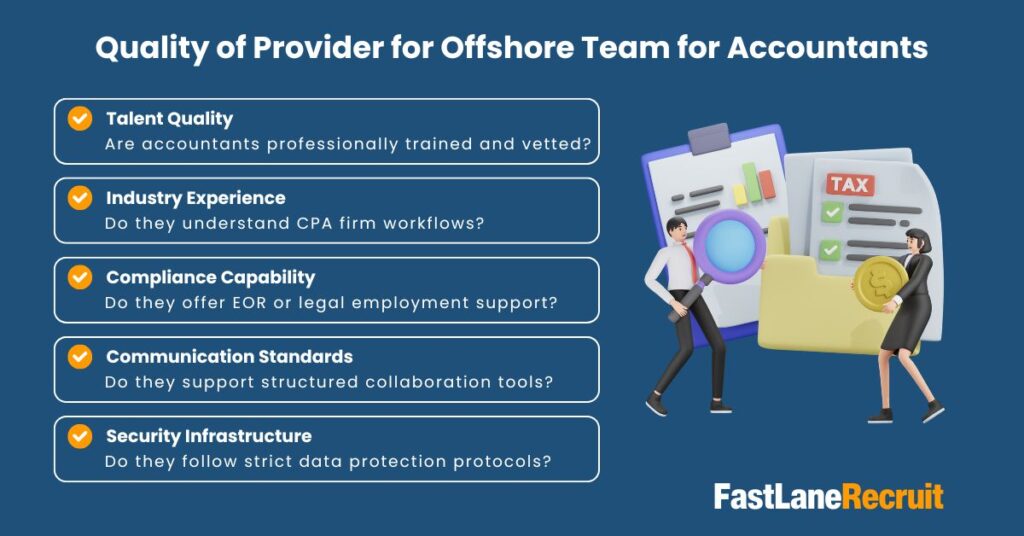
How to Select a Reliable Provider for Offshore Team for Accountants
When choosing a provider, evaluate:
Best Offshore Teams for Accountants (What Strong Providers Offer)
High-performing offshore accounting providers typically deliver:
- Dedicated accounting staff (not shared freelancers)
- CPA-level trained professionals
- Structured onboarding systems
- Workflow management support
- Long-term retention strategies
Build Your Offshore Accounting Team with FastLaneRecruit
If your accounting firm is struggling with hiring delays, rising costs, or workload pressure, building an offshore team for accountants may be the most effective scaling solution.
FastLaneRecruit helps firms build dedicated offshore accounting teams with:
- Pre-vetted accounting professionals
- Employer of Record (EOR) support
- Compliance-managed hiring
- Structured onboarding and integration
- Scalable staffing solutions for accounting firms
Contact us today to start building a high-performing offshore accounting team in Malaysia that scales with your firm’s growth.
Conclusion
Building an offshore team for accountants is no longer just an operational cost-saving tactic, it is a strategic scaling model for modern accounting firms facing talent shortages, rising client expectations, and increasing workload complexity.
When implemented correctly, offshore teams enable firms to expand capacity without proportionally increasing overhead, improve turnaround times through time-zone advantages, and allow senior accountants to focus on higher-value advisory work rather than repetitive processing tasks. However, the success of this model depends heavily on structure.
Without well-defined SOPs, clear communication workflows, and proper onboarding, offshore setups can quickly lead to inefficiencies, rework, and quality issues. This makes planning and process standardization just as important as hiring the right talent.
The most effective firms treat offshore accountants as an integrated extension of their core team, not as temporary or external labor. They invest in training, build strong communication systems, and establish clear performance benchmarks to ensure consistency and accountability.
As the accounting industry continues to evolve, offshore teams are becoming a core component of competitive firm strategy. Firms that adopt this model early and implement it correctly gain a significant advantage in scalability, profitability, and client service delivery.
Ultimately, an offshore accounting team is not just about reducing costs, it is about building a more flexible, resilient, and scalable firm that can grow sustainably in a highly competitive global market.
FAQ: Offshore Team for Accountants
What is an offshore team for accountants?
An offshore accounting team is a dedicated group of accounting professionals located overseas who support bookkeeping, tax, audit, and financial reporting tasks.
What are the benefits of engaging an offshore accounting department?
Benefits include:
- Lower hiring costs
- Faster scalability
- Access to global talent
- Improved turnaround time
- Reduced workload for local teams
How do I hire an offshore accounting team from reliable providers?
You should:
- Define required tasks
- Choose a vetted offshore staffing provider
- Use structured onboarding processes
- Ensure compliance and data security systems are in place
How do I select a reliable provider for remote accounting services?
Look for:
- Proven accounting industry experience
- Transparent hiring process
- Strong compliance framework
- Dedicated team model (not gig-based labor)
What are the top services offered by offshore teams for accountants?
They include bookkeeping, payroll, tax support, audit assistance, and financial reporting services.