

Hiring a skilled contractor in another country can give a business access to specialized talent without immediately building a permanent local team. But once contractors work across borders, managing contracts, documentation, payments, classification and local requirements can become significantly more complicated.
A Contractor of Record (COR) can help businesses organize and manage genuine independent contractor engagements across countries. However, COR is not the same as an Employer of Record (EOR), and choosing between the two depends on the actual working relationship.
Understanding the difference can help businesses select the right workforce model before expanding internationally.
Content Outline
Key Summary
A Contractor of Record Supports Independent Contractor Engagements
A Contractor of Record is a third-party service that supports businesses in managing independent contractor relationships. Depending on the country and engagement structure, services may include contractor onboarding, agreements, payment administration, documentation, compliance support and offboarding.
COR Does Not Turn a Contractor Into an Employee
A Contractor of Record is designed for genuine independent contractor arrangements. It should not be used simply to label an employment relationship as contractor work.
EOR Is Designed for Employees
If the individual should be an employee, an Employer of Record may be the more appropriate structure. An EOR legally employs the worker locally and manages employment-related obligations such as contracts, payroll, statutory contributions and benefits.
COR Can Simplify International Contractor Administration
For businesses managing contractors across multiple countries, a structured COR or contractor-management arrangement can centralize administrative processes and reduce the burden of handling every contractor relationship independently.
The Right Model Depends on the Working Relationship
The decision should not be based only on cost or convenience. Businesses should first determine whether the individual is genuinely operating as an independent contractor or whether the relationship is more appropriately structured as employment.
What Is a Contractor of Record?
A Contractor of Record (COR) is a third-party service that supports a business in managing an independent contractor engagement.
Instead of the business handling every administrative aspect of an international contractor relationship internally, the COR can support processes such as:
- Contractor onboarding
- Contractor agreements and documentation
- Invoicing and payment administration
- Contractor records
- Compliance-related processes
- Engagement management
- Offboarding
The exact responsibilities of a Contractor of Record vary by provider, country and engagement structure.
The fundamental distinction is that the worker remains an independent contractor. A COR does not automatically create an employment relationship.
FastLaneRecruit provides contractor management support for international businesses and can help organize contractor-related administrative processes across supported markets.
How Does a Contractor of Record Work?
A COR arrangement typically introduces an additional administrative layer between the business and the independent contractor.
Step 1: Determine the Appropriate Engagement Model
Before onboarding a contractor, the business should assess whether the proposed relationship genuinely qualifies as independent contracting under the relevant country’s rules.
This is an important step because worker status is determined by the actual relationship, not simply by the wording used in a contract.
For example, factors can include:
- Who controls how the work is performed?
- How independently does the individual operate?
- Who provides tools and resources?
- How is the individual paid?
- Can the individual provide services to other clients?
- Is the engagement project-based or ongoing?
- Does the individual receive employee-type benefits?
The precise test varies by jurisdiction. The IRS, for example, evaluates behavioral control, financial control and the relationship of the parties.
Step 2: Establish the Contractor Agreement
Once contractor status is appropriate, the relevant agreement and supporting documentation can be prepared.
A contractor agreement may define:
- Scope of services
- Deliverables
- Payment terms
- Fees
- Invoicing requirements
- Intellectual property provisions
- Confidentiality
- Termination or completion terms
- Applicable governing provisions
Local requirements should be considered before using a standard agreement across multiple countries.
Step 3: Complete Contractor Onboarding
The contractor provides the information required for the engagement.
Depending on the country and arrangement, this can include:
- Identity information
- Tax documentation
- Payment details
- Contractor information
- Signed agreements
- Required compliance documentation
A structured onboarding process creates a clearer record of the relationship from the beginning.
Step 4: Manage Invoices and Payments
The COR or contractor-management provider can support the administrative workflow for invoices and contractor payments.
This can be particularly useful when a business works with contractors in multiple countries and needs to manage different currencies, payment schedules and documentation requirements.
Step 5: Maintain Records and Ongoing Administration
Contractor management does not end after the first payment.
Businesses may need to maintain:
- Agreements
- Invoices
- Payment records
- Contractor information
- Engagement documentation
- Changes to the scope of work
- Renewal or termination records
Keeping these records organized can make ongoing contractor administration easier.
Step 6: Manage the End of the Engagement
When the project or engagement ends, businesses may need to complete final invoices, payments, documentation and contract closure.
A structured offboarding process helps prevent unresolved administrative issues.
What Does a Contractor of Record Do?
The exact scope differs by provider, but a Contractor of Record may support several stages of the contractor lifecycle.
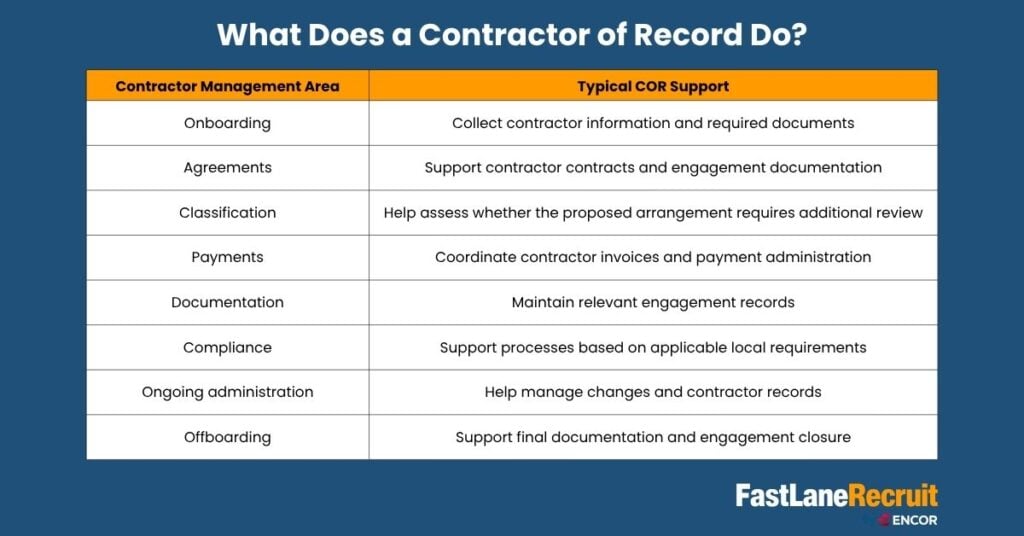
| Contractor Management Area | Typical COR Support |
| Onboarding | Collect contractor information and required documents |
| Agreements | Support contractor contracts and engagement documentation |
| Classification | Help assess whether the proposed arrangement requires additional review |
| Payments | Coordinate contractor invoices and payment administration |
| Documentation | Maintain relevant engagement records |
| Compliance | Support processes based on applicable local requirements |
| Ongoing administration | Help manage changes and contractor records |
| Offboarding | Support final documentation and engagement closure |
Important: The scope of services and allocation of legal or compliance responsibilities can differ by country and provider. Businesses should review the specific service agreement before relying on a COR arrangement.
Why Do Businesses Use a Contractor of Record?
International contractor management can become difficult when a company works with people across several jurisdictions.
A Contractor of Record or structured contractor-management service may help businesses address several operational challenges.
Reduce Administrative Work
Instead of creating separate internal processes for every contractor, businesses can use a structured workflow for onboarding, documentation, invoicing and payments.
Support International Contractor Management
Country-specific requirements can make cross-border contractor engagements more complicated than domestic arrangements.
A specialized provider can help businesses organize these processes according to the relevant market.
Centralize Contractor Administration
Businesses managing multiple contractors may benefit from having one structured process for:
- Agreements
- Documentation
- Payments
- Records
- Contractor lifecycle administration
Support Faster Workforce Expansion
Businesses may use contractors when they need specialized expertise, project-based support or access to talent in a new market without immediately establishing a permanent local workforce.
Create a More Consistent Process
Standardized contractor workflows can make it easier for HR, finance and management teams to coordinate contractor relationships as the workforce grows.
Contractor of Record vs Employer of Record
One of the most important questions businesses ask is:
Should we use a Contractor of Record or an Employer of Record?
The answer depends primarily on the worker’s actual status and the nature of the relationship.
| Factor | Contractor of Record | Employer of Record |
| Worker status | Independent contractor | Employee |
| Primary purpose | Manage genuine contractor engagements | Employ workers locally |
| Contract | Contractor/service agreement | Employment contract |
| Payroll | Contractor payment administration | Employee payroll |
| Employee benefits | Generally not part of contractor status | Statutory and applicable employment benefits |
| Employment relationship | Does not create employment by itself | EOR becomes the legal employer |
| Best suited for | Genuine independent contractor relationships | Employees working in a foreign market |
| Local entity | May help manage contractor arrangements without the client’s own entity, subject to local rules | Allows employee hiring without the client establishing its own local employing entity |
| Key consideration | Contractor classification must be appropriate | Local employment obligations must be met |
FastLaneRecruit similarly distinguishes contractor management from EOR: contractor management is intended for genuine independent contractor relationships, while EOR services are designed for employees who need to be employed locally.
Contractor of Record vs Direct Contractor Management
A business does not necessarily need a COR simply because it hires contractors internationally.
The practical choice may be between:
- Managing contractors internally
- Using a Contractor of Record or contractor-management provider
- Hiring the worker through an EOR when the relationship is employment
| Option | Best Suited For | Administrative Responsibility |
| Direct contractor management | Businesses comfortable managing their own contractor relationships | Primarily the business |
| Contractor of Record / contractor management | Businesses seeking structured support for international contractor administration | Shared or provider-supported, depending on service scope |
| Employer of Record | Workers who should be employees | EOR manages local employment administration |
The right option depends on the worker’s status, country, risk profile, internal resources and business objectives.
When Should You Use a Contractor of Record?
A COR may be worth considering when the following conditions apply.
You Are Working With Genuine Independent Contractors
The most important consideration is whether the relationship is genuinely independent.
A COR should not be used to disguise an employment relationship.
You Are Hiring Contractors Internationally
Managing contractors across borders can introduce additional administrative and compliance requirements.
A specialist provider can help organize these processes.
You Manage Multiple Contractors
As the number of contractors increases, manually managing agreements, invoices, payments and records can become resource-intensive.
You Need More Structured Contractor Administration
Businesses without dedicated international contractor-management infrastructure may benefit from an established process.
You Are Entering a New Market Through Contractor Engagements
Contractors can sometimes provide businesses with flexible access to specialized talent while they evaluate a new market. However, the engagement model should always be assessed against local requirements.
When Should You Consider an Employer of Record Instead?
A Contractor of Record is not the right answer for every international hire.
Consider an EOR when the individual should be an employee rather than an independent contractor.
Indicators that an employment structure may be more appropriate can include:
- The relationship is long-term and ongoing.
- The individual is integrated into your core team.
- Your business exercises substantial control over how the person works.
- The person works under employee-like conditions.
- The role requires employee benefits or statutory employment protections.
- Local rules make the proposed contractor arrangement unsuitable.
- You want the worker employed locally without establishing your own entity.
For example, UK guidance identifies factors associated with self-employment such as working without direct supervision, invoicing for work and responsibility for one’s own tax and National Insurance, although employment status ultimately depends on the specific circumstances and applicable rules.
Also Read: When to Use an Employer of Record: 7 Signs Your Business Needs an EOR
A Simple Decision Guide
| Your Situation | Potentially Appropriate Model |
| Short, defined project with a genuinely independent professional | Contractor management / COR |
| Contractor provides services independently to multiple clients | Contractor management / COR |
| Several international contractors need centralized administration | Contractor management / COR |
| Long-term employee integrated into your team | EOR |
| You need local employment contracts and statutory benefits | EOR |
| You are unsure whether the relationship is contractor or employment | Obtain a jurisdiction-specific review before choosing the structure |
The actual facts of the working relationship should come first. The label “contractor” or “employee” in an agreement does not, by itself, determine legal status.
What Are the Risks of Managing International Contractors?
Hiring internationally can create additional responsibilities when the business manages contractor relationships directly.
Worker Misclassification
If a worker is treated as an independent contractor when the actual relationship is employment, the business may face tax, employment or other legal consequences depending on the jurisdiction.
The IRS specifically notes that misclassification can result in employment-tax liabilities.
Inconsistent Documentation
Using an unsuitable or incomplete agreement can make it harder to demonstrate how the contractor relationship was structured.
Payment and Tax Administration
International payments may involve different documentation, currencies, payment processes and tax considerations.
Country-Specific Requirements
A contractor arrangement that works in one country may not be appropriate in another.
Contractor Relationship Drift
A contractor engagement can change over time.
For example, a project-based consultant may gradually become:
- Full-time
- Indefinite
- Exclusively engaged
- Closely supervised
- Integrated into internal operations
That change can warrant a fresh review of the engagement model.
How to Choose a Contractor of Record Provider
Before selecting a provider, businesses should look beyond the headline service description.
1. Check Country Coverage
Confirm that the provider can support the countries where your contractors are located.
2. Understand the Service Scope
Ask exactly what is included:
- Onboarding
- Contracts
- Classification support
- Invoicing
- Payments
- Documentation
- Compliance support
- Offboarding
3. Clarify Responsibility for Compliance
Do not assume that using a COR automatically eliminates every legal or tax risk.
Ask who is responsible for each part of the engagement and what happens if a classification or regulatory issue arises.
4. Review Payment Processes
Understand:
- Payment currencies
- Payment schedules
- Contractor invoicing
- Fees
- Exchange-rate treatment
- Required payment documentation
5. Consider Your Future Workforce Needs
If your business expects contractors to become employees later, choose a provider that can support a broader workforce strategy.
This is where having access to both contractor-management and EOR services can be particularly useful.
Contractor of Record and Global Workforce Expansion
A Contractor of Record can form part of a broader international workforce strategy.
Businesses may use different workforce models depending on the country, role and nature of the relationship.
For example:
Genuine independent contractor → Contractor management
Employee → EOR
Permanent local operation → Local entity
This approach avoids treating every international worker in the same way.
FastLaneRecruit supports EOR solutions for businesses across selected markets in Asia Pacific, Europe, and the Middle East & Africa, including: Malaysia, Singapore, Hong Kong, China, India, Philippines, Taiwan, Vietnam, Australia, United Kingdom, Switzerland, UAE, Saudi Arabia, Qatar
Because requirements vary between countries, the appropriate workforce structure should be considered on a market-by-market basis.
Why Businesses Choose FastLaneRecruit
International workforce management requires more than simply finding talent. Businesses also need a practical way to manage the administrative and employment structures behind that talent.
FastLaneRecruit combines contractor management and EOR support to help businesses select a workforce model that matches the actual engagement.
Contractor Management Support
For genuine independent contractor relationships, FastLaneRecruit can support processes including:
- Contractor onboarding
- Agreement administration
- Documentation
- Invoicing
- Payment administration
- Contractor records
- Engagement closure
- Compliance-related processes
The exact support available depends on the country and engagement arrangement.
EOR Services for Employees
When a worker should be an employee, FastLaneRecruit’s EOR model provides a different structure.
FastLaneRecruit can act as the local employer and support:
- Employment contracts
- Employee onboarding
- Payroll
- Tax administration
- Statutory contributions
- Employee benefits
- Local employment compliance
This allows businesses to hire employees in supported markets without immediately establishing their own local employing entity.
One Workforce Strategy Across Multiple Markets
Your workforce may not require one model everywhere.
A business might engage a genuine contractor in one country while employing a full-time team member through an EOR in another.
FastLaneRecruit can help businesses evaluate these workforce requirements and determine which available service is more appropriate for the engagement.
FastLaneRecruit Contractor Management and EOR Support
Whether you are engaging an independent contractor or hiring an employee internationally, the workforce structure matters.
If the worker is genuinely an independent contractor: FastLaneRecruit can support contractor management and related administrative processes.
If the worker should be an employee: FastLaneRecruit can provide EOR support in eligible markets.
The goal is not to force every worker into one model. It is to create a workforce structure that reflects the actual relationship and the requirements of the relevant country.
Ready to Choose the Right Global Hiring Model?
Talk with FastLaneRecruit about your contractor or employee hiring plans.
Make Your International Workforce Strategy Simpler
Hiring internationally does not always require the same workforce model for every person or country.
The key is to match the structure to the actual relationship:
Independent contractor → Contractor Management
Employee → Employer of Record
Long-term local operation → Consider your own entity
FastLaneRecruit can support businesses with both international contractor management and EOR services, helping you assess the appropriate route for your workforce plans across supported markets.
Ready to discuss your hiring plans?
Book a Free Consultation with an Expert
Frequently Asked Questions About Contractor of Record
What is a Contractor of Record?
A Contractor of Record is a third-party service that supports businesses in managing independent contractor engagements. Depending on the country and arrangement, this can include onboarding, agreements, documentation, payment administration, compliance-related processes and offboarding.
What does a Contractor of Record do?
A COR can help manage administrative processes associated with international contractors, including contractor onboarding, agreements, documentation, invoicing, payments and engagement closure. The exact scope varies by provider and jurisdiction.
Is a Contractor of Record the same as an Employer of Record?
No.
A Contractor of Record supports independent contractor engagements, while an Employer of Record legally employs workers on behalf of a client company.
If the worker should be an employee, an EOR may be the more appropriate model.
Does a Contractor of Record employ contractors?
A Contractor of Record arrangement is generally designed to maintain an independent contractor relationship rather than create employment.
The exact legal structure and responsibilities depend on the provider, country and engagement arrangement.
Can I hire international contractors without setting up a local company?
A contractor-management or COR arrangement may allow a business to manage certain international contractor engagements without establishing its own local entity. However, whether the structure is appropriate depends on the contractor relationship and the laws of the country involved.
Does using a COR eliminate misclassification risk?
Not automatically.
Worker classification depends on the actual working relationship and applicable local law. Using a COR does not make an otherwise employee-like relationship a valid contractor arrangement. Businesses should obtain appropriate legal or tax advice when classification is uncertain or jurisdiction-specific.
What is the difference between a Contractor of Record and contractor management?
The terms can overlap in the market, but they should not be assumed to mean exactly the same thing.
Contractor management is the broader process of administering independent contractor relationships. A COR service may provide a more structured third-party arrangement for handling parts of that relationship. The actual scope depends on the provider.
When should I use EOR instead of a Contractor of Record?
An EOR may be more appropriate when the worker should be an employee, particularly where the role is ongoing, integrated into the business and subject to significant employer-like direction and control.
Can FastLaneRecruit support both contractors and employees?
Yes. FastLaneRecruit provides contractor management support for international contractor arrangements and EOR services for eligible employee hiring requirements across supported markets.
Which countries does FastLaneRecruit support?
FastLaneRecruit supports international workforce requirements across selected markets including Malaysia, Singapore, Hong Kong, China, India, Philippines, Taiwan, Vietnam, Australia, United Kingdom, Switzerland, UAE, Saudi Arabia and Qatar. Service availability and scope can vary by country and engagement structure.
Should I use a Contractor of Record or an EOR?
Start with the worker’s actual relationship.
If the person is genuinely an independent contractor, contractor management may be appropriate. If the person should be an employee, an EOR may provide the appropriate employment structure.
If the classification is unclear, seek jurisdiction-specific professional advice before deciding.