

The Philippines has become one of the world’s top destinations for remote hiring, outsourcing, and global workforce expansion. From customer support and accounting to software development and digital marketing, companies worldwide continue hiring Filipino professionals because of their strong English communication skills, cultural compatibility, and cost-efficient talent market. However, the average salary Philippines is rapidly evolving. Remote work, global competition, inflation, and rising demand for skilled workers are reshaping salary expectations across industries.
For international employers, understanding the real salary landscape is essential for:
- Building competitive compensation packages
- Attracting and retaining top Filipino talent
- Managing outsourcing costs effectively
- Expanding compliantly in the Philippines
- Making smarter global hiring decisions
Whether you are hiring one remote employee or building a distributed team, this article will help you understand what competitive compensation looks like in the Philippine market.
Content Outline
Key Summary
Salaries in the Philippines Are Increasing Due to Global Demand
Remote work and international hiring competition are driving steady upward pressure on compensation levels across multiple industries.
Skilled Professionals Often Earn Above National Averages
Experienced talent, especially in specialized roles, can command salaries significantly higher than typical local benchmarks.
Location Still Strongly Influences Salary Levels
Metro Manila generally offers higher pay scales, while provincial hiring can provide more cost-efficient workforce options for employers.
Total Employment Cost Includes Mandatory Benefits
Employers must account for statutory contributions, benefits, and compliance obligations in addition to base salary when budgeting.
Competitive Compensation Is Key for Talent Retention
Organizations that offer market-aligned pay structures are better positioned to attract and retain top-tier Filipino professionals.
Employer of Record (EOR) Simplifies Cross-Border Hiring
EOR solutions help global companies hire talent in the Philippines while ensuring full compliance with local labor and tax regulations.
What Is the Average Salary in the Philippines in 2026?
The average salary in the Philippines varies significantly depending on:
- Industry
- Experience level
- Location
- Skill specialization
- Remote or local employment structure
Based on market hiring trends and employer salary benchmarks, the estimated average monthly salary in the Philippines in 2026 ranges from:
| Salary Type | Estimated Monthly Salary |
| National average salary | ₱18,000–₱25,000 |
| Skilled professionals | ₱30,000–₱60,000 |
| Mid-level tech and finance roles | ₱50,000–₱120,000 |
| Senior specialized professionals | ₱120,000+ |
While government labor statistics often report lower national averages, actual salaries for experienced professionals working with international companies are usually much higher.
Today’s remote hiring environment has created a more globally competitive labor market, especially in:
- IT and software engineering
- Digital marketing
- Accounting and finance
- Customer support
- Executive assistance
- Cybersecurity
- Data analytics
Why Global Employers Hire Filipino Talent
The Philippines remains one of the strongest remote hiring markets in Asia because it offers a balance between affordability and workforce quality.
Strong English Communication Skills
The Philippines is consistently ranked among the largest English-speaking countries globally. This makes Filipino professionals highly suitable for:
- Customer-facing roles
- Client support
- International collaboration
- Virtual assistance
- Sales and operations
Cost-Effective Hiring Compared to Western Markets
Hiring employees in the Philippines is significantly more affordable compared to:
- The United States
- Australia
- The United Kingdom
- Singapore
For example, a mid-level software developer in the US may cost over USD 7,000 monthly, while a similarly skilled Filipino developer may cost between USD 1,500–3,000 monthly depending on expertise.
Strong Remote Work Culture
The country has decades of experience supporting:
- BPO operations
- Outsourcing companies
- Offshore staffing
- Remote-first businesses
This has created a workforce already familiar with:
- International business standards
- Virtual communication tools
- Remote collaboration workflows
- Flexible time zone arrangements
Average Salary in the Philippines by Industry
Salary expectations differ heavily across sectors. Industries with strong global demand typically offer higher compensation.
IT and Software Development
Technology remains one of the highest-paying sectors in the Philippines.
| Role | Average Monthly Salary |
| Junior Developer | ₱35,000–₱60,000 |
| Mid-Level Developer | ₱60,000–₱100,000 |
| Senior Software Engineer | ₱120,000–₱250,000 |
| Cybersecurity Specialist | ₱90,000–₱180,000 |
Demand continues growing due to:
- AI adoption
- SaaS expansion
- Remote engineering teams
- Global tech outsourcing
Customer Support and BPO
The Philippines remains a global leader in customer support outsourcing.
| Role | Average Monthly Salary |
| Call Center Agent | ₱18,000–₱35,000 |
| Technical Support Specialist | ₱30,000–₱50,000 |
| Team Leader | ₱45,000–₱80,000 |
Night differential pay and international accounts can increase earnings significantly.
Accounting and Finance
Accounting professionals remain highly sought after by SMEs and multinational companies.
| Role | Average Monthly Salary |
| Bookkeeper | ₱25,000–₱40,000 |
| Accountant | ₱40,000–₱80,000 |
| Finance Manager | ₱100,000–₱180,000 |
International accounting standards knowledge and software expertise often command premium salaries.
Digital Marketing and Creative Roles
Remote marketing talent from the Philippines continues gaining popularity.
| Role | Average Monthly Salary |
| SEO Specialist | ₱30,000–₱60,000 |
| Social Media Manager | ₱35,000–₱70,000 |
| Graphic Designer | ₱30,000–₱65,000 |
| Performance Marketer | ₱60,000–₱120,000 |
Metro Manila vs Provincial Salary Differences
Location remains a major factor in salary benchmarking.
Metro Manila Salaries
Employees in Metro Manila generally receive:
- Higher salaries
- Better benefits
- Larger international exposure
However, operational costs are also higher because of:
- Housing expenses
- Transportation
- Competition for talent
Metro Manila salaries are typically:
- 20–50% higher than provincial rates
Provincial Hiring Advantages
Cities such as:
- Cebu
- Davao
- Iloilo
- Bacolod
- Clark
have become strong outsourcing and remote hiring hubs.
Benefits of hiring provincially include:
- Lower salary expectations
- Reduced turnover
- Growing skilled workforce
- Better employee loyalty
Many global companies now hire remote employees nationwide instead of focusing only on Metro Manila.
Remote Work Is Reshaping Philippine Salaries
The remote work boom has transformed compensation expectations across the Philippines.
Global Competition for Talent
Filipino professionals now work directly with:
- US startups
- Australian agencies
- European SaaS companies
- Global eCommerce brands
As a result:
- Skilled workers increasingly benchmark salaries internationally
- Employers must offer more competitive packages
- Remote contractors can sometimes earn more than local employees
Skill-Based Compensation Is Growing
Salary decisions are becoming more dependent on:
- Specialized expertise
- Performance
- Technical capability
- Communication skills
instead of simply geographic location.
This trend is particularly visible in:
- Tech
- Marketing
- Finance
- AI-related roles
- Data analytics
Also Read: Essential Elements to Include in a Remote Work Policy
Employer Costs Beyond Base Salary
Many foreign companies underestimate the total cost of employment in the Philippines.
In addition to salary, employers should account for:
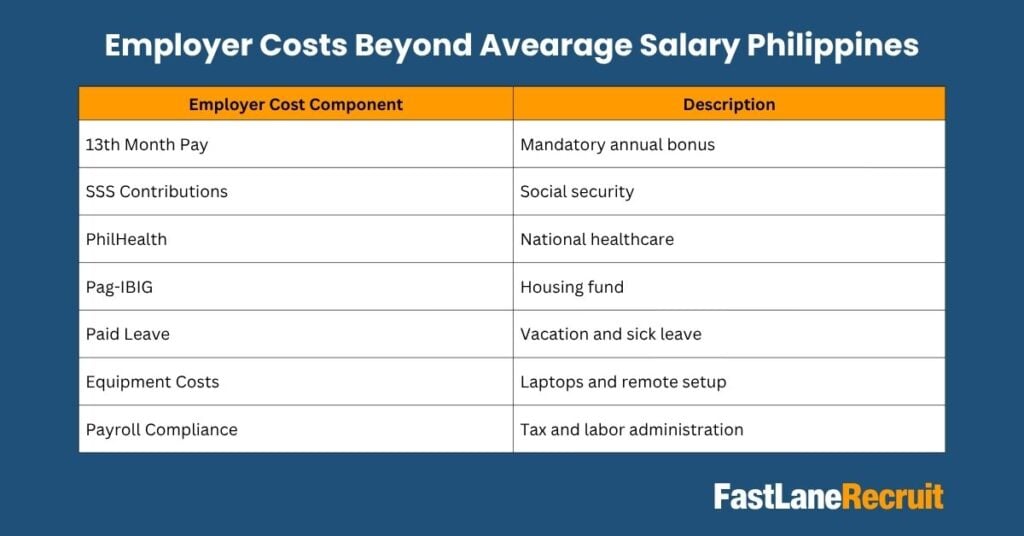
Overall, total employment costs may increase by approximately 15–30% beyond the employee’s base salary.
What Is a Competitive Salary in the Philippines?
Offering the cheapest salary possible is no longer an effective hiring strategy.
Top Filipino professionals often evaluate:
- Career growth opportunities
- Remote flexibility
- Company culture
- International exposure
- Learning opportunities
- Work-life balance
To attract strong candidates, employers should aim for:
- Market-aligned compensation
- Transparent benefits
- Stable remote work policies
- Competitive career progression
Underpaying employees frequently leads to:
- High turnover
- Poor productivity
- Recruitment instability
How to Hire Employees in the Philippines Legally
Foreign companies generally choose between:
- Direct local entity setup
- Contractors
- Employer of Record (EOR) services
For many businesses, Employer of Record solutions provide the fastest and most compliant approach.
An EOR helps manage:
- Payroll
- Tax compliance
- Employment contracts
- Benefits administration
- Labor law compliance
This allows companies to hire Filipino employees without opening a local entity.
Why Companies Use Recruitment and EOR Partners
Hiring internationally can be complex without local expertise.
Global employers often struggle with:
- Salary benchmarking
- Compliance risks
- Candidate sourcing
- Payroll administration
- Employment documentation
Working with an experienced recruitment and EOR partner simplifies the process while reducing hiring risk.
Conclusion
The average salary Philippines in 2026 reflects a rapidly evolving labor market shaped by global hiring demand, remote work adoption, and rising skill-based compensation. While national salary averages remain modest, highly skilled professionals in IT, finance, marketing, and customer support are earning increasingly competitive wages, especially when working with international employers.
For global companies, the Philippines continues to offer a strong balance of affordability and talent quality. Its English-proficient workforce, established remote work culture, and cost advantages outside Metro Manila make it one of the most attractive hiring destinations in Asia.
However, employers must go beyond base salary when planning compensation. Factors such as mandatory benefits, regional salary differences, and compliance requirements all play a key role in building sustainable hiring strategies.
As remote work continues to reshape global employment trends, understanding the average salary Philippines benchmark is essential for attracting top talent, controlling hiring costs, and building compliant, high-performing distributed teams.
For businesses looking to scale in the Philippines, working with experienced recruitment or Employer of Record (EOR) partners can help simplify hiring, ensure compliance, and support long-term growth.
Build Your Global Team With FastLaneRecruit
FastLaneRecruit provides recruitment and hiring solutions in Malaysia for global companies looking to build and expand their teams.
We help businesses streamline talent acquisition and workforce planning in Malaysia through:
- Recruitment and talent sourcing in Malaysia
- Employer of Record (EOR) services for international companies
- Payroll management
- Remote Workforce expansion within the Malaysian market
- Hiring coordination for global employers operating in Malaysia
With strong local expertise, FastLaneRecruit helps companies hire efficiently in Malaysia while ensuring a smooth and compliant recruitment process.
For businesses looking to build teams in Malaysia, get in touch with FastLaneRecruit today to get started.
Frequently Asked Questions
What is the average monthly salary Philippines in 2026?
The average monthly salary in the Philippines typically ranges from ₱18,000 to ₱25,000 nationally, while skilled professionals often earn between ₱30,000 and ₱60,000 or more depending on industry and experience.
Which jobs have the highest salaries in the Philippines?
Some of the highest-paying roles include:
- Software engineers
- Cybersecurity specialists
- Finance managers
- Data analysts
- AI professionals
- Senior digital marketers
Is hiring employees in the Philippines cost-effective?
Yes. The Philippines offers strong value for global employers because of its highly skilled English-speaking workforce and comparatively lower labor costs than Western countries.
What additional costs should employers expect beyond salary?
Employers should budget for:
- 13th month pay
- Social contributions
- Healthcare contributions
- Paid leave
- Payroll compliance
- Equipment and operational costs
What is the difference between Metro Manila and provincial salaries?
Metro Manila salaries are generally 20–50% higher because of living costs and stronger competition for talent. Provincial regions often provide more affordable hiring opportunities.
Can foreign companies hire employees in the Philippines without opening a company?
Yes. Many businesses use Employer of Record (EOR) services to legally hire employees without establishing a local entity.