Building a remote workforce can give businesses access to international talent without requiring every employee to work from a traditional office. But when an employee works across borders, the location of the work can create tax, employment, payroll, and compliance considerations that employers cannot afford to overlook.
One of the most important is permanent establishment (PE) risk.
A company does not necessarily need a registered office or subsidiary in another country to face a potential taxable presence there. Depending on the circumstances, the activities of a remote employee, contractor, or other representative may create corporate tax exposure in the country where the work is performed.
At the same time, remote work alone does not automatically create permanent establishment. The analysis depends on the facts, applicable domestic rules, tax treaties, and the nature and duration of the activities performed.
For businesses hiring internationally, the challenge is therefore not simply deciding whether to hire abroad. It is choosing an employment structure that supports growth while managing tax and employment compliance appropriately.
Content Outline
Key Summary
Permanent establishment is a corporate tax concept
Permanent establishment generally refers to a sufficient business presence in another jurisdiction that can give that jurisdiction taxing rights over profits attributable to the business presence.
Remote work does not automatically create PE
An employee working from another country is not, by itself, proof that a permanent establishment exists. The employee’s location, working pattern, activities, authority, commercial purpose, and applicable tax rules all matter.
Employee activities can increase PE exposure
Risk may become more significant when remote workers perform core business activities, regularly serve customers locally, develop business opportunities, negotiate or conclude contracts, or otherwise represent the company in the foreign market.
PE risk and employment compliance are different issues
Even when an arrangement does not create a permanent establishment, an employer may still need to address local employment, payroll, social security, benefits, immigration, and reporting requirements.
An EOR can simplify international employment
An Employer of Record (EOR) can provide a local employment structure without requiring the client to immediately establish its own employing entity. However, an EOR should not be presented as an automatic solution that eliminates all corporate tax or PE exposure.
The right structure depends on the business
An EOR can be particularly useful for first hires, small teams, market testing, or businesses that want to expand internationally before establishing their own entity. A local subsidiary may make more sense when a business has a substantial, long-term operational presence.
What Is Permanent Establishment?
Permanent establishment (PE) is an international tax concept used to determine when a business has enough presence or business activity in another country for that country to potentially tax profits attributable to that presence.
The OECD Model Tax Convention generally describes a PE around the concept of a fixed place of business through which the business of an enterprise is wholly or partly carried out. The OECD’s 2025 update added specific guidance addressing modern cross-border remote-work arrangements and when a person’s home or another location may constitute a place of business.
Importantly, permanent establishment is not the same as having a legal entity.
A company can deliberately establish a subsidiary or branch in another country. A PE, by contrast, can arise from the company’s activities and circumstances even when the company did not intentionally establish a separate local entity.
Permanent Establishment vs. Legal Entity
| Permanent Establishment | Local Legal Entity |
| A tax concept | A formally registered business structure |
| Can arise from business activities | Created deliberately through incorporation or registration |
| May create corporate tax obligations | Creates a separate local corporate structure |
| Does not necessarily mean a subsidiary exists | Usually involves a subsidiary, branch, or other registered entity |
| Assessment depends on applicable rules and facts | Requires formal establishment and ongoing administration |
This distinction matters for businesses hiring internationally. Not having a subsidiary does not automatically mean there is no tax presence.
What Is Permanent Establishment Risk for a Remote Workforce?
Permanent establishment risk for a remote workforce is the possibility that employees or other representatives working in a foreign country create sufficient business presence for the employer to be treated as having a taxable presence there.
For example, imagine a company based in Country A hires an employee who permanently works from Country B.
The company may initially think:
“We have no office in Country B, so we have no business presence there.”
That conclusion may be premature.
Tax authorities may consider factors such as:
- How regularly the employee works from Country B
- Whether the employee’s home or another location is considered a place of business
- Why the employee is working from Country B
- Whether the employee performs core business activities there
- Whether the employee works with local customers
- Whether the employee develops business opportunities
- Whether the employee negotiates or concludes contracts
- Whether the employee has authority to represent the company
- Whether the arrangement is temporary or ongoing
- What the relevant tax treaty and domestic legislation provide
The OECD’s updated guidance recognizes that cross-border remote work requires a fact-specific analysis rather than an automatic assumption that every remote employee creates a PE.
Also Read: Managing Remote Employees: Hire, Onboard & Lead Remote Teams Effectively
Does Remote Work Automatically Create Permanent Establishment?
No.
This is one of the most important points employers should understand.
The fact that an employee works remotely from another country does not automatically mean the employer has created a permanent establishment.
The OECD’s 2025 commentary provides additional guidance for assessing when a home or similar location may become a place of business. As a general framework, where a person works from their home in another country for less than half of their total working time, the home would generally not, by itself, constitute a place of business in the absence of other facts showing otherwise. Where the employee works there for at least half of their working time, additional analysis—including whether there is a commercial reason for the person’s presence in that country—is relevant.
This should not be treated as a universal safe harbor.
Domestic laws, bilateral tax treaties, the actual activities performed, and other facts can change the analysis.
Why the Employee’s Role Matters
Two employees working remotely in the same country can create very different risk profiles.
Consider these examples:
Employee A — Software Developer
- Works remotely
- Develops internal software
- Has no authority to negotiate contracts
- Does not conduct local sales
- Has no local customer-facing responsibility
Employee B — Sales Director
- Works remotely
- Develops customers in the country
- Negotiates commercial terms
- Regularly meets prospective customers
- Plays a significant role in closing contracts
The second role may require significantly more careful PE analysis because the employee’s activities are directly connected to revenue generation and the company’s commercial presence.
The lesson is simple:
PE risk is about more than where an employee sits. It is also about what the employee does.
What Creates Permanent Establishment Risk?
There is no single factor that determines PE in every jurisdiction. However, several recurring considerations deserve attention when building a remote workforce.
1. A Home Office or Other Fixed Location
A remote employee’s home office can become relevant to PE analysis when it is used regularly and the circumstances indicate that it functions as a place of business.
The OECD’s updated commentary specifically addresses remote-working situations and recognizes that the mere fact an employee works from home does not automatically make that home a place of business. The analysis can change depending on the duration and pattern of work and the commercial reason for the employee’s presence in the country.
Questions employers should consider include:
- Is the employee working there regularly?
- How much of their working time is spent there?
- Is the employee’s presence in the country commercially necessary?
- Does the business require the employee to work from that location?
- Is the location used to conduct core business activities?
- Are customers or suppliers regularly served from that location?
2. Sales and Revenue-Generating Activities
Sales activities can receive particular attention in PE analysis.
Potentially higher-risk activities can include:
- Negotiating commercial agreements
- Playing a principal role in concluding contracts
- Regularly closing sales
- Developing customers in the local market
- Managing important commercial relationships
- Representing the company in revenue-generating activities
This does not mean every sales employee automatically creates a PE.
The relevant legal test depends on the applicable rules and treaty. However, companies should not assume that changing an employee’s title or putting the employee on an EOR payroll automatically removes the underlying tax considerations.
3. Dependent-Agent Activities
A business may also face agency-related PE considerations where a person habitually acts on its behalf in ways that satisfy the applicable rules.
This can be particularly important when someone abroad:
- Negotiates contracts
- Concludes contracts
- Plays a principal role in contract conclusion
- Represents the company commercially
- Regularly acts for the business in the local market
For this reason, employers should evaluate authority and actual behavior, not simply the wording of an employment agreement.
4. Long-Term International Relocations
An employee temporarily working from another country may present a different risk profile from an employee who permanently relocates.
Before approving an international relocation, employers should consider:
- Expected duration
- Work location
- Employee responsibilities
- Customer-facing activities
- Contract authority
- Local management responsibilities
- Immigration requirements
- Payroll and employment obligations
- Corporate tax implications
A relocation should therefore be evaluated before the employee begins working in the new jurisdiction rather than after the arrangement has become permanent.
5. International Contractors
Hiring an independent contractor abroad does not automatically eliminate PE considerations.
The contractor’s activities may still matter, particularly where the individual performs significant sales, customer-facing, or representative functions.
There is also a separate issue:
worker classification.
If a contractor is effectively managed and treated like an employee, the company may face employee misclassification risks in addition to other tax and compliance concerns.
Permanent Establishment Risk Factors at a Glance
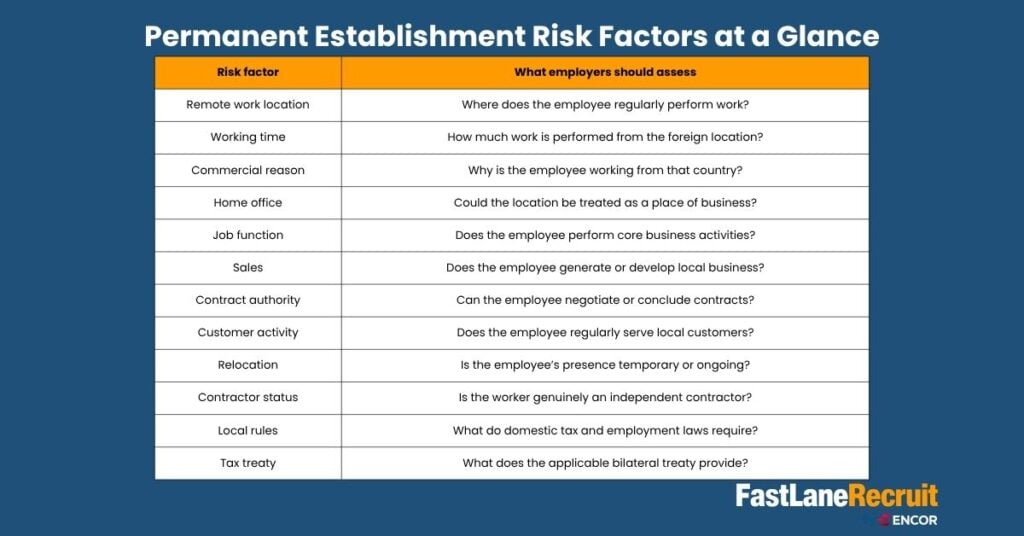
| Risk factor | What employers should assess |
| Remote work location | Where does the employee regularly perform work? |
| Working time | How much work is performed from the foreign location? |
| Commercial reason | Why is the employee working from that country? |
| Home office | Could the location be treated as a place of business? |
| Job function | Does the employee perform core business activities? |
| Sales | Does the employee generate or develop local business? |
| Contract authority | Can the employee negotiate or conclude contracts? |
| Customer activity | Does the employee regularly serve local customers? |
| Relocation | Is the employee’s presence temporary or ongoing? |
| Contractor status | Is the worker genuinely an independent contractor? |
| Local rules | What do domestic tax and employment laws require? |
| Tax treaty | What does the applicable bilateral treaty provide? |
What Are the Risks of Permanent Establishment?
A PE finding can create consequences beyond simply paying another tax.
Depending on the jurisdiction and circumstances, businesses may need to consider:
Corporate Tax Exposure
A permanent establishment can potentially give the host jurisdiction taxing rights over profits attributable to the PE.
This can create additional tax analysis, documentation, reporting, and compliance requirements.
Registration and Filing Obligations
A business may need to register with local authorities and comply with corporate tax or other reporting requirements.
Additional Compliance Costs
Managing obligations across multiple countries can require additional:
- Tax administration
- Accounting
- Payroll coordination
- Legal support
- Reporting
- Documentation
Payroll and Employment Issues
PE analysis is separate from employment compliance, but the two can overlap operationally.
A company hiring an employee abroad may also need to consider:
- Employment contracts
- Payroll withholding
- Social security
- Statutory benefits
- Leave requirements
- Termination rules
- Employment reporting
- Immigration and work authorization
Current 2026 analysis also emphasizes that PE exposure can interact with payroll and local reporting obligations, making cross-border hiring a broader compliance question rather than a corporate-tax issue alone.
How Does the 2025 OECD Update Affect Remote Work?
The OECD approved an update to its Model Tax Convention in November 2025 that added more detailed guidance on cross-border remote work. The changes clarify when a home or similar location may constitute a place of business for an enterprise.
One important element of the updated commentary is the consideration of how much time an employee works from the relevant location.
For example, the OECD provides an example where an employee works from a home in another country for 30% of their working time. In the absence of other facts indicating otherwise, that home would not be treated as the enterprise’s place of business for PE purposes. Another example considers an employee working from home for 80% of their working time while providing services to customers in that country; in that fact pattern, the commercial connection to the country becomes significant.
The OECD also explains that commercial reasons can include factors such as developing customers, identifying business opportunities, managing supplier relationships, providing services requiring physical presence, or facilitating business collaboration.
Important: The 50% Concept Is Not a Universal PE Safe Harbor
Employers should not interpret the updated OECD commentary as:
“Below 50% means there is no PE.”
That is too broad.
The 50% framework forms part of the OECD’s treaty interpretation guidance for relevant remote-work circumstances. Actual PE exposure still depends on the applicable treaty, domestic rules, facts, and other circumstances.
For companies hiring internationally, the appropriate approach is therefore risk assessment rather than relying on one numerical threshold.
Permanent Establishment vs. Employment Compliance
These concepts are closely related but should not be confused.
| Issue | Main question |
| Permanent establishment | Could the company’s activities create a taxable corporate presence? |
| Employment compliance | Can the worker legally be employed under local rules? |
| Payroll compliance | How should salary, withholding and statutory contributions be handled? |
| Social security | Which system applies and what contributions are required? |
| Immigration | Does the worker have the right to work in the country? |
| Worker classification | Is the person correctly classified as an employee or contractor? |
This distinction is important when choosing a global hiring model.
Avoiding PE does not automatically mean employment compliance is satisfied.
Likewise, having a compliant employment arrangement does not necessarily eliminate corporate tax exposure.
How Can Businesses Manage Permanent Establishment Risk?
Managing PE risk starts before the international hire is made.
Step 1: Assess the Country
Before hiring, review:
- Local employment rules
- Corporate tax rules
- Applicable tax treaties
- Payroll requirements
- Social security
- Immigration requirements
- PE considerations
Step 2: Assess the Role
Ask what the employee will actually do.
A useful internal assessment includes:
Where will they work?
How often will they work there?
Who will they serve?
Will they generate local revenue?
Will they negotiate contracts?
Will they have authority to represent the company?
Will they manage local operations?
Is their presence commercially necessary?
Step 3: Choose the Right Employment Structure
Businesses generally have several options:
- Employ through their own local entity
- Establish a subsidiary or branch
- Use an Employer of Record
- Use a genuine independent contractor where appropriate
- Delay hiring until the appropriate structure is established
The right choice depends on the company’s growth plans, headcount, role type, country, risk tolerance, and long-term strategy.
Step 4: Document the Arrangement
Maintain documentation covering:
- Employee location
- Role and responsibilities
- Employment structure
- Contract authority
- Business activities
- Working arrangements
- Relocation details
- Payroll and employment compliance
Good documentation can help businesses demonstrate how an international arrangement was structured and why.
Step 5: Review as the Business Grows
PE risk is not necessarily static.
A company that starts with one software engineer may later add:
- A sales manager
- A country manager
- Local customer support
- Multiple employees
- Local suppliers
- Local office space
- Revenue-generating activities
The appropriate employment structure should therefore be reviewed as the business expands.
EOR vs. Local Entity for Managing International Hiring
One of the most important decisions is whether to establish your own entity or use an Employer of Record.
| Factor | Employer of Record | Own Local Entity |
| Local entity owned by client | No | Yes |
| Initial setup | Generally faster | More involved |
| Employment administration | EOR manages local employment processes | Client manages directly |
| Payroll | Managed through EOR structure | Managed by client/entity |
| Local HR administration | Supported by EOR | Client responsibility |
| Best for | First hires, small teams, market testing | Long-term substantial presence |
| Control | Business manages day-to-day work | Direct employment structure |
| Long-term scalability | Useful for distributed hiring | Often suitable for established operations |
| Corporate tax/PE | EOR does not automatically eliminate PE | Entity provides an intentional local structure |
An EOR is therefore not simply a tax workaround.
It is an employment infrastructure solution that can help companies hire internationally without immediately creating their own employing entity in every country.
Can an EOR Eliminate Permanent Establishment Risk?
No, not automatically.
This distinction is critical.
An EOR can become the local legal employer and support employment-related processes such as:
- Employment contracts
- Payroll
- Statutory requirements
- Benefits coordination
- Employee onboarding
- Offboarding
- Local employment administration
But the client’s broader business activities can still matter for corporate tax and PE analysis.
For example, if an employee is responsible for significant revenue-generating activities or contract-related activities, putting that employee on an EOR arrangement does not necessarily make those activities irrelevant to PE analysis.
Current 2026 guidance from multiple professional and industry sources similarly emphasizes that an EOR can mitigate employment and local payroll complexity without serving as an automatic shield against corporate tax exposure.
So Why Use an EOR?
Because PE is only one part of international hiring.
A company may decide that an EOR is appropriate because it wants to:
- Hire an employee without immediately establishing a local entity
- Enter a new market faster
- Test a market before making a larger investment
- Build a small international team
- Simplify local employment administration
- Coordinate payroll across countries
- Reduce the administrative burden of managing multiple employment systems
- Access local employment infrastructure while maintaining control over the employee’s day-to-day work
The EOR does not remove the need for appropriate tax and legal analysis.
Instead, it can provide a structured employment foundation from which the business can expand.
Also Read: What Is an Employer of Record (EOR)?
When Should You Choose an EOR?
An EOR may be a practical option when:
You Are Hiring Your First Employee Abroad
Creating a subsidiary solely for one employee may be disproportionate to your immediate hiring needs.
You Are Testing a New Market
If you are evaluating market demand before establishing a permanent operation, an EOR can provide an employment structure without requiring immediate entity formation.
You Need to Hire Quickly
Entity establishment can involve incorporation, registrations, banking, accounting, tax, payroll, and ongoing administrative requirements.
An EOR can streamline the employment side of the process.
You Are Building a Distributed Workforce
Managing employees across multiple jurisdictions can become difficult when every country requires separate employment processes.
A multi-country EOR provider can give businesses a more centralized approach.
You Expect to Establish an Entity Later
An EOR does not have to be the final structure.
A company may begin with an EOR while assessing the market, then establish its own entity once headcount, revenue, and operational requirements justify the investment.
When Should You Consider Your Own Local Entity?
An EOR is not always the best long-term structure.
A local entity may become more appropriate when:
- You have significant headcount in the country
- The market is strategically important
- You expect long-term operations
- You need a substantial local office
- You are developing local management
- You conduct significant local commercial activities
- You need direct control over the local employing entity
- Your tax and corporate structure requires a local presence
The decision should be based on the company’s business model and growth trajectory, rather than simply the number of employees.
A Practical Decision Framework
Before hiring a remote employee internationally, ask these questions:
Question 1: Where will the employee work?
Identify the actual country and expected work location.
Question 2: What will the employee do?
Review the employee’s responsibilities, especially customer-facing, sales, management, and contract-related activities.
Question 3: How long will the arrangement last?
Temporary work, permanent relocation, and recurring cross-border work can create different considerations.
Question 4: Does the country have an applicable tax treaty?
Review the relevant treaty and domestic rules rather than relying on a general global rule.
Question 5: Do we need a local employment structure?
If the employee is genuinely an employee working abroad, determine how employment, payroll, benefits, and statutory obligations will be handled.
Question 6: Should we use an EOR or establish an entity?
Consider:
- Number of employees
- Expected growth
- Market importance
- Speed
- Cost
- Administrative capacity
- Long-term plans
Question 7: Has the arrangement changed?
Review the structure if the employee:
- Changes location
- Takes on sales responsibilities
- Begins managing local operations
- Gains contract authority
- Becomes customer-facing
- Relocates permanently
- Becomes part of a larger local team
This turns PE management into an ongoing business process rather than a one-time checklist.
How FastLaneRecruit Supports International Hiring
Once a company has decided that an EOR structure fits its international hiring strategy, the next challenge is finding a provider that can manage the employment side consistently across the target markets.
FastLaneRecruit provides EOR and global employment solutions for businesses hiring internationally without immediately establishing their own employing entity in each supported country. Its services can support employment contracts, payroll administration, statutory requirements, benefits coordination, and other local employment processes, depending on the country.
FastLaneRecruit currently supports EOR services across: Malaysia, Singapore, Hong Kong, China, India, Philippines, Taiwan, Vietnam, Australia, United Kingdom, Switzerland, UAE, Saudi Arabia, Qatar.
This multi-market coverage can be useful for businesses that are building a distributed workforce rather than hiring in only one country.
Why Businesses Choose FastLaneRecruit for EOR
Hire Without Establishing Your Own Entity
For eligible employment arrangements, an EOR can provide an alternative to establishing a client-owned company solely to employ workers in a new market.
Simplify Employment Administration
International hiring can involve contracts, payroll, statutory requirements, benefits, onboarding, and offboarding.
Using an EOR can centralize much of the employment administration.
Expand Across Multiple Markets
Businesses expanding across Asia Pacific, Europe, and the Middle East can use an EOR model across supported markets instead of coordinating an entirely separate employment structure for every initial hire.
Maintain Focus on the Business
The business remains responsible for managing the employee’s day-to-day work, performance, objectives, and business activities, while the EOR manages the employment-side infrastructure within the applicable local framework.
Build Before You Commit to an Entity
For companies testing a market or building a small initial team, an EOR can provide a practical employment structure while the business determines whether a permanent local entity makes commercial sense.
Permanent Establishment Risk Checklist for Employers
Before hiring a remote employee in another country, use this checklist:
- Identify the employee’s actual work location.
- Determine whether the arrangement is temporary, hybrid, or permanent.
- Review the employee’s expected working pattern.
- Assess whether the employee’s presence has a commercial reason.
- Review the employee’s job responsibilities.
- Identify sales and revenue-generating activities.
- Check whether the employee can negotiate or conclude contracts.
- Review customer-facing responsibilities.
- Consider whether the employee’s home could be relevant to PE analysis.
- Review applicable domestic tax rules.
- Review applicable tax treaties.
- Assess local employment and payroll requirements.
- Confirm immigration and work authorization requirements.
- Determine whether the worker should be an employee or contractor.
- Compare EOR and local-entity options.
- Document the employment structure.
- Reassess the arrangement when the employee’s role or location changes.
Final Decision: EOR, Local Entity or Another Structure?
There is no single international hiring model that works for every business.
If you are hiring one employee abroad, testing a market, or building a small distributed team, establishing a subsidiary may create more infrastructure than you need at the beginning.
If you have a significant and long-term business operation in a country, your own local entity may eventually provide a more suitable structure.
And if you need a practical way to employ workers internationally while you evaluate your market and growth plans, an Employer of Record can provide a structured employment solution without requiring your business to immediately establish its own employing entity.
The key is to separate three decisions:
Where will the employee work?
What will the employee do?
What employment structure best supports the business?
Permanent establishment risk should be evaluated as part of that decision, not after international hiring is already underway.
Hire Globally With a More Manageable EOR Structure
International hiring can open access to new talent and markets, but expanding across borders requires more than finding the right candidate. Employment structure, payroll, statutory requirements, benefits, immigration, and tax considerations all need to work together.
FastLaneRecruit provides EOR and global employment solutions across Malaysia, Singapore, Hong Kong, China, India, Philippines, Taiwan, Vietnam, Australia, United Kingdom, Switzerland, UAE, Saudi Arabia, and Qatar.
If you are planning your first international hire, expanding an existing remote workforce, or deciding between an EOR and establishing a local entity, talk to FastLaneRecruit about the employment structure that fits your expansion plans.
Ready to Hire Internationally?
Book a Free Consultation with a FastLaneRecruit Expert to discuss your target country, hiring needs, and EOR options.
Frequently Asked Questions About Permanent Establishment Risk for Remote Workforces
Can a remote employee create permanent establishment risk?
Yes, potentially. A remote employee does not automatically create a PE, but the employee’s working location, duration, activities, commercial purpose, authority, and applicable tax rules can affect the analysis.
Does working from home create permanent establishment?
Not automatically.
The OECD’s updated guidance specifically addresses when a home or similar location may constitute a place of business. Working time, commercial reasons, and other facts and circumstances are relevant.
Is the 183-day rule the same as permanent establishment?
No.
The 183-day concept is commonly associated with treaty rules for taxing employment income, but it should not be treated as a universal PE threshold. Permanent establishment is a separate corporate tax concept with its own applicable rules.
Can one employee create permanent establishment?
Potentially, yes.
The number of employees is not the only consideration. One employee performing certain activities in another country can potentially create tax exposure depending on the applicable rules and circumstances.
Does an EOR prevent permanent establishment?
An EOR can help manage the employment and payroll side of international hiring, but it does not automatically eliminate permanent establishment risk.
The company’s activities in the country remain relevant to corporate tax analysis.
Is EOR better than setting up a local entity?
It depends on the company’s circumstances.
An EOR may be suitable for first hires, small teams, market testing, or businesses that want to hire internationally before establishing their own entity.
A local entity may be more appropriate for a substantial and long-term market presence.
Can contractors create permanent establishment risk?
Potentially.
Contractor status does not automatically remove PE considerations. The actual activities performed by the contractor and the applicable rules should be assessed.
Can a remote sales employee create permanent establishment?
Potentially.
Sales, contract negotiation, contract conclusion, and other revenue-generating activities can be important factors in PE analysis. The precise outcome depends on the applicable jurisdiction and treaty.
Does permanent establishment mean the company has to open a subsidiary?
Not necessarily.
PE and a local legal entity are different concepts. A company can have a PE for tax purposes without having intentionally established a separate subsidiary.
How can businesses reduce permanent establishment risk when hiring abroad?
Businesses can start by assessing the employee’s location, role, working pattern, commercial purpose, contract authority, customer activity, and applicable tax rules. They should also establish an appropriate employment structure and review the arrangement as the business evolves.
Should I use an EOR for my first international employee?
An EOR can be a practical option when a company wants to hire internationally without immediately establishing its own local employing entity. Whether it is appropriate depends on the country, role, business activities, long-term plans, and applicable legal and tax considerations.