The global digital economy is facing a distinct paradox: while businesses desperately accelerate mobile transformation initiatives via AI, IoT, and cloud-native application ecosystems, the local supply of qualified mobile software engineers remains fiercely constrained. For talent acquisition specialists and CTOs, benchmarking the global app developer salary landscape is no longer just an HR exercise—it is a critical fiscal strategy.
When calculating engineering overhead, many corporate leaders make the mistake of looking strictly at base pay. However, the true cost to hire includes localized payroll taxes, mandatory benefits, compliance costs, and recruitment friction.
This comprehensive guide breaks down empirical, real-market compensation data collected over the past 36 months, contrasting traditional high-cost tech epicenters with the strategic cost-to-talent benefits available through US, Singapore, Hong Kong, Australia and Malaysia.
Content Outline
Key Summary
Premium Skills Drive Top-Dollar App Developer Salaries
Global compensation data indicates that developers with specialized cross-functional expertise—specifically matching mobile systems with AI frameworks and cloud infrastructure, command up to a 25% premium across all major tech regions.
The True Cost to Hire Far Exceeds Base Compensation
In premium tier-1 cities like New York, Singapore, and Sydney, localized overhead burdens including mandatory health care, local payroll taxes, 401(k) or superannuation matchings, and office infrastructure can swell your actual corporate expenditure to nearly double a developer’s net take-home pay.
Malaysia Offers the Premier Cost-to-Talent Geographic Arbitrage
While Western and mature APAC tech hubs battle intense localized wage inflation and critical software engineer shortages, Malaysia provides a vast pool of top-tier, highly specialized, and English-fluent engineering profiles at a dramatic structural discount.
Traditional Entity Setup Creates Strict Operational Friction
Attempting to tap into international engineering pools independently presents massive corporate roadblocks, exposing foreign enterprises to slow local registration times, expensive legal setup fees, and severe local statutory tax non-compliance penalties.
Strategic EOR Support De-Risks Cross-Border Engineering Growth
By utilizing a hyper-localized Employer of Record framework like FastLaneRecruit, international businesses can legally hire and seamlessly manage elite Malaysian application developers within days, bypassing foreign incorporation while maintaining absolute operational control.
Understanding App Developer Salary Structure In 2026
App Developer Salary is influenced by:
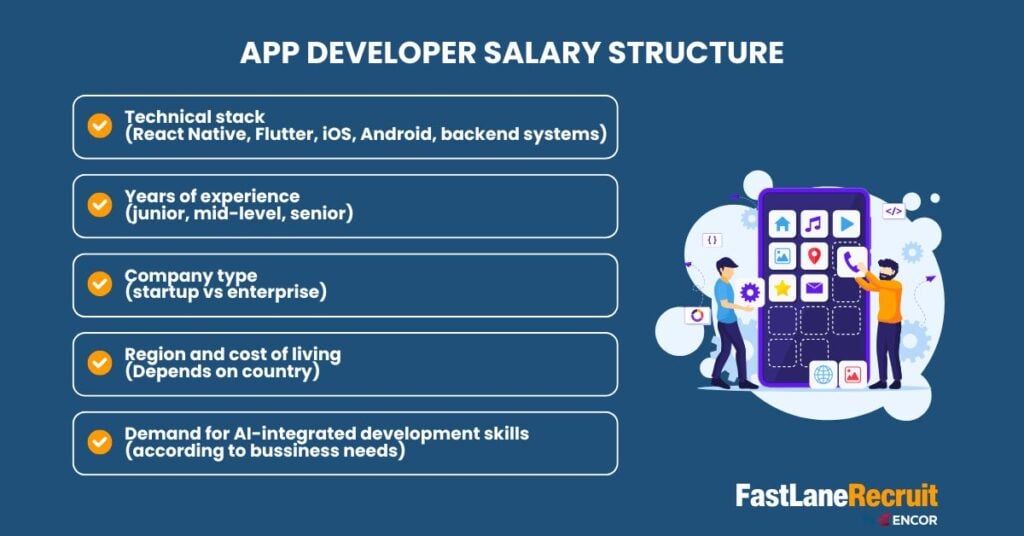
In 2026, developers with AI, mobile and cloud integration skills command premium salaries across all regions.
Global App Developer Salary Benchmark Matrix (2026)
To build an objective, data-driven framework for your engineering team’s expansion, we have compiled localized market values across five key regions. All native currencies have been normalized to USD for accurate corporate auditing.
| Country / Region | Seniority Level | Native Annual Base Range | Equivalent Annual Range (USD) | Additional Annual Variable Pay / Bonuses |
| United States (National Average) | Entry (0-2 yrs) Mid (3-5 yrs) Senior (6+ yrs) | $70,000 – $85,000 $105,000 – $125,000 $135,000 – $160,000 | $70,000 – $85,000 $105,000 – $125,000 $135,000 – $160,000 | Avg. $5,000 cash bonus + equity options |
| New York City, US (High-Cost Hub) | Entry (0-2 yrs) Mid (3-5 yrs) Senior (6+ yrs) | $78,200 – $90,000 $110,000 – $140,000 $143,500 – $189,600 | $78,200 – $90,000 $110,000 – $140,000 $143,500 – $189,600 | Significant wall street premium / variable performance bonuses |
| Singapore (APAC Hub) | Entry (0-2 yrs) Mid (3-5 yrs) Senior (6+ yrs) | SGD 43,000 – 55,000 SGD 88,000 – 120,000 SGD 140,000 – 170,000 | $31,600 – $40,500 $64,800 – $88,400 $103,100 – $125,200 | 13th-month AWS (Annual Wage Supplement) standard |
| Hong Kong (Fintech Hub) | Entry (0-2 yrs) Mid (3-5 yrs) Senior (6+ yrs) | HK$215,000 – 250,000<br>HK$290,000 – 350,000 HK$430,000 – 500,000 | $27,500 – $32,100 $37,100 – $44,700 $55,100 – $63,800 | Housing allowance variations & performance weightings |
| Australia (Sydney/Melb) | Entry (0-2 yrs) Mid (3-5 yrs) Senior (6+ yrs) | AU$58,000 – 70,000<br>AU$88,000 – 105,000 AU$115,000 – 130,000 | $37,800 – $46,000 $57,700 – $68,900 $75,300 – $85,100 | Compulsory superannuation (11.5%+) excluded from base |
| Malaysia (Arbitrage Hub) | Entry (0-2 yrs) Mid (3-5 yrs) Senior (6+ yrs) | MYR 38,000 – 50,000 MYR 58,000 – 75,000 MYR 82,000 – 95,000 | $8,100 – $10,600 $12,400 – $16,000 $17,500 – $20,200 | Highly competitive local medical insurance & performance scaling |
Deep-Dive Regional Market Analysis
United States and New York City: The Premium Cost of Local Talent
Sourcing directly out of the US market carries the highest global price tag. According to aggregated data from thousands of live job postings, the national average base salary hovers just under six figures at $99,733, but tier-1 tech cities like New York scale dramatically higher, tracking 22% above the national baseline.
In NYC, a senior platform developer regularly draws a base up to $189,627. When you factor in the True Cost to Hire, such as employer-paid healthcare premiums, 401(k) matching, FICA taxes, state unemployment insurance, and office space overhead, companies are paying nearly double the developer’s take-home pay. For startups and mid-market firms, this makes local engineering expansion highly restrictive.
Singapore and Hong Kong: The Dense Asian Banking Hubs
Both Singapore and Hong Kong serve as critical regulatory gatekeepers for international commerce and fintech. Singapore ranks at the top of Asian compensation matrices, where deep competition for senior iOS and Android engineers drives salaries to a peak of SGD 170,000 ($125,200 USD).
Hong Kong matches this competitive ecosystem closely, fueled by institutional banks building secure web3 and retail trading applications, pushing senior pay up to HK$500,000. While these hubs provide exceptional infrastructure, the hyper-inflated cost of local living directly compresses corporate hiring margins, forcing businesses to explore cross-border distributed teams.
Australia: Strong Protections and Superannuation Costs
Australia balances robust technical proficiency with high employment quality of life, placing mid-level mobile specialists around AU$105,000 ($68,900 USD). However, international companies looking to hire directly in Sydney or Melbourne frequently find themselves caught off guard by strict statutory benefits.
Employers must navigate mandatory Superannuation contributions (currently scaling past 11.5%), comprehensive worker compensation mandates, and stringent payroll tax thresholds that vary across states like New South Wales and Victoria.
Malaysia: The Core Engine of Software Talent Arbitrage
Malaysia offers a highly compelling combination of technical skill and economic efficiency. For comparison, a premier, enterprise-grade senior application developer in Kuala Lumpur earns up to MYR 95,000 annually, which translates to roughly $20,200 USD.
This means a business can secure top-tier, multi-platform engineering talent in Malaysia for less than the cost of an entry-level intern in New York or Singapore. Malaysian developers operate comfortably within English-speaking corporate environments, share overlapping time zones with major APAC business centers, and graduate from world-class, government-backed STEM institutions.
Also Read: Singapore vs Malaysia: Full Comparison for Business Expansion, Hiring Costs, and Workforce Strategy
Key Decision Insight for Employers
To help your leadership team make an informed, data-driven choice when scaling your technical workforce, look at how the real operational elements stack up globally:
Total Capital Expenditure Realities
When assessing the true financial commitment of expanding your team, consider these core markers:
- High-Overhead Hubs (US/NYC/Singapore): Direct employee acquisition forces companies to take on steep payroll tax burdens, mandatory premium medical insurance, and expensive employee onboarding setup.
- The Malaysia Arbitrage: Sourcing through a structured system in Malaysia bypasses these massive overhead pools. The total corporate expense remains predictable and contained.
Risk and Compliance Profiles
- Independent Entity Setup: Registering a business entity in a foreign country takes months, involves complex legal steps, and locks your enterprise into long-term corporate tax liabilities.
- The EOR Legal Shield: Leveraging a localized Employer of Record completely eliminates structural legal exposure. The local EOR entity assumes all statutory liabilities, allowing you to focus purely on code delivery and system deployment.
Why Companies Are Shifting to Malaysia for Development Teams
The massive shift toward building engineering and app development teams in Malaysia is not merely an exercise in cutting monthly expenses. Forward-thinking companies view Malaysia as a stable, high-yield digital hub that resolves the chronic technical talent shortages plaguing Western and mature APAC markets.
Deep Technical Specialization in High-Impact Stacks
Driven by national development frameworks like the New Industrial Master Plan (NIMP) and targeted investments via the Malaysia Digital Economy Corporation (MDEC), Malaysia’s engineering ecosystem has matured rapidly. Local software engineers are highly skilled in complex digital disciplines:
- Fintech & Secure Architecture: Thanks to Kuala Lumpur’s position as a major regional finance hub, developers are deeply experienced in building high-security mobile banking applications, payment gateways, and e-commerce infrastructure.
- AI and Machine Learning Integration: Backed by massive national investments in data center infrastructure, the country features a surging pool of developers fluent in cloud infrastructure, DevOps pipelines, and AI/LLM deployment.
- Cross-Platform Competency: Local talent regularly demonstrates native proficiency in hybrid systems (Flutter, React Native) alongside traditional iOS (Swift) and Android (Kotlin) tracks, giving organizations broader project agility.
Fluent English and Seamless Cross-Border Integration
Communication breakdown is the primary reason why standard offshore software development projects fail. Malaysia ranks among the top nations in Asia for English proficiency. The workforce operates comfortably within international corporate environments, handling technical documentation, code sprints, and cross-border client updates without structural language barriers.
Unmatched Cost-to-Talent Purchasing Power Parity
Because the local cost of living in Kuala Lumpur or Penang is significantly lower than in New York, London, or Singapore, the local currency value allows foreign enterprises to access senior, elite engineering profiles for less than the price of a standard junior developer in high-cost hubs. Your company benefits from premium technical output while maximizing structural capital efficiency.
Structural Bottlenecks of Traditional Cross-Border Hiring
While the financial logic of targeting lower-cost talent markets like Malaysia is clear, executing an offshore expansion strategy independently presents major operational risks:
- Entity Establishment Barriers: Most nations require a foreign firm to incorporate a local legal subsidiary, establish native bank accounts, and register with tax agencies simply to run a compliant monthly payroll. This setup process can take months and cost thousands in upfront legal fees.
- Foreign Statutory Complexities: In Malaysia, employers must strictly manage monthly statutory accounts, including the Employees Provident Fund (EPF), Social Security Organization (SOCSO), and Employment Insurance System (EIS). Failing to calculate these accurately can result in severe compliance fines.
- Employment Contract Vulnerabilities: Drafting cross-border employment documents without local legal counsel exposing your organization to sudden termination disputes, intellectual property leaks, and regulatory audits.
Also Read: Hiring Malaysian Talent: Employer of Record Malaysia Guide for Australian Companies
Conclusion
The numbers in 2026 make it clear: scaling software development teams entirely within high-cost local markets like New York, Singapore, or Sydney is an increasingly restrictive approach for growing enterprises. The true cost to hire an application developer in these regions extends far beyond basic wages, consuming critical capital that could be funneled into product R&D and market acquisition.
By strategically shifting your development initiatives to Malaysia, your business unlocks elite, English-fluent engineering talent capable of driving modern AI, mobile, and enterprise transformations.
You don’t need to take on the administrative burdens, legal friction, or upfront costs of opening an overseas corporate entity to capture this advantage. Partnering with a dedicated, local expert like FastLaneRecruit lets you securely onboard top-tier Malaysian app developers onto a fully compliant, managed local payroll system within days. Protect your margins, eliminate compliance risks, and accelerate your development cycles.
Streamline Your Tech Team Expansion Across Asia and the UAE
Don’t let talent shortages, rising labour costs, or cross-border hiring complexities slow your business growth. Access highly skilled technology professionals across Malaysia, Hong Kong, Singapore, China, the United Arab Emirates (UAE), and Taiwan while ensuring full compliance with local employment regulations.
FastLaneRecruit‘s Employer of Record (EOR) services enable you to hire software developers, engineers, and other technology talent quickly without the need to establish local legal entities. We take care of employment, payroll, onboarding, statutory compliance, and HR administration, so your team can focus on building great products.
Contact FastLaneRecruit today for a transparent consultation and tailored workforce solution designed to support your international hiring strategy.
Scale Your Tech Team with Confidence — Partner with FastLaneRecruit Today
Frequently Asked Questions (FAQ)
What is the true cost of an app developer beyond their base salary?
The true cost of hiring an app developer generally runs 1.2 to 1.4 times their agreed base salary. This margin covers essential payroll burdens, including corporate health insurance contributions, retirement matching (like 401k or EPF), national social security taxes, and onboarding software provisions.
Can an international firm hire a developer in Malaysia without a local corporate setup?
Yes. By deploying an exclusive Employer of Record (EOR) provider like FastLaneRecruit, an international enterprise can legally onboard full-time Malaysian app developers. The EOR hosts the talent on its local payroll, shielding the parent firm from direct regulatory exposure.
Is Malaysia A Good Place To Hire App Developers?
Malaysia offers an elite balance of advanced infrastructure, widespread professional English fluency, and strong intellectual property enforcement, backed by highly competitive localized salary baselines. This creates a more reliable environment for enterprise-grade product deployment compared to more volatile outsourcing markets.
Which Country Pays App Developers The Most?
The United States offers the highest salaries, followed by Australia and Singapore.
How Much Does It Cost To Hire A Remote App Developer?
Total cost depends on salary, benefits, and hiring structure. Remote hiring in Malaysia can reduce costs by up to 60% compared to Western markets.
What Is The Cheapest Country To Hire App Developers?
Among the listed regions, Malaysia is the most cost-effective while maintaining strong talent quality.
Why Use Employer Of Record (EOR) Services?
EOR allows companies to hire internationally without opening a local entity, reducing legal and administrative complexity.