The comparison between Singapore and Malaysia is no longer a simple question of “which country is better.” Instead, it reflects how modern companies design regional workforce architecture in Southeast Asia.
Businesses expanding across borders must evaluate:
- Cost efficiency of hiring structures
- Availability of skilled talent
- Speed of market entry
- Legal complexity of employment
- Long-term scalability of workforce operations
In practice, Singapore and Malaysia serve different but complementary roles in regional business strategy. One functions as a high-value strategic hub, while the other operates as a scalable execution hub.
This guide provides a structured breakdown to support informed hiring and expansion decisions.
Content Outline
Key Summary
Singapore = high-cost strategic hub
Singapore is typically positioned as a premium regional headquarters location, offering strong governance, infrastructure, and access to capital. However, it comes with significantly higher employment and operational costs compared to neighbouring markets.
Malaysia = scalable execution hub
Malaysia provides a cost-efficient and talent-rich environment for scaling operational teams. It is increasingly used by regional companies to house shared services, customer support, finance, and back-office functions.
Hiring cost gap is structurally significant
The cost difference between Singapore and Malaysia is not marginal—it is structural. Salary benchmarks, statutory contributions, and overheads collectively create a wide gap that directly impacts long-term workforce planning.
Hybrid workforce models deliver highest efficiency
Companies combining strategic roles in Singapore with execution teams in Malaysia typically achieve better cost control, operational resilience, and access to broader talent pools.
EOR enables faster, lower-risk expansion
Employer of Record (EOR) models allow companies to hire in Malaysia without establishing a local entity, reducing setup time, compliance burden, and market entry risk while maintaining workforce flexibility.
Why Companies Are Comparing Singapore vs Malaysia for Business Strategy
Businesses expanding in Southeast Asia typically compare Singapore and Malaysia because they represent two fundamentally different workforce economics within the same region.
Singapore: High-Cost Strategic Business Hub
Singapore is widely used as:
- Regional headquarters (ASEAN HQ)
- Financial and investment hub
- Legal and compliance base
- Executive decision-making center
However, this comes with structural realities:
- High salary benchmarks across all roles
- Strong competition for talent
- Elevated cost of employment and operations
- Limited scalability for large workforce expansion
Key implication:
When we overlook Singapore vs Malaysia, Singapore is best suited for strategic, high-impact, and leadership functions, not mass hiring.
Malaysia: Scalable Talent and Operations Hub
Malaysia is increasingly used as a workforce scaling destination due to:
- Lower employment costs
- Large and diverse talent pool
- Strong English-speaking workforce
- Competitive technical and support capabilities
- Proximity to Singapore and ASEAN markets
Key implication:
Malaysia is ideal for execution-heavy, scalable, and cost-sensitive roles.
Core Business Insight
Companies are not choosing between the two—they are separating roles:
Singapore = strategic control
Malaysia = operational scalability
This distinction is the foundation of modern ASEAN workforce design.
Economic Structure: Why Singapore and Malaysia Differ Fundamentally
Singapore: High-Productivity, High-Cost Economy
Singapore is one of the most advanced economies in Asia, characterized by:
- High GDP per capita
- Strong financial and technology sectors
- Global headquarters ecosystem
- Highly productive but expensive labor market
Business implication:
Singapore is optimized for decision-making, capital management, and strategic leadership functions, rather than cost-sensitive workforce scaling.
Malaysia: Scalable, Talent-Rich Emerging Economy
Malaysia offers:
- Large workforce population (~33M)
- Competitive salary structure
- Strong English proficiency
- Expanding digital and service industries
Business implication:
Malaysia is optimized for execution, operational scaling, and offshore team development.
Also Read: Why Malaysia Is an Ideal Hub for HRIS and HR Tech Talent
Hiring Cost Comparison: Structural Gap Between Singapore vs Malaysia
Core cost dynamics
Companies typically observe:
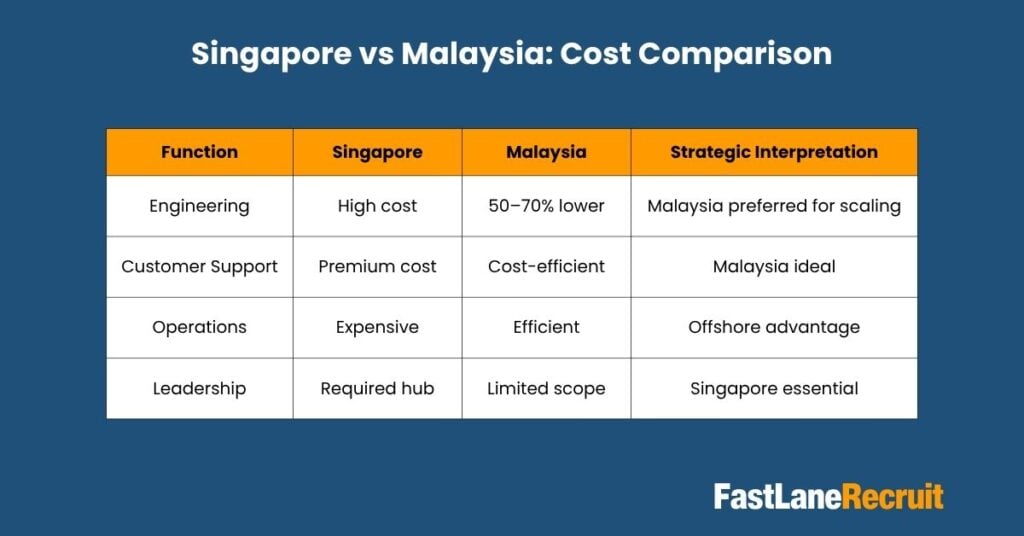
- Singapore roles cost significantly more than Malaysia
- Higher employer contributions and compliance costs in Singapore
- Greater operational overhead per employee in Singapore
Singapore vs Malaysia Role-Based Comparison
Key Insight
Singapore concentrates high-value talent, while Malaysia provides scalable workforce capacity.
Malaysia vs Singapore for Business Expansion Strategy
Singapore as a Strategic Hub
Used for:
- Regional headquarters
- Investor relations
- Legal and tax structuring
- Executive leadership
Malaysia as an Execution Hub
Used for:
- Engineering teams
- Shared services
- Customer support operations
- Back-office functions
Structural Interpretation
Successful companies use both markets simultaneously instead of choosing one.
Workforce Strategy: The Hybrid Singapore–Malaysia Model
Singapore = Strategic Layer
- Leadership
- Governance
- Strategy
- Investor-facing roles
Malaysia = Operational Layer
- Engineering
- Customer operations
- Support teams
- Scalable delivery functions
Why this model works
- Lower total workforce cost
- Faster scaling capability
- Better access to operational talent
- Reduced dependency on high-cost hiring markets
Company Incorporation vs EOR in Malaysia
Company Incorporation
Requires:
- Legal entity setup
- Payroll infrastructure
- Compliance management
- Long setup timeline
Limitations:
- High upfront cost
- Slow hiring process
- Operational complexity
Employer of Record (EOR)
Allows companies to:
- Hire without legal entity
- Onboard talent quickly
- Ensure full compliance
- Scale flexibly
Strategic Comparison
| Factor | Incorporation | EOR |
| Speed | Slow | Fast |
| Cost | High setup | Low upfront |
| Flexibility | Limited | High |
| Compliance | Internal | Managed |
EOR is the most efficient entry strategy for hiring in Malaysia without operational friction.
FastLaneRecruit: EOR Solution for Malaysia Expansion
FastLaneRecruit enables companies to:
- Hire employees in Malaysia without entity setup
- Reduce hiring costs vs Singapore
- Ensure compliance with Malaysian employment laws
- Scale teams across ASEAN efficiently
Ideal for:
- Startups expanding into Southeast Asia
- SMEs building offshore teams
- Enterprises optimizing workforce cost structures
Decision Framework: Where Should Companies Hire?
Choose Singapore if:
- You need HQ and leadership presence
- You require investor-facing operations
- You are building strategic governance functions
Choose Malaysia if:
- You want cost-efficient hiring
- You need scalable operational teams
- You require faster hiring cycles
Conclusion: The Real Decision Behind Singapore vs Malaysia
The Singapore vs Malaysia comparison is not simply about cost or geography—it is about how businesses structure growth itself.
Companies that rely solely on Singapore often face limitations in scaling operational teams due to high employment costs and competitive talent constraints. On the other hand, companies that leverage Malaysia gain access to a large, cost-efficient, and capable talent pool, but may lack the strategic headquarters advantages that Singapore provides.
The most effective regional strategy is not substitution but role-based distribution:
- Singapore anchors strategy, governance, and leadership
- Malaysia drives execution, scalability, and operational efficiency
- EOR bridges the gap by removing the friction of entity setup and enabling rapid hiring
This structure allows businesses to expand faster, control costs more effectively, and adapt to market demands without being constrained by legal or operational bottlenecks.
For companies entering Southeast Asia, the decision is no longer “Singapore or Malaysia,” but rather:
How quickly can we build a structured, compliant, and scalable workforce across both markets?
Build Your ASEAN Workforce Strategically
FastLaneRecruit helps companies expand into Malaysia without the complexity of entity setup.
With Employer of Record (EOR) Malaysia, you can:
- Hire faster without incorporation
- Reduce hiring costs vs Singapore
- Scale teams flexibly across ASEAN
- Stay fully compliant with local regulations
Get in touch with us and start hiring in Malaysia today!
FAQs– Singapore vs Malaysia Business Expansion
Is Malaysia cheaper than Singapore for hiring?
Yes. Malaysia offers significantly lower salary and operational costs.
Why is Singapore more expensive?
Due to higher GDP per capita and strong talent demand.
Can I hire in Malaysia without a company?
Yes, through an Employer of Record (EOR).
Which is better for business expansion?
Singapore for HQ roles, Malaysia for scalable operations.
What is the fastest hiring method in Malaysia?
EOR allows hiring within days without entity setup.
Is EOR better than incorporation?
For speed and flexibility, EOR is typically more efficient.