Hiring internationally opens the door to new talent, markets, and business opportunities. But choosing the wrong Employer of Record (EOR) provider can turn a promising expansion into a costly operational challenge.
A provider may advertise extensive country coverage, competitive pricing, and simplified employment administration. The real differences become clearer when you examine its local employment arrangements, payroll processes, contractual responsibilities, and ability to resolve problems.
The right EOR provider should offer more than international hiring capabilities. It should provide clear responsibilities, transparent costs, reliable payroll administration, and country-specific employment support.
Before signing an agreement, use these 10 warning signs to evaluate potential EOR providers, identify risks, and determine whether a provider can support your international hiring plans.
Content Outline
Key Summary
Look Beyond Headline Pricing
A low monthly fee does not necessarily represent the total cost of employment. Ask for a complete breakdown of service fees, statutory employment costs, onboarding charges, and other applicable expenses.
Verify Local Employment Arrangements
Confirm which legal entity will employ your workers in each country and whether the proposed arrangement is appropriate for your hiring requirements.
Examine Compliance Responsibilities
Understand how the EOR handles employment contracts, payroll, statutory contributions, employee benefits, and termination procedures under applicable local requirements.
Evaluate Support and Payroll Reliability
Ask how payroll discrepancies, employee concerns, and urgent employment issues are handled, including escalation procedures and expected response times.
Review Contract and Exit Terms
Understand your contractual obligations, liability allocation, termination provisions, and employee-transition arrangements before committing to a provider.
Choose a Provider That Fits Your Expansion Plans
Prioritise the countries you need, the level of local expertise required, and the support your business will need as its international workforce grows.
What Are the Biggest Red Flags When Choosing EOR Providers?
The biggest warning signs include unclear pricing, vague explanations of local employment arrangements, unsupported compliance claims, unreliable payroll processes, and restrictive contract terms.
Not every provider will offer identical pricing, technology, or service models. The important question is whether the provider can explain its approach clearly and demonstrate that it meets your business requirements.
Use the following checklist to compare providers consistently.
| Red flag | What to investigate | Question to ask |
| 1. Unclear pricing | Additional fees and total employment costs | What is included in the monthly fee, and what is charged separately? |
| 2. Unclear local employment arrangements | Identity of the legal employer and operating model | Which entity will employ my worker in this country? |
| 3. Vague compliance responsibilities | Contractual obligations and local expertise | Who handles each employment and payroll responsibility? |
| 4. Limited country-specific knowledge | Local contracts, statutory requirements, and employment procedures | How do you manage employment requirements in this market? |
| 5. Unreliable payroll processes | Payroll cutoffs, validation, payments, and corrections | How do you prevent and resolve payroll errors? |
| 6. Poor customer support | Account ownership and escalation procedures | Who handles urgent issues, and how quickly are they addressed? |
| 7. Inadequate benefits administration | Mandatory benefits and agreed supplementary benefits | Which benefits are included, and how are they administered? |
| 8. Restrictive contract terms | Minimum commitments, termination, and transition | What happens if we end the agreement or change providers? |
| 9. Weak data protection and IP provisions | Personal information, access controls, and intellectual property | How are employee data and work-related IP handled? |
| 10. Unsupported promises | Verifiable service capabilities and documented commitments | Can you confirm these commitments in writing? |
Also Read: When to Use an Employer of Record: 7 Signs Your Business Needs an EOR
10 Red Flags to Watch for When Evaluating EOR Providers
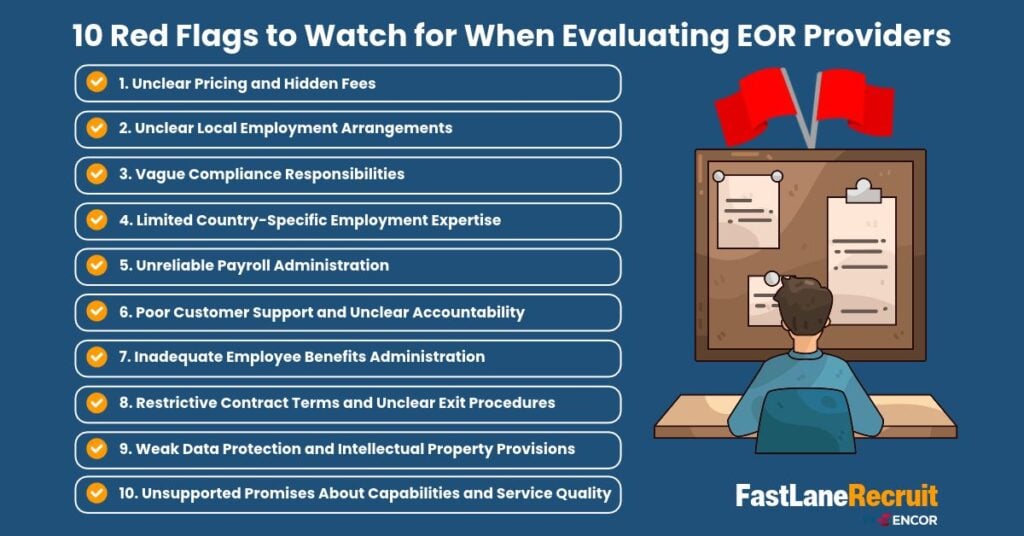
1. Unclear Pricing and Hidden Fees
Why it matters: International employment involves more than an EOR service fee. Statutory employer contributions, benefits, insurance, currency conversion, and other employment-related expenses may affect your total cost.
A provider that offers an attractive headline price but cannot explain the full cost structure makes it difficult to budget accurately.
What to look for
- Unexplained differences between quoted and invoiced amounts.
- Unclear distinctions between service fees and employment costs.
- Additional onboarding, offboarding, or administration charges that were not disclosed clearly.
- Unspecified currency conversion or international payment fees, where applicable.
- Unclear billing arrangements for benefits, insurance, or other supplementary services.
These charges are not automatically unreasonable. The warning sign is a lack of transparency about when they apply and how they are calculated.
Questions to ask EOR providers
- Is the service fee fixed per employee or calculated as a percentage of salary?
- Which statutory contributions and employment costs are billed separately?
- Are there onboarding, termination, or employee-transition fees?
- How are foreign exchange and payment charges calculated, where applicable?
- Can you provide an itemised quotation based on our intended hiring country and salary range?
Decision tip: Compare the estimated total monthly and annual employment costs, not just the advertised EOR fee. Ask for assumptions and exclusions in writing.
2. Unclear Local Employment Arrangements
Why it matters: An EOR arrangement depends on a suitable legal employment structure in the relevant country. Understanding who will employ your worker is fundamental to evaluating the provider.
Some EOR providers use their own local entities in certain markets, while others rely on third-party partners. A partner-based model is not automatically unsuitable, but you should understand how it works and who is responsible for each part of the service.
What to look for
- The provider cannot identify the proposed legal employer.
- Its explanation of local employment arrangements changes between discussions.
- It cannot explain how local employment contracts will be issued.
- The responsibilities of the provider and any local partner are unclear.
- It cannot provide appropriate documentation to substantiate its proposed arrangement.
Questions to ask EOR providers
- Which legal entity will employ our worker in the specific country?
- Is that entity operated by your organisation or a local partner?
- Who will sign the employment contract?
- Who handles payroll, statutory contributions, and employment administration?
- How are issues escalated if a third-party partner is involved?
Decision tip: Ask for country-specific confirmation rather than relying on a general statement that the provider operates globally. The relevant legal structure and responsibilities should be consistent with the service agreement and local requirements.
3. Vague Compliance Responsibilities
Why it matters: Employment obligations differ across countries and can change over time. An EOR should be able to explain how its services support the employment responsibilities assigned to it under the applicable arrangement.
However, engaging an EOR does not automatically eliminate every legal, tax, or operational risk for the client. Responsibilities depend on local law, the actual working arrangement, and the contractual allocation of duties.
What to look for
- Broad claims of guaranteed compliance without explaining the underlying processes.
- Unclear responsibility for employment contracts and statutory payments.
- No defined process for handling payroll discrepancies or compliance issues.
- Contractual exclusions that are difficult to reconcile with the proposed service.
- No clear explanation of how regulatory changes are communicated.
Questions to ask EOR providers
- Which employment and payroll responsibilities will your team handle?
- How do you monitor changes to local employment requirements?
- How are compliance issues identified, reported, and resolved?
- What responsibilities remain with our company?
- How are liability, indemnification, and dispute-resolution matters addressed in the agreement?
Decision tip: Review the actual service agreement and relevant country-specific employment documentation. Ask the provider to explain important exclusions before signing.
4. Limited Country-Specific Employment Expertise
Why it matters: A general understanding of international HR is not the same as practical knowledge of the employment requirements in a particular country.
Employment contracts, payroll administration, statutory contributions, benefits, and termination procedures can differ significantly between markets. A provider should be able to explain how its service addresses the requirements relevant to your planned hires.
What to look for
- Generic answers to country-specific employment questions.
- Uncertainty about applicable payroll or statutory processes.
- No clear process for preparing locally appropriate employment documentation.
- Inability to explain how country-specific requirements affect onboarding or offboarding.
- Country coverage claims that do not distinguish between available services and planned expansion.
Questions to ask EOR providers
- Do you currently support EOR employment in our intended hiring country?
- What local employment and payroll processes will you manage?
- How do you handle changes to statutory requirements?
- Which employment matters require additional specialist advice?
- Can you explain the onboarding process and documentation required for our proposed hire?
Decision tip: Evaluate the provider against your actual hiring countries and employee requirements. A provider’s overall geographic reach is less important than its ability to support the specific markets you need.
5. Unreliable Payroll Administration
Why it matters: Payroll errors can affect employee trust, create administrative rework, and lead to problems with statutory payments or reporting.
Before choosing an EOR, understand how the provider collects payroll inputs, validates calculations, processes payments, and corrects discrepancies.
What to look for
- Unclear payroll submission deadlines.
- No defined process for reviewing payroll inputs.
- Unexplained payroll discrepancies.
- No clear contact for urgent payment issues.
- Uncertainty about payslips, statutory deductions, or payroll reporting.
Questions to ask EOR providers
- What information must we submit before each payroll cutoff?
- How are salary changes, bonuses, and approved overtime handled?
- How are payroll calculations checked before payment?
- What happens if an employee is underpaid or a payment is delayed?
- What payroll reports and employee records will we receive?
Decision tip: Request a sample payroll calendar and a description of the discrepancy-resolution process. Confirm payment deadlines, correction procedures, and reporting responsibilities in advance.
6. Poor Customer Support and Unclear Accountability
Why it matters: An EOR relationship extends beyond onboarding. Your business may need assistance with payroll corrections, employment changes, employee questions, or complex offboarding situations.
A provider’s support model should be appropriate for the number of employees you plan to hire and the urgency of the issues it may need to resolve.
What to look for
- No clearly defined account contact or support channel.
- Unclear escalation procedures for urgent matters.
- Vague answers about response times.
- Repeated handoffs between teams without clear ownership.
- No explanation of how employee concerns are managed.
Questions to ask EOR providers
- Will we have a designated account manager or support contact?
- How should urgent payroll or employment issues be escalated?
- What response and resolution targets apply?
- Who supports employees with payroll and employment questions?
- How will we receive updates when an issue remains unresolved?
Decision tip: Assess the support process rather than relying solely on promises of excellent customer service. Ask for documented service commitments where appropriate and confirm who is accountable for resolving issues.
7. Inadequate Employee Benefits Administration
Why it matters: Employee benefits influence the overall employment experience and may include statutory entitlements as well as supplementary benefits offered by the employer.
The availability and requirements of benefits vary by country. A provider should distinguish between legally required entitlements, benefits included in its service, and optional benefits that may involve additional costs.
What to look for
- Unclear explanations of statutory benefits.
- Unspecified eligibility requirements or exclusions.
- Unclear administration fees for supplementary benefits.
- Limited information about insurance or benefits enrolment.
- No defined process for handling benefit changes or employee questions.
Questions to ask EOR providers
- Which statutory benefits and contributions apply to our employees?
- Which benefits are included in the quoted service?
- What optional benefits can be arranged, and what additional costs apply?
- How are benefit enrolment and changes administered?
- Who handles employee questions about benefits and eligibility?
Decision tip: Request a country-specific benefits summary and itemised pricing for any optional benefits your company wants to provide. Do not assume that the same benefits package applies across all countries.
8. Restrictive Contract Terms and Unclear Exit Procedures
Why it matters: Your business may eventually need to reduce its workforce, change providers, establish its own local entity, or adjust its international employment strategy.
The service agreement should explain the process and costs associated with ending or changing the arrangement.
What to look for
- Unclear minimum contract periods or renewal conditions.
- Unspecified notice requirements.
- Unclear termination or transition fees.
- No defined process for transferring employee records.
- Ambiguous responsibilities for employee offboarding and final payroll.
Questions to ask EOR providers
- What are the contract term, renewal, and notice requirements?
- Are there minimum employee commitments?
- What fees apply when employment or the service agreement ends?
- How are final salary, accrued entitlements, and other applicable payments handled?
- How will employee records and other necessary information be transferred if we change providers?
Decision tip: Review the commercial service agreement alongside the relevant employment arrangements. Ending an EOR service agreement does not necessarily end an employee’s employment automatically; the appropriate process depends on the circumstances and applicable local law.
9. Weak Data Protection and Intellectual Property Provisions
Why it matters: EOR arrangements involve employee information and may involve access to confidential business information, work products, and intellectual property.
Your provider should explain how personal information is handled and how contractual provisions address intellectual property and confidentiality.
What to look for
- Unclear responsibilities for employee data.
- No understandable explanation of data access or retention.
- Unclear arrangements with third-party service providers.
- Inadequate contractual provisions addressing confidentiality or intellectual property.
- No defined process for responding to data incidents or information requests.
Questions to ask EOR providers
- What employee information will you collect and process?
- How is that information protected, accessed, and retained?
- Which third parties may process employee data?
- How are confidentiality and intellectual property addressed in the relevant agreements?
- What procedures apply if a data incident occurs or information must be transferred?
Decision tip: Have the appropriate legal, privacy, or security specialists review relevant terms when the nature of your business or data requires it. Do not assume that an EOR agreement automatically resolves every data protection or intellectual property issue.
10. Unsupported Promises About Capabilities and Service Quality
Why it matters: Marketing claims can make different EOR providers appear similar. Your decision should be based on what a provider can actually deliver under the proposed service arrangement.
Promises about immediate onboarding, comprehensive country coverage, guaranteed compliance, or unlimited support should be assessed against the specific terms and operating model.
What to look for
- Country coverage that cannot be confirmed for your intended hire.
- Onboarding timelines presented without explaining their conditions.
- Broad guarantees without clearly defined responsibilities.
- Pricing or service commitments that are not reflected in the quotation.
- Reluctance to explain service limitations or provide relevant documentation.
Questions to ask EOR providers
- Can you confirm that our intended country and employment arrangement are supported?
- What documents and approvals are required before onboarding can begin?
- Which factors could delay the proposed start date?
- What service commitments are included in the agreement?
- What limitations, exclusions, or additional charges should we understand before signing?
Decision tip: Ask the provider to document important commitments, assumptions, and exclusions. A credible provider should be able to explain both its capabilities and the limitations of its service.
How to Compare EOR Providers Before Making a Decision
Identifying red flags is only the first step. You also need a consistent way to compare providers and determine which one fits your international hiring plans.
Step 1: Define Your Hiring Requirements
Document the countries where you intend to hire, the number of employees, expected salaries, proposed start dates, and the employment support you need.
Clarify whether you need EOR services, contractor management, payroll administration, or a combination of services.
Step 2: Confirm Country-Specific Capabilities
Ask each provider to confirm its current service availability and proposed legal employment arrangement for every country you need.
Do not assume that a provider supports every service in every country it lists.
Step 3: Compare the Full Cost
Request comparable quotations based on the same hiring scenario.
| Cost category | What to confirm |
| EOR service fee | Monthly fee, pricing model, and billing frequency |
| Employment costs | Salary, employer statutory contributions, and other applicable costs |
| Benefits | Included benefits and optional benefits charges |
| Onboarding and administration | Setup, documentation, and other applicable fees |
| Payroll and payments | Payment processing and currency conversion charges, where applicable |
| Offboarding | Termination administration and other applicable costs |
| Contract terms | Minimum commitments, notice periods, and early-exit charges, if any |
The exact cost categories will depend on the country, employment arrangement, and service agreement.
Step 4: Review the Agreement and Responsibilities
Confirm the legal employer, service scope, payroll responsibilities, compliance processes, liability provisions, data protection arrangements, and termination procedures.
Have qualified legal or tax advisers review complex issues when necessary.
Step 5: Assess Operational Support
Ask how the provider manages onboarding, payroll deadlines, employee questions, employment changes, and urgent issues.
Look for clearly defined processes and accountable contacts rather than relying on general service promises.
Step 6: Score Providers Against Your Priorities
Use a simple scorecard to compare the evidence provided by each shortlisted provider.
| Evaluation criterion | Suggested weighting |
| Country coverage and local employment arrangements | 25% |
| Compliance and payroll capabilities | 25% |
| Pricing transparency and total cost | 20% |
| Customer and employee support | 15% |
| Contract terms, data protection, and exit arrangements | 15% |
| Total | 100% |
These are suggested starting weights, not an industry-standard formula. Adjust them to reflect your company’s risk tolerance, hiring plans, and operational needs.
Score each criterion from 1 to 5, where 1 means the provider has not demonstrated that it meets the requirement and 5 means the evidence strongly supports its suitability.
Important: Do not allow a high overall score to compensate for a critical failure. If a provider cannot establish a suitable employment arrangement for your intended country, for example, resolve that issue before comparing less critical features.
Also Read: EOR Services: A Game Changer for Startup Growth
Why Businesses Choose FastLaneRecruit
Choosing an EOR provider requires more than comparing prices. Businesses need a partner that can support local employment administration, payroll operations, and the practical requirements of international expansion.
FastLaneRecruit provides Employer of Record services to help businesses employ talent internationally without establishing a local company in every market where they hire, where the EOR model is appropriate.
Local Employment and Regional Expertise
Our EOR services support businesses hiring across selected markets in Asia-Pacific, Europe, and the Middle East and Africa.
FastLaneRecruit operates in the following markets:
- Asia Pacific: Malaysia, Singapore, Hong Kong, China, India, Philippines, Taiwan, Vietnam, Australia,
- Europe: United Kingdom, Switzerland
- Middle East & Africa: UAE, Saudi Arabia, Qatar
Confirm service availability, the proposed employment arrangement, and the requirements for your specific hire with our team before proceeding.
Employment Administration and Payroll Support
FastLaneRecruit supports key employment administration processes, which may include:
- Locally appropriate employment contracts and onboarding documentation.
- Payroll processing and administration.
- Applicable statutory contributions and employment-related administration.
- Benefits administration within the agreed service scope.
- Ongoing employment administration and offboarding support.
The precise scope depends on the country, the employment arrangement, and the services agreed with the client.
A Practical Route to International Hiring
An EOR arrangement may help businesses hire in a new market without immediately establishing their own local entity.
This can be useful when testing a market, hiring an initial employee, or building a regional team before deciding whether to establish a local operation.
The right approach depends on your intended activities, workforce plans, local requirements, and long-term business strategy.
Clearer Service Scope and Cost Planning
Understanding the full cost and responsibilities of an EOR arrangement is essential to making an informed decision.
FastLaneRecruit can discuss your hiring requirements, explain the relevant service scope, and help you understand the costs and arrangements applicable to your intended markets.
Our goal is to help you evaluate your options with greater clarity before committing to an international employment arrangement.
Choose an EOR Provider With Greater Confidence
The right EOR partner should make international employment easier to manage by clearly explaining its local employment arrangements, service scope, pricing, and responsibilities.
Before committing, investigate potential warning signs, compare providers against the same requirements, and ensure that important commitments are documented.
FastLaneRecruit helps businesses navigate international employment through EOR services, payroll administration, and ongoing employment support across its operating markets.
Planning to hire internationally? Discuss your hiring countries, workforce requirements, and employment arrangements with our team to understand whether FastLaneRecruit’s EOR services are right for your business.
Book a Free Consultation with FastLaneRecruit to discuss your international hiring requirements.
Frequently Asked Questions About EOR Providers
1. What should I look for when choosing an EOR provider?
Look for confirmed country coverage, a suitable local employment arrangement, transparent pricing, clearly defined compliance responsibilities, reliable payroll processes, responsive support, and fair, understandable contract terms.
Ask providers to substantiate important claims and explain any limitations before signing.
2. What are the biggest red flags when comparing EOR providers?
Common warning signs include unclear pricing, an unidentified legal employer, vague compliance responsibilities, weak payroll procedures, inadequate customer support, restrictive exit terms, and unsupported service promises.
A warning sign should prompt further investigation. Assess the provider’s explanation and supporting documentation before deciding whether the issue is disqualifying.
3. How much do EOR providers charge?
EOR pricing varies by country, provider, service scope, employee circumstances, and contractual terms.
Some providers charge a fixed monthly fee per employee, while others use a percentage-based model or another pricing structure.
Compare the total expected cost, including applicable employment costs, benefits, administration charges, payment fees, and offboarding expenses, rather than relying on the headline service fee.
4. Are EOR providers responsible for employment compliance?
An EOR generally assumes specified legal employer responsibilities under the relevant employment arrangement and applicable local law. The exact allocation of responsibilities varies by country and contract.
The client may retain responsibilities relating to its business activities, workplace practices, management decisions, and other obligations. An EOR arrangement does not automatically eliminate all legal or tax risks.
5. Is it better to choose an EOR with local entities or a partner network?
Neither model is automatically best in every situation.
A provider’s own local entity may offer a more direct operating structure, while a partner network may provide broader coverage. Evaluate who legally employs the worker, how responsibilities are allocated, how issues are escalated, and whether the arrangement meets your requirements.
6. How can I tell whether an EOR provider is reliable?
Review the provider’s proposed employment arrangement, contract, pricing, payroll procedures, support model, and country-specific capabilities.
Ask for clear documentation and, where available, relevant references from businesses with similar requirements. Assess whether the provider gives specific, consistent answers to difficult questions.
7. What should an EOR service agreement include?
Depending on the arrangement, the agreement should clearly address service scope, fees, billing, the parties’ responsibilities, payroll administration, compliance processes, data protection, confidentiality, liability, dispute resolution, contract duration, termination, and transition arrangements.
The agreement should also explain how the EOR service agreement relates to the employee’s local employment contract.
8. Can I change EOR providers after hiring employees?
Changing providers may be possible, but the process requires planning.
You should confirm contractual notice requirements, outstanding fees, employee documentation, payroll continuity, data transfers, and the appropriate employment process in the relevant country.
A provider change does not automatically transfer an employee’s employment relationship. The transition must be structured in accordance with applicable law and the circumstances of the employment arrangement.
9. Is an EOR suitable for a company hiring only one employee overseas?
An EOR may be suitable when a business wants to hire one employee in a country where it does not have an appropriate local employing entity.
However, the decision should account for service costs, local requirements, the proposed role, the duration of employment, and the company’s longer-term plans.
10. Which countries does FastLaneRecruit support for EOR services?
FastLaneRecruit operates in Malaysia, Singapore, Hong Kong, China, India, the Philippines, Taiwan, Vietnam, Australia, the United Kingdom, Switzerland, the UAE, Saudi Arabia, and Qatar.
Service availability and the appropriate employment arrangement should be confirmed for your specific country and hiring requirements.