
Expanding into a new country can open the door to valuable talent and new business opportunities. However, the cost of hiring internationally involves more than an employee’s salary. Businesses must also account for local employment obligations, payroll administration, employee benefits, and the fees charged by an Employer of Record (EOR).
Understanding how much an EOR costs helps businesses plan their international hiring budgets, compare providers fairly, and avoid unexpected expenses as their teams grow.
EOR pricing varies depending on the provider, country of employment, employee compensation, and services included. Some providers charge a fixed monthly fee per employee, while others calculate their fees as a percentage of gross salary. Additional charges may also apply depending on the agreement.
This guide explains common EOR pricing models, compares flat fees with percentage-based pricing, identifies hidden costs to check, and outlines how businesses can evaluate an EOR quote before committing.
Content Outline
Key Summary
EOR service fees vary by provider and employment market
As an indicative market benchmark, published pricing and industry guides commonly place EOR service fees in the range of approximately US$600 per employee per month for many mid-market providers. Actual quotes may fall below or above this range depending on the provider, country, and service scope.
Flat fees and percentage-based pricing work differently
A flat monthly fee remains the same regardless of an employee’s salary. A percentage-based fee increases or decreases with the compensation used to calculate it.
The EOR service fee is not the total employment cost
Businesses must budget separately for gross salary, employer statutory contributions, mandatory benefits, and other applicable employment expenses.
Additional charges can increase the final bill
Setup, onboarding, offboarding, currency conversion, benefits administration, deposits, and specialized services may incur separate charges depending on the provider’s terms.
Compare complete quotes, not just advertised prices
The most suitable EOR provider should offer a clear breakdown of recurring fees, employment costs, additional charges, and contractual responsibilities.
How Much Does an EOR Cost Per Employee?
An Employer of Record typically charges a service fee for employing workers on behalf of a client company in another country. The fee generally covers agreed employment administration services, which may include local employment contracts, payroll processing, statutory administration, and benefits administration.
The exact services included depend on the provider’s agreement.
As a general budgeting reference, EOR service fees are often structured in one of three ways:
| Pricing Model | How It Works | Main Budget Consideration |
| Flat monthly fee | A fixed service fee per employee each month | Predictable provider fees as salaries change |
| Percentage of salary | A fee calculated as a percentage of an employee’s compensation | Fees increase as the compensation used in the calculation increases |
| Hybrid pricing | A base fee combined with additional service charges | The total depends on the base fee and the services used |
For example, an EOR provider charging a flat fee of US$1,000 per month in service fees for two employees, assuming the same rate applies to both.
This amount excludes their salaries, employer contributions, benefits, and any additional charges.
Important: These figures illustrate how EOR pricing works. They are not a quotation or representation of FastLaneRecruit’s service fees.
Flat Fee vs. Percentage of Salary: Which EOR Pricing Model Is Better?
Choosing between a flat fee and a percentage of salary can affect the long-term cost of international employment.
The right option depends on employee compensation, hiring volume, the provider’s contract, and how predictable you need your monthly expenses to be.
1. Flat-fee EOR pricing
Under a flat-fee model, the provider charges a fixed service fee for each employee every month.
For example, if the agreed EOR fee is US$450 whether that employee earns US$8,000 per month, assuming the contract does not impose additional charges.
Advantages
- Makes recurring EOR service fees easier to forecast.
- Keeps the service fee independent of salary increases.
- Can be attractive for senior or highly paid employees.
- Simplifies comparisons when hiring employees with different compensation levels.
Potential drawbacks
- May represent a relatively high percentage of salary for lower-paid employees.
- Additional services may still incur separate charges.
- The fixed fee does not eliminate changes in statutory contributions, benefits, or other employment costs.
Best suited for: Businesses prioritizing predictable service fees, particularly when hiring employees with higher salaries or planning long-term international teams.
2. Percentage-based EOR pricing
Under a percentage-based model, the provider calculates its service fee using an agreed percentage of an employee’s gross salary or another defined compensation base.
For example, a provider charging 10% of a US$400 in monthly service fees.
If the salary increases to US$600.
Advantages
- The fee adjusts with the compensation base.
- May be attractive for certain lower-paid roles, depending on the percentage charged.
- Can provide a straightforward relationship between salary and service fees.
Potential drawbacks
- Fees rise when the compensation base increases.
- Senior employees may generate substantially higher service fees.
- Bonuses, commissions, and other compensation may affect the calculation if included in the contract.
Best suited for: Businesses whose expected compensation levels and hiring plans make percentage-based pricing commercially attractive.
Before signing, confirm exactly which compensation components are included in the calculation.
3. Hybrid EOR pricing
A hybrid model combines a base service fee with additional charges for selected services or requirements.
For example, a provider may charge a monthly EOR fee and separately bill for immigration support, specialized benefits administration, or other services outside the standard agreement.
This structure can accommodate different service requirements, but businesses need to understand how additional charges affect the total budget.
Best suited for: Companies with specialized employment requirements or varying support needs across countries.
Flat Fee vs. Percentage of Salary: Cost Comparison
Consider two hypothetical employees and compare the service fees under the following assumptions:
- Flat fee: US$500 per employee per month.
- Percentage-based fee: 10% of gross monthly salary.
- No additional fees or discounts.
| Monthly Gross Salary | Flat EOR Fee | 10% Salary-Based Fee | Lower Service Fee |
| US$3,000 | US$500 | US$300 | Percentage-based |
| US$5,000 | US$500 | US$500 | Equal |
| US$8,000 | US$500 | US$800 | Flat fee |
Under these assumptions, both models produce the same monthly service fee at a salary of US$5,000.
Above that salary, the flat fee is lower. Below it, the percentage-based fee is lower.
Break-even formula:
Break-even monthly salary = Flat monthly fee ÷ Percentage rate
Using the example above:
US$5,000.
This calculation helps businesses compare pricing structures before requesting or accepting an EOR quote.
However, the lowest service fee does not necessarily represent the lowest total employment cost. The scope of services, statutory obligations, additional charges, and contractual terms must also be considered.
Also Read: When to Use an Employer of Record: 7 Signs Your Business Needs an EOR
What Factors Affect Employers of Record Costs?
EOR pricing varies because international employment requirements differ across markets and providers.
Understanding the main cost drivers helps businesses prepare a more realistic hiring budget.
1. Country of employment
Each country has its own employment laws, statutory contributions, tax requirements, and mandatory benefits.
These obligations affect the total cost of employing someone, even when the EOR’s service fee remains unchanged.
For example, employer contributions and mandatory employment benefits in one country may differ considerably from those in another.
What to check: Request a country-specific breakdown of employer contributions, mandatory benefits, and other employment expenses before finalizing your budget.
2. Employee salary and compensation structure
Salary directly affects total employment costs.
It can also influence the EOR service fee when a provider uses percentage-based pricing.
Bonuses, commissions, allowances, and other compensation components may affect the calculation depending on the contract and local requirements.
What to check: Confirm the compensation base used to calculate the EOR fee and identify any additional employer costs associated with the employee’s compensation package.
3. Employee benefits
Mandatory benefits and employer-sponsored benefits can increase the cost of employment.
Depending on the country and agreement, these may include health coverage, pension contributions, insurance, or other benefits.
Some providers include benefits administration within their standard service fee but charge separately for benefit premiums or optional coverage.
What to check: Separate the cost of administering benefits from the actual cost of providing them.
4. Number of employees
Hiring volume can affect the commercial terms available from an EOR provider.
Some providers may offer volume-based pricing or customized arrangements for larger teams, although discounts are not guaranteed.
The number of employees may also influence the administrative requirements of a project.
What to check: Ask for a quote based on your expected headcount and anticipated hiring timeline rather than relying exclusively on a single-employee starting price.
5. Scope of EOR services
Providers differ in the services included in their standard packages.
Depending on the agreement, services may include employment contracts, onboarding, payroll administration, statutory reporting, benefits administration, and offboarding support.
Specialized requirements may involve separate fees.
What to check: Compare providers using the same service requirements so that the quoted prices are commercially comparable.
6. Provider operating model
EOR providers may employ workers through their own local legal entities or work with local partners.
These arrangements can affect how services are delivered, how responsibilities are allocated, and how employment administration is managed.
The operating model alone does not determine whether a provider is cheaper or more reliable.
What to check: Ask which legal entity will employ your workers, who will manage local employment administration, and how the provider maintains compliance in each country.
Hidden EOR Costs Businesses Should Check Before Signing
An advertised monthly fee does not always represent the full cost of an EOR engagement.
Some additional charges are legitimate expenses associated with specific services. Others may be difficult to identify if the provider’s quote does not clearly explain its pricing structure.
Review the following items before signing an agreement.
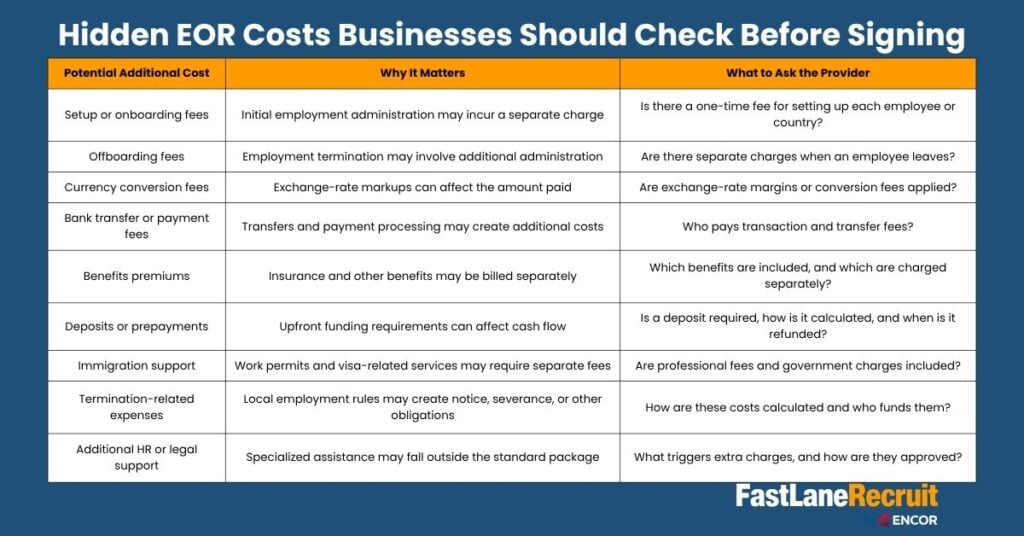
| Potential Additional Cost | Why It Matters | What to Ask the Provider |
| Setup or onboarding fees | Initial employment administration may incur a separate charge | Is there a one-time fee for setting up each employee or country? |
| Offboarding fees | Employment termination may involve additional administration | Are there separate charges when an employee leaves? |
| Currency conversion fees | Exchange-rate markups can affect the amount paid | Are exchange-rate margins or conversion fees applied? |
| Bank transfer or payment fees | Transfers and payment processing may create additional costs | Who pays transaction and transfer fees? |
| Benefits premiums | Insurance and other benefits may be billed separately | Which benefits are included, and which are charged separately? |
| Deposits or prepayments | Upfront funding requirements can affect cash flow | Is a deposit required, how is it calculated, and when is it refunded? |
| Immigration support | Work permits and visa-related services may require separate fees | Are professional fees and government charges included? |
| Termination-related expenses | Local employment rules may create notice, severance, or other obligations | How are these costs calculated and who funds them? |
| Additional HR or legal support | Specialized assistance may fall outside the standard package | What triggers extra charges, and how are they approved? |
Not every provider charges these fees, and their applicability depends on the service agreement and local requirements.
How to identify hidden costs in an EOR quote
Before agreeing to a contract:
- Request a complete breakdown of recurring and one-time charges.
- Confirm which services are included in the monthly fee.
- Ask whether the provider applies currency conversion margins or transaction fees.
- Clarify deposit requirements and the conditions for refunds.
- Review offboarding, notice, and termination-related provisions.
- Confirm which employment expenses are variable and how they are calculated.
- Ask how additional services are approved and invoiced.
The objective is not simply to find a provider with no additional fees. It is to understand the complete financial commitment before hiring.
How to Calculate the Total Cost of an EOR
To understand how much an EOR costs, separate the provider’s service fee from the other expenses associated with employment.
A useful budgeting formula is:
Total employment cost = Gross salary + Employer statutory contributions + Benefits and other employment expenses + EOR service fee + Applicable additional charges
The exact calculation depends on local employment requirements, the employee’s compensation, the services included in the contract, and the timing of payments.
Example: Calculating a monthly EOR budget
Assume a company plans to hire an employee with the following illustrative costs:
| Cost Component | Monthly Amount |
| Gross salary | US$4,000 |
| Employer statutory contributions and other employment expenses | US$600 |
| EOR service fee | US$500 |
| Additional monthly service charges | US$50 |
| Illustrative total monthly employment cost | US$5,150 |
Under these assumptions, the company’s total monthly employment cost would be US$5,150.
The EOR service fee is only US$500 of that amount.
The other figures are hypothetical and do not represent statutory rates or a quote for a particular country. Actual employer contributions, benefits, and additional charges must be calculated using the relevant country’s requirements and the agreed service terms.
What this calculation tells you
- The employee’s salary is a major component of the budget.
- Employer contributions and benefits can materially affect the final cost.
- The EOR service fee should be evaluated separately from employment expenses.
- Additional charges should be identified before calculating the total.
For accurate forecasting, ask providers to prepare a country-specific cost breakdown based on the employee’s expected salary, benefits, and employment arrangement.
EOR Costs vs. Establishing a Local Entity
An EOR and a locally incorporated entity serve different business needs.
An EOR allows a company to employ workers in a supported country without establishing its own local employing entity for that employment arrangement, subject to the relevant legal requirements.
Establishing a local entity gives a company a direct local corporate presence but may involve incorporation, registration, accounting, tax administration, payroll arrangements, and ongoing corporate compliance.
| Consideration | Hiring Through an EOR | Establishing a Local Entity |
| Initial setup | May avoid the need to establish a separate local employing entity | Requires incorporation and relevant registrations |
| Time to hire | May simplify the process when the EOR can onboard the employee | Hiring timelines depend on entity setup and operational readiness |
| Ongoing administration | EOR manages agreed employment and payroll administration | The business manages or outsources its own local administration |
| Employment costs | Includes EOR fees and applicable employment expenses | Includes employment expenses and the costs of operating the entity |
| Control over local operations | The client directs the employee’s day-to-day work, subject to the employment arrangement | The business operates through its own local entity |
| Long-term suitability | May suit market testing or teams that do not require their own entity | May suit businesses needing a direct local corporate presence |
An EOR is not automatically cheaper in every situation.
For a small team entering a new market, avoiding entity setup and ongoing administration may make EOR a practical option. For a larger, established operation, maintaining a local entity may be appropriate depending on long-term plans, commercial activities, and legal requirements.
How to decide: Compare the expected total costs over your intended operating period, including setup, recurring administration, employment expenses, and any eventual transition costs.
Also Read: Co-Employment Risk: What Businesses Need to Know and How an EOR Can Help
How to Choose an EOR Provider Based on Cost and Value
Price is an important factor when choosing an EOR, but it should not be the only consideration.
A provider’s ability to manage local employment requirements, deliver reliable payroll administration, and explain its contractual responsibilities also matters.
Use the following checklist when comparing proposals.
1. Compare the complete cost breakdown
Make sure each quote includes the same salary assumptions, employment location, benefits, and service requirements.
2. Confirm the legal employer
Identify the legal entity named in the employment contract and understand how the provider operates in the relevant country.
3. Understand the services included
Confirm whether employment contracts, onboarding, payroll administration, benefits administration, statutory reporting, and offboarding support are included.
4. Review additional fees and payment terms
Check currency conversion, transaction fees, deposits, termination provisions, and any charges for specialized services.
5. Assess local expertise and compliance processes
Ask how the provider monitors changes in employment requirements and manages local payroll and employment administration.
6. Evaluate service and communication
Confirm how payroll questions, employee issues, and urgent employment matters are handled.
7. Consider your long-term hiring plans
The best pricing structure for one employee may not be the most suitable arrangement for a team expanding across multiple markets.
A good EOR proposal should make the costs, service scope, and responsibilities clear enough for your business to make an informed decision.
Why Businesses Choose FastLaneRecruit for EOR Services
International hiring requires more than finding a provider with an attractive monthly fee. Businesses also need a clear understanding of local employment arrangements, payroll administration, and the responsibilities involved in employing workers across borders.
FastLaneRecruit provides Employer of Record services to support companies hiring employees in selected international markets.
Our supported markets include:
- Asia Pacific: Malaysia, Singapore, Hong Kong, China, India, Philippines, Taiwan, Vietnam, Australia,
- Europe: United Kingdom, Switzerland
- Middle East & Africa: UAE, Saudi Arabia, Qatar
EOR support for international employment
Through our EOR services, businesses can hire employees in supported markets without establishing their own local employing entity where the EOR arrangement is appropriate.
Depending on the applicable country requirements and agreed service scope, EOR support can include:
- Local employment contracts and employment administration.
- Payroll processing and statutory payroll administration.
- Benefits administration.
- Employee onboarding and ongoing employment support.
- Employment changes and offboarding administration.
The client company retains responsibility for directing employees’ day-to-day work, while FastLaneRecruit supports the agreed employment and administrative responsibilities.
The precise services and responsibilities depend on the country and service agreement.
Understand your EOR costs before you commit
Every international hiring plan has different requirements. The appropriate pricing arrangement depends on where you intend to hire, how many employees you plan to employ, their compensation, and the support your business needs.
Rather than comparing providers on their headline fees alone, evaluate the complete cost of employment and the services included.
Planning to hire internationally? FastLaneRecruit can help you explore EOR services for your target markets and understand the employment and payroll considerations involved.
Plan Your International Hiring Budget with FastLaneRecruit
Choosing an EOR is a financial and operational decision. The right arrangement should fit your hiring plans, provide clarity on employment costs, and support the administration required in each market.
Understanding the difference between flat-fee and percentage-based pricing is a useful starting point. Reviewing additional charges, statutory employment costs, and contractual responsibilities helps you make a more informed comparison.
FastLaneRecruit supports businesses hiring employees across selected markets in Asia-Pacific, Europe, and the Middle East.
Ready to explore international hiring?
Contact FastLaneRecruit to discuss your target countries, employment requirements, and EOR service options.
Book a Free Consultation with an Expert to explore an EOR arrangement aligned with your business needs.
Frequently Asked Questions About EOR Costs
1. How much does an EOR cost per employee per month?
EOR service fees vary by provider, country, and service scope. As an indicative benchmark, many mid-market providers publish fees of approximately US300–600 per employee per month, although actual prices can fall outside this range.
The service fee is separate from salary, employer contributions, benefits, and other applicable employment expenses. Request a tailored quote to understand your actual costs.
2. Is a flat-fee EOR cheaper than a percentage of salary?
It depends on the flat fee, the percentage rate, and the employee’s compensation.
A flat fee can be more economical for higher-paid employees, while a percentage-based model may cost less for lower-paid employees. Calculate the break-even salary using the provider’s actual rates before choosing a pricing structure.
3. What is included in an EOR service fee?
Depending on the agreement, the fee may cover employment contracts, payroll processing, statutory administration, benefits administration, and ongoing employment support.
Not every provider includes the same services. Confirm which activities are covered and whether any require additional payment.
4. What hidden fees should I look for in an EOR contract?
Review potential setup fees, onboarding and offboarding charges, currency conversion margins, transaction fees, deposits, benefits premiums, immigration support fees, and termination-related expenses.
Ask the provider to identify all applicable charges in writing before signing.
5. Does an EOR fee include employee salary?
Usually, the EOR service fee is separate from the employee’s gross salary.
The total employment budget generally includes salary, applicable employer contributions, benefits and other employment expenses, the EOR fee, and any additional charges.
Always confirm how the provider structures its invoices.
6. Does EOR pricing vary by country?
Yes. The provider’s fee and the total employment cost may vary by country.
Local statutory contributions, mandatory benefits, payroll requirements, currency considerations, and the provider’s operating arrangements can affect the overall cost.
7. Is using an EOR cheaper than setting up a local entity?
An EOR can reduce the need for initial entity setup and ongoing corporate administration, which may make it suitable for businesses entering a new market with a small team.
However, the most economical option depends on the expected hiring volume, operating period, local requirements, and the costs associated with each model.
8. Can businesses negotiate EOR pricing?
Some providers may offer customized pricing based on employee volume, hiring plans, contract duration, or service requirements.
Discounts and contract terms vary. Ask for a quote that reflects your expected headcount and compare the full service scope rather than focusing solely on the monthly fee.
9. How can I estimate the total cost of hiring through an EOR?
Start with the employee’s gross salary, then add employer statutory contributions, mandatory and agreed benefits, the EOR service fee, and applicable additional charges.
Request a country-specific cost breakdown so you can budget using the relevant employment requirements and actual provider terms.
10. How do I get an EOR cost estimate from FastLaneRecruit?
Prepare the country where you want to hire, the expected number of employees, their anticipated salaries, and any specific benefits or employment requirements.
Contact FastLaneRecruit to discuss your hiring plans, explore our EOR services in supported markets, and clarify the cost components relevant to your requirements.