Hiring internationally can give your business access to new talent, but managing employees across borders introduces a different set of responsibilities. Payroll is no longer just about calculating salaries and paying employees on time. Businesses must also consider local employment contracts, statutory contributions, tax requirements, employee benefits, and ongoing compliance.
For companies hiring overseas, the decision between managing payroll internally and using an Employer of Record (EOR) can affect operational costs, administrative workload, and the ability to enter new markets.
In-house payroll gives businesses direct control over their payroll operations, while EOR payroll allows them to employ workers in supported foreign markets through an EOR without establishing their own local employing entity, where legally appropriate. The right choice depends on your existing business structure, target countries, hiring plans, and available resources.
This guide compares in-house payroll vs EOR payroll to help you evaluate the differences, understand the costs and responsibilities, and choose an employment model that supports your business goals.
Content Outline
Key Summary
In-House Payroll Offers Direct Control
Businesses with an established local entity and sufficient HR, finance, and payroll resources may prefer to manage payroll internally. This provides direct oversight but requires the company to maintain the systems, expertise, and processes needed to meet local obligations.
EOR Payroll Supports International Hiring
An Employer of Record becomes the legal employer under the EOR arrangement and manages agreed employment responsibilities, including payroll administration and applicable statutory requirements. This can help businesses hire in supported countries without establishing their own local employing entity.
The Cost Difference Goes Beyond Payroll Fees
In-house payroll costs may include employee salaries for payroll administration, software, compliance support, and internal processing time. EOR costs typically include a service fee alongside employment-related costs such as salary, statutory contributions, and applicable benefits.
Compliance Responsibilities Depend on the Employment Model
Outsourcing payroll calculations does not automatically transfer the client’s legal employer responsibilities. Under an EOR arrangement, the EOR assumes applicable employer obligations, while the client generally directs the employee’s day-to-day work.
The Right Choice Depends on Your Expansion Plans
In-house payroll may suit businesses with established local operations. EOR can be a practical alternative for companies testing a market, hiring their first international employee, or building a team without immediately establishing a local entity.
What Is In-House Payroll?
In-house payroll is a model in which a company manages its own payroll operations using internal employees, payroll software, or a combination of both.
The company typically employs workers through its own legal entity and remains responsible for meeting applicable employer obligations. Its internal HR, finance, or payroll team calculates wages, manages deductions, processes payments, and maintains payroll records.
Businesses may also use external accountants or payroll software providers for specific tasks while retaining responsibility for the employment relationship and applicable legal obligations.
How Does In-House Payroll Work?
A typical in-house payroll process involves:
- Payroll data collection: Gathering working hours, attendance records, approved leave, overtime, and compensation changes.
- Salary calculations: Calculating gross pay, deductions, and net salary.
- Tax and statutory administration: Applying relevant tax withholding, social contributions, and other statutory requirements.
- Salary payments: Arranging employee payments according to the applicable payroll schedule.
- Payroll reporting: Preparing required reports, maintaining records, and reconciling payroll expenses.
- Ongoing maintenance: Updating payroll processes to reflect changes in employee information and applicable regulations.
For international operations, these activities may need to be repeated across several countries, each with different employment rules, reporting requirements, and payroll practices.
Advantages of In-House Payroll
Greater operational control: Internal teams can manage payroll schedules, reporting processes, and workflows according to the company’s requirements.
Direct access to payroll information: HR and finance teams can work directly with payroll data for budgeting, reconciliation, and workforce planning.
Potential efficiency at scale: Businesses with established entities, standardised processes, and sufficient payroll expertise may find internal management appropriate for a large workforce.
Integration with internal systems: In-house payroll can be integrated with existing accounting, HR, attendance, and financial reporting systems.
Challenges of In-House Payroll
Administrative workload: Payroll processing, reporting, reconciliations, and employee queries require ongoing resources.
Compliance management: The company must keep up with relevant employment, tax, and statutory requirements.
Multiple-country complexity: Managing payroll independently in several jurisdictions can require additional systems, local expertise, and processes.
Dependence on internal expertise: Errors or staff turnover can disrupt payroll operations if processes and specialist knowledge are concentrated in a small team.
Additional infrastructure for international expansion: Depending on the country and employment structure, the company may need an appropriate local entity and supporting infrastructure before employing workers directly.
Best suited to: Businesses with established local entities, dedicated payroll resources, and a preference for direct control over payroll operations.
What Is EOR Payroll?
EOR payroll is the payroll administration provided through an Employer of Record arrangement.
An Employer of Record (EOR) is a third-party organisation that legally employs workers on behalf of a client company in a particular country. The EOR enters into the employment relationship and manages applicable employer responsibilities under local law and the service arrangement.
The client generally retains responsibility for the employee’s day-to-day work, business objectives, and performance management.
Unlike a conventional payroll processing provider, an EOR does more than calculate wages or process payments. It provides the employment structure through which the worker is hired.
How Does EOR Payroll Work?
The process typically involves the following steps.
1. Select the employee
Your business identifies the candidate it wants to hire in a supported country.
2. Establish the local employment arrangement
The EOR prepares the employment contract and onboarding documentation according to applicable local requirements.
3. Complete onboarding
The EOR coordinates the necessary employment documentation and onboarding procedures.
4. Process payroll and applicable statutory requirements
The EOR manages agreed payroll activities, including salary processing, applicable tax withholding, statutory contributions, and relevant benefits administration.
5. Manage ongoing employment administration
The EOR supports recurring payroll and employment administration throughout the employment relationship.
6. Coordinate offboarding when required
If employment ends, the EOR supports the relevant administrative process, taking applicable contractual and local employment requirements into account.
Advantages of EOR Payroll
Hire without establishing your own local entity: An EOR may enable your business to employ workers in a supported country without creating a separate local employing entity.
Reduce internal administrative work: Your business can delegate agreed employment and payroll responsibilities to the EOR.
Access local employment expertise: An EOR helps manage country-specific employment processes and statutory requirements.
Support international market entry: Businesses can hire an initial employee or build a small team before deciding whether to establish their own local operation.
Coordinate employment across markets: Working with one EOR provider across multiple supported countries can simplify the administration of an international workforce.
What to Consider Before Choosing EOR Payroll
EOR services involve provider fees, and the client must still manage the employee’s work appropriately.
Businesses should also evaluate:
- The provider’s coverage in the target country.
- The scope of services and responsibilities covered by the agreement.
- The provider’s local employment expertise and operating structure.
- Payroll reporting, billing, and communication processes.
- The long-term suitability of the arrangement as the business grows.
An EOR does not eliminate every employment or compliance risk. Responsibilities depend on applicable law, the actual working arrangement, and the contract between the parties.
Best suited to: Businesses hiring internationally that want to employ workers in supported markets without immediately establishing their own local employing entity.
Also Read: Top 10 Best Outsourced Payroll Companies for Growing Business in 2026
In-House Payroll vs EOR Payroll: Key Differences
The main difference is the employment structure behind the payroll process.
With in-house payroll, the company generally employs workers through its own entity and manages payroll internally. With EOR payroll, the EOR becomes the legal employer under the arrangement and manages agreed employment responsibilities.
| Comparison factor | In-house payroll | EOR payroll |
| Legal employer | Generally the client company | The EOR under the employment arrangement |
| Local entity | Required where necessary for the company’s direct employment structure | May not be necessary for the client to establish its own local entity |
| Payroll management | Managed internally by the company | Managed by the EOR within the agreed service scope |
| Employment contracts | Issued by the client company | Arranged through the EOR |
| Statutory administration | Managed by the client or its appointed providers | Managed by the EOR within its applicable responsibilities |
| Internal workload | Requires internal resources and processes | Reduces the need to build internal local employment administration |
| Initial setup | Depends on existing infrastructure and local requirements | Depends on country requirements, documentation, and EOR onboarding |
| Cost structure | Internal payroll expenses and related operating costs | EOR service fees plus employment-related costs |
| Operational control | Direct employer control, subject to applicable law | Client generally directs day-to-day work; the EOR manages the employment relationship |
| International expansion | May require additional entities, systems, and local expertise | Can support hiring in countries where the client has no local employing entity |
| Scalability | Depends on internal capacity and infrastructure | Can support expansion across supported markets without requiring a separate client entity in each market |
| Long-term suitability | May suit established local operations | May suit initial market entry or international hiring without immediate entity setup |
Note: The precise allocation of responsibilities depends on the country, employment structure, and service agreement. An EOR is not simply a payroll processor, and outsourcing payroll alone does not transfer legal employer status.
In-House Payroll vs EOR Payroll Costs
Cost is often a major factor when choosing between in-house payroll and an EOR. However, comparing only the monthly payroll processing fee can produce an incomplete picture.
Businesses should evaluate the full cost of operating the employment structure, including internal resources, infrastructure, statutory obligations, and the administrative requirements of each country.
What Does In-House Payroll Cost?
The cost of in-house payroll depends on the size of the workforce, payroll complexity, existing systems, and the number of countries involved.
Potential cost components include:
- Payroll software and system subscriptions.
- Salaries and time allocated to HR, finance, and payroll administration.
- External accounting, tax, or employment compliance support.
- Payroll processing, reconciliation, and reporting.
- Training and updates required to maintain relevant expertise.
- Local entity establishment and maintenance where required for direct employment.
- Costs associated with correcting payroll errors or addressing compliance issues.
A company with an established payroll department may already absorb many of these expenses. A business hiring its first employee in a new country may need to build additional infrastructure.
What Does EOR Payroll Cost?
EOR payroll generally includes the provider’s service fee alongside the costs associated with employing the worker.
These may include:
- Employee salary and other agreed compensation.
- Employer-paid statutory contributions.
- Applicable employee benefits and insurance.
- EOR service fees.
- Other agreed employment-related expenses.
The precise fee structure varies by provider, country, and service scope.
Cost Comparison
| Cost factor | In-house payroll | EOR payroll |
| Payroll software | May require a separate subscription | Payroll administration is generally included within the agreed service |
| Internal administration | Requires internal staff time | Can reduce internal payroll and employment administration |
| Local expertise | Must be available internally or through advisers | Accessed through the EOR service |
| Entity setup | May be required for direct local employment | May be avoided where EOR employment is legally appropriate |
| Provider fees | May apply for software, advisers, or outsourced processing | EOR service fees apply |
| Employer contributions | Paid according to applicable law | Applicable employer contributions remain part of the employment cost |
| Cost predictability | Depends on internal systems and operating expenses | May be easier to budget when fees and service scope are clearly defined |
Which Option Is More Cost-Effective?
In-house payroll may be more cost-effective when your company already has an established local entity, sufficient payroll expertise, and systems that can accommodate additional employees without substantial new investment.
EOR payroll may be more practical financially when establishing a local entity would introduce significant setup, maintenance, and administrative requirements for a small or newly established international team.
Neither option is automatically cheaper. The appropriate comparison should include the full cost of the employment structure, not just the payroll processing fee.
Compliance and Legal Responsibilities: What Businesses Need to Know
Payroll compliance involves more than paying employees accurately and on time. Depending on the country and employment arrangement, businesses may need to address employment contracts, tax withholding, statutory contributions, benefits, recordkeeping, and other employer obligations.
The distinction between in-house payroll and EOR payroll is important because processing payroll and being the legal employer are different responsibilities.
Compliance Under In-House Payroll
When a company directly employs workers through its own entity, it generally retains responsibility for meeting applicable employer obligations.
The company must ensure that its payroll and employment processes reflect relevant local requirements. It may engage accountants, payroll processors, or legal advisers to support these activities, but outsourcing administrative tasks does not automatically transfer the company’s legal responsibilities.
Compliance Under EOR Payroll
Under an EOR arrangement, the EOR becomes the contractual legal employer and assumes applicable employer obligations within the relevant legal framework.
Depending on the country and service agreement, the EOR may manage:
- Locally compliant employment contracts.
- Payroll processing and salary payments.
- Applicable tax withholding and reporting.
- Statutory contributions.
- Relevant employee benefits administration.
- Employment documentation and onboarding.
- Ongoing employment administration and offboarding support.
The client generally manages the employee’s daily responsibilities and business performance.
An EOR can help businesses manage local employment requirements, but the arrangement does not guarantee that every risk disappears. The parties must understand their respective responsibilities, and the working relationship must comply with applicable law.
Why Country-Specific Compliance Matters
Employment and payroll requirements vary by jurisdiction. Rules governing statutory contributions, tax deductions, benefits, working time, leave, and termination may differ substantially between countries.
A payroll process that works in one market may not be suitable for another.
Before hiring internationally, businesses should confirm:
- Whether the intended employment arrangement is permitted.
- Which entity will legally employ the worker.
- Which party manages each employment and payroll responsibility.
- What statutory contributions and benefits apply.
- What records, reporting, and ongoing administration are required.
- Whether the provider supports the intended country and employment arrangement.
For country-specific decisions, consult relevant government guidance or qualified local advisers.
When Should You Choose In-House Payroll?
In-house payroll may be the right choice when your business has the infrastructure, expertise, and operating requirements to manage payroll directly.
Consider in-house payroll if:
- You already have an established local entity. Your company has the appropriate structure for direct employment.
- You have experienced payroll staff. Your internal team can manage payroll calculations, reporting, and applicable compliance requirements.
- You need direct control over payroll processes. Your business has specific reporting, integration, or approval requirements.
- Your existing systems can accommodate growth. Additional employees can be managed without disproportionate administrative costs.
- Your long-term operations are established in the market. You expect to maintain a significant local workforce and have a clear reason to operate through your own entity.
Example: An Established Local Employer
A company already employing 200 workers through its local entity may have an experienced payroll team, established software, and reliable reporting processes.
If the company plans to hire additional employees in the same country, expanding its existing payroll operation may be more appropriate than engaging an EOR solely for payroll administration.
The decision should still account for changes in payroll complexity, internal capacity, and applicable requirements.
When Should You Choose EOR Payroll?
EOR payroll may be more suitable when your business needs to employ workers in another country but does not want to establish its own local employing entity immediately.
Consider EOR if:
- You want to hire your first employee in a foreign market. You need a practical employment structure without immediately creating a local entity.
- You are testing a new market. You want to assess business opportunities before making a larger investment in local infrastructure.
- You need access to local employment expertise. Your internal team does not have the resources to manage another country’s employment requirements independently.
- You want to reduce administrative complexity. You prefer to delegate agreed employment and payroll processes to a specialist provider.
- You are building a distributed team. You need employment support across multiple countries covered by the same provider.
- You need to move forward without unnecessary infrastructure. Establishing a local entity may be disproportionate to your immediate hiring requirements.
Example: Hiring Without Establishing a Local Entity
Suppose a company based in Australia wants to hire a specialist in Singapore but does not have a Singaporean employing entity.
The company could evaluate establishing its own entity or using an EOR arrangement, subject to the relevant legal and business requirements.
With an appropriate EOR arrangement, the EOR can employ the specialist locally and manage agreed employment administration, including payroll and applicable statutory requirements. The client continues to direct the employee’s day-to-day work.
This can offer a practical route to hiring while the company evaluates its longer-term presence in the market.
Also Read: When to Use an Employer of Record: 7 Signs Your Business Needs an EOR
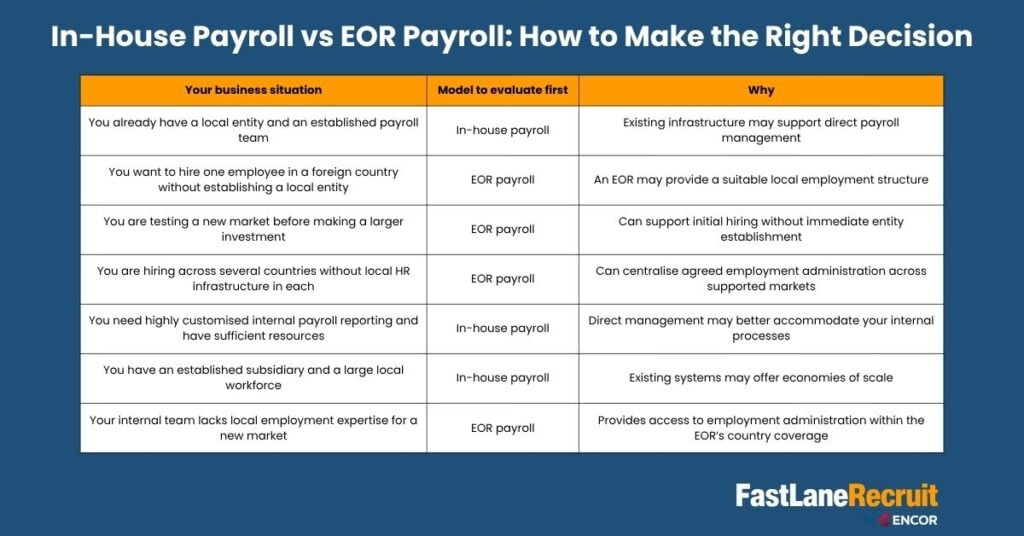
In-House Payroll vs EOR Payroll: How to Make the Right Decision
The right model depends on where you are hiring, your existing infrastructure, the number of employees involved, and your long-term business plans.
Use the following framework to assess your options.
| Your business situation | Model to evaluate first | Why |
| You already have a local entity and an established payroll team | In-house payroll | Existing infrastructure may support direct payroll management |
| You want to hire one employee in a foreign country without establishing a local entity | EOR payroll | An EOR may provide a suitable local employment structure |
| You are testing a new market before making a larger investment | EOR payroll | Can support initial hiring without immediate entity establishment |
| You are hiring across several countries without local HR infrastructure in each | EOR payroll | Can centralise agreed employment administration across supported markets |
| You need highly customised internal payroll reporting and have sufficient resources | In-house payroll | Direct management may better accommodate your internal processes |
| You have an established subsidiary and a large local workforce | In-house payroll | Existing systems may offer economies of scale |
| Your internal team lacks local employment expertise for a new market | EOR payroll | Provides access to employment administration within the EOR’s country coverage |
These are starting points, not universal rules. A business should assess local legal requirements, the provider’s service scope, and the full operating cost before making a final decision.
Questions to Ask Before Choosing
Before committing to either model, ask:
- Do we already have the appropriate legal entity for direct employment?
- How many employees do we expect to hire in this country?
- What are the total costs of establishing and maintaining the required infrastructure?
- Do we have the internal expertise to manage payroll and employment obligations?
- How much administrative work can our team reasonably absorb?
- Do we need a short-term market-entry solution or a long-term local operating structure?
- Does the provider support our target country and intended employment arrangement?
- How will we manage payroll reporting, employee support, and ongoing compliance?
Answering these questions can help you identify the employment structure that best fits your business requirements.
How FastLaneRecruit Supports International Hiring Through EOR Services
Expanding internationally should not require your internal team to build a separate employment administration process for every market before hiring talent.
FastLaneRecruit provides Employer of Record services to help businesses employ workers in supported countries without establishing their own local employing entity where the EOR arrangement is appropriate.
Our services support key employment processes, including:
- Local employment contracts: Arranging employment documentation in line with applicable country requirements.
- Payroll administration: Managing agreed payroll processes and salary payments.
- Statutory requirements: Supporting applicable tax-related administration and statutory contributions.
- Employee benefits: Coordinating relevant benefits according to local requirements and the agreed service scope.
- Employee onboarding: Managing employment documentation and onboarding procedures.
- Ongoing employment administration: Supporting employment-related processes throughout the employee lifecycle.
- Offboarding support: Coordinating the relevant administrative procedures when employment ends.
By working with an EOR provider, businesses can focus on day-to-day operations, employee performance, and growth while delegating agreed local employment responsibilities.
Countries Supported by FastLaneRecruit
FastLaneRecruit supports EOR services across the following markets:
- Asia Pacific: Malaysia, Singapore, Hong Kong, China, India, Philippines, Taiwan, Vietnam, Australia,
- Europe: United Kingdom, Switzerland
- Middle East & Africa: UAE, Saudi Arabia, Qatar
Country availability, onboarding requirements, and the scope of services should be confirmed with our team before proceeding.
Why Businesses Choose FastLaneRecruit
Choosing an EOR provider involves more than comparing service fees. Businesses need a partner that understands international employment administration, communicates clearly, and can support their intended markets.
Support Across Multiple Markets
FastLaneRecruit provides EOR services across 14 markets in Asia Pacific, Europe, and the Middle East, helping businesses explore international hiring through one service relationship.
Local Employment and Payroll Administration
We support employment contracts, payroll administration, applicable statutory requirements, benefits coordination, and onboarding based on the requirements of each supported country.
A Practical Route to International Hiring
An EOR arrangement can help businesses employ workers in supported markets without establishing their own local employing entity, where legally appropriate.
Support Throughout the Employment Lifecycle
Our services cover key employment processes, from onboarding and payroll administration to ongoing employment support and offboarding.
Clearer Employment Administration
Working with an EOR can reduce the need to coordinate multiple local employment administration processes independently. Businesses can discuss the service scope and fees with our team before proceeding.
A Solution Aligned With Your Expansion Plans
Whether you are hiring your first international employee or building a team across several countries, FastLaneRecruit can help you assess whether EOR is suitable for your intended markets and hiring requirements.
Ready to Simplify International Payroll and Employment?
Managing payroll internally may be appropriate when your business has established local operations and the resources to handle employment administration. But when you want to hire internationally without immediately establishing your own local employing entity, an Employer of Record may offer a more practical route.
FastLaneRecruit helps businesses manage international employment through EOR services, including employment contracts, payroll administration, applicable statutory requirements, employee benefits coordination, onboarding, and ongoing employment administration across supported markets.
Discuss your international hiring plans with our team to understand whether EOR is the right fit for your business.
Book a Free Consultation with an Expert
Share your target countries, hiring plans, and employment requirements with FastLaneRecruit. Our team can help you explore the available EOR options and understand the next steps for building your international workforce.
Frequently Asked Questions
1. What is the difference between in-house payroll and EOR payroll?
In-house payroll is managed by a company for employees it generally employs through its own entity. EOR payroll operates through an Employer of Record arrangement in which the EOR becomes the legal employer and manages agreed employment and payroll responsibilities. The main differences concern legal employer status, administrative responsibility, infrastructure, and cost.
2. Is EOR payroll the same as outsourced payroll?
No. Conventional payroll outsourcing generally involves a provider processing payroll for a client’s employees. An EOR also provides the employment arrangement and becomes the legal employer under that arrangement. Outsourcing payroll processing alone does not transfer legal employer status.
3. Is EOR payroll cheaper than in-house payroll?
Not necessarily. In-house payroll may be more economical when a company already has an established entity, payroll team, and systems. EOR may be more practical when the alternative involves establishing and maintaining a local employing entity for a small international team. A fair comparison should include service fees, internal costs, entity expenses, and employment-related costs.
4. Can I hire international employees without setting up a local company?
In many situations, an EOR can enable a business to employ workers in a supported country without establishing its own local employing entity. However, suitability depends on the country, the nature of the work, the employment arrangement, and applicable legal requirements.
5. Who is responsible for taxes and statutory contributions under EOR payroll?
The EOR manages the employer responsibilities allocated to it under the applicable legal framework and service arrangement, which may include payroll-related tax administration and statutory contributions. The precise obligations depend on the country and circumstances. The client should confirm the division of responsibilities with the EOR provider.
6. Does using an EOR eliminate employment compliance risks?
No. An EOR can help manage local employment administration and applicable employer obligations, but it does not eliminate every legal or operational risk. The parties must follow the applicable law, maintain an appropriate working arrangement, and understand their respective responsibilities.
7. When should a company switch from in-house payroll to EOR payroll?
A company may consider EOR when it plans to hire in a foreign market without establishing its own entity, lacks local employment expertise, or wants to reduce the administrative work associated with international hiring. The decision should reflect the company’s target market, workforce plans, costs, and long-term operating strategy.
8. Can a company move from EOR employment to its own local entity later?
Potentially, yes. A business may establish its own entity as its operations grow and assess whether employees should transition to the new structure. The transition requires careful planning, including applicable employment law, contracts, payroll, statutory obligations, and employee rights. It should not be treated as an automatic transfer.
9. Which countries does FastLaneRecruit support for EOR services?
FastLaneRecruit supports EOR services in Malaysia, Singapore, Hong Kong, China, India, Philippines, Taiwan, Vietnam, Australia, the United Kingdom, Switzerland, the UAE, Saudi Arabia, and Qatar. Contact our team to confirm availability and the requirements for your intended market.
10. How can I choose the right EOR provider for international hiring?
Compare country coverage, local employment expertise, service scope, payroll administration, statutory compliance processes, pricing transparency, onboarding procedures, and ongoing support. Ask the provider to explain its legal employer role and the responsibilities that remain with your company.