Hiring employees in another country opens the door to new talent and business opportunities. However, every new market brings its own employment laws, payroll procedures, tax obligations, and employee benefits requirements. Managing these responsibilities independently can quickly become complicated, particularly when a business expands across several countries.
Employer of Record (EOR) services help businesses employ international talent without establishing a local legal entity in every market. An EOR acts as the legal employer for eligible employees and manages employment administration, including payroll processing, applicable tax obligations, statutory contributions, and employee benefits within the scope of the arrangement.
FastLaneRecruit helps businesses navigate international employment through EOR services across selected markets in Asia Pacific, Europe, and the Middle East & Africa. Our approach supports businesses that want to hire internationally while managing local employment requirements through an established employment structure.
Understanding how EOR services manage payroll, taxes, and benefits can help you determine whether an EOR is the right solution for your international hiring plans.
Content Outline
Key Summary
EOR Services Simplify International Payroll
An EOR manages payroll administration for employees it legally employs, including salary calculations, applicable deductions, payment processing, and relevant payroll documentation.
Tax Administration Depends on Local Regulations
An EOR can administer applicable employment-related tax withholding, employer contributions, remittances, and reporting obligations. The specific requirements depend on the employee’s country and the employment arrangement.
Employee Benefits Must Meet Local Requirements
EOR services can support statutory benefits, social security contributions, and agreed supplementary benefits, depending on local law and the service arrangement.
Businesses Retain Day-to-Day Workforce Management
While the EOR manages the employment relationship and associated administration within its scope, the client company generally directs the employee’s day-to-day work, priorities, and performance.
EOR Services Can Support International Expansion
Businesses can use an EOR to hire eligible employees in supported markets without immediately establishing their own local employing entity.
The Right Employment Model Depends on Your Hiring Needs
EOR services are generally suited to businesses hiring employees internationally. Contractor management may be more appropriate for genuinely independent professionals engaged for specific projects or services.
What Are EOR Services?
Employer of Record services allow a business to employ workers in another country through a third-party organization that serves as their legal employer.
Instead of establishing its own local entity solely to employ someone, a company can engage an EOR to manage the employment arrangements in a supported market.
The EOR typically handles employment contracts, payroll administration, applicable statutory contributions, employee benefits, and other employment-related requirements within the agreed service scope.
Meanwhile, the client company generally retains responsibility for directing the employee’s daily activities, setting work priorities, and managing business performance.
How Does an Employer of Record Work?
An EOR establishes the local employment arrangement and manages the associated administrative responsibilities.
The process generally involves:
- Candidate selection: Your company identifies the employee it wants to hire.
- Employment arrangement: The EOR prepares an employment agreement appropriate to the applicable local requirements.
- Onboarding: The required documentation and employment procedures are completed.
- Payroll and benefits administration: The EOR processes payroll and administers applicable statutory contributions and agreed benefits.
- Ongoing employment support: The EOR supports relevant employment administration throughout the employee lifecycle.
The exact process depends on the employee’s location, applicable laws, and the services included in the arrangement.
When Should a Business Use EOR Services?
EOR services may be suitable when a business wants to:
- Hire its first employee in another country.
- Build a small international team before establishing a local entity.
- Test a new market without immediately creating a permanent local employment infrastructure.
- Employ distributed teams across multiple jurisdictions.
- Reduce the administrative burden of managing international employment independently.
- Access local employment and payroll expertise.
Also Read: What Does EOR Do? 10 Key Responsibilities of an Employer of Record
How Do EOR Services Manage Payroll?
International payroll involves more than transferring salaries to employees. Employers may need to account for local pay cycles, employment contracts, statutory deductions, employer contributions, payroll records, and reporting obligations.
EOR services help coordinate these responsibilities through an employment arrangement designed around the requirements of the employee’s country.
1. Salary Calculations and Payroll Processing
The EOR processes payroll based on the employee’s agreed compensation, employment terms, and applicable local requirements.
Depending on the arrangement, this can include:
- Calculating gross salary and applicable allowances.
- Accounting for approved bonuses, commissions, and other earnings.
- Applying required employee deductions.
- Calculating applicable employer contributions.
- Determining net pay.
- Processing salary payments according to the agreed payroll schedule.
Accurate payroll depends on complete employee records, approved compensation changes, and timely information from the client company.
2. Payroll Deductions and Statutory Contributions
Payroll deductions and employer contributions differ between countries.
Employees may be subject to income tax withholding, social security contributions, pension contributions, or other legally required deductions. Employers may also have separate contribution obligations.
An EOR helps administer the applicable requirements for employees it employs.
The exact deductions, contribution rates, reporting procedures, and deadlines must be determined according to the relevant jurisdiction and the employee’s circumstances.
3. Salary Payments and Payslips
Employees need accurate and timely compensation information.
As part of its payroll administration, an EOR may manage salary disbursements and provide payslips showing relevant earnings and deductions.
A payslip typically includes information such as:
- Gross earnings.
- Applicable allowances or additional payments.
- Employee deductions.
- Employer contributions, where required to be shown.
- Net salary payable.
- Pay period and payment details.
Payslip formats and disclosure requirements vary by country.
Clear payroll documentation helps employees understand their compensation and gives businesses better visibility into employment costs.
4. Payroll Records and Reporting
International payroll often requires accurate employment and payment records.
Depending on local requirements, an EOR may maintain payroll documentation, prepare required reports, and support the submission of applicable employment-related filings.
This can help businesses manage the administrative requirements associated with employing people in different countries without building a separate payroll process for every market.
Business benefit: EOR payroll services provide a structured way to manage international employee compensation while accounting for country-specific payroll requirements.
How Do EOR Services Manage Employment Taxes?
Employment taxes can create significant administrative challenges for businesses hiring internationally.
Tax systems differ in how income tax is withheld, which employer contributions apply, when payments must be remitted, and what reporting is required.
An EOR helps administer the employment-related tax obligations associated with employees it legally employs, subject to applicable laws and the agreed arrangement.
1. Employee Income Tax Withholding
Where required, the EOR calculates and withholds applicable income tax from employee compensation.
The amount withheld depends on the relevant country’s tax rules and may be influenced by factors such as earnings, residency status, tax allowances, and other legally recognized circumstances.
The EOR uses the required employee information to administer the relevant payroll process.
Employees remain responsible for meeting any personal tax obligations that fall outside the EOR’s responsibilities.
2. Employer Taxes and Statutory Contributions
Employers may be required to make contributions in addition to an employee’s gross salary.
Depending on the country, these obligations can include social security, pension, insurance, or other employment-related contributions.
An EOR can calculate and administer applicable employer contributions within its service scope.
These costs should be considered when budgeting for an international hire because the total employment cost may be higher than the employee’s gross salary alone.
3. Tax Remittances and Payroll Reporting
Withholding the correct amount is only part of the process. Applicable amounts may also need to be remitted to the relevant authorities, accompanied by required reporting.
An EOR helps manage the applicable payroll tax processes according to local rules, including relevant payment deadlines and documentation requirements.
The exact reporting obligations and allocation of legal responsibilities depend on the jurisdiction and employment structure.
4. Managing Country-Specific Tax Requirements
Businesses expanding internationally should not assume that payroll and tax procedures are identical across markets.
Requirements can differ in areas such as:
- Income tax withholding.
- Employer social contributions.
- Payroll reporting.
- Statutory benefits.
- Salary payment deadlines.
- Employee registration.
- Final salary and termination payments.
An EOR provides a local employment framework for managing these requirements in supported markets.
However, using an EOR does not automatically eliminate every tax or regulatory obligation that may apply to the client company. Businesses should confirm the scope of their responsibilities for each market.
How Do EOR Services Manage Employee Benefits?
Employee benefits are an important part of the employment relationship. They affect compensation, employee experience, workforce costs, and compliance with local employment requirements.
EOR services can support the administration of statutory entitlements and agreed supplementary benefits for employees under the EOR arrangement.
1. Statutory Employee Benefits
Statutory benefits are benefits or entitlements required under applicable employment legislation.
Depending on the jurisdiction and the employee’s circumstances, these may include:
- Social security or pension contributions.
- Paid annual leave.
- Paid sick leave.
- Maternity or paternity leave entitlements.
- Public holiday entitlements.
- Other legally required employment benefits.
The specific entitlements, eligibility conditions, payment requirements, and contribution rates vary by country.
An EOR helps administer the applicable requirements for the employees it employs.
2. Supplementary Employee Benefits
In addition to statutory entitlements, companies may offer supplementary benefits to attract and retain employees.
These can include:
- Private medical insurance.
- Additional paid leave.
- Life or accident insurance.
- Additional retirement or pension benefits.
- Other contractual allowances or employee benefits.
The availability and administration of these benefits depend on the country, the agreed employment terms, and the services offered by the EOR.
Businesses should confirm which benefits are included in the service arrangement and which involve additional costs.
3. Leave and Benefits Administration
Employee benefits must be administered consistently with local requirements and the applicable employment terms.
An EOR may support processes such as maintaining leave records, administering eligible paid leave, coordinating applicable benefit contributions, and updating employment records when an employee’s circumstances change.
The client company should communicate relevant employee information promptly so that payroll and benefits can be administered accurately.
4. Benefits and Total Employment Costs
When planning an international hire, businesses should consider more than base salary.
The total employment cost may include:
- Gross salary.
- Employer statutory contributions.
- Required insurance or benefit costs.
- Agreed supplementary benefits.
- EOR service fees.
- Other applicable employment expenses.
A clear breakdown helps businesses compare employment options and forecast workforce expenditure more accurately.
Business benefit: EOR benefits administration helps businesses manage local employment entitlements while giving them a clearer understanding of the costs associated with international hiring.
Also Read: Understanding Employee Benefits
EOR vs. In-House Payroll vs. Contractor Management
Choosing the right employment model depends on whether you are hiring an employee or engaging a genuinely independent professional, whether you already have a local entity, and how much employment administration your business wants to manage.
The following comparison highlights the main differences.
| Factor | EOR Services | In-House Payroll | Contractor Management |
| Worker relationship | Employee legally employed through the EOR | Employee of the company’s local entity | Independent contractor providing services |
| Local entity requirement | May not be required for eligible hires in supported markets | Generally requires an appropriate local employing structure | Depends on the jurisdiction and engagement model |
| Payroll administration | Managed through the EOR arrangement | Managed internally or through a payroll provider | Contractor invoices and payments are administered according to the contract |
| Employment tax administration | Applicable employment-related obligations administered within the EOR’s scope | Employer manages its applicable obligations | Tax treatment depends on contractor status and local rules |
| Employee benefits | Applicable statutory and agreed benefits are administered under the employment arrangement | Employer manages required and offered benefits | Employee benefits generally do not apply in the same way, subject to local law and classification |
| Day-to-day work | Generally directed by the client company | Directed by the employer | Managed according to the genuine independent service relationship |
| Typical use case | Hiring employees internationally without establishing a local entity | Employing workers through an established local entity | Engaging independent professionals for defined services or projects |
Which Option Is Right for Your Business?
Choose EOR services when:
- You need to employ someone in another country.
- You do not want to establish a local entity immediately.
- You need support with local employment, payroll, and benefits administration.
- You want a structured employment arrangement for international expansion.
Consider in-house payroll when:
- You already have an appropriate local employing entity.
- You want to retain direct control over payroll administration.
- You have the internal expertise and resources to manage local requirements.
Consider contractor management when:
- You are engaging a genuinely independent professional.
- The work arrangement is appropriately structured as a contractor relationship.
- The engagement, payment terms, and responsibilities are compatible with applicable local laws.
The distinction matters. A business should not classify someone as an independent contractor simply to avoid employment obligations. Worker classification depends on the actual relationship and applicable legal tests, not just the contract’s title.
FastLaneRecruit can help businesses explore EOR and contractor service options based on their international hiring requirements.
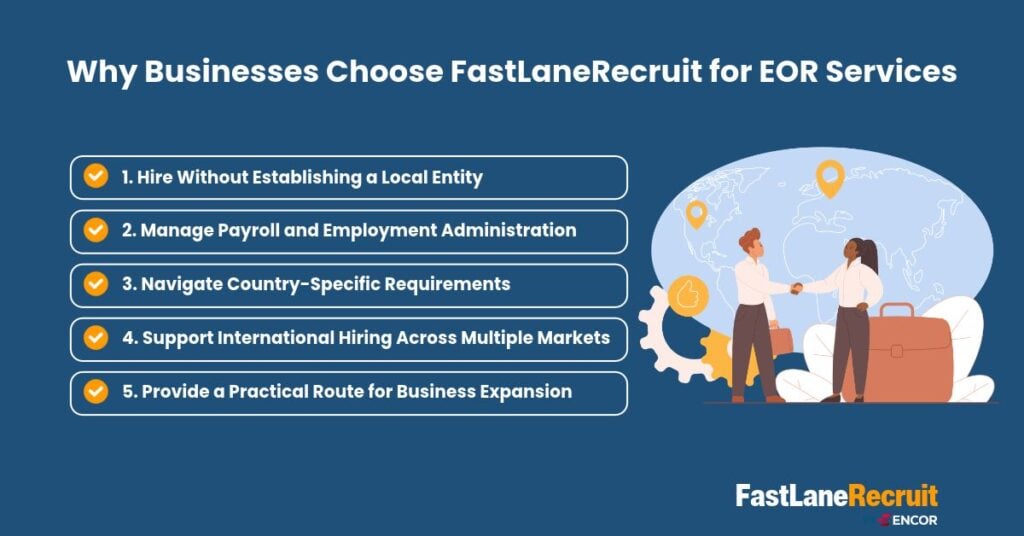
Why Businesses Choose FastLaneRecruit for EOR Services
International hiring requires a practical approach to local employment, payroll, tax administration, and employee benefits.
FastLaneRecruit helps businesses navigate these requirements through EOR services designed to support international workforce expansion.
1. Hire Without Establishing a Local Entity
For eligible employment arrangements, our EOR services provide a way to hire employees in supported markets without establishing your own local employing entity as the first step.
This can be useful when entering a new market, hiring your first overseas employee, or building a small international team.
2. Manage Payroll and Employment Administration
We support payroll administration and relevant employment processes for employees engaged through our EOR arrangements.
Depending on the country and service scope, this can include salary processing, applicable statutory contributions, benefits administration, and other employment-related requirements.
3. Navigate Country-Specific Requirements
Employment legislation, payroll rules, statutory contributions, and employee entitlements vary across jurisdictions.
Our approach takes these local differences into account, helping businesses understand the employment processes applicable to their target markets.
4. Support International Hiring Across Multiple Markets
FastLaneRecruit supports international employment across selected markets in Asia Pacific, Europe, and the Middle East & Africa.
Our EOR coverage includes:
Malaysia, Singapore, Hong Kong, China, India, Philippines, Taiwan, Vietnam, Australia, United Kingdom, Switzerland, UAE, Saudi Arabia, Qatar
Service availability and specific employment arrangements should be confirmed with our team before hiring in a particular country.
5. Provide a Practical Route for Business Expansion
An EOR can help businesses hire internationally without committing immediately to the administrative requirements of establishing a local entity.
As your workforce grows, you can reassess whether continuing with an EOR, establishing your own entity, or adopting a combination of employment models best supports your business.
FastLaneRecruit helps you evaluate your employment requirements and identify an appropriate approach for your expansion plans.
How to Get Started With FastLaneRecruit EOR Services
The right employment structure begins with understanding where you want to hire, the role you need to fill, and how you intend to manage the employment relationship.
Step 1: Identify Your Target Market
Determine the country where you plan to hire and confirm whether FastLaneRecruit supports the required employment arrangement there.
Step 2: Define Your Hiring Requirements
Provide details about the position, proposed salary, expected start date, and other relevant employment terms.
Step 3: Review the Employment Arrangement
Discuss the applicable employment structure, payroll requirements, benefits, statutory contributions, and relevant service fees.
Step 4: Prepare for Onboarding
Once the arrangement is confirmed, the required employment documentation and onboarding procedures can be coordinated according to local requirements.
Step 5: Manage Ongoing Employment
Your business continues managing the employee’s day-to-day work, while FastLaneRecruit supports the applicable employment administration within the agreed service scope.
Simplify International Hiring With FastLaneRecruit
Managing international employees involves more than processing salaries. Businesses must also consider employment contracts, tax administration, statutory contributions, employee benefits, and country-specific requirements.
FastLaneRecruit helps businesses navigate these responsibilities through EOR services across supported international markets.
Whether you are hiring your first overseas employee, expanding an existing team, or evaluating EOR services against contractor management, our team can help you assess the employment structure that fits your needs.
Ready to hire internationally?
Book a Free Consultation With FastLaneRecruit
Discuss your target market, hiring plans, payroll requirements, and employee benefits with our team.
We can help you understand the available EOR and contractor service options, clarify the relevant employment considerations, and plan your next steps with greater confidence.
Frequently Asked Questions About EOR Payroll, Taxes, and Benefits
1. How do EOR services handle payroll and taxes?
EOR services manage payroll administration for employees they legally employ, including salary processing, applicable deductions, and relevant payroll documentation. They can also administer employment-related tax withholding, statutory contributions, remittances, and reporting obligations within the scope of the arrangement and applicable local law.
2. Does an Employer of Record pay employees directly?
An EOR generally manages salary payments for employees it legally employs. The payment process, schedule, and documentation depend on the country and the terms of the employment arrangement.
3. Who is responsible for employment taxes when using an EOR?
The EOR administers the employment-related tax obligations assigned to it under the applicable law and arrangement. However, the client company may retain other legal, tax, or business obligations. The division of responsibilities should be confirmed for the relevant jurisdiction.
4. What employee benefits does an EOR provide?
An EOR can administer legally required benefits and agreed supplementary benefits for employees it employs. These may include applicable social security contributions, paid leave, insurance, or other benefits, depending on local law, employment terms, and the service arrangement.
5. Can EOR services manage payroll across multiple countries?
Yes. An EOR provider with appropriate country coverage can support employment and payroll administration across multiple markets. However, payroll requirements, statutory contributions, benefits, and reporting obligations must still be handled according to each country’s rules.
6. Can an EOR help a company hire without establishing a local entity?
Yes. EOR services can provide an employment route for eligible hires in supported countries where the client company does not have its own local employing entity. The arrangement must be appropriate for the jurisdiction and the intended employment relationship.
7. What is the difference between EOR payroll and payroll outsourcing?
EOR services involve a legal employment arrangement in which the EOR employs the worker and manages associated employment administration within its scope. Payroll outsourcing generally involves a provider processing payroll for employees who remain employed by the client company or its local entity.
The two services can involve similar payroll activities, but their employment structures and legal responsibilities differ.
8. Is an EOR better than hiring an independent contractor?
Neither option is universally better. An EOR is generally appropriate when a business needs to employ someone as an employee in another country. Contractor management is appropriate when the individual genuinely operates as an independent service provider under the applicable legal framework.
The decision should reflect the actual working relationship, the business requirements, and local classification rules.
9. How much do EOR services cost?
EOR pricing depends on the country, salary, statutory employer costs, benefits, service fees, and the complexity of the employment arrangement. Businesses should request a clear cost breakdown that distinguishes employee compensation, employer contributions, benefits, and provider fees.
FastLaneRecruit can discuss the relevant requirements and service scope for your intended hiring market.
10. Which countries does FastLaneRecruit support for EOR services?
FastLaneRecruit’s published coverage includes Malaysia, Singapore, Hong Kong, China, India, Philippines, Taiwan, Vietnam, Australia, the United Kingdom, Switzerland, the UAE, Saudi Arabia, and Qatar. Contact our team to confirm current availability and the employment arrangements supported in your target country.
11. Can FastLaneRecruit help manage independent contractors?
FastLaneRecruit can help businesses explore contractor service options alongside EOR services. The appropriate arrangement depends on the engagement requirements, the nature of the working relationship, and applicable local laws.
12. When should a business choose an EOR instead of establishing its own entity?
An EOR may be appropriate when a business wants to hire a small team, enter a new market, or employ an international worker without immediately establishing a local entity. Establishing a local entity may be more suitable when a business plans substantial, long-term operations or needs a permanent local corporate presence.
The right decision depends on hiring plans, costs, operational needs, and local requirements.