Expanding into a new country can open doors to new markets and specialized talent, but hiring internationally involves more than finding the right candidate. Businesses must also consider local employment arrangements, payroll administration, statutory obligations, and ongoing workforce management.
An Employer of Record (EOR) can help simplify these responsibilities by employing workers on behalf of a client company in supported jurisdictions. However, not all EOR providers offer the same country coverage, service models, pricing structures, or level of local support.
Choosing the right partner means looking beyond advertised prices and comparing what each provider can actually deliver in your target markets.
This guide explains how to compare global EOR providers, which factors matter most when evaluating them, and how to determine whether an EOR arrangement fits your international hiring plans.
Content Outline
Key Summary
Country coverage should come first
Confirm that a provider can support your intended hire and employment arrangement in the specific country where you plan to operate.
Compare total costs, not just monthly fee
Review service fees, employment-related costs, additional charges, currency conversion, and any applicable termination or transition costs.
Verify the local employment arrangement
Understand which entity employs the worker, how local employment requirements are handled, and which responsibilities remain with your business.
Evaluate the complete service scope
Payroll, employment contracts, onboarding, statutory contributions, benefits administration, and offboarding may be included differently across providers.
Consider long-term business needs
The right EOR should suit your current hiring plans while allowing you to reassess your employment structure as your workforce grows.
Choose a provider that matches your operating model
A business hiring one employee in Asia may have different requirements from an enterprise building teams across several continents.
What Is an EOR Provider?
An Employer of Record (EOR) provider is an organization that legally employs workers on behalf of a client company in a jurisdiction where the client may not have its own employing entity.
Under an EOR arrangement, the provider generally manages the formal employment relationship and agreed administrative responsibilities, while the client directs the employee’s day-to-day work, subject to the contractual arrangement and applicable local law.
Depending on the country and service agreement, EOR services may include:
- Local employment contracts and documentation.
- Employee onboarding and offboarding.
- Payroll processing and salary payments.
- Applicable tax filings and statutory contributions.
- Benefits administration.
- Employment-related HR administration.
- Support with local employment requirements.
An EOR can be useful when a company wants to hire employees in another country without immediately establishing its own local entity. However, an EOR does not eliminate every legal, tax, or operational risk, and it may not be suitable for every business activity.
When Should a Business Consider an EOR?
An EOR may be worth considering when a business needs to:
- Hire its first employee in a new country.
- Build a small international team before committing to a local entity.
- Expand into selected overseas markets.
- Employ international talent while avoiding the immediate administrative burden of incorporation.
- Establish a more structured approach to employment and payroll across supported jurisdictions.
Decision point: Before selecting an EOR, determine whether your business needs an employment solution, an independent contractor arrangement, a local entity, or another structure appropriate to its activities.
Also Read: When to Use an Employer of Record: 7 Signs Your Business Needs an EOR
How to Compare Global EOR Providers
Comparing EOR providers requires more than checking how many countries they advertise or how much they charge per employee.
The following criteria can help your business evaluate providers consistently and identify the most suitable option.
1. Country Coverage and Local Employment Expertise
Start by confirming that the provider supports the country where you intend to hire.
A provider may advertise worldwide coverage without offering the same employment model, service scope, or level of local support in every jurisdiction.
Ask each shortlisted provider:
- Can you support this specific country and employee profile?
- Which entity will employ the worker?
- Do you operate through your own local entity or a third-party partner in this market?
- How are local employment contracts and statutory requirements handled?
- Are there any restrictions related to the role, industry, or employment arrangement?
The distinction between an owned entity and a partner-based model can help you understand the service structure, but neither arrangement should be treated as an automatic guarantee of better compliance or service quality.
Evaluate the actual local capabilities, accountability, and responsibilities offered in your target country.
2. EOR Pricing and Total Employment Costs
Advertised EOR prices do not necessarily represent the total cost of employing someone internationally.
Depending on the provider and country, the overall cost may include the EOR service fee, gross salary, employer statutory contributions, applicable benefits, insurance, and other employment-related expenses.
Additional charges may also apply for services such as special onboarding requests, employment changes, offboarding, or other activities outside the standard service scope.
Use the following table when comparing quotations.
| Cost component | What to verify |
| EOR service fee | Is the fee fixed, percentage-based, or dependent on the service package? |
| Salary and employer costs | Are gross salary and applicable employer contributions shown separately? |
| Statutory payments | Which required contributions, taxes, or employment-related payments are included in the estimate? |
| Benefits and insurance | Which benefits are included, optional, or charged separately? |
| Currency and payment fees | Are exchange-rate margins, transfer fees, or other payment charges applicable? |
| Onboarding and offboarding | Are there additional fees for employment setup, termination, or administrative changes? |
| Contract changes | Are amendments, renewals, or other employment changes covered by the standard fee? |
| Contract termination and transition | What costs, notice requirements, or outstanding obligations could arise when employment ends or the arrangement changes? |
Best practice: Request a written, itemized quotation based on the same salary, country, benefits, employment duration, and service requirements from every shortlisted provider.
This makes comparisons more meaningful than comparing headline service fees alone.
3. Compliance Support and Employment Responsibilities
Employment laws, payroll requirements, statutory contributions, and employee entitlements differ between countries.
An EOR provider should be able to explain how it manages the employment requirements relevant to your intended hire.
Before signing a contract, clarify:
- Who prepares and maintains the employment documentation?
- How are applicable payroll taxes and statutory contributions administered?
- How are changes to local employment requirements communicated?
- What happens when a payroll or employment issue arises?
- How are leave entitlements and applicable benefits administered?
- How are notice periods, termination procedures, and final payments handled?
- Which responsibilities remain with the client company?
An EOR arrangement can help businesses manage local employment administration, but the precise responsibilities of each party depend on the country, contract, and actual working relationship.
What to look for: A provider that clearly explains its responsibilities, documents its service scope, and can demonstrate how it handles the employment requirements relevant to your target market.
4. Payroll, Benefits, and Employee Administration
Payroll accuracy and reliable employee administration are essential when managing an international workforce.
A provider should explain how it coordinates payroll inputs, salary payments, statutory deductions, applicable contributions, and relevant employee benefits.
Ask about:
- Payroll processing schedules and cut-off dates.
- Procedures for reviewing payroll inputs.
- Handling of payroll discrepancies.
- Salary payment timelines.
- Administration of applicable statutory benefits.
- Employee onboarding documentation.
- Employee queries and issue escalation.
- Offboarding and final payroll procedures.
Also, clarify which tasks your internal HR or finance team must complete.
An EOR can manage agreed employment processes, but the client may still need to provide accurate salary information, approve changes, communicate work-related decisions, and coordinate other responsibilities under the service agreement.
5. Customer Support and Service Accountability
An EOR relationship extends beyond onboarding. Businesses may need support when employment circumstances change or an unexpected issue arises.
For example, a company may need to revise an employment agreement, resolve a payroll discrepancy, manage a leave request, or understand the steps required for an employee’s departure.
Before choosing a provider, ask:
- Will you have a dedicated account manager or support contact?
- How can employees and client representatives raise questions?
- What are the expected response and escalation procedures?
- Who handles complex country-specific employment matters?
- How are urgent payroll and employment issues managed?
Do not assess customer support solely through a sales demonstration. Ask providers to explain their actual support processes and contractual service commitments.
6. Scalability and Long-Term Flexibility
The right EOR provider should fit your current needs without forcing you into an unsuitable arrangement as your business develops.
A company may begin with one employee in a new market and later expand its team. Another business may plan to hire several employees across multiple countries from the outset.
Consider whether the provider can support your anticipated hiring locations, employee numbers, administrative requirements, and potential changes to your operating structure.
Also, understand the practical implications of moving employees from an EOR arrangement to your own local entity. Such a transition may involve employment documentation, continuity of service, applicable employee entitlements, tax considerations, and other local requirements.
Decision point: Choose a provider based on your current hiring needs and realistic growth plans, rather than paying for capabilities you do not require or overlooking requirements that may become important later.
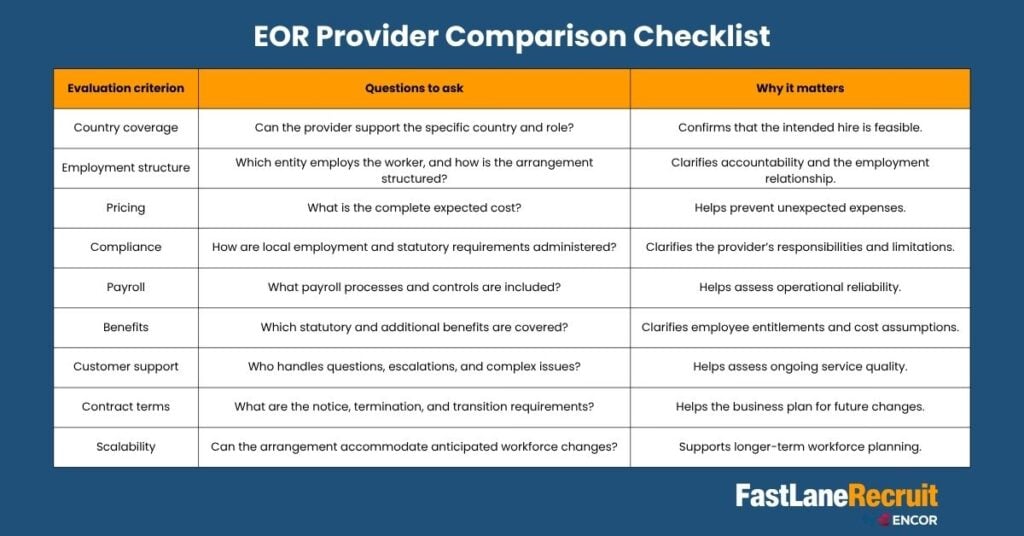
EOR Provider Comparison Checklist
Use this checklist to evaluate shortlisted EOR providers against the same requirements.
| Evaluation criterion | Questions to ask | Why it matters |
| Country coverage | Can the provider support the specific country and role? | Confirms that the intended hire is feasible. |
| Employment structure | Which entity employs the worker, and how is the arrangement structured? | Clarifies accountability and the employment relationship. |
| Pricing | What is the complete expected cost? | Helps prevent unexpected expenses. |
| Compliance | How are local employment and statutory requirements administered? | Clarifies the provider’s responsibilities and limitations. |
| Payroll | What payroll processes and controls are included? | Helps assess operational reliability. |
| Benefits | Which statutory and additional benefits are covered? | Clarifies employee entitlements and cost assumptions. |
| Customer support | Who handles questions, escalations, and complex issues? | Helps assess ongoing service quality. |
| Contract terms | What are the notice, termination, and transition requirements? | Helps the business plan for future changes. |
| Scalability | Can the arrangement accommodate anticipated workforce changes? | Supports longer-term workforce planning. |
How to Score Your Shortlist
To make your decision more objective, assign each provider a score from 1 to 5 for every criterion.
- 1 — Unsuitable: Does not meet a critical requirement.
- 2 — Limited: Significant gaps or unresolved questions.
- 3 — Acceptable: Meets the basic requirement.
- 4 — Strong: Meets the requirement with clear supporting evidence.
- 5 — Excellent fit: Meets the requirement with well-documented capabilities and suitable contractual commitments.
Weight the criteria according to your business priorities. For example, country availability and employment structure may be mandatory requirements, while platform integrations may be less important to a company hiring only one employee.
Important: Resolve mandatory legal, operational, and country-coverage requirements before relying on an overall score. A high total should not compensate for a provider’s inability to support your intended hire.
Also Read: Deel vs Rippling vs Remote vs Papaya: Compare EOR Pricing, Services, and Features
Global EOR Providers vs. Regional EOR Providers: Which Is Better?
Global and regional EOR providers can serve different business needs. Neither model is automatically superior.
Global providers may appeal to businesses hiring across several regions, while regional specialists may be attractive when a company needs focused support in a smaller group of markets.
However, the actual capabilities of each provider matter more than the label it uses.
| Comparison factor | Global EOR provider | Regional EOR provider |
| Geographic focus | Designed to support hiring across multiple regions, depending on actual coverage. | Focuses on selected countries or regions. |
| Best-fit use case | Businesses with diverse international hiring requirements. | Businesses concentrating on specific markets. |
| Local expertise | Varies by country and employment model. | May offer focused regional knowledge, which should be verified. |
| Service structure | May combine owned entities, local partners, or different arrangements by country. | May use its own entities, partners, or a combination of models. |
| Pricing | Depends on country, service scope, and contract terms. | Depends on country, service scope, and contract terms. |
| Operational support | Depends on the provider’s support model and local capabilities. | Depends on the provider’s support model and local capabilities. |
Which Model Should You Choose?
Consider a global provider if you need to employ people across numerous regions and want to assess whether one provider can support those locations under a consistent service arrangement.
Consider a regional provider if your immediate hiring needs are concentrated in particular markets and you value a provider whose capabilities align closely with those locations.
In either case, verify the employment arrangement, total costs, local responsibilities, and support model for each country.
For companies expanding across Asia-Pacific and selected European and Middle Eastern markets, FastLaneRecruit offers an EOR service focused on supporting international employment across its designated service locations.
Why Businesses Choose FastLaneRecruit
Choosing an EOR provider is not simply about outsourcing payroll. It is about finding a practical employment arrangement that supports your hiring plans while providing clarity around local employment administration.
FastLaneRecruit helps businesses hire employees internationally without establishing a separate local employing entity in every supported market, subject to the suitability of the arrangement and applicable local requirements.
Regional Expertise and International Coverage
FastLaneRecruit supports EOR services across selected markets in Asia-Pacific, Europe, and the Middle East & Africa.
Our listed service markets include:
- Asia Pacific: Malaysia, Singapore, Hong Kong, China, India, Philippines, Taiwan, Vietnam, Australia,
- Europe: United Kingdom, Switzerland
- Middle East & Africa: UAE, Saudi Arabia, Qatar
Country coverage and the available service scope should be confirmed for your specific hiring requirements before proceeding.
Employment Administration and Payroll Support
FastLaneRecruit’s EOR service can support key employment processes, including employment documentation, onboarding, payroll administration, applicable statutory requirements, and ongoing employment administration.
The precise scope depends on the country and agreed service arrangement.
A Practical Approach to International Hiring
An EOR arrangement can be useful when your business wants to hire in a new market without immediately establishing its own local entity.
FastLaneRecruit helps businesses assess their international employment needs and coordinate the relevant employment processes in supported markets.
Support for Different Business Stages
Whether you are hiring your first international employee, establishing a small overseas team, or expanding into additional markets, the appropriate employment structure depends on your business objectives, the country involved, and your longer-term plans.
Our approach focuses on understanding those requirements before determining whether EOR services are an appropriate fit.
How to Choose the Right EOR Provider: A Step-by-Step Process
A structured evaluation can help you avoid choosing a provider based solely on price or brand recognition.
Step 1: Define Your Hiring Requirements
Identify the countries where you intend to hire, the number of employees, the expected start dates, and the nature of the roles.
Consider whether you need ongoing employment, a short-term market-entry arrangement, or a broader international workforce solution.
Step 2: Confirm Country and Role Eligibility
Ask each provider to confirm that it can support the specific country, employment arrangement, and intended role.
Resolve any restrictions before proceeding to commercial comparisons.
Step 3: Request Comparable Quotes
Provide shortlisted providers with the same hiring requirements and request a written breakdown of service fees, employment-related costs, additional charges, and contract terms.
Step 4: Verify Employment and Compliance Responsibilities
Review the proposed employment arrangement, documentation, statutory administration, payroll responsibilities, and offboarding procedures.
Seek qualified legal or tax advice where your business circumstances require it.
Step 5: Evaluate Service Quality
Assess support arrangements, payroll controls, issue escalation, and the provider’s ability to explain country-specific requirements.
Step 6: Review the Contract Before Signing
Confirm the service scope, fees, payment terms, responsibilities, termination provisions, and procedures for changing or ending the arrangement.
Step 7: Choose the Provider That Best Fits Your Business
Compare the evidence against your mandatory requirements and priorities.
The best EOR provider is the one that can support your intended hiring arrangement with suitable local capabilities, transparent costs, clear responsibilities, and reliable ongoing administration.
Ready to Compare Your EOR Options?
Choosing an EOR provider is an important decision for any business building an international workforce. The right partner should offer suitable country coverage, transparent pricing, clear employment responsibilities, and the administrative support required to manage employees in your target markets.
FastLaneRecruit helps businesses navigate international employment through EOR services across selected markets in Asia-Pacific, Europe, and the Middle East & Africa.
Whether you are hiring your first overseas employee or expanding an existing international team, our team can help you understand the available employment arrangement and the relevant service requirements.
Book a Free Consultation with an Expert
Discuss your target hiring countries, employment needs, and international expansion plans with FastLaneRecruit to determine whether our EOR services are the right fit for your business.
Frequently Asked Questions About EOR Providers
What are EOR providers?
EOR providers are organizations that legally employ workers on behalf of client companies in supported jurisdictions. Depending on the arrangement and local law, they manage employment documentation, payroll, statutory administration, and other agreed employment processes while the client generally directs the employee’s day-to-day work.
How do I choose the best EOR provider?
Start by confirming country coverage and the proposed employment arrangement. Then compare total costs, compliance responsibilities, payroll administration, benefits, customer support, contract terms, and scalability. Request written confirmation of important capabilities before signing an agreement.
How much do EOR providers charge?
EOR pricing varies by provider, country, employee requirements, and service scope. Some providers charge a fixed monthly fee per employee, while others use different pricing structures. The total cost may also include salary, employer statutory contributions, benefits, insurance, and additional administrative charges. Request an itemized quote for an accurate comparison.
Are global EOR providers better than regional providers?
Not necessarily. Global providers may suit businesses hiring across multiple regions, while regional providers may be a good fit for businesses concentrating on specific markets. Compare actual country coverage, local employment capabilities, pricing, and support rather than relying on the provider’s geographic label.
Do EOR providers guarantee compliance?
No provider can guarantee that every employment risk will be eliminated. An EOR can administer agreed employment responsibilities and support compliance with applicable local requirements, but the outcome depends on the arrangement, the provider’s capabilities, the client’s actions, and the relevant law.
What is the difference between an EOR and a PEO?
An EOR generally acts as the legal employer of the worker in the relevant jurisdiction. A Professional Employer Organization (PEO) typically operates through a co-employment model, which often depends on the client having its own local entity and meeting applicable requirements. The exact legal distinctions vary by jurisdiction.
Can an EOR help a company hire internationally without establishing a local entity?
Yes. Where the EOR model is available and appropriate, a business may hire employees in a supported country without establishing its own local employing entity solely for that purpose. However, other business activities or legal requirements may still necessitate a local entity.
Which countries does FastLaneRecruit support for EOR services?
FastLaneRecruit’s listed EOR markets include Malaysia, Singapore, Hong Kong, China, India, the Philippines, Taiwan, Vietnam, Australia, the United Kingdom, Switzerland, the UAE, Saudi Arabia, and Qatar. Availability and service scope should be confirmed for the intended hire and country.
Can FastLaneRecruit help us hire employees in Asia?
FastLaneRecruit provides EOR services across selected Asian markets, including Malaysia, Singapore, Hong Kong, China, India, the Philippines, Taiwan, and Vietnam, as well as Australia. Contact our team to discuss your hiring location, employment requirements, and the available service scope.
Can a company move employees from an EOR arrangement to its own entity later?
Potentially, yes. Businesses may transition employees to their own local entity as their operations develop. However, the transition needs to be assessed against local employment requirements, employee entitlements, contractual terms, tax considerations, and any applicable continuity-of-service rules.