Building an international team involves more than finding the right talent. Businesses must also decide how to employ workers, manage contractual relationships, administer payments, and meet local employment requirements.
Choosing the wrong workforce model can create unnecessary administrative costs, unclear responsibilities, and potential worker misclassification issues. An Employer of Record (EOR), a staffing agency, and contractor management services each address different business needs.
Understanding the differences helps you choose the right approach for your workforce strategy, whether you are hiring a full-time employee abroad, recruiting temporary staff, or engaging independent contractors across borders.
Content Outline
Key Summary
Choose an Employer of Record (EOR)
when you need to employ international workers in a supported country without establishing your own local employing entity.
Choose a staffing agency
when you need help sourcing, screening, and placing candidates for permanent, temporary, or project-based positions.
Use contractor management
when engaging genuine independent contractors and managing their agreements, documentation, invoicing, and payments.
Evaluate compliance before cost.
The correct arrangement depends on the actual working relationship, local laws, and the responsibilities assigned to each party.
Consider combining solutions.
A staffing agency can source talent while an EOR handles employment, or contractor management can support an appropriately classified independent contractor relationship.
What Is the Difference Between EOR, Staffing Agency, and Contractor Management?
An EOR, staffing agency, and contractor management service solve different workforce challenges. The main difference is whether your business needs a legal employment structure, recruitment support, or administrative support for independent contractors.
1. Employer of Record (EOR)
An Employer of Record is a third-party organization that legally employs a worker on behalf of a client company in a country where the EOR can provide the service.
The EOR manages the formal employment relationship and associated responsibilities, which may include employment contracts, payroll, statutory contributions, benefits administration, and local employment compliance.
Your company generally directs the employee’s day-to-day work, responsibilities, and performance, subject to the applicable legal and contractual framework.
An EOR is suitable when you:
- Want to hire an employee in another country without establishing your own local employing entity.
- Have already identified a candidate and need an employment arrangement.
- Need support with local employment contracts, payroll, and statutory requirements.
- Want to test a market or build an initial international team.
- Need employment administration across multiple supported countries.
2. Staffing Agency
A staffing agency helps businesses find, screen, and place candidates. Depending on its business model and the agreement, it may recruit permanent employees, supply temporary workers, or employ workers assigned to client projects.
Recruitment and employment administration are separate functions. A staffing agency may handle recruitment alone, or it may also employ temporary workers and manage certain employment responsibilities.
A staffing agency is suitable when you:
- Need help finding qualified candidates.
- Want to fill temporary, seasonal, or project-based positions.
- Require specialist recruitment expertise.
- Need additional workforce capacity for a defined period.
- Want to outsource some or all of the candidate sourcing and screening process.
If you already have a candidate but need a compliant way to employ that person internationally, an EOR may be more relevant than a recruitment-focused service.
3. Contractor Management
Contractor management involves administering relationships with independent contractors who provide services under a genuine contractor arrangement.
Depending on the service provider, contractor management may cover contractor agreements, onboarding documentation, invoice processing, payment coordination, recordkeeping, and compliance-related administration.
Unlike an EOR employment arrangement, a genuine independent contractor relationship does not make the contractor an employee simply because a third party helps manage administrative processes.
Contractor management is suitable when you:
- Engage freelancers or independent specialists for defined services or projects.
- Work with contractors in multiple countries.
- Need a consistent process for agreements, onboarding, documentation, and payments.
- Want better visibility into contractor engagements and administrative obligations.
- Need support managing an international contractor workforce.
Contractor management does not automatically eliminate misclassification risk. Businesses must assess the actual working relationship under the relevant country’s laws.
EOR vs Staffing Agency vs Contractor Management: Key Differences
The best hiring model depends on what your business needs to solve. Use this comparison to identify the main differences before choosing a provider.
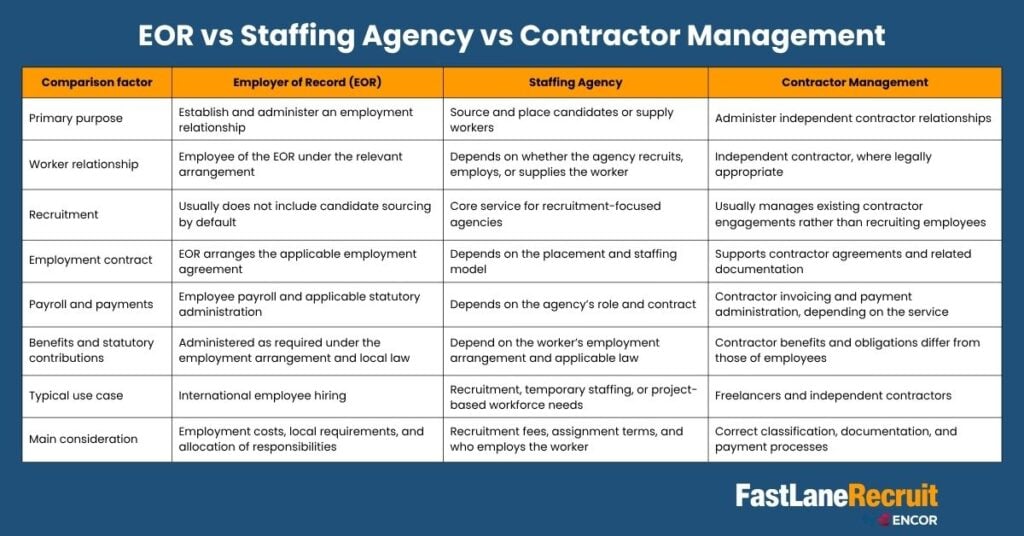
| Comparison factor | Employer of Record (EOR) | Staffing Agency | Contractor Management |
| Primary purpose | Establish and administer an employment relationship | Source and place candidates or supply workers | Administer independent contractor relationships |
| Worker relationship | Employee of the EOR under the relevant arrangement | Depends on whether the agency recruits, employs, or supplies the worker | Independent contractor, where legally appropriate |
| Recruitment | Usually does not include candidate sourcing by default | Core service for recruitment-focused agencies | Usually manages existing contractor engagements rather than recruiting employees |
| Employment contract | EOR arranges the applicable employment agreement | Depends on the placement and staffing model | Supports contractor agreements and related documentation |
| Payroll and payments | Employee payroll and applicable statutory administration | Depends on the agency’s role and contract | Contractor invoicing and payment administration, depending on the service |
| Benefits and statutory contributions | Administered as required under the employment arrangement and local law | Depend on the worker’s employment arrangement and applicable law | Contractor benefits and obligations differ from those of employees |
| Typical use case | International employee hiring | Recruitment, temporary staffing, or project-based workforce needs | Freelancers and independent contractors |
| Main consideration | Employment costs, local requirements, and allocation of responsibilities | Recruitment fees, assignment terms, and who employs the worker | Correct classification, documentation, and payment processes |
Important: These models are not interchangeable. A staffing agency may also provide employment or payroll services, while contractor management offerings vary by provider. Always confirm who signs the contract, who pays the worker, and who is responsible for each employment or administrative obligation.
EOR vs Staffing Agency: Which Should You Choose?
The main distinction in the EOR vs staffing agency comparison is the problem each model solves.
A staffing agency primarily helps you find people. An EOR primarily helps you employ a person in a country where you need an appropriate local employment structure.
Choose an EOR When You Need International Employment
An EOR may be the better fit when you have identified the right candidate but do not have your own local employing entity in the hiring country.
For example, a Singapore-based technology company wants to hire a software engineer in Malaysia. The company has already selected the candidate but does not have a Malaysian entity through which to employ them.
An EOR may provide the local employment structure and manage applicable employment contracts, payroll, statutory contributions, and other employment administration.
This allows the company to hire without immediately establishing its own local employing entity, subject to the country’s requirements and the suitability of the arrangement.
Choose a Staffing Agency When You Need Talent Sourcing
A staffing agency may be the better fit when your main challenge is finding qualified candidates.
For example, a business needs additional customer service representatives during a seasonal increase in demand. A staffing agency can help source and screen candidates and may provide temporary staffing, depending on its service model.
If a candidate is selected for a longer-term international role, the business may need a separate employment solution.
Can You Use Both an EOR and a Staffing Agency?
Yes. The services can complement each other when their responsibilities are clearly defined.
A business may use a staffing agency to source candidates and an EOR to establish the employment relationship for a selected candidate in a supported country.
Before proceeding, confirm recruitment fees, employment responsibilities, candidate data handling, and any restrictions on transferring a candidate between providers.
Also Read: Guide to PEO vs EOR
Contractor Management vs EOR: Which Is Right for Your Workforce?
The decision between contractor management and an EOR should start with the nature of the working relationship, not simply which option appears cheaper or easier to administer.
Choose Contractor Management for Genuine Independent Contractors
Contractor management may be appropriate when you engage an independent specialist to deliver defined services while retaining the independence required under the applicable legal framework.
For example, a company engages a freelance graphic designer to create a defined set of marketing assets. The designer works under a service agreement and retains the level of independence appropriate to that relationship.
Contractor management can help organize agreements, documentation, invoices, and payments.
However, the contract label alone does not determine employment status. Local authorities may consider factors such as control, economic dependence, integration into the business, and the actual terms of the relationship.
Choose an EOR When the Role Requires Employment
An EOR may be more appropriate when the business needs a worker to be employed under a local employment arrangement.
For example, a company hires an international customer success manager who works as an ongoing member of its team. The company expects a continuing employment relationship and needs local employment administration in a country where it does not have its own employing entity.
An EOR can provide the employment structure and administer applicable payroll and statutory requirements.
What If a Contractor Becomes an Employee?
Review the arrangement when a contractor’s responsibilities or working conditions change significantly.
Warning signs may include the contractor becoming subject to fixed working hours, performing an ongoing role under close direction, working exclusively for one business, or becoming integrated into normal employee operations. These factors do not independently determine classification, and the legal tests vary by country.
If the relationship no longer qualifies as independent contracting under applicable law, the business should assess an appropriate employment arrangement. An EOR may be one option where the business needs to employ the worker in a supported country without its own local entity.
How Do Costs Compare?
There is no universal price comparison between EOR services, staffing agencies, and contractor management. Providers use different pricing structures, and the total cost depends on the country, worker’s compensation, duration, and services required.
| Cost factor | EOR | Staffing Agency | Contractor Management |
| Service fees | Often a recurring fee per employee or a percentage-based fee | May charge a placement fee, hourly markup, or other agreed fee | May charge a recurring fee per contractor or transaction-based fees |
| Worker compensation | Salary and applicable employment costs | Depends on the placement and staffing model | Contracted service fees |
| Statutory costs | Apply as required under local employment law | Depend on the employment arrangement and applicable law | Depend on contractor status and local requirements |
| Administration | Employment and payroll administration within the agreed scope | Recruitment and potentially staffing administration | Contractor documentation and payment administration within the agreed scope |
| Additional costs | May include benefits, insurance, onboarding, or offboarding charges | May include recruitment, overtime, or assignment-related fees | May include transaction fees, currency conversion, or additional services |
How to Compare Total Costs
Before choosing a provider, ask for a clear breakdown of:
- Service and management fees.
- Salary or contractor compensation.
- Employer contributions and statutory costs, where applicable.
- Benefits and insurance.
- Recruitment or placement fees.
- Onboarding, termination, and offboarding charges.
- Currency conversion and payment fees.
- Additional services and minimum contract commitments.
Compare the total expected cost over the intended engagement period rather than relying on a single headline fee.
A contractor arrangement should not be selected solely because it appears less expensive than employment. The arrangement must reflect the actual working relationship and applicable legal requirements.
How to Choose the Right Global Hiring Model
Use the following decision framework to narrow your options.
| Your business requirement | Model to consider | Why |
| You have a candidate but need to employ them in a country where you have no local entity | EOR | Provides a local employment structure for eligible arrangements |
| You need help sourcing and screening candidates | Staffing agency | Focuses on recruitment and placement |
| You need temporary workers for a defined project | Staffing agency or another suitable engagement model | Depends on the role, duration, and employment structure |
| You engage genuinely independent freelancers | Contractor management | Supports contractor administration and payments |
| You need to employ an existing contractor as an employee | EOR or direct employment, depending on your setup | Establishes an appropriate employment relationship |
| You are hiring employees across multiple countries | EOR or your own local entities | Depends on country coverage, business plans, and operating requirements |
| You need both recruitment and international employment | Staffing agency plus EOR | Separates candidate sourcing from employment administration |
Questions to Ask Before Making a Decision
Before committing to a workforce model, consider:
- What do we need most? Candidate sourcing, legal employment, or contractor administration?
- Where will the worker be based? Country-specific requirements can affect the available options.
- What is the actual working relationship? Does the role qualify as employment or independent contracting?
- Who will sign the contract? Identify the legal employer or contracting parties.
- Who handles payments and statutory obligations? Confirm responsibilities in writing.
- How long will the engagement last? Consider whether the arrangement suits the anticipated duration and business needs.
- Could the role change? Plan for changes in responsibilities, location, or employment status.
The right choice should support your operational requirements while establishing clear responsibilities and an appropriate legal structure.
Also Read: Permanent Establishment Risk for Remote Workforce: How to Manage Global Hiring
Why Businesses Choose FastLaneRecruit
International hiring requires coordination between employment contracts, payroll, statutory obligations, and local employment processes. Managing these requirements independently in every country can add administrative complexity as your workforce grows.
FastLaneRecruit helps businesses employ international talent through Employer of Record services and manage independent contractor engagements through contractor management support.
EOR Services for International Hiring
Our Employer of Record services help businesses employ eligible workers in supported countries without establishing their own local employing entity for each hire.
Depending on the country and agreed service scope, our support includes:
- Local employment contracts and onboarding.
- Payroll administration and salary payments.
- Statutory contributions and employment-related requirements.
- Benefits coordination and employment administration.
- Ongoing employment lifecycle support.
Businesses retain responsibility for directing their teams’ day-to-day work and performance within the applicable legal and contractual framework.
Contractor Management for Independent Contractors
Our contractor management support helps businesses organize international contractor engagements through structured administrative processes.
Depending on your requirements and the country involved, support may include:
- Contractor onboarding and documentation.
- Contractor agreement administration.
- Invoice and payment coordination.
- Contractor recordkeeping.
- Compliance-related process support.
- Assessment of appropriate workforce options when an engagement changes.
Contractor management does not turn an independent contractor into an employee or remove the need to assess worker classification under local law.
Support Across 14 International Markets
FastLaneRecruit supports EOR-based employment across the following markets:
Malaysia, Singapore, Hong Kong, China, India, Philippines, Taiwan, Vietnam, Australia, United Kingdom, Switzerland, UAE, Saudi Arabia, Qatar
Service availability and requirements depend on the country and the specific engagement. Contact our team to confirm coverage and the appropriate arrangement for your intended hire.
A Workforce Solution Aligned With Your Needs
Whether you need to employ an international team member or manage a genuine independent contractor relationship, the right approach starts with understanding your workforce requirements.
FastLaneRecruit can help you evaluate your international hiring plans, understand the relevant service options, and identify the next steps for supported markets.
Find the Right Solution for Your Global Hiring Plans
Choosing between an EOR, staffing agency, and contractor management depends on whether your business needs to find talent, establish an employment relationship, or administer independent contractor engagements.
The right structure can help you manage international hiring more systematically, clarify responsibilities, and support your workforce as your business expands.
Hire International Employees With FastLaneRecruit
If you have identified a candidate in another country and need a local employment structure without establishing your own entity, our EOR team can help you explore the available options.
Book a Free Consultation with FastLaneRecruit to discuss your target country, hiring plans, employment requirements, and onboarding needs.
Simplify International Contractor Management
If your business works with independent contractors across borders, we can help you explore contractor management support for documentation, onboarding, payment coordination, and related administration.
Contact FastLaneRecruit to discuss your contractor workforce and identify an appropriate approach for your international operations.
Frequently Asked Questions
Is an EOR the same as a staffing agency?
No. An EOR provides a legal employment structure and manages agreed employment administration. A staffing agency primarily sources and places candidates, although some agencies also employ temporary workers or provide additional workforce services. The exact responsibilities depend on the arrangement.
What is the difference between EOR and contractor management?
An EOR employs a worker under an employment arrangement and manages relevant employment administration. Contractor management supports the administration of genuine independent contractor relationships, which may include agreements, documentation, invoicing, and payments. The correct model depends on the actual working relationship and applicable local law.
Is contractor management cheaper than using an EOR?
It can have a lower administrative fee in some circumstances, but the services are not directly interchangeable. An EOR involves employment-related costs and obligations, while contractor management supports a different type of relationship. Compare total costs and ensure the worker is correctly classified before deciding.
Can a staffing agency and an EOR be used together?
Yes. A staffing agency can help source and screen candidates, while an EOR can provide the employment structure for a selected candidate in a supported country. Businesses should confirm the contractual arrangements, fees, and responsibilities of each provider.
Can an independent contractor be managed through an EOR?
An EOR is designed for employment relationships, not for maintaining a worker as an independent contractor under the same arrangement. If the business needs to engage a genuine independent contractor, contractor management may be more appropriate. If the relationship requires employment, an EOR may be an option where available.
How can businesses reduce contractor misclassification risks?
Businesses should assess the actual working relationship against the relevant country’s legal tests, review the degree of control and independence, maintain accurate documentation, and reassess the arrangement when working conditions change. A contractor agreement alone does not guarantee independent status.
Can FastLaneRecruit help with both international employees and contractors?
Yes. FastLaneRecruit provides EOR services for eligible employment arrangements and contractor management support for independent contractor engagements. The appropriate service depends on the worker’s classification, country, and business requirements.
Which countries does FastLaneRecruit support?
FastLaneRecruit supports EOR-based employment across Malaysia, Singapore, Hong Kong, China, India, Philippines, Taiwan, Vietnam, Australia, the United Kingdom, Switzerland, the UAE, Saudi Arabia, and Qatar. Contact us to confirm current service availability and country-specific requirements.