Global hiring is no longer limited to large enterprises. Today, startups, SMEs, and scaling companies are actively using outsourcing business models to access global talent, reduce operational burden, and accelerate market entry.
However, outsourcing is not a single approach. It is a structured ecosystem of models ranging from simple staff augmentation to fully managed services and Employer of Record (EOR) solutions.
The key challenge for business leaders is not whether to outsource but which outsourcing model fits their strategy, risk tolerance, and growth stage.
Content Outline
Key Summary
Outsourcing Business Models Are Not One-Size-Fits-All
Different models provide different levels of control, cost efficiency, and operational ownership depending on business maturity.
The Shift Is From Cost Saving To Strategic Workforce Design
Companies now use outsourcing for scalability, speed-to-hire, and global talent access—not just cost reduction.
Managed Services And EOR Are Replacing Traditional Offshore Hiring
Businesses increasingly prefer structured, compliance-safe models instead of informal outsourcing arrangements.
EOR Is Faster And Lower Risk Than Company Incorporation
For companies entering Malaysia or Asia, Employer of Record (EOR) eliminates entity setup delays and legal complexity.
The Right Model Directly Impacts Hiring Speed And Profitability
Choosing the wrong outsourcing structure leads to inefficiencies, hidden costs, and compliance risks.
What Are Outsourcing Business Models?
Outsourcing business models define how companies structure external workforce engagement. Key factors include:
- Level of control over employees
- Operational responsibility
- Legal employment structure
- Cost and pricing mechanism
- Geographic delivery model
In simple terms, these models determine whether you manage the talent, co-manage it, or fully outsource it.
Top 5 Outsourcing Business Models In 2026
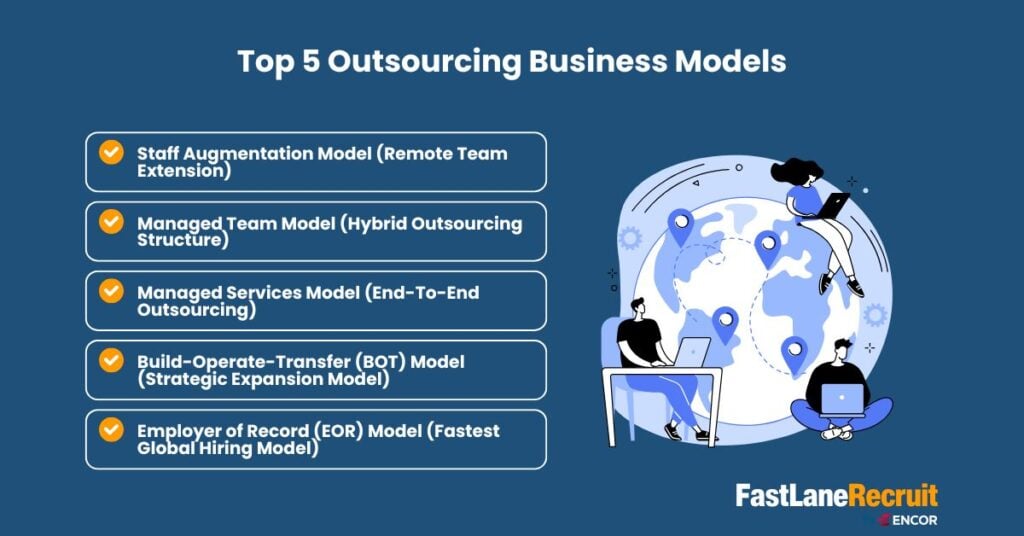
1. Staff Augmentation Model (Remote Team Extension)
The staff augmentation model is the most basic and widely used outsourcing structure. It allows companies to hire external professionals who function as part of the internal team.
- How It Works: The vendor provides skilled professionals, while the client manages daily tasks and output. There is minimal vendor involvement after hiring.
- Best For: Short-term capacity gaps, tech teams needing quick scaling, and startups needing flexibility.
- Advantages: Fast hiring process, high control over talent, and flexible scaling up or down.
- Limitations: No operational support from the vendor, management burden stays internal, and risk of inconsistent performance.
Decision Insight: This model works best when you already have strong internal leadership and need extra hands, not extra systems.
2. Managed Team Model (Hybrid Outsourcing Structure)
The managed team model introduces shared responsibility between the client and outsourcing provider.
- How It Works: The vendor manages HR, payroll, and administration. The client manages workflow and performance. Local compliance is handled externally.
- Best For: Scaling companies, regional expansion teams, and mid-sized businesses entering new markets.
- Advantages: Reduced HR and admin burden, better employee retention support, and a balanced control structure.
- Limitations: Partial dependency on vendor systems and less direct control than staff augmentation.
Decision Insight: This model is ideal for companies transitioning from internal hiring to structured outsourcing.
3. Managed Services Model (End-To-End Outsourcing)
Managed services represent full operational outsourcing where the vendor owns process delivery and outcomes.
- How It Works: The vendor handles an entire function or department. KPIs and SLAs define performance, and continuous optimization is included.
- Best For: Finance, HR, IT operations, cost optimization strategies, and enterprise-level scaling.
- Advantages: Significant cost efficiency, reduced operational complexity, and built-in process improvement.
- Limitations: Lower internal visibility, reduced direct control, and requires strong SLA governance.
Decision Insight: This model is best when businesses want to focus on core growth while outsourcing non-core operations.
4. Build-Operate-Transfer (BOT) Model (Strategic Expansion Model)
The BOT model is a long-term outsourcing strategy used for building offshore or regional teams.
- How It Works: The vendor builds and operates the team initially. After stabilization, ownership is transferred to the client.
- Best For: Enterprises entering new countries, long-term offshore centers, and high-control global scaling strategies.
- Advantages: Risk-free market entry, knowledge transfer included, and full ownership after transition.
- Limitations: Higher initial setup time and requires long-term commitment.
Decision Insight: BOT is a strategic alternative to company incorporation, especially for businesses testing new markets.
5. Employer of Record (EOR) Model (Fastest Global Hiring Model)
The Employer of Record model is one of the fastest-growing outsourcing business models in 2026. Instead of spending months setting up a legal entity in a new market like Malaysia, companies can hire immediately, stay compliant, and reduce administrative overhead.
- How It Works: The EOR becomes the legal employer of record, handling payroll, tax, compliance, and contracts. The client manages daily work and performance.
- Best For: Companies hiring internationally without entities, businesses expanding into Malaysia or Asia, and remote-first companies.
- Advantages: No company incorporation required, fully compliant employment structure, fast onboarding (days, not months), and reduced legal and HR risk.
Decision Insight: If speed, compliance, and cost efficiency matter, EOR is often the most strategic outsourcing model in 2026.
Also Read: EOR Services: A Game Changer for Startup Growth
Why Businesses Prefer EOR Over Company Incorporation In Malaysia
Many companies exploring outsourcing business models are now shifting away from entity setup due to several compounding challenges:
- High Setup Complexity: Companies face legal registration delays, strict local compliance requirements, and complex banking and tax onboarding.
- Slower Hiring Cycles: Entity setup can take weeks or months, delaying critical talent acquisition.
- Operational Overhead: Managing payroll, HR, and legal administration becomes a massive internal burden.
The EOR Advantage
With an EOR model, you hire immediately, remain 100% compliant, avoid steep incorporation costs, and scale faster in Malaysia and across Asia.
Also Read: How to Hire Using EOR in Malaysia
Why Choosing The Right Outsourcing Model Matters
From an operational expertise standpoint, outsourcing is not just cost optimization—it is workforce architecture design. Businesses that select the wrong model often face hidden operational costs, poor retention, compliance risks, and inefficient scaling.
Experienced companies carefully evaluate their market entry strategy, internal HR capability, legal exposure, and growth timeline before committing to a model.
How FastLaneRecruit Helps You Execute Successful Outsourcing Business Models
FastLaneRecruit helps businesses implement the right outsourcing strategy through an integrated suite of recruitment, Employer of Record (EOR), payroll, and workforce management solutions.
Recruitment Services
- Global talent sourcing and role-specific hiring
- Candidate screening and recruitment support
- Remote and distributed workforce building
Payroll Management
- Multi-country payroll administration
- Payroll processing and statutory compliance
- HR administration and employee lifecycle support
Employer of Record (EOR)
- Hire employees without establishing a local legal entity
- Compliant employment contracts and onboarding
- Payroll, tax, and employment compliance management
- Local HR support across Malaysia, Hong Kong, Singapore, China, the United Arab Emirates (UAE), and Taiwan
Strategic Workforce Consulting
- Guidance on selecting the right outsourcing model
- Workforce planning and cost optimization
- Market entry and regional expansion strategies
- Scalable hiring solutions for growing businesses
Whether you’re expanding into a single market or building a regional workforce across Asia and the UAE, FastLaneRecruit provides the expertise and local support you need to hire confidently, remain compliant, and scale efficiently.
Ready to build your global team? Contact FastLaneRecruit today to discover how our recruitment, payroll, and Employer of Record solutions can support your international growth.
Conclusion: Choosing The Right Outsourcing Business Model
The future of outsourcing is no longer about “cheap labor”—it is about strategic workforce design. Each outsourcing business model serves a specific purpose: staff augmentation for flexibility, managed teams for scaling, managed services for efficiency, BOT for expansion, and EOR for fast global hiring.
For companies entering Asia or Malaysia in 2026, EOR is increasingly becoming the preferred model due to unparalleled speed, strict compliance, and radically reduced risk.
FAQs: Outsourcing Business Models
What Are The 4 Types Of Outsourcing?
The four common types are offshore outsourcing, nearshore outsourcing, onshore outsourcing, and onsite outsourcing.
What Are The 4 Types Of Business Models?
Common business models include the subscription model, marketplace model, freemium model, and on-demand service model.
Who Is The Biggest BPO In The World?
Some of the largest global BPO companies include Teleperformance, Concentrix, and Accenture Operations.
What Is The Difference Between Outsourcing And EOR?
Traditional outsourcing delegates the work to a vendor, while an EOR legally employs the worker on your behalf while you retain operational control over their day-to-day tasks.
Is EOR Better Than Setting Up A Company In Malaysia?
For speed and compliance, EOR is often vastly superior for companies testing or entering the Malaysian market.
What Is The Best Outsourcing Model For Startups?
Staff augmentation and EOR are most commonly used by startups due to their maximum flexibility and low setup costs.
Can Outsourcing Reduce Business Costs?
Yes, especially through managed services and offshore teams that optimize both labor and operational expenses.