

Global outsourcing refers to the practice of delegating business functions or roles to external providers or professionals located in different countries. These functions may include recruitment, payroll, customer support, IT development, finance, and administrative operations.
Traditionally, outsourcing was primarily associated with cost reduction. However, modern global outsourcing has evolved into a strategic workforce model that enables companies to access international talent, improve operational efficiency, and scale faster without the limitations of local hiring markets.
Businesses today use global outsourcing to overcome three major challenges: rising labour costs, talent shortages, and slow internal scaling processes.
Content Outline
Key Summary
Global outsourcing is now a strategic growth model, not just cost reduction
Businesses no longer use global outsourcing only to save money. It has evolved into a core operating model that supports scalability, global hiring, and long-term competitiveness across industries.
Cost efficiency remains a major advantage, but not the only one
While companies can still achieve significant cost savings through lower labour and operational expenses, the stronger value now comes from improved productivity, flexibility, and access to global capabilities.
Access to global talent is a critical competitive advantage
Global outsourcing removes geographic hiring limits, allowing companies to tap into specialised skills, niche expertise, and diverse talent pools that may not be available locally.
Faster scaling improves business responsiveness
Outsourcing enables organisations to expand or contract teams quickly based on demand, helping them respond faster to market opportunities without long recruitment cycles.
Operational focus improves internal performance
By outsourcing non-core functions, internal teams can focus on strategic priorities such as growth, innovation, and customer experience, leading to higher overall efficiency.
Flexibility and agility are key drivers of modern outsourcing adoption
Global outsourcing allows businesses to adjust workforce size, structure, and capability more easily, which is critical in fast-changing and competitive markets.
Risks exist and must be actively managed
Challenges such as data security, communication gaps, and quality control issues highlight the importance of choosing the right outsourcing partners and governance structure.
Malaysia is a strategic location for global hiring expansion
For companies expanding into Southeast Asia, Malaysia offers strong compliance structures and talent availability. FastLaneRecruit supports this through Employer of Record (EOR) services, enabling compliant hiring without entity setup.
Why Businesses Are Shifting toward Global Outsourcing
Search behaviour shows that companies are increasingly looking for solutions to:
- Reduce hiring and operational costs
- Access skilled global talent quickly
- Scale teams without long recruitment cycles
- Improve business flexibility
- Maintain competitiveness in global markets
This shift is driven by structural changes in the workforce, including remote work adoption and global digital transformation.
Global outsourcing is no longer a temporary solution. It is becoming a permanent operating model for companies that want flexibility and global reach.
Benefits of Global Outsourcing
Cost efficiency and reduced operational overhead
One of the most significant advantages of global outsourcing is cost reduction. Businesses can optimise expenses by hiring talent from regions with lower labour costs while maintaining performance quality.
Cost savings typically come from:
- Reduced salary benchmarks compared to local markets
- Lower infrastructure and office-related costs
- Reduced recruitment and onboarding expenses
- Minimal long-term employment commitments
For many companies, this translates into 30 to 70 percent cost optimization depending on the role and geography.
Access to global talent and specialised skills
Global outsourcing removes geographic limitations in hiring. Companies are no longer restricted to local talent pools, which is particularly valuable in competitive industries such as technology, finance, and digital marketing.
Key advantages include:
- Access to highly specialised professionals
- Wider talent availability across multiple countries
- Improved diversity of skills and experience
- Ability to fill niche or hard-to-hire roles faster
This is especially important for companies facing talent shortages in their domestic markets.
Faster scaling and workforce expansion
Scaling internal teams can be slow due to recruitment bottlenecks, onboarding delays, and local hiring constraints. Global outsourcing solves this by enabling companies to expand teams quickly through external talent networks.
Benefits include:
- Rapid team deployment
- Flexible hiring based on project demand
- Reduced time-to-productivity
- Easier expansion into new markets
This allows businesses to respond quickly to growth opportunities without being constrained by internal HR capacity.
Improved focus on core business activities
Outsourcing non-core functions allows internal teams to focus on strategic priorities such as product development, business expansion, and customer experience.
This leads to:
- Higher productivity among internal teams
- Better allocation of leadership resources
- Reduced operational distractions
- Improved strategic execution
By shifting operational workload externally, companies can concentrate on value creation rather than administrative execution.
Access to on-demand expertise
Instead of hiring full-time specialists, businesses can access external experts on demand. This is particularly useful for short-term projects or highly technical functions.
Advantages include:
- Reduced hiring risk for specialised roles
- Access to global consultants and professionals
- Flexible engagement models (project-based or long-term)
- Faster problem solving with experienced talent
Greater business agility and flexibility
Global outsourcing improves operational flexibility by allowing companies to adjust workforce size and structure based on market conditions.
This supports:
- Scalable workforce models
- Faster response to demand changes
- Reduced fixed labour commitments
- More adaptive business operations
In volatile markets, this flexibility becomes a competitive advantage.
Risk diversification across markets
Relying solely on one location for talent or operations can create concentration risk. Global outsourcing distributes business operations across multiple regions, reducing dependency on a single market.
This helps mitigate:
- Economic instability risks
- Local talent shortages
- Regional disruptions
- Operational bottlenecks
24/7 operational capability
With teams distributed across different time zones, businesses can operate continuously.
This enables:
- Round-the-clock customer support
- Faster project turnaround cycles
- Continuous workflow execution
- Improved global customer experience
How Global Outsourcing Works in Practice
The global outsourcing process typically follows these steps:
- Identify business functions suitable for outsourcing
- Select outsourcing partners or providers
- Define role requirements and performance expectations
- Recruit or allocate external talent
- Integrate outsourced teams into existing workflows
- Manage performance and compliance remotely
Modern outsourcing is supported by digital HR systems, payroll platforms, and compliance frameworks that ensure smooth cross-border workforce management.
Common Use Cases of Global Outsourcing
Global outsourcing is widely used across multiple business functions, including:
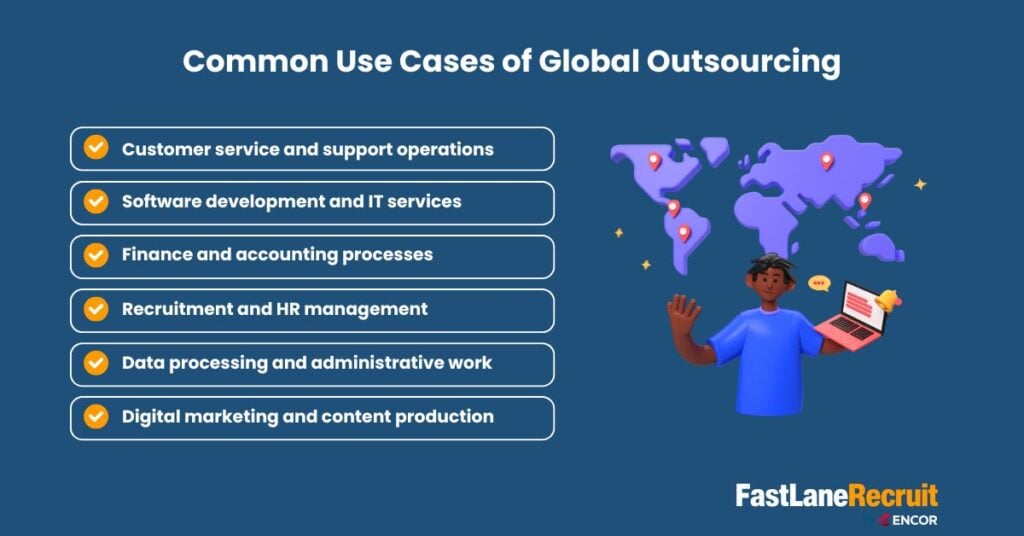
These functions are typically outsourced due to their scalability and standardised workflows.
Major Global Outsourcing Providers in 2026
The global outsourcing ecosystem includes enterprise consulting firms, BPO providers, staffing companies, and modern remote workforce platforms.
Enterprise outsourcing and consulting firms
- Accenture
- Deloitte
- IBM Consulting
- Capgemini
- Cognizant
- Tata Consultancy Services
- Infosys
- Wipro
- HCLTech
- Genpact
Business process outsourcing (BPO) providers
- Teleperformance
- Concentrix
- Foundever
- Alorica
- TTEC
Staffing and workforce providers
- Randstad
- Adecco Group
- ManpowerGroup
- Kelly Services
Global remote hiring platforms
- Remote.com
- Deel
- Oyster HR
- Papaya Global
- Velocity Global
- Toptal
- Upwork
These providers represent different layers of the outsourcing ecosystem, from enterprise-level operations to flexible remote hiring platforms.
Risks and Challenges of Global Outsourcing
While global outsourcing offers strong advantages, it also presents challenges that businesses must manage carefully.
Key risks include:
- Data security and compliance concerns
- Communication gaps across time zones
- Variability in service quality
- Cultural and operational differences
- Dependency on third-party providers
Successful outsourcing strategies require strong governance, clear processes, and the right partner selection.
Strategic Perspective: Why Global Outsourcing is Evolving
Global outsourcing has shifted from a cost-saving tactic to a strategic workforce model. Businesses now use it to build distributed teams, improve resilience, and access global capabilities that are not available within a single domestic labour market.
One of the key drivers of this evolution is the need for more flexible, borderless hiring structures that can support rapid scaling and specialized skill requirements. Companies are increasingly prioritizing locations that offer not only cost efficiency but also regulatory stability, talent availability, and strong business infrastructure.
Malaysia is emerging as a particularly relevant option within this global outsourcing landscape. It offers a well-developed digital and financial ecosystem, a multilingual workforce, and strong alignment with international business standards. English proficiency, competitive labour costs, and a stable regulatory environment make it attractive for companies looking to establish or extend regional operations.
From an outsourcing and workforce expansion perspective, Malaysia also provides a practical balance between cost efficiency and talent quality. This makes it suitable for functions such as customer support, shared services, finance operations, and regional coordination roles.
For companies expanding into Southeast Asia, Malaysia is often considered a strategic entry point due to its geographic positioning, business-friendly policies, and access to a growing pool of skilled professionals.
Also Read: Outsourcing in Malaysia: Why It Leads Southeast Asia in 2026 and How Businesses Benefit
How FastLaneRecruit Supports Global Hiring Across Asia and the UAE
FastLaneRecruit helps businesses build and manage compliant international workforces through comprehensive Employer of Record (EOR) services across Malaysia, Hong Kong, Singapore, China, the United Arab Emirates (UAE), and Taiwan.
With FastLaneRecruit, businesses can:
- Hire employees without establishing a local legal entity
- Ensure compliance with local employment laws, payroll, tax, and statutory requirements
- Streamline payroll, HR administration, and employee onboarding
- Reduce administrative, legal, and operational complexity
- Expand into multiple markets with a single trusted regional EOR partner
Whether you’re hiring talent in Malaysia or expanding into other key markets across Asia and the UAE, our team provides localized expertise and end-to-end workforce solutions to help you scale your business confidently while remaining fully compliant with local regulations.
Ready to grow your international team? Contact FastLaneRecruit today to learn how our Employer of Record services can support your expansion across Malaysia, Hong Kong, Singapore, China, the UAE, and Taiwan.
Conclusion
Global outsourcing has become a core business strategy for organisations seeking efficiency, scalability, and access to international talent. It allows companies to reduce operational costs while improving flexibility and speed of execution.
However, success depends on choosing the right structure, managing risks effectively, and partnering with reliable service providers.
For companies looking to hire and expand in Asia and the UAE, FastLaneRecruit provides a compliant and efficient pathway to build a scalable workforce without operational complexity.
Frequently Asked Questions
What are the main benefits of global outsourcing?
The main benefits include cost reduction, access to global talent, faster scaling, and improved operational efficiency.
Is global outsourcing suitable for small businesses?
Yes. Small businesses benefit from lower costs, flexible hiring models, and access to specialised skills without heavy overhead.
How does global outsourcing reduce costs?
It reduces costs by lowering salary expenses, eliminating infrastructure needs, and reducing long-term hiring commitments.
What is the difference between outsourcing and offshoring?
Outsourcing refers to hiring external providers, while offshoring refers to relocating business functions to another country.
What industries use global outsourcing most?
Technology, finance, customer support, HR, marketing, and administrative services are the most common.
What are the risks of global outsourcing?
Risks include communication challenges, quality control issues, compliance risks, and vendor dependency.
Can outsourcing help with global hiring?
Yes. It enables companies to access international talent faster without establishing local entities.
Is global outsourcing still relevant today?
Yes. It is increasingly important due to remote work trends and global talent competition.