
India is one of the world’s most attractive hiring destinations due to its large talent pool, competitive labor costs, and strong expertise in technology, engineering, finance, and customer operations. However, hiring employees in India directly can be complex for foreign companies due to strict employment laws and administrative requirements.
An Employer of Record (EOR India) provides a legal framework that allows companies to hire employees in India without incorporating a local entity. The EOR becomes the official employer for legal and compliance purposes, while the client company retains full control over daily work and performance management.
This model has become a preferred global hiring strategy for companies expanding into India efficiently and compliantly.
Content Outline
Key Summary
What an Employer of Record in India does
An Employer of Record (EOR India) is a third-party organization that legally employs workers in India on behalf of a foreign company while the client manages day-to-day work.
Why companies use EOR in India
It enables fast hiring without establishing a local entity, while ensuring compliance with India’s complex labor laws, tax obligations, and statutory benefits.
India’s compliance environment is highly regulated
Employment in India involves central and state-level labor laws, mandatory contributions such as Provident Fund (PF) and Employee State Insurance (ESI), and strict payroll reporting.
EOR reduces legal and operational risk
Using an EOR helps mitigate risks related to misclassification, tax non-compliance, and improper employment structuring.
EOR is faster than entity setup
Hiring through an EOR can take days or weeks compared to months required to incorporate a local company in India.
EOR is ideal for market entry and distributed teams
It is commonly used for hiring remote developers, customer support teams, and testing new markets before establishing a permanent presence.
Understanding India’s Employment Laws and Payroll Compliance
India is a high-growth but regulation-intensive employment market. Understanding its structure is essential before hiring.
Multi-layered employment laws
India has overlapping employment regulations:
- Central government labor laws
- State-specific labor regulations
- Industry-specific compliance requirements
This creates complexity for foreign employers operating without local expertise.
Mandatory statutory contributions
Employers must comply with several statutory obligations:
- Employees’ Provident Fund (PF)
- Employees’ State Insurance (ESI)
- Professional Tax (varies by state)
- Gratuity payments (based on tenure)
Payroll compliance requirements
Payroll must be structured and reported monthly, including:
- Income tax withholding (TDS)
- Payslip formatting compliance
- Government filings and submissions
Employment classification risks
Improper classification of employees may lead to:
- Penalties and fines
- Backdated tax liabilities
- Legal disputes and audits
Hiring Challenges in India Without an EOR
Hiring employees directly in India presents several operational challenges:
- Requirement to register a local legal entity
- Long incorporation timelines (often 3–9 months)
- Complex payroll setup across jurisdictions
- High compliance burden across labor laws
- Exposure to employment law violations
- Continuous HR administration requirements
For companies without local legal and HR teams, these challenges can slow down expansion significantly.
Why Use an Employer of Record in India Instead of Setting Up an Entity?
An EOR is especially valuable for companies testing the Indian market or hiring distributed teams without committing to long-term infrastructure.
Benefits of Using an EOR in India
Faster hiring and market entry
Companies can onboard employees quickly without waiting for entity registration.
Full compliance management
The EOR ensures adherence to Indian labor laws, tax regulations, and statutory filings.
Reduced administrative burden
HR, payroll, and legal compliance are managed externally.
Risk mitigation
Minimizes exposure to misclassification and employment disputes.
Cost efficiency
Eliminates incorporation, legal, and ongoing administrative costs.
Access to a large talent pool
Companies can hire across major Indian tech hubs such as Bangalore, Hyderabad, Mumbai, and Delhi.
Compliance and Legal Framework in India
Employment in India is governed by multiple legal frameworks, including:
- Industrial Disputes Act
- Employees’ Provident Fund Act
- Employees’ State Insurance Act
- Payment of Gratuity Act
- Income Tax Act (TDS provisions)
Employer responsibilities under EOR model
An Employer of Record typically manages:
- Drafting compliant employment contracts
- Employee registration with statutory bodies
- Monthly payroll tax deductions
- HR documentation and record keeping
- Legally compliant termination processes
Payroll and Benefits Administration in India
Payroll in India is structured and compliance-driven.
Key payroll components
- Basic salary structure
- House Rent Allowance (HRA)
- Special allowances and bonuses
- Monthly TDS deductions
- Employer contributions to PF and ESI
Mandatory employee benefits
- Paid leave (casual, sick, and earned leave)
- Provident Fund retirement savings
- Gratuity benefits (based on tenure)
- Insurance coverage (where applicable)
An EOR ensures accurate calculation, timely payments, and full regulatory compliance.
Also Read: Payroll Specialist Salary Guide 2026
Step-by-Step Hiring Process with an EOR in India
Step 1: Define role requirements
The company defines job scope, salary structure, and employment terms.
Step 2: Candidate selection
The employer identifies or recruits the candidate.
Step 3: EOR onboarding
The EOR issues a compliant employment contract under Indian law.
Step 4: Payroll setup
Salary structure, deductions, and benefits are configured.
Step 5: Employee onboarding
The employee is registered with all required statutory systems.
Step 6: Ongoing compliance management
Payroll, taxes, and HR compliance are handled monthly.
Step 7: Offboarding and termination
Employment termination is managed according to Indian labor law requirements.
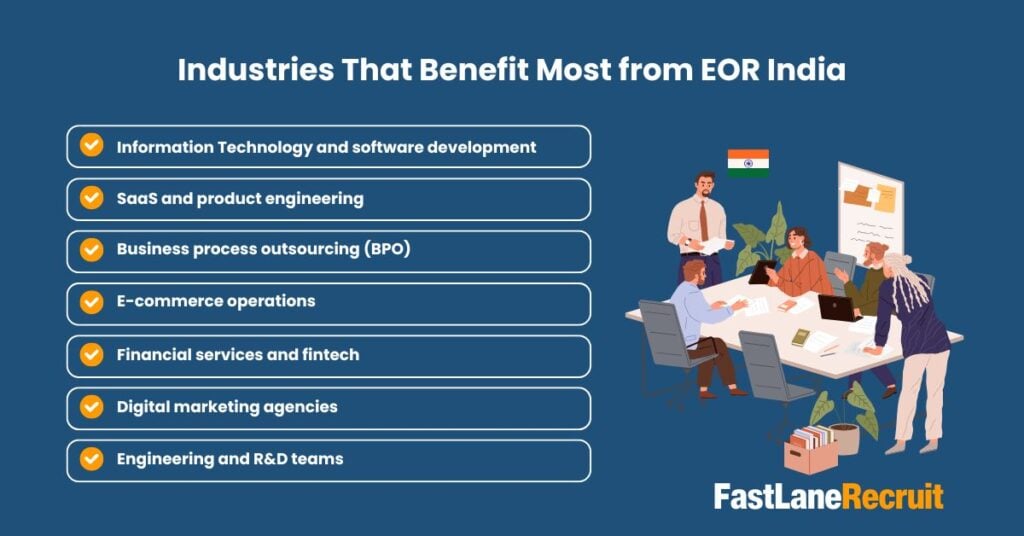
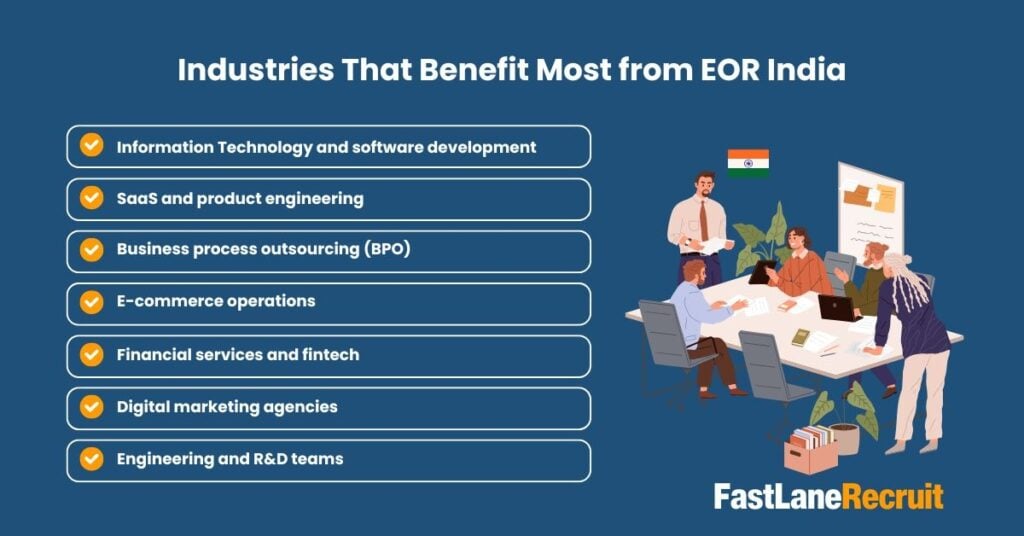
Industries That Benefit Most from EOR in India
EOR models are widely used across:
Risks and Considerations of Using EOR in India
While EOR simplifies hiring, companies should consider:
- Dependence on the EOR provider’s quality and compliance capability
- Limited direct control over legal employment structure
- Variations in state-level labor regulations
- Termination and employment protection constraints
- Need for strong coordination between employer and EOR
Selecting a reliable provider is critical for long-term stability.
EOR Provider Selection Checklist
When choosing an Employer of Record in India, evaluate:
- Local legal entity presence in India
- Proven compliance track record
- Payroll accuracy and audit history
- HR and legal expertise in Indian labor law
- Transparent pricing structure
- Technology platform for payroll and reporting
- Employee support capabilities
- Experience with international clients
Also Read: 10 Best Employer of Record (EOR) Services To Consider in 2026
Practical Use Cases for Employer of Record India
An Employer of Record (EOR) in India is not just a compliance workaround, it is a strategic hiring infrastructure for companies that want speed, flexibility, and reduced regulatory burden. The model is particularly valuable in scenarios where setting up a local entity is either too slow, too expensive, or unnecessary for the business objective.
Below are the most common and practical use cases for using an Employer of Record in India.
Market Entry Testing in India
Companies often use an EOR to test the Indian market before committing to full-scale expansion.
This allows businesses to:
- Validate product-market fit without incorporation costs
- Hire a small local team to understand customer behavior
- Test sales channels, partnerships, and demand
- Reduce financial and legal risk during early-stage expansion
Instead of investing months into setting up a subsidiary, companies can begin operations within days through an EOR structure. This is especially useful for SaaS, fintech, and digital service companies exploring India as a growth market.
Hiring Remote Engineering Teams
India is one of the largest global hubs for software engineering talent, particularly in:
- Backend development
- Full-stack engineering
- DevOps and cloud infrastructure
- Mobile application development
An EOR enables companies to hire engineers in India without establishing a local HR or legal entity. This is ideal for:
- Startups building distributed engineering teams
- Enterprises scaling offshore development centers
- Product companies needing specialized technical talent
The EOR handles employment contracts, payroll, tax withholding, and statutory compliance, while the company retains full control over engineering output and workflow.
Scaling Customer Support Operations
India is a major global destination for customer support and business process outsourcing due to its:
- Large English-speaking workforce
- Cost-efficient labor market
- Experience in global service operations
Companies use EOR arrangements to:
- Build customer support teams quickly
- Operate 24/7 support functions across time zones
- Scale seasonal or fluctuating support demand
- Maintain compliance across multiple states in India
This allows businesses to focus on service quality and operations while the EOR manages employment administration.
Managing Distributed Global Teams
Many companies today operate with fully distributed or hybrid global teams. India is often a key hiring location in this structure.
An EOR supports distributed workforce models by:
- Enabling compliant hiring in India alongside other countries
- Standardizing HR and payroll processes across regions
- Reducing the need for multiple legal entities globally
- Supporting centralized workforce management
This is particularly relevant for companies scaling across Asia-Pacific, Europe, or North America with decentralized teams.
Short-Term Project Hiring
Some business needs in India are project-based rather than permanent. In such cases, establishing a legal entity is inefficient.
EOR is ideal for:
- Software development projects with fixed timelines
- Market research or business expansion projects
- Temporary consulting engagements
- Implementation or system migration teams
The EOR structure allows companies to hire talent for the exact duration of the project while ensuring full legal compliance with Indian employment laws.
Avoiding Entity Setup for Pilot Programs
Setting up a legal entity in India requires time, capital investment, and ongoing compliance responsibilities. For pilot programs, this is often unnecessary overhead.
Using an EOR helps companies:
- Launch pilot teams quickly without incorporation delays
- Evaluate operational feasibility before long-term commitment
- Reduce regulatory exposure during experimentation
- Exit easily if the pilot does not scale
This is particularly useful for startups and multinational companies testing new services, products, or regional strategies in India.
Strategic Consideration: Hiring Alternatives in Other Markets
While India offers a large talent pool, many companies also consider hiring in jurisdictions with simpler compliance structures and faster onboarding processes.
FastLaneRecruit provides Employer of Record and recruitment solutions in:
- Malaysia
- Hong Kong
- Singapore
- China
- United Arab Emirates
- Taiwan
These markets typically offer:
- Faster hiring timelines
- More predictable compliance systems
- Lower administrative complexity
- Strong regional business infrastructure
Country Comparison Overview
| Country | Setup Complexity | Hiring Speed | Compliance Complexity | EOR Suitability |
| India | High | Medium | High | Strong for scale hiring |
| Malaysia | Low | Fast | Moderate | Highly suitable |
| Singapore | Low | Very fast | Low | Highly suitable |
| Hong Kong | Low | Fast | Low | Highly suitable |
| UAE | Medium | Fast | Moderate | Strong |
| Taiwan | Medium | Fast | Moderate | Strong |
Why Choose FastLaneRecruit
FastLaneRecruit provides Employer of Record solutions that enable companies to hire globally without setting up local entities.
FastLaneRecruit supports businesses by:
- Enabling compliant international hiring
- Managing payroll and HR administration
- Reducing expansion time and cost
- Supporting scalable workforce growth across multiple regions
Expand your global workforce without complexity.
Hire talent across Malaysia, Hong Kong, Singapore, China, UAE, and Taiwan with FastLaneRecruit. Contact us today!
Conclusion
Using an Employer of Record in India is one of the most efficient ways for international companies to hire talent without establishing a local entity. It reduces compliance burden, accelerates hiring, and minimizes legal risks in a complex regulatory environment.
However, companies should also evaluate alternative EOR markets depending on their expansion strategy, operational priorities, and long-term workforce plans.
FAQs
What is Employer of Record India?
It is a service where a third-party organization legally employs workers in India on behalf of a foreign company.
Is EOR legal in India?
Yes. EOR arrangements are widely used when structured in compliance with local employment laws.
How fast can hiring happen with EOR in India?
Hiring can typically be completed within days to a few weeks.
What taxes are managed under EOR India?
Income tax (TDS), Provident Fund, ESI, and other statutory contributions.
Do I need a local entity to hire in India?
No. An EOR eliminates the need for a local company setup.