
As companies expand globally, offshore teams have become a core part of modern business operations rather than just a cost-saving option. From startups to enterprise organizations, businesses now rely on distributed talent to scale faster, reduce operational load, and access specialized skills across borders.
But the reality is simple: hiring offshore talent is easy, managing offshore teams effectively is where most companies struggle.
Without a structured system, offshore teams often face misalignment, inconsistent output, and communication breakdowns that slow down execution instead of improving it.
This guide breaks down five interconnected, practical strategies for managing offshore teams, showing how structure, communication, performance systems, and Employer of Record (EOR) hiring in Malaysia work together to build a scalable global workforce.
Content Outline
Key Summary
Offshore Teams Require Systems, Not Just Hiring
Performance depends on structure, communication, and measurable workflows.
Communication And Execution Must Be Connected
Clear communication systems directly impact productivity and accountability.
KPI-Driven Management Improves Offshore Performance
What gets measured gets improved—especially in distributed teams.
Malaysia EOR Enables Fast And Compliant Hiring
Companies can legally hire offshore talent without setting up a local entity.
FastLaneRecruit Supports End-To-End Offshore Scaling
From recruitment to payroll and EOR, offshore operations become streamlined.
Understanding Offshore Teams In Modern Business Operations
Before diving into strategies, it is important to understand what offshore teams actually represent in today’s business environment.
Offshore teams are not just remote employees in another country, they are integrated extensions of your core business functions operating across borders.
They typically handle:
- Customer support and operations
- Finance and accounting
- Software development and IT services
- Marketing and content production
- Administrative and back-office functions
Why Offshore Teams Are Difficult To Manage Without Structure
The challenges are not about talent quality. They come from operational gaps such as:
- Time zone differences
- Lack of unified processes
- Inconsistent communication flow
- Undefined performance expectations
- Limited visibility for managers
This is why managing offshore teams requires a system-driven approach rather than ad-hoc coordination.
Build A Clear Offshore Team Structure Before Execution Begins
Effective offshore management starts before the first hire is made. Without structure, even skilled professionals cannot deliver consistent output.
A strong offshore structure ensures that every team member understands their role within the broader business system.
Key Components Of Offshore Team Structure
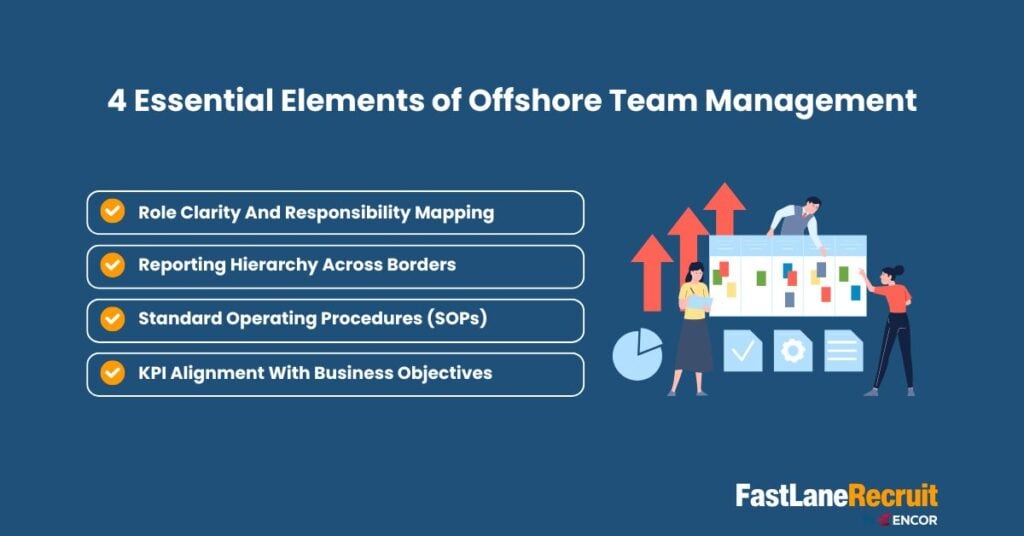
Role Clarity And Responsibility Mapping
Each offshore role must have clearly defined ownership to avoid duplication and confusion.
Reporting Hierarchy Across Borders
Offshore employees should know exactly who they report to and how escalation works.
Standard Operating Procedures (SOPs)
Documented workflows ensure consistency in execution regardless of location.
KPI Alignment With Business Objectives
Each role must contribute to measurable business outcomes.
Why Structure Directly Impacts Performance
When structure is missing:
- Work becomes reactive instead of planned
- Managers spend time correcting errors instead of scaling output
- Offshore teams lack autonomy
When structure is clear:
- Execution becomes predictable
- Decision-making speeds up
- Scaling becomes repeatable
Structure is the foundation that all other offshore management strategies depend on.
Establish Communication Systems That Support Distributed Work
Once structure is in place, communication becomes the execution layer that keeps offshore teams aligned.
Most offshore inefficiencies are not caused by lack of skill, they are caused by inconsistent communication systems.
How Offshore Communication Should Be Designed
Asynchronous Communication For Daily Work
Tools like Slack, Notion, and ClickUp should be used for:
- Task updates
- Documentation
- Progress tracking
Scheduled Synchronous Alignment
Meetings should be reserved for:
- Strategic discussions
- Problem-solving
- Cross-team alignment
Documented Decision-Making Process
Every important decision should be recorded to avoid repeated misalignment.
Defined Response Time Expectations
Clear SLAs ensure accountability across time zones.
How Communication Connects To Structure
- Structure defines responsibilities
- Communication enables execution
- Documentation ensures continuity
Without this alignment, offshore teams become fragmented and reactive instead of coordinated and efficient.
Also Read: Top 11 Collaboration Tools In 2026
Implement KPI-Driven Performance Systems For Offshore Teams
After structure and communication are established, performance must be measured objectively.
One of the biggest mistakes in managing offshore teams is relying on subjective performance evaluation instead of measurable KPIs.
Why KPIs Are Critical For Offshore Teams
- They eliminate ambiguity in expectations
- They create accountability across time zones
- They allow scalable performance tracking
KPI Framework For Offshore Team Management
Productivity KPIs
Measures output volume relative to workload.
Quality KPIs
Tracks accuracy, error rates, and rework frequency.
Responsiveness KPIs
Measures communication speed and turnaround time.
Consistency KPIs
Ensures stable delivery across weekly or monthly cycles.
How KPIs Connect The Entire System
- Structure defines what should be done
- Communication ensures it is understood
- KPIs measure whether it is done correctly
Without KPIs, offshore teams operate without feedback loops, making scaling unpredictable.
Also Read: Benefits of Offshoring for Australian Businesses
Use EOR In Malaysia To Simplify Offshore Hiring And Compliance
Even the best offshore management system can fail if hiring and compliance are complex and slow.
This is where Employer of Record (EOR) solutions become critical, especially in Malaysia.
Malaysia is emerging as a top offshore destination due to its strong talent pool and business-friendly environment.
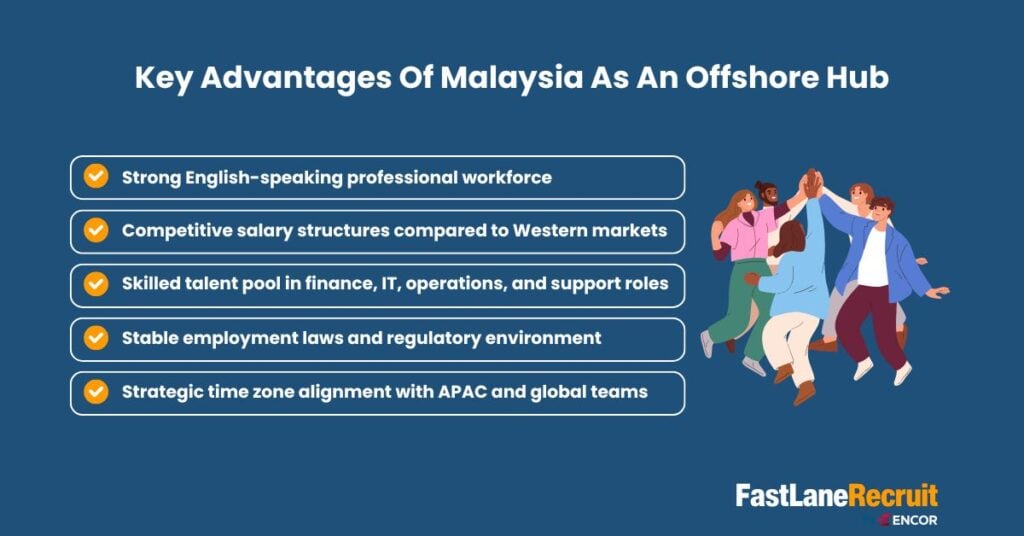
Why Malaysia Is A Strategic Offshore Hub
- High English proficiency across professional roles
- Competitive labor costs compared to Western markets
- Strong talent in finance, IT, and operations
- Stable regulatory and employment framework
- Time zone alignment with Asia-Pacific business regions
How EOR Supports Offshore Team Management
An EOR provider like FastLaneRecruit enables companies to:
Legally Hire Offshore Talent Without A Local Entity
Businesses can onboard employees quickly without setting up legal infrastructure.
Manage Payroll, Taxes, And Compliance Centrally
All administrative responsibilities are handled under one system.
Scale Teams Faster Across Borders
Hiring becomes operationally simple and repeatable.
Why EOR Strengthens Offshore Management Systems
EOR directly supports the entire offshore framework:
- Structure defines roles
- Communication ensures execution
- KPIs measure performance
- EOR enables scalable hiring
Without EOR, expansion becomes slow and compliance-heavy.
Build Continuous Training And Integration Systems For Offshore Teams
The final pillar of managing offshore teams is often ignored: continuous development.
Offshore teams are not static resources—they are evolving parts of a global workforce.
Key Components Of Offshore Training Systems
Structured Onboarding Programs
Every new hire should follow a standardized onboarding process.
Centralized Knowledge Base
Documentation ensures consistency in task execution.
Regular Upskilling Sessions
Continuous learning improves long-term performance.
Cross-Team Integration Activities
Helps align offshore and in-house teams culturally and operationally.
Why Training Is Directly Linked To Performance
Without training:
- Productivity declines over time
- Knowledge gaps increase
- Onboarding becomes inconsistent
With training:
- Teams adapt faster
- Performance remains stable
- Scaling becomes sustainable
Training closes the loop between hiring and execution.
Bringing Everything Together: A Unified Offshore Management System
Each of the five strategies works as part of a connected system:
- Structure defines roles and expectations
- Communication ensures execution clarity
- KPIs measure performance outcomes
- EOR in Malaysia enables scalable hiring
- Training ensures continuous improvement
When combined, managing offshore teams becomes a structured business capability rather than an operational challenge.
Why Consider EOR For Offshore Team Expansion
Before building offshore teams at scale, companies must decide how they will legally hire and manage international talent.
This is where Employer of Record (EOR) becomes a critical strategic option.
What EOR Actually Solves
EOR is not just an HR service, it is an operational infrastructure layer that handles:
- Legal employment of offshore staff
- Payroll processing and salary distribution
- Tax compliance and statutory obligations
- Local labor law adherence
- Contract and HR administration
Why Companies Choose EOR Instead Of Entity Setup
Setting up a legal entity in a foreign country can be:
- Time-consuming
- Expensive
- Legally complex
- Difficult to scale across multiple countries
EOR removes these barriers and allows companies to:
- Hire quickly
- Stay compliant
- Focus on performance management instead of legal setup
How EOR Connects To Offshore Team Management
EOR directly supports offshore operations by enabling:
- Faster onboarding of offshore employees
- Centralized payroll and compliance control
- Scalable hiring without operational bottlenecks
Without EOR, offshore expansion often becomes slow and fragmented.
Why Malaysia Is A Strategic Location For Offshore Teams
Malaysia has emerged as one of the most practical offshore destinations in Asia, particularly for companies building structured global teams.
Key Advantages Of Malaysia As An Offshore Hub
Why Malaysia Works Operationally
Unlike many offshore markets that focus only on cost reduction, Malaysia offers a balance of:
- Talent quality
- Business stability
- Operational predictability
- Communication efficiency
How Malaysia Strengthens Offshore Team Management
When combined with a structured management system, Malaysia enables:
- Faster onboarding cycles
- Higher retention rates
- Stronger alignment with global workflows
- Reduced communication friction
This makes it an ideal foundation for companies scaling offshore teams through EOR.
Why FastLaneRecruit Is The Right Offshore Scaling Partner
FastLaneRecruit helps businesses build and manage teams through an integrated workforce solution:
- Recruitment solutions
- Employer of Record (EOR) services in Malaysia
- Payroll and compliance management
- Scalable offshore workforce solutions
Instead of managing fragmented vendors and operational complexity, companies gain a single structured system for global hiring and workforce management.
If your business is ready to move beyond inconsistent outsourcing and build a structured offshore team that performs reliably, FastLaneRecruit provides the systems to support that growth.
Expand Across Asia and the UAE with FastLaneRecruit EOR Services
In addition to our Employer of Record (EOR) services in Malaysia, FastLaneRecruit also supports compliant hiring across Hong Kong, Singapore, China, the United Arab Emirates (UAE), and Taiwan. Our regional EOR solutions enable businesses to hire employees quickly without establishing local legal entities while ensuring full compliance with local employment laws, payroll requirements, tax regulations, and HR obligations.
Whether you’re entering a new market or building a regional team across multiple countries, FastLaneRecruit provides the local expertise and operational support to help you scale with confidence.
If your business is ready to move beyond inconsistent outsourcing and build a structured offshore team that performs reliably, FastLaneRecruit has the expertise and regional infrastructure to support your growth.
Partner with FastLaneRecruit today and transform offshore hiring into a structured, performance-driven business advantage. Contact us to discuss your global expansion plans.
Partner with FastLaneRecruit today and transform offshore hiring into a structured, performance-driven business advantage. Contact us today!
Conclusion
Managing offshore teams is no longer just an operational task, it is a structural capability that determines how effectively a company can scale across markets. Businesses that rely only on hiring often struggle with inconsistency, while those that invest in systems consistently achieve higher productivity, stronger communication, and predictable performance outcomes.
The five pillars outlined in this guide, structured team design, communication systems, KPI-driven performance management, continuous training, and strategic use of EOR in Malaysia, work together as a unified operating model. When these elements are aligned, offshore teams shift from being fragmented remote contributors to fully integrated extensions of the core business.
For companies looking to scale without the burden of entity setup, compliance complexity, or fragmented hiring processes, Malaysia presents a strong offshore destination. And with an Employer of Record model, businesses can enter this market quickly, safely, and efficiently while focusing on what truly drives growth: execution and performance.
FastLaneRecruit provides the infrastructure to make this transition seamless, combining recruitment, payroll management, and EOR services into a single scalable solution for global teams.
The outcome is simple: less operational friction, stronger team alignment, and a more controlled path to global expansion.
Frequently Asked Questions (FAQ)
What Is The Best Way To Manage Offshore Teams Effectively?
The most effective approach includes structured workflows, clear communication systems, KPI tracking, and continuous training.
Why Do Offshore Teams Underperform In Many Companies?
Most underperformance comes from lack of structure, unclear communication, and absence of measurable performance systems.
What Is EOR In Malaysia And Why Is It Important?
EOR allows companies to legally hire employees in Malaysia without setting up a local entity, simplifying payroll and compliance.
Is Malaysia A Good Location For Offshore Hiring?
Yes. Malaysia offers strong English proficiency, skilled talent, competitive costs, and stable employment regulations.
How Do You Improve Offshore Team Productivity?
Productivity improves through clear KPIs, structured onboarding, role clarity, and efficient communication systems.
What Tools Are Commonly Used To Manage Offshore Teams?
Common tools include Slack for communication, Notion for documentation, and ClickUp or Asana for task management.
How Does FastLaneRecruit Help With Offshore Teams?
FastLaneRecruit provides recruitment, EOR services, payroll management, and offshore workforce scaling solutions.