
Choosing between hiring contractors vs employees is one of the most important workforce decisions a business can make. It directly impacts legal compliance, tax obligations, operational control, cost structure, and long-term scalability.
However, worker classification is not always straightforward. Many organizations unintentionally misclassify workers due to blurred operational boundaries in remote, hybrid, and global work environments. This creates legal exposure and financial risk.
This guide provides a detailed framework to help you correctly determine contractor vs employee status using legal tests, practical indicators, and real-world decision criteria.
Content Outline
Key Summary
Worker classification impacts legal, tax, and operational risk
Incorrect classification can create legal, tax, payroll, and compliance issues for businesses.
Employees and Contractors Serve Different Roles
Employees work under company control, while contractors operate independently on flexible terms.
Control Is the Main Classification Factor
Authorities often assess how much control a company has over a worker’s schedule, tasks, and operations.
Misclassification Can Be Costly
Businesses may face penalties, back taxes, lawsuits, and reputational damage for non-compliance.
Hybrid Workforce Models Improve Flexibility
Combining employees and contractors allows companies to scale efficiently while managing costs.
Clear Contracts Help Reduce Compliance Risks
Well-defined agreements clarify responsibilities, payment terms, and legal expectations from the start.
What Is an Employee?
An employee is an individual engaged under a formal employment relationship with a company to perform ongoing duties that contribute to core business operations.
Employees are typically governed by labor and employment laws, and their relationship with the employer is structured around control, continuity, and integration.
Key characteristics of employees:
- Work under an employment contract governed by labor law
- Receive fixed salary (monthly, biweekly, or hourly)
- Employer withholds taxes and makes statutory contributions
- Eligible for statutory benefits (leave, insurance, pensions, etc.) depending on jurisdiction
- Work is controlled by the employer (schedule, process, performance expectations)
- Integrated into internal teams and business structure
Employees are generally considered part of the organization’s long-term workforce and contribute to ongoing operational stability and growth.
What Is an Independent Contractor?
An independent contractor is a self-employed individual or business entity engaged to perform specific tasks or deliverables under a service agreement.
Unlike employees, contractors operate independently and are not integrated into the employer’s organizational structure.
Key characteristics of contractors:
- Operate as independent businesses or freelancers
- Paid per project, milestone, or deliverable
- Responsible for their own taxes, insurance, and business expenses
- Control their own working methods, tools, and schedules
- Not entitled to employee benefits or statutory protections
- Engagement is temporary or project-based
Contractors are typically used for specialized expertise, short-term needs, or scalable workforce flexibility.
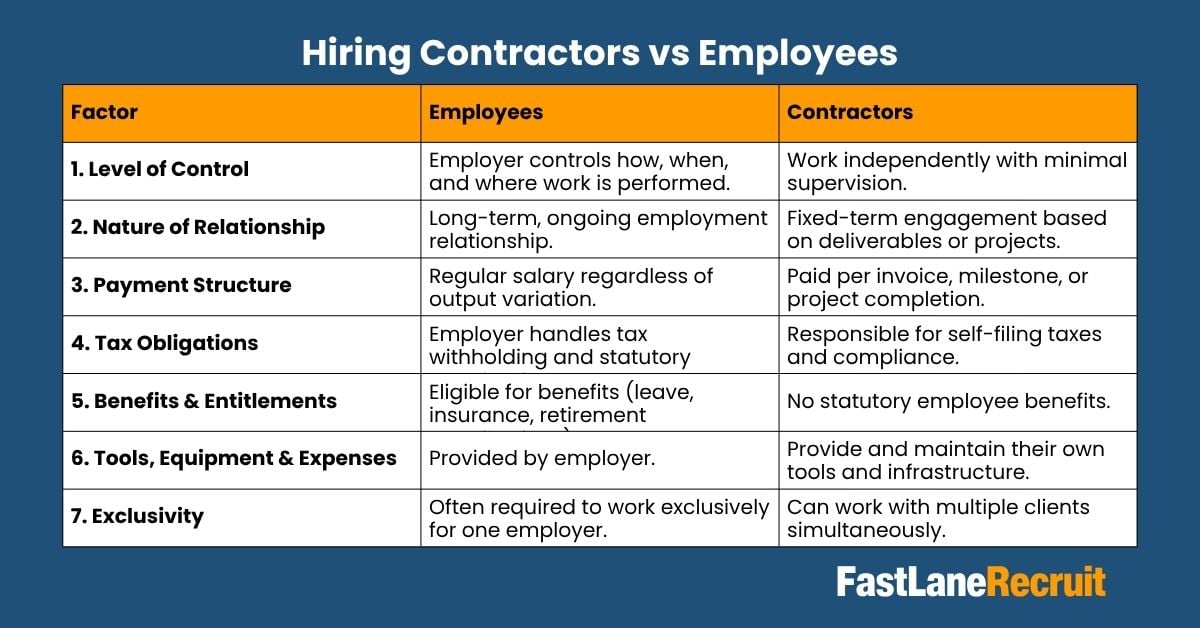
Key Differences Between Contractors and Employees
Understanding hiring contractors vs employees requires evaluating legal, financial, and operational factors.
Legal Tests for Worker Classification
Regulators typically assess classification using structured legal frameworks. While details vary by country, most systems evaluate three key areas:
Behavioral Control Test
Assesses how much control the business has over work execution.
Indicators of employee classification:
- Fixed working hours
- Direct supervision
- Mandatory procedures and workflows
Indicators of contractor classification:
- Independent work schedule
- Autonomy in methods and tools
- Output-based evaluation
Financial Control Test
Evaluates who controls financial aspects of the work.
Employee indicators:
- Fixed salary
- Employer covers expenses
- Limited financial risk for worker
Contractor indicators:
- Invoice-based payment
- Self-funded tools and expenses
- Business profit/loss risk borne by contractor
Nature of Relationship Test
Evaluates intent and structure of engagement.
Employee indicators:
- Long-term role in business operations
- Eligibility for benefits
- Ongoing work expectation
Contractor indicators:
- Defined project scope
- Temporary or milestone-based engagement
- No expectation of permanence
Benefits of Hiring Employees
Stronger Organizational Alignment
Employees are embedded into company culture, values, and long-term goals.
Greater Operational Control
Employers can manage schedules, workflows, and performance standards directly.
Workforce Stability
Employees provide continuity and reduce turnover risk in core functions.
Long-Term Skill Development
Businesses can invest in training and internal capability building.
Drawbacks of Hiring Employees
Higher Total Employment Cost
Includes salary, benefits, taxes, insurance, and compliance costs.
Increased Legal Responsibility
Employers must comply with labor laws, including overtime, leave, and workplace safety.
Administrative Burden
Requires HR management, payroll systems, and regulatory compliance tracking.
Reduced Flexibility
Scaling workforce up or down is slower and more complex.
Benefits of Hiring Contractors
Access to Specialized Skills
Ideal for technical or niche expertise not available internally.
Lower Long-Term Cost Commitment
No obligation for benefits, payroll taxes, or long-term salary costs.
High Flexibility
Easily scale workforce up or down based on project demand.
Faster Hiring Process
Contractors can often be engaged quickly for urgent needs.
Drawbacks of Hiring Contractors
Limited Control
Less authority over how work is performed.
Reduced Cultural Integration
Contractors may not fully align with company culture or mission.
Availability Risk
Contractors may prioritize other clients or projects.
Inconsistent Output Quality
Varies depending on experience and engagement level.
Common Worker Classification Mistakes
Many businesses unintentionally create misclassification risk through operational decisions such as:
- Assigning fixed working hours to contractors
- Including contractors in employee management structures
- Providing employee benefits to contractors
- Using contractors for core business operations
- Applying excessive behavioral control over contractors
- Failing to update contracts when roles evolve
Even small operational overlaps can trigger regulatory scrutiny.
Legal Risks of Misclassification
Misclassifying workers can result in serious consequences:
- Back taxes and unpaid statutory contributions
- Financial penalties and fines
- Legal disputes and worker claims
- Regulatory audits and investigations
- Reputational damage affecting hiring and clients
Governments globally are increasing enforcement due to rising remote and gig-based work models.
How to Decide Between Hiring Contractors vs Employees
Choose Employees When:
- Work is core to business operations
- Long-term stability is required
- High supervision and coordination are needed
- The role requires deep integration with internal teams
Choose Contractors When:
- Work is project-based or short-term
- Specialized expertise is required
- Flexibility is a priority
- The role is not central to core operations
Strategic Workforce Model: The Hybrid Approach
Most modern businesses adopt a hybrid workforce strategy:
- Employees handle core business functions
- Contractors support specialized or temporary needs
- External experts fill capability gaps efficiently
This approach balances cost control, scalability, and operational agility.
Final Thoughts
Correctly distinguishing between contractors and employees is essential for legal compliance and effective workforce planning. The distinction is primarily driven by control, financial dependency, and the nature of the working relationship.
As global hiring becomes more flexible, businesses that implement strong classification frameworks gain a competitive advantage in compliance, cost efficiency, and scalability.
Partner With FastLane Recruit for Compliant Global Hiring
Managing international teams and worker classification can be complex, especially when hiring across multiple jurisdictions. FastLane Recruit supports businesses with compliant workforce solutions that reduce risk and improve hiring efficiency.
Through Employer of Record (EOR) services, FastLane Recruit enables companies to legally hire global employees without establishing local entities—ensuring full compliance with local labor laws while accelerating international expansion.
Contact us to know more about FastLane Recruit services!
FAQ Section
What is the main difference between a contractor and an employee?
Employees work under employer control and receive salary and benefits, while contractors operate independently and are paid per project without employee benefits.
How do you determine if a worker is a contractor or employee?
Classification depends on behavioral control, financial control, and the nature of the relationship. High employer control usually indicates an employee.
What are the risks of misclassification?
Risks include back taxes, penalties, legal disputes, audits, and reputational damage.
Can contractors work full-time for one company?
Yes, but high control over their work may legally reclassify them as employees depending on jurisdiction.
When should a business hire employees instead of contractors?
Hire employees for long-term, core business roles requiring supervision and integration. Use contractors for short-term or specialized work.