Expanding into a new country can open access to valuable talent without requiring your business to establish a full operation there from day one. But hiring an employee internationally involves more than finding the right candidate. Employment contracts, payroll, statutory benefits, taxes, immigration requirements, and local labor laws all need to be handled correctly.
An Employer of Record (EOR) can provide a practical route when you need to employ people in a country where your business does not have its own legal entity.
But an EOR is not automatically the right solution for every international hire.
So, when should you use an employer of record?
An EOR may be a strong fit when you need to hire one or a small number of employees abroad, enter a market without immediately establishing an entity, move quickly, or manage local employment requirements without building an in-country HR and payroll infrastructure.
This guide explains seven signs your business may need an EOR, when an alternative may be more appropriate, and what to consider before choosing an EOR provider.
Content Outline
Key Summary
An EOR can help you hire without establishing a local entity
An EOR becomes particularly useful when your company wants to employ workers in a country where it does not have its own legal entity.
EORs are well suited to early-stage international expansion
Businesses can use an EOR to test a market, hire initial employees, or build a small team before deciding whether establishing a subsidiary is justified.
An EOR handles local employment administration
Depending on the country and service scope, EOR services can support employment contracts, payroll, statutory contributions, benefits administration, onboarding, and offboarding in accordance with local requirements.
You still manage the employee’s day-to-day work
The EOR becomes the legal employer, while your business generally remains responsible for the employee’s work, objectives, performance, and operational direction.
EOR is not the right answer for every worker
A genuine independent contractor, an established local operation, or a large long-term workforce may require a different employment model.
What Is an Employer of Record?
An Employer of Record (EOR) is a third-party organization that legally employs workers on behalf of a client company in a country where the client may not have its own entity.
The EOR typically takes responsibility for employer-related obligations such as:
- Locally compliant employment contracts
- Payroll processing
- Employment-related tax withholding and payments
- Statutory contributions
- Mandatory benefits administration
- Employee onboarding and offboarding
- Employment documentation
- Local HR and compliance administration
Your company generally continues to manage the employee’s day-to-day responsibilities, objectives, workload, performance, and team integration.
EOR vs. direct employment
The key distinction is the legal employer.
| Factor | EOR | Direct employment |
| Legal employer | EOR | Your company |
| Your own local entity required | Generally no | Yes |
| Local employment administration | EOR-supported | Your company |
| Day-to-day employee management | Your company | Your company |
| Local payroll administration | EOR | Your company/provider |
| Best suited for | International hiring without an entity | Established local operations |
The exact legal structure, permitted activities, and responsibilities vary by country, so businesses should assess the local requirements before hiring.
Also Read:What Is an Employer of Record (EOR)?
When to Use an Employer of Record: 7 Signs Your Business Needs an EOR
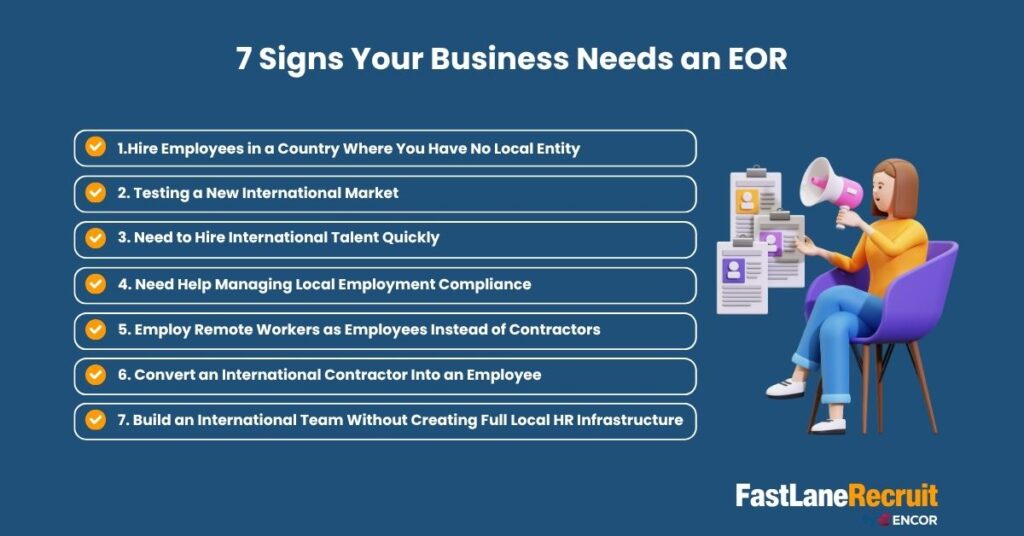
1. You Want to Hire Employees in a Country Where You Have No Local Entity
This is one of the clearest situations in which an EOR can be useful.
Suppose your company wants to hire a software engineer in Singapore, a sales manager in the UAE, or a marketing specialist in Australia, but you do not have a local subsidiary or branch in that country.
Establishing an entity solely for one employee may create substantial administrative work before the hire can even begin.
An EOR can provide an alternative by employing the worker locally while your company manages their day-to-day work.
An EOR may be appropriate when:
- You have no local entity
- You need a full employee rather than a contractor
- You want to begin hiring without immediately incorporating
- Your initial headcount is small
- You are still evaluating the market
This is one of the most commercially important search intents around “when to use an employer of record.”
2. You Are Testing a New International Market
Not every market expansion begins with a subsidiary.
You may first want to determine whether there is sufficient demand, talent availability, customer potential, or long-term commercial opportunity.
An EOR can allow a business to establish an initial workforce without immediately committing to a permanent local structure.
An EOR can make sense for market testing when you want to:
- Hire an initial employee or small team
- Validate the local talent market
- Establish operations before making a larger investment
- Avoid premature entity setup
- Evaluate long-term workforce requirements
If the market develops into a major operating hub, you can later reassess whether establishing your own entity makes greater strategic or financial sense.
Current EOR guidance similarly identifies market testing and small initial teams as common situations where EOR can be useful.
3. You Need to Hire International Talent Quickly
International entity establishment can involve incorporation, registrations, banking, tax administration, payroll infrastructure, and other local requirements.
If your priority is to recruit and onboard talent without waiting for the full entity setup process, an EOR can simplify the employment infrastructure.
This can be particularly valuable when:
- A candidate has a short availability window
- You have identified scarce international talent
- A business-critical role needs to start quickly
- You are entering several countries simultaneously
- Delaying the hire could mean losing the candidate
The exact onboarding timeline depends on the country, worker documentation, and local requirements, so businesses should confirm expected timelines with their EOR provider rather than relying on a universal setup period.
4. You Need Help Managing Local Employment Compliance
Employment rules are not standardized globally.
Requirements can differ significantly between countries and may cover:
- Employment contracts
- Minimum employment standards
- Working hours
- Paid leave
- Statutory benefits
- Social contributions
- Payroll taxes
- Probation
- Termination procedures
- Notice periods
- Employee documentation
An EOR can help administer employment according to applicable local requirements.
This is particularly valuable when your internal HR team does not have specialists in every country where you hire.
Important
An EOR can reduce administrative and compliance risks, but it does not mean every legal, tax, or corporate risk disappears.
For example, an EOR arrangement does not automatically eliminate potential permanent establishment, corporate tax, immigration, or regulatory issues. Country-specific professional advice may still be necessary.
That distinction is important for an E-E-A-T-focused article because it avoids presenting EOR as a universal legal shield.
5. You Want to Employ Remote Workers as Employees Instead of Contractors
Remote work does not automatically mean a worker should be classified as an independent contractor.
If the individual works as an integrated member of your organization, has an ongoing role, receives employee benefits, and operates under an employment relationship, employee status may be more appropriate depending on the applicable law.
Using a contractor arrangement simply because your business does not have a local entity can create worker-classification risk.
An EOR can provide an employment structure when:
- The worker should genuinely be an employee
- You do not have a local entity
- The role is ongoing
- The employee works as part of your organization
- You need locally compliant employment administration
If the worker is genuinely independent, however, an EOR may not be necessary. Contractor management may be more appropriate.
6. You Are Converting an International Contractor Into an Employee
Businesses sometimes begin an international relationship with a contractor and later decide the person should become an employee.
This can happen when:
- The role becomes permanent
- The worker becomes more integrated into the business
- The company wants to offer employee benefits
- The worker takes on greater responsibilities
- Classification concerns arise
- The business wants a more structured employment relationship
If you do not have a local entity, an EOR can provide an employment route without requiring your business to establish one immediately.
This is particularly relevant where a company has already built a successful relationship with a contractor and wants to retain that talent under a compliant employment structure.
7. You Want to Build an International Team Without Creating Full Local HR Infrastructure
Managing employees across several countries can quickly increase administrative complexity.
Instead of building separate processes for every market, businesses may use an EOR to centralize key employment administration through one provider.
An EOR can support areas such as:
- Employee onboarding
- Payroll
- Statutory contributions
- Benefits administration
- Employment documentation
- Local HR administration
- Offboarding
This allows your internal team to concentrate on business operations, employee performance, talent development, and growth, while the EOR supports the local employment administration.
When Should You Use an EOR Instead of Setting Up a Local Entity?
An EOR and a local entity solve different business needs.
The right choice depends on factors such as headcount, expected duration of operations, country strategy, administrative capacity, cost, and the activities employees will perform.
| Consideration | EOR | Local entity |
| Initial international hiring | Strong fit | May require more preparation |
| Small team | Often suitable | May be disproportionate |
| Market testing | Strong fit | Usually a larger commitment |
| Long-term large workforce | Review carefully | Often worth evaluating |
| Local commercial operations | May be limited | Stronger fit |
| Direct legal presence | No | Yes |
| Local HR/payroll administration | Provider-supported | Company-managed or outsourced |
| Long-term strategic presence | Depends on circumstances | Often more suitable |
There is no universal employee-count threshold at which a company should switch from EOR to an entity. Current guidance varies considerably by country and cost structure, so businesses should evaluate the total cost and strategic requirements rather than relying on a generic “10 employees” or “20 employees” rule.
Consider a local entity when:
- You expect substantial long-term headcount
- The country is strategically important
- You need a permanent legal presence
- Employees need to conduct activities requiring your own local entity
- You need direct control over local corporate infrastructure
- Your long-term operating model justifies the setup and maintenance costs
When Not to Use an Employer of Record
An EOR is not designed for every international worker or business model.
A contractor is genuinely independent
If a worker operates an independent business, serves multiple clients, controls how the work is performed, and otherwise meets the applicable legal criteria for contractor status, contractor management may be more appropriate.
Do not use contractor status simply to avoid employment obligations. Worker classification depends on the facts and applicable law.
You already have your own local entity
If your company already has a legal entity in the country, an EOR may duplicate infrastructure you already have.
A payroll provider, HR outsourcing arrangement, or PEO-type service may be more appropriate depending on the jurisdiction and your needs.
You are building a large, permanent local operation
If a country is becoming a major long-term market with substantial headcount, establishing your own entity may eventually make more strategic sense.
The decision should be based on total cost, operational requirements, local regulations, and long-term business plans rather than headcount alone.
The role requires a local legal or regulatory presence
Certain roles or activities may require specific licenses, registrations, or legal authority that an EOR arrangement may not provide.
For regulated or highly specialized positions, obtain country-specific legal advice before choosing the employment structure.
EOR vs Contractor vs Local Entity: Which Option Is Right?
Use this decision framework as a starting point:
| Your situation | Potentially suitable model |
| One or a few employees abroad, no local entity | EOR |
| Testing a new market | EOR |
| Need employee status without establishing an entity | EOR |
| Genuine independent project-based worker | Contractor |
| Existing local entity | Direct employment / payroll or HR outsourcing |
| Large, permanent local workforce | Consider a local entity |
| Need your own local commercial presence | Local entity |
| Need to convert a contractor into an employee | EOR or direct employment, depending on entity status |
The best choice depends on the worker relationship, country, headcount, timeline, business activities, and long-term strategy.
What Does an EOR Handle?
The scope varies by provider and country, but EOR services can commonly include:
Employment
- Locally compliant employment contracts
- Employee onboarding
- Employment documentation
- Offboarding administration
Payroll
- Payroll calculations
- Salary payments
- Tax withholding
- Statutory contributions
- Payroll reporting
Benefits
- Statutory benefits
- Local benefits administration
- Leave administration
- Other employment-related benefits where applicable
HR and compliance administration
- Local employment requirements
- HR documentation
- Employee changes
- Termination administration
- Ongoing employment compliance support
The client company generally remains responsible for managing the employee’s actual work and business performance.
How to Choose the Right EOR Provider
Choosing an EOR should go beyond comparing monthly fees.
1. Check country coverage
Confirm that the provider can legally support employment in the specific country where you want to hire.
2. Understand the employment structure
Ask whether the provider employs workers through its own local entity or a third-party partner and understand what that means for your workforce.
3. Review compliance capabilities
Look for evidence of local employment expertise and processes for keeping contracts, payroll, benefits, and employment administration aligned with changing requirements.
4. Evaluate payroll and benefits
Ask what is included in the fee and which costs are additional.
5. Check onboarding and offboarding support
A strong EOR should support the employment lifecycle, not simply process monthly payroll.
6. Understand pricing
Compare the total cost, including EOR fees, statutory employment costs, benefits, onboarding charges, foreign exchange costs, and other applicable fees.
7. Consider scalability
If you plan to hire across several countries, choose a provider that can support your international workforce as it grows.
Hire International Employees With FastLaneRecruit
Expanding into a new country should not require you to build an entire local employment infrastructure before you can hire your first employee.
FastLaneRecruit provides EOR solutions to help businesses employ talent across multiple international markets while supporting local employment, payroll, benefits, and HR administration.
Whether you are testing a new market, hiring your first international employee, expanding a distributed team, or converting a contractor into an employee, we can help you evaluate the appropriate employment approach for your business. FastLaneRecruit supports international employment across: Malaysia, Singapore, Hong Kong, China, India, Philippines, Taiwan, Vietnam, Australia, United Kingdom, Switzerland, UAE, Saudi Arabia, Qatar
Ready to hire internationally?
Talk to FastLaneRecruit about your hiring plans and find out whether an EOR is the right solution for your business.
Book a Free Consultation with an Expert!
Frequently Asked Questions About When to Use an Employer of Record
When should you use an employer of record?
You should consider an EOR when you need to hire employees in a country where your company does not have a local entity, particularly when you are hiring a small team, testing a market, need to hire relatively quickly, or want support with local employment administration.
When do you need an EOR?
You may need an EOR when your business wants to employ someone internationally but cannot or does not yet want to establish its own legal entity in that country.
Why use an employer of record?
Businesses use EOR services to simplify international employment administration, support locally compliant hiring, and employ workers in countries where they do not have their own entity.
Can an EOR hire employees without a local entity?
Yes. One of the primary purposes of an EOR is to employ workers locally on behalf of a client that does not have its own legal entity in the country, subject to the country’s laws and the provider’s operating model.
Does an EOR manage my employees?
An EOR is generally responsible for the legal employment relationship and related administration, while the client company continues to manage the employee’s day-to-day work, responsibilities, objectives, and performance.
Is an EOR the same as a PEO?
No. An EOR generally becomes the legal employer of the worker, while a PEO arrangement typically involves co-employment and usually requires the client to have an established local entity. The precise structure varies by jurisdiction.
Should I use an EOR or an independent contractor?
It depends on the actual working relationship. A genuine independent contractor may be better suited to contractor management, while an ongoing role that meets the legal criteria for employment may require an employee structure such as direct employment or EOR.
Is an EOR better than setting up a local entity?
Not necessarily. An EOR can be attractive for small teams, market testing, and early international expansion. A local entity may make more sense for a substantial, permanent operation or when your business requires its own legal and commercial presence.
Can I convert a contractor to an employee through an EOR?
Potentially, yes. If the worker should become an employee and your company does not have a local entity, an EOR can provide an employment structure in supported countries. The worker’s classification and local requirements should be reviewed before conversion.
Does using an EOR eliminate permanent establishment risk?
No. An EOR may help structure employment, but it does not automatically eliminate permanent establishment or corporate tax risk. Those issues depend on factors such as the employee’s activities, authority, business model, and applicable tax rules. Specialist tax advice may be necessary.