Hiring independent talent gives businesses flexibility, but choosing the right working arrangement becomes more complicated when a freelancer works with your company for months or becomes part of an ongoing team.
The terms freelancer, self-employed, and independent contractor are often used interchangeably. However, they can describe different aspects of a working relationship. Understanding the difference matters because contracts, tax obligations, benefits, worker classification and employer responsibilities can vary depending on the country and the actual arrangement.
For businesses hiring internationally, the question is bigger than terminology: Should you engage the person as an independent contractor, or should you employ them?
This guide explains the difference between freelance and self-employed work, what businesses should know about taxes, contracts and benefits, and when contractor management or an Employer of Record (EOR) may be the more appropriate solution.
Content Outline
Key Summary
Freelancer and self-employed are closely related, but not identical
A freelancer generally provides services independently to clients, often on a project, hourly or retainer basis. Self-employed is a broader concept that can include freelancers, consultants, sole traders and other people operating their own businesses.
Freelancers are commonly self-employed
In many jurisdictions, freelancers operate as self-employed individuals or independent contractors. However, the label alone does not determine legal or tax status. The actual working relationship and local rules matter.
A contract does not automatically determine worker status
Calling someone an “independent contractor” in an agreement does not necessarily make them one. Authorities may consider factors such as control, independence, permanence, economic dependence and the nature of the work.
Contractor management and EOR solve different problems
Contractor management is designed for genuine independent contractor relationships. An EOR is designed for employment relationships where a worker needs to be locally employed without the client establishing its own entity in that country.
The right model depends on the actual relationship
If someone is genuinely operating independently, contractor engagement may be appropriate. If the relationship functions more like employment, businesses should evaluate whether an employment structure, including an EOR where suitable, is more appropriate.
What Is a Freelancer?
A freelancer is generally an independent professional who provides services to clients without being employed as a regular employee by those clients.
Freelancers may work on:
- Specific projects
- Fixed-term assignments
- Hourly or daily engagements
- Retainer agreements
- Multiple client projects at the same time
Common freelance roles include writers, designers, developers, consultants, marketers, translators, photographers and other specialized professionals.
A freelancer typically manages their own work, negotiates fees, invoices clients and handles their own business administration.
However, “freelancer” is generally a description of the working arrangement rather than a universal legal classification. The legal treatment can differ between countries and circumstances.
What Does Self-Employed Mean?
Self-employed is a broader term describing someone who works for themselves rather than as an employee.
A self-employed person may:
- Provide professional services
- Operate a freelance business
- Work as an independent contractor
- Run a consultancy
- Operate a sole-trader or sole-proprietor business
- Sell products or services
- Own and operate a business
- Hire employees or other workers
This means that freelancing can be one form of self-employment, but self-employment covers a much wider range of business activities.
Freelance vs Self-Employed: What’s the Difference?
The simplest distinction is:
Freelancing usually describes the way someone provides services. Self-employment describes their broader working or business status.
| Factor | Freelancer | Self-employed |
| Meaning | Usually provides services independently to clients | Broader category for people working for themselves |
| Work | Often project, hourly or retainer-based | Can include services, products or business operations |
| Clients | Often works with multiple clients | May have one or multiple clients/customers |
| Business size | Often operates individually | May operate alone or run a larger business |
| Employees | May work alone or subcontract | Can potentially employ workers |
| Income | Often varies by project or client | Can come from services, sales or business activities |
| Contract | Usually governed by a service or contractor agreement | Structure depends on the business and relationship |
| Tax treatment | Depends on jurisdiction and structure | Depends on jurisdiction and structure |
| Benefits | Generally not the same as employee benefits | Generally responsible for arranging their own benefits |
| Legal classification | “Freelancer” may not be a legal classification | Status varies according to local law and facts |
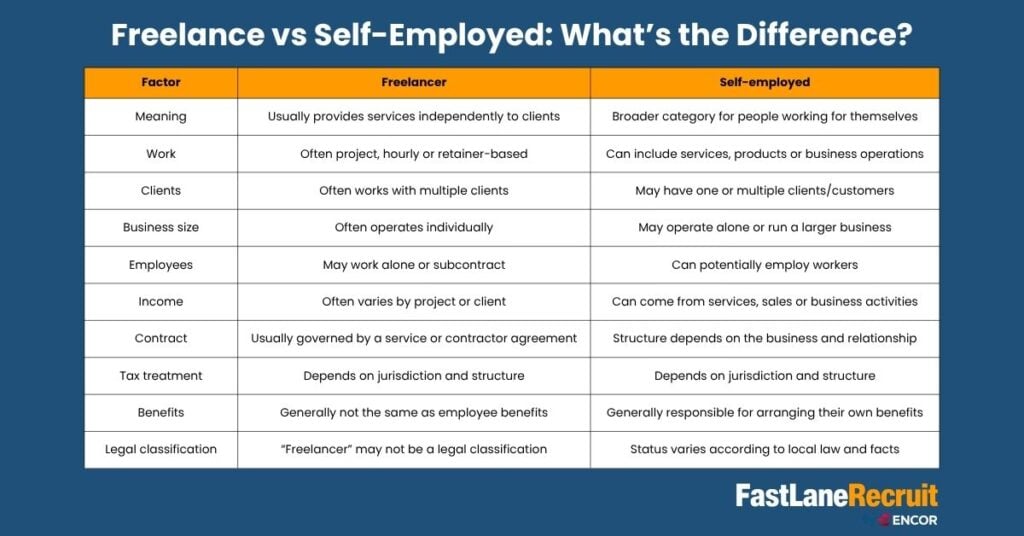
The distinction is therefore more about scope and context than two completely separate categories.
Are Freelancers Self-Employed?
Often, yes—but the terminology should not be treated as a universal legal rule.
A freelancer commonly operates independently, invoices clients and manages their own business obligations. In many countries, that arrangement is treated as self-employment or independent contracting.
However, a business should not rely solely on the label “freelancer” or “self-employed.” Employment authorities can assess the actual relationship between the worker and the company.
For example, relevant factors can include:
- Who controls how the work is performed
- Whether the worker controls their schedule
- Whether the worker can work for other clients
- Who provides equipment and resources
- Whether the relationship is permanent or project-based
- Whether the worker can make a profit or loss
- Whether the work is integral to the business
- Whether the worker operates an independent business
The specific test varies by jurisdiction. For example, U.S. Department of Labor guidance considers economic dependence and multiple factors rather than relying solely on a contract label. UK government guidance similarly emphasizes the facts of the working relationship when determining employment status.
Freelancer vs Independent Contractor: Are They the Same?
The terms are related, but they should not automatically be treated as identical.
A freelancer usually describes an individual who independently provides services to clients.
An independent contractor is more closely connected to the contractual and legal nature of the relationship between a worker and a business.
In practice, a freelancer may be engaged as an independent contractor. However, whether a person legally qualifies as an independent contractor depends on the applicable country’s rules and the facts of the engagement.
For employers, this distinction matters because the contract title should reflect the genuine working relationship rather than attempt to create a classification by wording alone.
Freelancer vs Self-Employed Taxes: What Changes?
One of the most common questions is whether freelancers and self-employed people pay different taxes.
There is no universal global answer.
Tax treatment can depend on:
- Country of residence
- Where the services are performed
- Business structure
- Income level
- Type of work
- Local tax registration requirements
- Social security or social insurance rules
- Whether the person operates through a company
In many cases, a freelancer who operates independently is responsible for reporting business income and managing their own tax and social contribution obligations. However, the exact requirements vary significantly between jurisdictions.
For example, UK guidance distinguishes tax status from other forms of employment status, while U.S. employment classification can involve separate tests for different purposes.
Important tax consideration for employers
Businesses hiring international freelancers should not assume that paying someone by invoice automatically removes employer obligations.
If the actual relationship resembles employment, the company may need to reassess the arrangement under the relevant local rules.
The worker’s label, invoice or contractor agreement should not be treated as the only evidence of classification.
Freelancer vs Self-Employed Contracts: What Should Be Included?
A well-structured independent contractor agreement should clearly define the commercial relationship.
Depending on the engagement and jurisdiction, it may address:
Scope of work
Clearly identify the services, deliverables, milestones and expected outcomes.
Payment terms
Specify:
- Fees or rates
- Currency
- Invoicing requirements
- Payment schedule
- Approved expenses
- Late-payment provisions where applicable
Intellectual property
Clarify ownership and permitted use of work products, inventions, designs, content, software or other deliverables.
Confidentiality
Protect confidential business, customer and commercial information.
Term and termination
State when the engagement begins, how long it is expected to last and how either party can end the agreement.
Independent status
The agreement should accurately reflect the intended independent relationship. It should not be used as a substitute for assessing the actual working arrangement.
Local compliance
For international engagements, contracts should be reviewed against the laws and requirements applicable to the worker’s location and the engagement.
Freelancer vs Self-Employed Benefits
Employees typically receive benefits and statutory protections according to applicable employment laws and their employment terms. Genuine independent contractors generally manage their own benefits and business expenses.
Potential differences include:
| Benefit or responsibility | Independent freelancer/contractor | Employee |
| Salary/payroll | Usually invoices for services | Paid through employer payroll |
| Paid leave | Generally not provided as an employee benefit | May be required by local law |
| Employer social contributions | Usually not treated like employee payroll | May apply depending on country |
| Health or insurance benefits | Usually arranged independently | May be provided by employer or required locally |
| Business expenses | Often managed by contractor | Often reimbursed or provided by employer |
| Work equipment | Often contractor-provided | Often employer-provided |
| Employment protections | Depends on legal classification | Generally broader statutory protections |
The exact benefits and rights depend on the jurisdiction and worker classification. A person described as a contractor may still have certain statutory protections under local law.
When Should a Business Hire a Freelancer or Independent Contractor?
Independent contractors can be useful when a business needs specialized expertise, flexibility or project-based support.
A contractor arrangement may be worth considering when:
- The work is clearly project-based
- The engagement has defined deliverables
- The worker operates an independent business
- The worker controls how the work is performed
- The worker can provide services to other clients
- The company needs specialist expertise temporarily
- The relationship genuinely meets applicable contractor requirements
For example, a company launching a new website may engage an independent developer for a defined project rather than hire a permanent employee.
However, the business should assess the actual relationship rather than selecting contractor status simply because it appears more flexible.
When Should a Business Hire an Employee Instead?
An employee structure may be more appropriate when the role is an ongoing part of the company’s workforce and the business exercises significant direction and control over the individual’s work.
Consider reassessing a contractor arrangement when:
- The worker has become a core member of the team
- The engagement has become open-ended
- The company controls the worker’s schedule and methods
- The worker performs work integral to the business
- The individual works primarily or exclusively for the company
- The business provides the equipment and resources
- The company wants to provide an employee benefits package
- The relationship increasingly resembles employment
These factors do not automatically determine classification. Local legal tests vary, and businesses should evaluate the complete relationship. U.S. Department of Labor guidance, for example, emphasizes multiple economic-reality factors rather than one decisive factor.
Contractor Management vs EOR: Which Should You Choose?
The key decision is not simply freelancer vs self-employed. For employers, it is often:
Should this person remain an independent contractor, or should they become an employee?
| Business situation | Potential model |
| Genuine independent contractor relationship | Contractor management |
| Project-based specialist | Independent contractor |
| International contractor requiring administrative support | Contractor management / Contractor of Record, where appropriate |
| Long-term employee relationship | Employment |
| Employee in a country where you have no entity | EOR |
| Contractor relationship becoming employee-like | Review classification and consider employee conversion |
| Entering a new market with a small initial team | EOR may provide an alternative to immediate entity setup |
FastLaneRecruit’s contractor management service is designed for genuine independent contractor relationships, including support with agreements, onboarding, payments and related administration. Our EOR service is designed for employees who need to be locally employed while the client manages their day-to-day work.
When Should You Consider an EOR?
An Employer of Record (EOR) can be useful when a company wants to employ someone in another country but does not have its own local employing entity there.
With an EOR structure:
- The company identifies the employee.
- The EOR establishes the local employment relationship.
- The employee signs the applicable local employment agreement.
- The EOR manages agreed employment administration, payroll and statutory requirements.
- The client continues to manage the employee’s day-to-day work.
FastLaneRecruit describes its EOR model as allowing businesses to hire employees without immediately establishing their own local entity, with support for employment contracts, payroll, statutory requirements and benefits administration.
EOR may be worth exploring when:
- You need to hire an international employee quickly
- You do not have a local legal entity
- You are testing a new market
- You are hiring your first employee in a country
- An existing contractor should transition into employment
- You want to centralize international employment administration
An EOR does not make every employment or tax obligation disappear. The appropriate structure depends on the country, role, employment relationship and applicable requirements.
Contractor to Employee Conversion: When Should You Reassess?
A contractor relationship can evolve over time.
A person may initially be engaged for a three-month project but later become:
- A long-term team member
- A full-time contributor
- Integrated into internal operations
- Subject to company schedules and processes
- Responsible for ongoing business-critical functions
At that point, the business should reassess whether the original contractor arrangement remains appropriate.
FastLaneRecruit supports contractor-to-employee conversion through its EOR infrastructure, allowing eligible workers to transition into local employment without requiring the client to establish its own entity solely for that employee.
Why Businesses Choose FastLaneRecruit
Choosing the right workforce model becomes more important as businesses hire across multiple countries.
FastLaneRecruit helps companies evaluate and manage international workforce arrangements through EOR and contractor management solutions, depending on the nature of the engagement.
EOR and contractor options
We support businesses that need to distinguish between genuine independent contractor engagements and employment relationships.
Local employment infrastructure
Our EOR model can support employment contracts, onboarding, payroll, statutory requirements, benefits coordination and ongoing employment administration.
International coverage
FastLaneRecruit provides global employment solutions across: Malaysia, Singapore, Hong Kong, China, India, Philippines, Taiwan, Vietnam, Australia, United Kingdom, Switzerland, UAE, Saudi Arabia, Qatar
Availability and the appropriate workforce model depend on the specific country and engagement.
Support for growing international teams
Whether you are engaging one independent contractor, converting a contractor into an employee or building a distributed international workforce, We can help you assess the appropriate hiring structure.
Choose the Right Workforce Model for Your International Team
Freelance vs self-employed is not simply a question of terminology. For businesses, the more important question is whether the actual working relationship is best structured as an independent contractor engagement or employment.
If the relationship is genuinely independent, contractor management can help organize contracts, onboarding, payments and administration.
If the worker should be an employee, an Employer of Record can provide a practical route to local employment in supported countries without requiring your business to immediately establish its own entity.
FastLaneRecruit can help you assess the available workforce model based on where you are hiring, how the worker will operate and your international expansion plans.
Ready to choose the right hiring model?
Talk to FastLaneRecruit about your international contractor or employee hiring needs.
Book a Free Consultation with an Expert and explore whether contractor management or EOR is the right fit for your workforce.
Frequently Asked Questions About Freelance vs Self-Employed
Is freelance the same as self-employed?
Not exactly. Freelancing generally describes how someone provides services, while self-employment is a broader concept covering people who work for themselves. A freelancer is commonly self-employed, but not every self-employed person is a freelancer.
Are freelancers independent contractors?
Many freelancers operate as independent contractors, but the exact legal classification depends on the country and facts of the working relationship.
Do freelancers pay their own taxes?
Often, independent freelancers are responsible for their own tax and social contribution obligations. However, tax rules vary by country, business structure and classification.
Do self-employed people get employee benefits?
Generally, self-employed individuals do not receive the same employer-provided benefits as employees. They may need to arrange their own insurance, retirement planning and other protections, subject to local rules.
Can a freelancer work for one company long term?
A freelancer can have a long-term relationship with one client. However, the longer and more integrated the relationship becomes, the more important it is for the business to review the applicable worker-classification rules rather than relying solely on the contractor label.
Can a freelancer become an employee?
Yes. A business can transition an independent contractor into an employee where an employment relationship is appropriate and legally available. For international workers, an EOR can be one possible employment structure when the company does not have a local entity.
What is the difference between contractor management and EOR?
Contractor management supports genuine independent contractor relationships. An EOR is designed to employ workers locally on behalf of a client company. The appropriate model depends on the actual working relationship and local requirements.
Can I hire an international freelancer without a local entity?
Possibly, but the appropriate structure depends on the worker’s classification, country and engagement. Contractor management may be appropriate for a genuine independent contractor, while an EOR may be more suitable when the worker should be employed.
When should a company convert a contractor to an employee?
Consider reassessing the relationship when a contractor becomes a long-term, highly integrated member of the workforce or the company exercises a level of control inconsistent with genuine independent contracting. Local classification rules should guide the decision.
Can FastLaneRecruit help with both contractors and employees?
Yes. FastLaneRecruit provides contractor management support for eligible independent contractor arrangements and EOR services for eligible employment arrangements across supported markets.