
Managing remote employees has become a core operational capability for modern businesses—not a temporary HR adjustment.
As organizations expand across borders, teams are increasingly distributed across countries, time zones, and legal systems. This shift creates both opportunity and complexity: access to global talent on one side, and challenges in coordination, productivity, and compliance on the other.
The fundamental challenge is no longer whether remote work works, but how to structure it so teams remain productive, accountable, and aligned without physical oversight.
Effective remote management requires a shift in mindset:
- From supervision → to system design
- From activity tracking → to outcome management
- From informal coordination → to structured communication
- From local hiring → to global workforce strategy
This guide provides a complete framework for hiring, onboarding, and leading remote employees effectively—while maintaining performance, clarity, and control at scale.
Content Outline
Key Summary
Remote Management Requires Systems, Not Supervision
Successful remote employee management depends on clear processes, workflows, and accountability structures rather than constant monitoring.
Measure Results Instead of Activity
Focus on deliverables, KPIs, and business outcomes rather than tracking hours worked or employees’ online status.
Hire for Independence and Communication
The best remote employees are self-disciplined, proactive communicators, and capable of working effectively with minimal supervision.
Create a Structured Remote Onboarding Process
The first 30 days should include clear role expectations, documented procedures, training schedules, and regular check-ins to accelerate employee success.
Track Productivity with KPIs and Project Tools
Use performance metrics, project management platforms, and simple reporting systems to measure progress instead of employee surveillance software.
Address Common Remote Work Challenges Early
Misalignment, communication gaps, and compliance risks are among the biggest threats to remote team performance and should be proactively managed.
Simplify Global Hiring with Employer of Record (EOR) Solutions
International hiring involves complex employment laws, payroll requirements, and compliance obligations. FastLaneRecruit’s EOR services help businesses hire globally without establishing local entities.
What Managing Remote Employees Actually Involves
Managing remote employees is not about monitoring work—it is about building an environment where work happens independently and consistently.
In traditional office environments, managers rely on visibility and proximity. In remote environments, those signals disappear, requiring structured systems instead.
Core Definition
Managing remote employees means:
- Designing workflows that function without supervision
- Establishing measurable outputs for every role
- Creating communication systems that replace physical interaction
- Ensuring alignment across distributed teams
The Structural Shift in Management
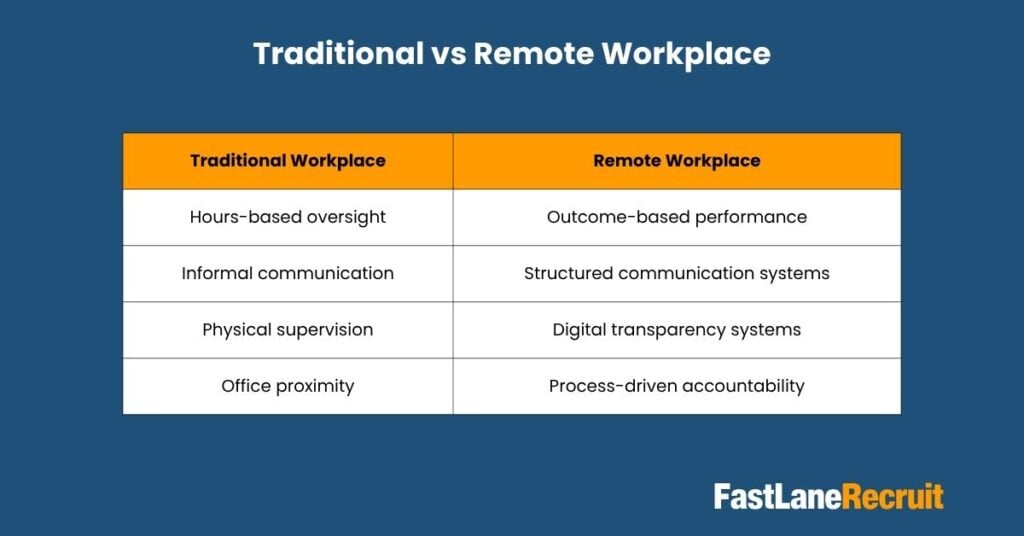
The most effective remote leaders act as system architects, not supervisors.
How to Hire Remote Employees for High-Performance Teams
Hiring remote employees requires a different approach than traditional recruitment. The focus shifts from credentials and proximity to autonomy, clarity, and communication ability.
Define Outcome-Based Roles
Every remote role should be structured around outputs rather than job activities.
Instead of:
“Social Media Assistant”
Define:
- Clear expectations
- Measurable performance
- Accountability without supervision
Identify Remote-Ready Talent
Strong remote employees typically demonstrate:
- High self-management capability
- Strong written communication skills
- Ability to work independently
- Proactive problem-solving behavior
Evaluate Communication Early
Communication is the backbone of remote performance. During hiring, assess:
- Clarity of written responses
- Structured thinking
- Ability to summarize tasks
- Responsiveness across asynchronous workflows
Global Hiring Complexity
Hiring remote employees internationally introduces challenges:
- Employment law variations
- Payroll compliance differences
- Tax and statutory obligations
- Contractual risk across jurisdictions
Many businesses struggle not due to talent shortages, but due to legal and operational constraints in global hiring.
How to Onboard Remote Employees Effectively
Onboarding is the most critical phase in remote employee success. Poor onboarding leads to confusion, slow productivity, and disengagement.
Structured 30-Day Onboarding Plan
Week 1: Orientation and Setup
- Company mission and structure
- Role expectations and KPIs
- Access to tools and systems
- Communication protocols
Week 2–3: Integration Phase
- Shadowing workflows
- Small task assignments
- Process training
- Feedback loops
Week 4: Independent Execution
- Full task ownership
- Performance evaluation
- Optimization feedback
Documentation-First Operating Model
Remote teams require documentation as a foundation:
- SOPs (Standard Operating Procedures)
- Workflow guides
- Knowledge repositories
Without documentation, teams rely on repeated verbal explanations, reducing scalability.
Early Success Milestones
Assigning early deliverables helps:
- Build confidence
- Validate role clarity
- Accelerate productivity
How to Lead Remote Employees Without Losing Control
Leadership in remote environments depends on structure, clarity, and consistency—not oversight.
Establish Clear Expectations
Every employee should understand:
- What success looks like
- What priorities matter most
- How performance is measured
Ambiguity is the leading cause of remote underperformance.
Build Communication Rhythm
Effective remote teams operate on predictable cycles:
- Daily asynchronous updates
- Weekly alignment meetings
- Monthly performance reviews
This replaces informal office conversations.
Focus on Outcomes, Not Activity
Evaluate performance based on:
- Output quality
- Delivery consistency
- Deadline adherence
Avoid reliance on:
- Online presence
- Response speed alone
- Working hours tracking
Build Trust Through Systems
Trust in remote teams is created through:
- Transparency in workflows
- Consistent reporting
- Predictable execution cycles
- Accountability structures
Read More: Best Practices for Managing Remote Teams Effectively
How to Track Productivity of Remote Employees
Productivity tracking should enhance clarity, not create surveillance.
KPI-Based Performance Tracking
Measure:
- Output volume
- Conversion rates
- Task completion rates
- Quality benchmarks
Project Management Systems
Tools such as:
- Asana
- ClickUp
- Monday.com
Provide visibility into:
- Task progress
- Deadlines
- workload distribution
Time Tracking (Selective Use Case)
Tools like:
- Toggl Track
- Hubstaff
Best suited for:
- billable work
- operational teams
- agency environments
Weekly Reporting System
A structured report should include:
- Completed tasks
- Current priorities
- Blockers
- Next steps
This ensures alignment without micromanagement.
How to Build a Strong Remote Team Culture
Remote culture does not emerge organically, it must be intentionally designed.
Ritual-Based Engagement
- Weekly team alignment calls
- Monthly business reviews
- Quarterly planning sessions
Recognition Systems
- Public appreciation channels
- Peer recognition systems
- Performance highlights
Asynchronous Social Interaction
- Optional chat channels
- Interest-based groups
- Informal updates
Transparency as Culture Foundation
- Shared goals and dashboards
- Open communication channels
- Clear decision-making documentation
Culture is built through consistency, not physical presence.
Best Software for Managing Remote Employees
Communication Tools
- Slack
- Microsoft Teams
Project Management
- Asana
- ClickUp
- Trello
Time Tracking
- Toggl Track
- Hubstaff
- Clockify
Documentation
- Notion
- Confluence
Performance Systems
- KPI dashboards
- Jira reporting systems
Key Challenges in Managing Remote Employees
Misalignment: Without structured systems, teams lose focus on priorities.
Communication Gaps: Too much or too little communication reduces efficiency.
Trust Deficit: Lack of visibility can create uncertainty between teams and management.
Time Zone Complexity: Global teams require asynchronous workflows.
Compliance Risk: International hiring introduces legal, tax, and payroll complexity.
How FastLaneRecruit Helps You Scale Remote Teams
Managing remote employees at scale requires more than leadership, it requires global workforce infrastructure.
FastLaneRecruit helps companies build and manage distributed teams without operational friction.
What FastLaneRecruit Enables
- Hire employees in Malaysia without setting up a local entity
- Ensure full legal and employment compliance
- Manage payroll and contracts efficiently
- Scale remote teams faster with reduced risk
Why It Matters
Most companies struggle with:
- cross-border employment laws
- payroll administration
- compliance complexity
- HR infrastructure setup
FastLaneRecruit removes these barriers so companies can focus on performance, growth, and talent, not legal complexity. Contact us now!
Conclusion: Building a Scalable Remote Workforce
Managing remote employees effectively requires a shift from traditional management to structured, outcome-driven leadership systems.
High-performing remote organizations consistently:
- Hire for autonomy and clarity
- Onboard with structured systems
- Lead through predictable workflows and accountability
But beyond leadership, scalable remote success depends on solving global employment complexity.
This is where FastLaneRecruit enables businesses to expand confidently—by simplifying international hiring, compliance, and workforce management.
FAQ
1. What is the best way to manage remote employees?
The best approach is outcome-based management supported by structured communication, clear expectations, and consistent reporting systems.
2. How do you track remote employee productivity?
Through KPIs, project management tools, weekly reporting systems, and selective time tracking where necessary.
3. What are the best practices for remote onboarding?
A structured 30-day onboarding plan, documentation-first processes, and early success tasks.
4. How do you build remote team culture?
Through structured rituals, recognition systems, transparency, and consistent communication cycles.
5. How can companies hire remote employees globally?
Through Employer of Record solutions like FastLaneRecruit that handle compliance, payroll, and legal employment structures.