
Malaysia is one of Southeast Asia’s most attractive business hubs with its skilled workforce, competitive costs, and strong regulatory framework. However, one area that often challenges foreign employers is Malaysia’s payroll processing.
From statutory contributions to strict payroll deadlines, managing payroll in Malaysia requires accuracy, compliance awareness, and strong operational discipline.
This guide explains everything you need to know about the payroll cycle, compliance rules, calculations, risks, and modern payroll solutions in Malaysia.
Content Outline
Key Summary
What Payroll Processing Means in Malaysia
Payroll processing in Malaysia is a monthly cycle that ensures employees are paid accurately, on time, and in full compliance with employment and tax laws. It includes salary calculation, deductions, reporting, and payment execution.
Malaysia Payroll Requires Strict Compliance
Payroll is governed by multiple authorities including LHDN, EPF, SOCSO, and EIS. Each has different rules, deadlines, and reporting requirements, making compliance essential for all employers.
Payroll Is Affected by Employment Conditions
Factors such as working hours, minimum wage, overtime rules, and statutory leave directly impact salary calculations. These regulations ensure fair compensation but add complexity to payroll management.
Payroll Cycle in Malaysia Is Monthly and Structured
The payroll cycle follows a fixed monthly process: data collection, salary calculation, approval, deductions, payment, and reporting. Employers must ensure wages are paid within 7 days after the pay period ends.
Documentation Is Essential for Compliance
Payroll accuracy depends on proper records such as attendance, overtime, leave, claims, and annual tax forms (EA and Form E). Employers must retain records for at least 7 years.
Payroll Challenges Are Common for Businesses
Companies often struggle with frequent regulatory updates, complex deductions, manual errors, and time-consuming processes. These challenges increase as businesses scale or hire internationally.
Modern Systems and Outsourcing Improve Efficiency
Cloud payroll systems and outsourcing solutions help automate calculations, ensure compliance, reduce errors, and improve data security, making payroll Malaysia easier to manage for growing businesses.
What Is Payroll Processing in Malaysia?
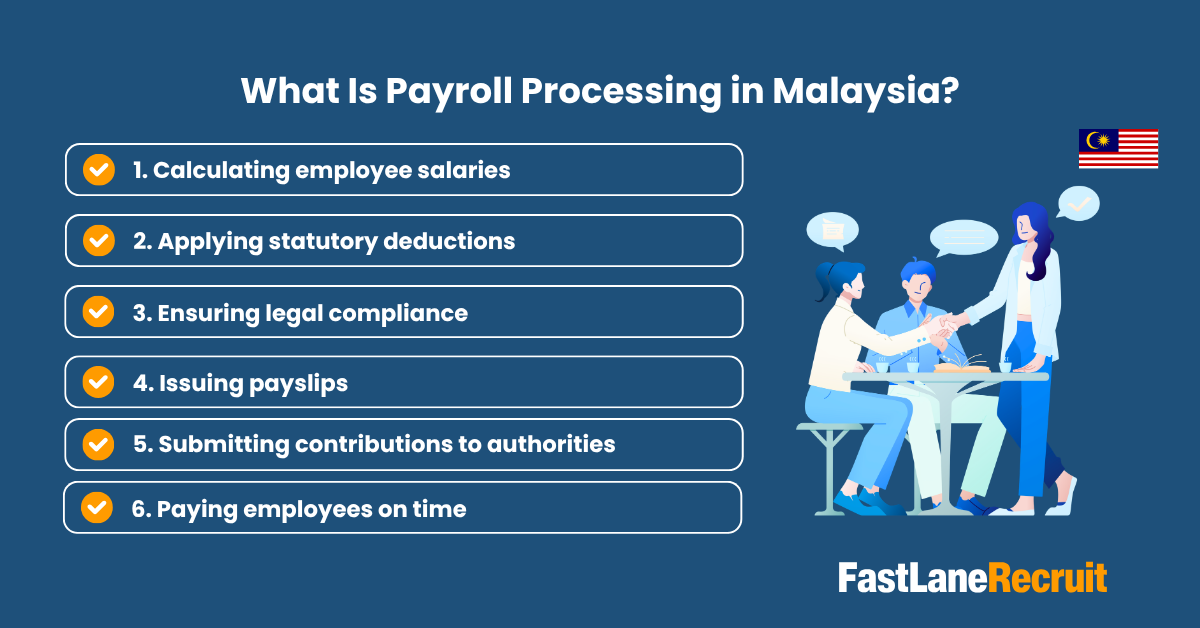
Payroll processing in Malaysia is the full monthly process of making sure employees are paid correctly, on time, and in line with Malaysian laws.
It’s not just about transferring salaries; it involves several important steps that must be completed every month.
1. Calculating employee salaries
This is the process of working out how much each employee should be paid for the month.
It includes:
- Basic salary
- Overtime pay
- Allowances (such as transport or meals)
- Bonuses or commissions
- Deductions for unpaid leave or other adjustments
All of these are combined to form the gross salary, which is the total earnings before deductions.
2. Applying statutory deductions
Before employees receive their final salary, mandatory deductions must be applied according to Malaysian law.
These include:
- EPF (KWSP) – retirement savings contribution
- SOCSO (PERKESO) – employee protection insurance
- EIS – unemployment insurance contribution
- PCB (Monthly Tax Deduction) – income tax deducted and submitted to LHDN
Each deduction follows specific government rules and rates.
3. Ensuring legal compliance
Payroll must comply with Malaysian employment and tax laws, including:
- Employment Act 1955 (rules on wages, working hours, and payment timing)
- Tax regulations from LHDN
- Contribution requirements from EPF, SOCSO, and EIS
Compliance ensures that all payroll activities follow legal standards and deadlines.
4. Issuing payslips
After payroll is processed, employers must provide employees with a payslip.
A payslip typically shows:
- Gross salary
- All deductions (EPF, SOCSO, tax, etc.)
- Net salary (final take-home pay)
Payslips can be issued in printed or digital format, as long as employees receive clear records.
5. Submitting contributions to authorities
Employers are responsible for submitting monthly payments and reports to government agencies, including:
- LHDN for tax deductions
- EPF for retirement contributions
- SOCSO for employee protection
- EIS for employment insurance
These submissions must be completed accurately and on time every month.
6. Paying employees on time
After all calculations and approvals, employees receive their salaries through bank transfer.
In Malaysia, wages are generally required to be paid within 7 days after the end of the salary period, making timely processing very important.
Summary
Payroll processing in Malaysia ensures that:
- Employees are paid correctly
- Legal deductions are applied properly
- Government contributions are submitted on time
- Employers remain compliant with Malaysian regulations
Also Read: Advantages of Payroll Outsourcing in Malaysia
Why Payroll in Malaysia Requires Careful Compliance
Payroll in Malaysia is regulated by multiple government authorities. Each authority is responsible for a different part of the payroll process, which makes compliance more complex.
Key government authorities involved:
1. Inland Revenue Board (LHDN)
Handles employee income tax.
Employers must:
- Deduct monthly tax (PCB/MTD) from salaries
- Submit tax payments to LHDN every month
- Issue annual tax documents (EA Form)
2. Employees Provident Fund (EPF / KWSP)
Manages employee retirement savings.
Employers must:
- Deduct employee EPF contributions
- Contribute employer’s share
- Submit payments monthly
3. Social Security Organisation (SOCSO / PERKESO)
Provides protection for workplace injury and disability.
Employers must:
- Make monthly contributions based on salary levels
- Ensure employees are properly registered
4. Employment Insurance System (EIS)
Provides financial support to employees who lose their jobs.
Both employers and employees contribute a small percentage each month.
Why this matters
Each authority has:
- Different rules and calculation methods
- Different submission deadlines
- Different reporting requirements
This creates a multi-layer compliance system that employers must manage carefully.
What happens if compliance is not followed?
If payroll is incorrect or late, companies may face:
- Financial penalties and fines
- Interest charges on unpaid contributions
- Government audits or investigations
- Legal action in serious cases
- Employee disputes or dissatisfaction
Summary
Payroll compliance in Malaysia is important because:
- Multiple government agencies are involved
- Each has strict rules and deadlines
- Employers are fully responsible for accuracy and timeliness
- Mistakes can lead to financial and legal consequences
Also Read: Best Payroll Outsourcing Companies in 2026
Working Conditions That Impact Payroll in Malaysia
Payroll in Malaysia is closely connected to employment laws and working conditions. These rules determine how salaries are calculated, what employees are entitled to, and how employers must manage payments each month.
Understanding these conditions is important because they directly affect payroll accuracy and compliance.
1. Standard working hours
In Malaysia, normal working hours are generally:
- Around 8 hours per day
- Up to 48 hours per week
Anything beyond these limits is usually considered overtime and must be paid at a higher rate under the Employment Act 1955.
2. Monthly payroll cycle is standard
Most companies in Malaysia operate on a monthly payroll cycle, meaning employees are paid once every month.
This is the most common and legally accepted pay structure, and it simplifies salary calculation, tax deduction, and statutory reporting.
3. Minimum wage regulations
Malaysia has a national minimum wage policy.
Employers must ensure that:
- Employees are not paid below the legal minimum wage
- Adjustments are made if the government updates the minimum wage rate
This directly impacts base salary calculations, especially for entry-level roles.
4. Overtime regulations
Overtime pay is governed by the Employment Act 1955.
In general:
- Overtime must be paid at a higher hourly rate
- Rates vary depending on whether work is done on weekdays, rest days, or public holidays
- Accurate time tracking is essential to calculate overtime correctly
This is one of the most sensitive parts of payroll calculation.
5. Paid leave and holidays
Employees in Malaysia are entitled to statutory leave benefits, which affect payroll planning and cost:
- Paid annual leave (varies based on length of service)
- Paid sick leave
- Paid public holidays (at least 11 gazetted holidays per year)
Some leave types may be unpaid depending on company policy or eligibility.
These entitlements must be factored into payroll calculations, especially when employees are absent or on leave.
How these conditions impact payroll
All of these working conditions influence:
- Total salary calculations
- Overtime payments
- Leave deductions or adjustments
- Statutory contribution amounts
- Overall payroll cost for employers
This is why payroll in Malaysia cannot be treated as a simple salary transfer process.
What Is the Payroll Cycle in Malaysia?
The payroll cycle in Malaysia refers to the complete monthly process of calculating salaries, applying deductions, and paying employees.
In most companies, this cycle repeats every month in a structured and fixed timeline.
Standard payroll cycle process
1. Payroll cut-off (data collection closes)
This is the point where all payroll-related information is finalized, such as:
- Attendance records
- Overtime hours
- Leave records
- Bonuses or commissions
- Expense claims
No changes should be made after this point unless approved.
2. Attendance and salary calculation
HR or payroll teams calculate each employee’s salary based on:
- Basic salary
- Allowances
- Overtime pay
- Leave adjustments
- Commissions or bonuses
This produces the gross salary before deductions.
3. Internal review and approval
Before payment is made, payroll reports are reviewed by management or finance teams.
This step ensures:
- Calculations are correct
- No missing payments or deductions
- Payroll data is accurate and complete
Approval is required before proceeding.
4. Statutory deductions processing
Mandatory deductions are then applied, including:
- EPF (retirement savings)
- SOCSO (employee protection)
- EIS (employment insurance)
- PCB (income tax deduction)
These are submitted to the relevant government authorities.
5. Salary payment execution
After approvals and deductions:
- Net salary is transferred to employees
- Payments are usually made via bank transfer
- Payment must follow the approved payroll schedule
6. Payslip and reporting
Employees receive payslips showing:
- Gross salary
- Deductions
- Net salary
Employers also maintain payroll reports for audits and compliance tracking.
Also Read: Types of Payroll Deductions and How They Work
Legal payment timeline
Under Malaysian employment law:
- Wages must be paid within 7 days after the end of the salary period
This makes timely payroll processing critical for compliance and employee trust.
Summary
The payroll cycle in Malaysia is a structured monthly process that ensures:
- Accurate salary calculation
- Proper statutory deductions
- On-time salary payment
- Full compliance with Malaysian labour laws
Payroll Documentation Required in Malaysia
Accurate payroll documentation is a key part of running compliant payroll in Malaysia. It ensures that every salary calculation is supported by proper records, and it also helps employers stay prepared for audits, tax reviews, and internal checks.
Good documentation is not just about record-keeping; it is the foundation of payroll accuracy, transparency, and legal compliance.
Why Payroll Documentation Matters
Payroll documents serve as proof for:
- How salaries were calculated
- Why certain deductions were made
- How allowances or overtime were approved
- Whether statutory contributions were correctly applied
Without proper documentation, companies may face:
- Compliance issues during audits
- Difficulty explaining payroll calculations
- Disputes with employees
- Penalties from regulatory authorities
Monthly Payroll Documents
These are the supporting records used every month to calculate employee salaries correctly.
1. Attendance and timesheets
These records show how many days and hours an employee has worked.
They are used to calculate:
- Basic salary eligibility
- Absences or unpaid leave
- Overtime hours
Accurate attendance tracking is essential for fair payroll processing.
2. Overtime records
Overtime records document any extra hours worked beyond normal working hours.
They help determine:
- Overtime pay rates
- Work done on rest days or public holidays
- Additional compensation required under the Employment Act
3. Commission and bonus approvals
Any additional earnings outside basic salary must be properly approved and recorded.
This includes:
- Sales commissions
- Performance bonuses
- Incentive payments
These documents ensure that extra payments are valid and correctly included in payroll.
4. Leave records
Leave records track employee absences, including:
- Annual leave
- Sick leave
- Unpaid leave
- Emergency leave
These records affect salary calculations, especially when leave is unpaid or exceeds entitlement.
5. Expense claims
Employees may submit claims for business-related expenses such as:
- Travel costs
- Meal allowances
- Work-related reimbursements
Only approved claims should be included in payroll to ensure accuracy and compliance.
Annual Payroll Documents
In addition to monthly records, employers must also prepare yearly documents for tax and compliance purposes.
1. EA Form (Employee income summary)
The EA Form is an annual statement provided to each employee.
It includes:
- Total annual income
- Bonuses and allowances
- Total tax deducted (PCB)
- EPF, SOCSO, and EIS contributions
Employees use this document to file their personal income tax returns.
2. Form E (Employer submission to LHDN)
Form E is a declaration submitted by the employer to the Inland Revenue Board (LHDN).
It summarizes:
- Total employee earnings for the year
- Total tax deductions made
- Employer payroll information
This form confirms that the company has fulfilled its tax reporting obligations.
Also Read: Comprehensive Guide to Payroll Management in Malaysia
Payroll Record Retention Requirement
In Malaysia, employers are required to keep payroll records for at least 7 years.
This includes both monthly and annual payroll documents.
Why this rule exists
Long-term record retention is important for:
- Tax audits by LHDN
- Labour inspections
- Employee disputes or claims
- Internal financial reporting
What should be stored
Employers should securely store:
- Payroll calculations
- Payslips
- Attendance and leave records
- Tax and statutory submission records
- Approval documents for bonuses and claims
Summary
Payroll documentation in Malaysia ensures that:
- Every salary payment is properly supported by records
- Employers can prove compliance with tax and labour laws
- Employees receive accurate and transparent payslips
- Companies are prepared for audits or inspections
How Payroll Calculation Works in Malaysia
Payroll calculation follows this structure:
Net Salary = Gross Salary – Statutory Deductions
Where:
- Gross Salary = basic pay + allowances + overtime + commissions + bonuses
- Deductions = EPF + SOCSO + EIS + PCB tax
Example:
| Component | Amount (RM) |
| Gross Salary | 5,000 |
| EPF (11%) | -550 |
| SOCSO | -19.75 |
| EIS | -10 |
| PCB Tax | -150 |
| Net Pay | 4,270.25 |
Even small errors in payroll Malaysia calculations can create compliance risks.
Statutory Contributions in Malaysia Payroll
Employers must manage several mandatory contributions:
EPF (KWSP)
Retirement savings fund for Malaysian employees.
SOCSO (PERKESO)
Provides injury and disability protection.
EIS
Unemployment insurance support.
PCB (Monthly Tax Deduction)
Income tax is deducted monthly and submitted to LHDN.
How Employees Are Paid in Malaysia
In Malaysia, the most common and preferred method of paying employees is through bank transfers. This ensures that salary payments are secure, traceable, and processed efficiently every month.
Bank transfers also make it easier for employers to comply with payroll regulations and maintain proper financial records.
1. Salary payment via bank transfer
Most companies directly transfer salaries into employees’ bank accounts.
This method is preferred because it:
- Ensures timely payment of salaries
- Reduces the risk of errors or delays
- Creates a clear audit trail for compliance purposes
- Aligns with modern payroll practices in Malaysia
In many cases, employers are encouraged to use bank transfers as the default payment method.
Also Read: How to Process Payroll for Global Teams
2. Issuing itemised payslips
Employers are required to provide employees with a detailed payslip every month.
A payslip should clearly show:
- Basic salary
- Overtime pay (if applicable)
- Allowances and bonuses
- Statutory deductions (EPF, SOCSO, EIS, PCB)
- Final net salary
Payslips can be issued in either printed or digital format, as long as employees can access and understand them easily.
3. Maintaining transparent payroll records
Employers must keep proper and transparent payroll records for every employee.
These records are important for:
- Internal audits and financial reporting
- Government inspections
- Resolving employee salary disputes
- Ensuring accuracy in future payroll cycles
Good record-keeping also helps companies avoid compliance issues and maintain trust with employees.
4. Ensuring accurate statutory deductions
Before salaries are paid, employers must correctly calculate and deduct mandatory contributions such as:
- EPF (retirement savings)
- SOCSO (employee protection)
- EIS (employment insurance)
- PCB (income tax deduction)
These deductions must be accurate and submitted to the relevant authorities on time.
Errors in this step can lead to penalties or compliance risks.
5. Alternative payment methods (with consent)
Although bank transfers are the standard method, some employers may still use cheque or cash payments.
However, this is only allowed if:
- The employee gives written consent
- Proper documentation is maintained
- It complies with internal company policies
Without consent, employers are generally expected to use bank transfers as the primary payment method.
Summary
Employee payments in Malaysia are designed to be:
- Secure through bank transfers
- Transparent through itemised payslips
- Compliant through accurate statutory deductions
- Well-documented for legal and audit purposes
Common Payroll Compliance Risks in Malaysia
Payroll mistakes can lead to serious consequences:
Key risks include:
- Late EPF or tax submissions
- Incorrect statutory deductions
- Missing EA Form reporting
- Misclassification of employees
- Incomplete payroll documentation
- Failure to update regulatory changes
Penalties may include:
- Fines up to RM10,000–RM20,000
- Legal action or imprisonment in severe cases
- Interest charges on unpaid tax
- Employer liability for unpaid contributions
Payroll Challenges for Businesses
Many companies face difficulties when managing payroll in Malaysia, especially as their workforce grows or when they expand internationally. Payroll is not just an administrative task; it is a compliance-heavy function that requires accuracy, consistency, and up-to-date knowledge of regulations.
1. Frequent regulatory updates
Malaysia’s payroll rules are updated regularly, including changes to:
- EPF contribution rates
- SOCSO and EIS requirements
- Income tax (PCB/MTD) calculations
- Employment law guidelines
These updates mean payroll teams must constantly stay informed. Missing even a small update can lead to incorrect salary calculations or compliance issues.
2. Multi-agency compliance requirements
Payroll in Malaysia involves multiple government bodies, each with its own rules and deadlines:
- LHDN (income tax submissions)
- EPF (retirement contributions)
- SOCSO (employee protection)
- EIS (job loss insurance)
Each agency requires separate calculations, filings, and reporting, which increases complexity for employers.
3. Complex deduction rules
Payroll calculations are not straightforward. Employers must correctly handle:
- EPF employee vs employer contribution rates
- SOCSO contribution categories based on salary bands
- EIS fixed percentage deductions
- PCB tax calculations based on income level and tax reliefs
Even small mistakes in deductions can result in compliance penalties or employee dissatisfaction.
4. High risk of manual errors
When payroll is managed using spreadsheets or manual processes, the risk of errors increases significantly. Common issues include:
- Incorrect salary calculations
- Missing overtime or allowance payments
- Wrong tax deductions
- Data entry mistakes
These errors can affect employee trust and may require time-consuming corrections.
5. Time-consuming monthly cycle
Payroll is a recurring monthly task with strict deadlines. Employers must:
- Collect employee data
- Verify attendance and claims
- Calculate salaries
- Obtain approvals
- Process payments
- Submit statutory filings
This cycle takes considerable time and effort every month, especially for growing teams.
6. Data sensitivity and security risks
Payroll data includes highly sensitive employee information such as:
- Salaries and bonuses
- Bank account details
- Identity and tax numbers
- Employment records
Without proper systems and controls, this data can be vulnerable to leaks, unauthorized access, or misuse.
Summary
Payroll challenges in Malaysia usually come down to:
- Constant regulatory changes
- Multiple compliance authorities
- Complex calculations
- High risk of human error
- Time-heavy monthly processes
- Sensitive employee data that must be protected
Also Read: Guide to Employee Cost: How to Calculate the Cost of an Employee
In-House Payroll vs Outsourcing in Malaysia
In-house payroll challenges:
- High staffing cost
- Software and compliance systems required
- Training and legal updates needed
- Greater risk of human error
Outsourced payroll advantages:
- Compliance expertise built-in
- Reduced operational workload
- Lower long-term cost
- Scalable for business growth
- Stronger data security
- Faster payroll execution
Modern Payroll Systems in Malaysia
Today, many companies in Malaysia are shifting away from manual payroll methods and adopting cloud-based payroll systems to improve efficiency, accuracy, and compliance.
Instead of relying on spreadsheets and manual calculations, these systems centralise the entire payroll process into one digital platform. This makes payroll in Malaysia easier to manage, especially for growing companies or businesses with remote and international teams.
How modern payroll systems help businesses
These systems automate and simplify many of the most complex parts of payroll processing:
1. Automatic statutory calculations
Modern payroll platforms automatically calculate mandatory contributions such as:
- EPF (KWSP)
- SOCSO (PERKESO)
- EIS
- PCB (Monthly Tax Deduction)
This reduces manual work and ensures calculations follow the latest government rules.
2. Real-time regulatory updates
Payroll regulations in Malaysia change frequently. Cloud payroll systems help by:
- Updating tax rates and contribution rules automatically
- Ensuring compliance with the latest government requirements
- Reducing the risk of outdated manual calculations
This helps employers stay compliant without constantly tracking legal updates.
3. Compliant payslip generation
These systems automatically generate detailed, regulation-compliant payslips that include:
- Gross salary breakdown
- Allowances and bonuses
- Statutory deductions
- Net salary
Payslips can be downloaded or shared digitally with employees.
4. Government submission readiness
Modern payroll systems prepare files that can be directly submitted to authorities such as:
- LHDN (tax submissions)
- EPF (retirement contributions)
- SOCSO (employee protection)
- EIS (employment insurance)
This reduces administrative work and helps ensure submissions are accurate and on time.
5. Error detection before payroll approval
Many platforms include validation tools that:
- Flag unusual salary changes
- Detect missing attendance or overtime data
- Highlight calculation inconsistencies
This helps employers catch mistakes before salaries are finalized and paid.
6. Employee self-service access
Modern payroll systems often include employee portals where staff can:
- View and download payslips
- Check leave balances
- Access tax documents
- Update personal information
This reduces HR workload and improves transparency.
Why this matters for businesses
By automating key payroll tasks, these systems help companies:
- Reduce manual errors
- Save time during monthly payroll cycles
- Improve compliance with Malaysian regulations
- Strengthen data security and record management
- Scale payroll more easily as the company grows
How Outsourced Payroll Processing Works
A typical outsourced payroll workflow includes:
- Employer submits payroll data
- Provider processes salary calculations
- Draft report is generated
- Employer reviews and approves
- Payments and filings are completed
- Payslips and reports are issued
This ensures both control and compliance.
Risks of Outsourcing Payroll (and How They’re Managed)
Outsourcing payroll in Malaysia can significantly reduce workload and improve compliance, but like any business function, it comes with certain risks. The key is not to avoid outsourcing, but to understand these risks and ensure they are properly managed through the right partner and agreements.
1. Data security risks
Payroll data includes highly sensitive employee information such as:
- Salary details
- Bank account information
- Identification numbers (IC/passport)
- Tax and statutory contribution records
Because of this, data security is one of the most important concerns in payroll outsourcing.
How it is managed:
Reputable payroll providers protect data through:
- Strong encryption systems (data is protected during storage and transfer)
- Role-based access controls (only authorized personnel can access sensitive data)
- Secure cloud infrastructure with regular backups
- Compliance with data protection regulations and internal security policies
These measures help ensure employee data remains safe and confidential.
2. Vendor dependency
When outsourcing payroll, businesses may become reliant on a third-party provider for critical monthly operations. If not managed properly, this can create operational risk.
How it is managed:
Companies reduce dependency risks by ensuring:
- Clear exit clauses in the service agreement
- Full ownership of payroll data remains with the employer
- Easy data export options for switching providers
- Documented processes for smooth transition if needed
This ensures businesses maintain control even when outsourcing.
3. Compliance errors
Payroll compliance in Malaysia is complex, involving multiple authorities and frequent regulatory updates. If a provider is not experienced, errors may still occur.
How it is managed:
This risk is reduced by working with providers that:
- Specialize in Malaysian payroll regulations
- Have dedicated compliance and payroll experts
- Continuously monitor changes in EPF, SOCSO, EIS, and tax rules
- Perform regular internal audits and validation checks
Expertise plays a major role in preventing compliance mistakes.
4. Hidden costs
Some payroll providers may have unclear pricing structures, leading to unexpected charges for additional services or changes.
How it is managed:
This can be avoided by:
- Requesting a full breakdown of fees before signing contracts
- Reviewing what is included in the monthly service package
- Clarifying charges for add-ons such as reports, amendments, or urgent processing
- Ensuring all terms are clearly stated in the Service Level Agreement (SLA)
Transparency in pricing helps businesses plan their payroll costs accurately.
Summary
While payroll outsourcing has risks, they are generally manageable when working with the right provider. Most risks come down to data protection, service quality, and contractual clarity.
Also Read: Payroll Process and Compliance Guide in Malaysia for Employer
How to Choose a Payroll Provider in Malaysia
Selecting the right payroll provider is an important decision because it directly affects compliance, employee satisfaction, and operational efficiency.
A good payroll partner should not only process salaries but also help your business stay compliant with Malaysian regulations. Key factors to consider:
1. Strong knowledge of Malaysian employment law
The provider should fully understand:
- Employment Act 1955
- EPF, SOCSO, EIS regulations
- Income tax (PCB/MTD) requirements
- Local payroll rules and deadlines
This ensures payroll is processed correctly and legally.
2. Proven compliance track record
Look for providers with:
- Experience handling payroll in Malaysia
- A strong history of accurate filings and submissions
- Case studies or client references
This shows reliability and trustworthiness.
3. Secure cloud-based systems
Modern payroll providers should use secure systems that offer:
- Data encryption
- Secure employee portals
- Controlled user access
- Reliable backup systems
This protects sensitive payroll information.
4. Transparent pricing structure
A reliable provider should clearly explain:
- Monthly fees
- Per-employee charges
- Additional service costs
- Any hidden or optional charges
Transparency helps avoid unexpected expenses.
5. SLA-backed guarantees
Service Level Agreements (SLAs) should define:
- Processing timelines
- Accuracy standards
- Data protection commitments
- Support response times
This ensures accountability and service quality.
6. Experience with international employers
For global companies, it is important that the provider understands:
- Cross-border hiring structures
- Remote workforce payroll
- Multi-country compliance coordination
- Foreign employee payroll rules
This makes expansion into Malaysia smoother.
7. Scalability for business growth
A good payroll partner should be able to support:
- Small teams today
- Rapid hiring in the future
- Multi-location or regional expansion
- Changing workforce structures
Scalability ensures long-term value.
Summary
A strong payroll provider in Malaysia should combine:
- Compliance expertise
- Secure systems
- Transparent pricing
- Scalable solutions
- Reliable support
A payroll partner should act as more than just a service provider. The right partner becomes a compliance extension of your business, helping you manage risk, save time, and ensure employees are paid accurately and on time.
Also Read: 6 Reasons Why You Should Outsource Your Payroll
Conclusion
Managing Malaysia payroll requires precision, legal knowledge, and consistent execution. From statutory contributions to payroll cycle deadlines, even small mistakes can lead to compliance risks.
For global employers, startups, and growing businesses, the most efficient approach is often to combine expert payroll support with structured processes or outsourcing solutions.
The goal is simple:
- Pay employees correctly
- Stay fully compliant
- Reduce operational burden
- Scale confidently in Malaysia.
Seamless Payroll Solutions for Your Malaysian Team with FastLaneRecruit
Managing payroll in Malaysia can be complex, but with FastLaneRecruit, it doesn’t have to be. We provide end-to-end payroll solutions designed specifically for Malaysian employees hired through our recruitment, offshore hiring, or Employer of Record (EOR) services. From accurate salary calculations and statutory contributions to payslip generation and mandatory regulatory filings, we manage the entire payroll process so you don’t have to worry about the details.
Whether your business is based in Singapore, Australia, Malaysia, the United States, or Hong Kong, you can rely on FastLaneRecruit to ensure your Malaysian workforce is paid accurately, on time, and in full compliance with EPF, SOCSO, EIS, and income tax requirements.
We manage:
- Payroll processing
- EPF, SOCSO, EIS, PCB compliance
- Payslip generation
- Monthly statutory filings
- Payroll reporting and support
Let us handle the complexity of payroll in Malaysia so you can focus on performance and scaling your business. Contact FastLaneRecruit today to learn how we can simplify and strengthen your payroll operations in Malaysia.