
Workforce restructuring is a reality for many businesses operating in Malaysia. Whether caused by economic uncertainty, digital transformation, mergers, acquisitions, automation, or strategic realignment, employers must understand their legal obligations when terminating employees due to redundancy.
One of the most frequently misunderstood areas of Malaysian employment law is severance pay, also known as termination and lay-off benefits. Employers often ask:
- How is severance pay calculated in Malaysia?
- Is severance pay mandatory?
- Which employees qualify?
- What happens if the company fails to pay severance?
- How can employers reduce retrenchment risks while staying compliant?
This guide explains everything employers need to know about severance pay Malaysia in 2026, including legal requirements, calculation formulas, retrenchment procedures, and practical HR strategies.
Content Outline
Key Summary
Severance Pay Is Not Optional in Qualified Retrenchment Cases
Employers must meet statutory severance obligations when eligible employees are retrenched.
Proper Documentation Is Critical
Business justification and employee selection processes should always be documented.
Severance Is Only One Part of Termination Costs
Notice pay, annual leave, and other contractual obligations may also apply.
Compliance Mistakes Can Be Expensive
Improper retrenchment processes can lead to Industrial Court claims and reputational damage.
EOR Solutions Can Reduce Employment Complexity
Companies expanding into Malaysia can often reduce administrative burdens and compliance risks by using an Employer of Record.
What Is Severance Pay in Malaysia?
Severance pay refers to compensation paid to eligible employees whose employment is terminated due to reasons beyond their control.
In Malaysia, severance pay is commonly associated with:
- Retrenchment
- Redundancy
- Business closure
- Organizational restructuring
- Workforce downsizing
- Lay-offs
The legal framework governing severance pay comes primarily from:
- Employment Act 1955
- Employment (Termination and Lay-Off Benefits) Regulations 1980
- Industrial Relations Act 1967
The purpose of severance pay is to provide financial support to employees while they search for new employment opportunities.
Also Read: Malaysia Employment Act 1955
Why Severance Pay Matters More in 2026
The Malaysian labour market continues to evolve rapidly due to:
- AI and automation adoption
- Economic restructuring
- Rising labour costs
- Digital transformation initiatives
- Increased regional competition
- Expansion of remote and distributed workforces
As organizations adapt, workforce restructuring becomes more common. Employers that fail to comply with retrenchment regulations may face:
- Industrial Court claims
- Unfair dismissal disputes
- Reputational damage
- Government investigations
- Financial penalties
Understanding severance obligations is therefore essential for both legal compliance and employer branding.
What Is the Law for Severance Pay in Malaysia?
Severance pay is governed by the Employment (Termination and Lay-Off Benefits) Regulations 1980.
Under Malaysian law, eligible employees who are terminated due to redundancy or retrenchment are generally entitled to termination benefits.
However, entitlement depends on several factors including:
- Length of service
- Reason for termination
- Employment contract provisions
- Applicable collective agreements
Employers cannot simply terminate employees without a valid business justification.
Malaysia does not operate under an “employment-at-will” system. Employers must demonstrate both:
Substantive Justification
A genuine business reason such as:
- Business downturn
- Restructuring
- Technological changes
- Company closure
- Position redundancy
Procedural Fairness
The employer must follow a fair process before termination occurs.
What Is Considered Retrenchment in Malaysia?
Retrenchment occurs when an employee’s position becomes redundant due to business requirements.
Common examples include:
Business Restructuring
Departments are reorganized, consolidated, or eliminated.
Automation
Technology replaces certain job functions.
Mergers and Acquisitions
Duplicate positions are removed after integration.
Economic Challenges
Cost-cutting measures require workforce reduction.
Business Closure
The company ceases operations entirely.
Retrenchment differs significantly from termination due to misconduct or poor performance.
Is Severance Pay Always Required?
Severance pay is not automatically required in every termination scenario.
Employees terminated for the following reasons may not be entitled to severance benefits:
- Serious misconduct
- Gross negligence
- Fraud
- Theft
- Breach of company policies
- Voluntary resignation
- End of fixed-term contract (under certain circumstances)
However, employers should always review:
- Employment contracts
- Company policies
- Collective agreements
- Relevant Industrial Court decisions
before proceeding with termination.
Who Is Eligible for Severance Pay in Malaysia?
Generally, employees qualify if:
- They are terminated due to redundancy or retrenchment
- They have completed at least 12 months of continuous service
- They are not dismissed for misconduct
Eligibility should always be assessed individually.
Employers should document the rationale for every retrenchment decision to minimize legal exposure.
What Is the Minimum Severance Pay in Malaysia?
The Employment (Termination and Lay-Off Benefits) Regulations 1980 establish minimum statutory severance rates.
| Length of Service | Minimum Severance Entitlement |
| Less than 2 years | 10 days wages per year of service |
| 2 years to less than 5 years | 15 days wages per year of service |
| 5 years and above | 20 days wages per year of service |
These are minimum statutory requirements.
Employers may provide enhanced severance packages through:
- Employment contracts
- Collective agreements
- Voluntary separation schemes (VSS)
- Mutual separation schemes (MSS)
How to Calculate Severance Pay in Malaysia
Employers frequently search for “how to calculate severance pay in Malaysia.”
The calculation depends on:
- Monthly salary
- Years of service
- Applicable severance rate
Step 1: Determine Daily Wage
Daily Wage = Monthly Salary ÷ 26
Example:
Monthly Salary = RM5,200
Daily Wage = RM5,200 ÷ 26
= RM200
Step 2: Identify Applicable Rate
Employee service length:
6 years
Applicable rate:
20 days per year
Step 3: Calculate Severance Benefit
RM200 × 20 × 6
= RM24,000
Total severance pay = RM24,000
Severance Pay Calculation Examples
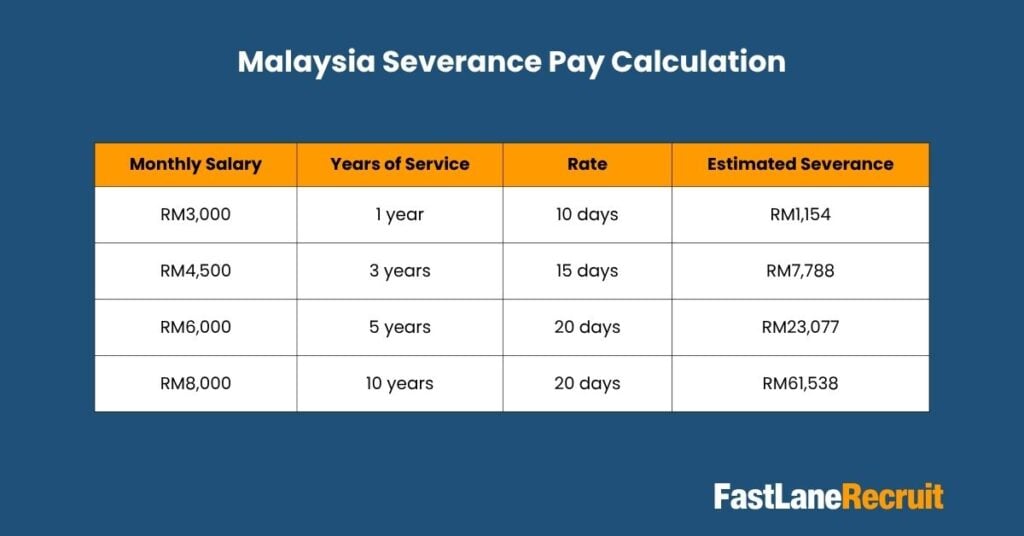
Employers should verify calculations carefully before issuing termination letters.
Other Payments Employers Must Consider
Severance pay is only one component of a termination package.
Employers may also need to pay:
- Salary Owed: Outstanding wages up to the final working day.
- Payment in Lieu of Notice: If notice periods are not served.
- Unused Annual Leave: Outstanding leave balances.
- Contractual Benefits: Any additional entitlements provided under the employment agreement.
Failing to account for these obligations may result in disputes and claims.
Employer Responsibilities During Retrenchment
Employers should follow a structured retrenchment process.
Assess Alternatives First
Before retrenching employees, consider:
- Redeployment
- Hiring freezes
- Reduced overtime
- Reduced work schedules
- Voluntary Separation Scheme (VSS)
Industrial Courts often examine whether employers explored alternatives.
Maintain Documentation
Keep records of:
- Business rationale
- Financial circumstances
- Selection criteria
- Employee communications
Apply Fair Selection Criteria
Selection should be objective and consistent.
Common criteria include:
- Skills
- Performance
- Business needs
- Future organizational requirements
Submit Required Notifications
Employers conducting retrenchments may be required to submit notifications to the relevant authorities.
Common Employer Mistakes That Lead to Legal Claims
Many unfair dismissal cases arise because employers:
- Fail to justify redundancy
- Use inconsistent employee selection criteria
- Skip consultation processes
- Underpay severance benefits
- Lack proper documentation
- Ignore statutory requirements
These mistakes can significantly increase legal and financial exposure.
Why Workforce Planning Is Better Than Reactive Retrenchment
Many businesses only think about workforce compliance when layoffs become unavoidable.
A proactive workforce strategy helps companies:
- Reduce turnover costs
- Improve productivity
- Scale efficiently
- Avoid retrenchment disputes
- Maintain employer reputation
This is especially important for foreign companies entering Malaysia.
Employer of Record (EOR) vs Company Incorporation: Which Reduces Employment Risks?
Many international companies entering Malaysia face a critical decision:
Should they establish a local entity or use an Employer of Record (EOR)?
Company Incorporation
Advantages:
- Full operational control
- Local business presence
Challenges:
- Entity setup costs
- Payroll administration
- Employment law compliance
- Employee termination obligations
- HR infrastructure requirements
Employer of Record (EOR)
An EOR legally employs workers on behalf of a foreign company.
Benefits include:
- Faster market entry
- No local entity required
- Reduced HR administration
- Payroll compliance support
- Employment contract management
- Assistance with local labour law compliance
For businesses testing the Malaysian market or hiring a small team, an EOR often provides a lower-risk and more cost-effective alternative to immediate company incorporation.
Also Read: Incorporation vs EoR in Malaysia
Get Expert Assistance with Employment Compliance in Malaysia
Employment compliance extends far beyond severance pay calculations.
Whether you are:
- Hiring employees in Malaysia
- Expanding into Southeast Asia
- Managing workforce restructuring
- Building a remote team
- Exploring an Employer of Record solution
FastLaneRecruit helps businesses navigate Malaysian employment regulations with confidence.
Also Read: Levy Calculation Guideline: HRDF Calculation, Payment Process & Compliance Rules in Malaysia
How FastLaneRecruit Can Help Employers Navigate Severance Pay and Employment Compliance in Malaysia
Managing severance pay, retrenchment exercises, and workforce restructuring requires more than simply calculating termination benefits. Employers must ensure compliance with Malaysian employment laws, maintain proper documentation, reduce legal risks, and protect their employer brand throughout the process.
For growing businesses, foreign companies entering Malaysia, and organizations undergoing workforce changes, navigating these requirements internally can be time-consuming and costly.
As a trusted HR and workforce solutions provider, FastLaneRecruit helps businesses build compliant and scalable employment strategies while reducing administrative burdens.
Employer of Record (EOR) Services
Businesses looking to hire in Malaysia without establishing a local entity can leverage FastLaneRecruit’s Employer of Record services.
Benefits include:
- Hire employees legally in Malaysia without company incorporation
- Compliant employment contracts
- Payroll processing and statutory contributions
- Employment law compliance support
- Employee onboarding and offboarding management
- Reduced administrative workload
This allows companies to test the Malaysian market, expand quickly, and minimize employment-related risks.
Recruitment and Talent Acquisition
Finding the right employees is often more cost-effective than managing high turnover and future retrenchment exercises.
FastLaneRecruit assists employers with:
- Permanent recruitment
- Executive search
- Talent sourcing
- Candidate screening
- Market salary benchmarking
- Hiring strategy development
Payroll and Employment Administration
Employment compliance extends beyond severance pay calculations.
FastLaneRecruit can help manage:
- Payroll administration
- Statutory contributions
- Leave management
- Employee records
- Regulatory compliance requirements
Why Employers Choose FastLaneRecruit
Businesses choose FastLaneRecruit because they gain access to local HR expertise without having to build an in-house HR infrastructure from scratch.
Whether you are:
- Expanding into Malaysia
- Hiring your first employee
- Managing a distributed workforce
- Restructuring your organization
- Exploring Employer of Record solutions
FastLaneRecruit can provide the expertise needed to remain compliant and operationally efficient.
Speak with FastLaneRecruit’s specialists today!
Conclusion
Understanding severance pay in Malaysia is essential for every employer operating in today’s increasingly complex employment landscape. While the statutory calculation may appear straightforward, compliance involves much more than applying a formula.
Employers must determine employee eligibility, justify retrenchment decisions, comply with termination regulations, maintain proper documentation, and ensure all payments are made accurately and on time. Failure to do so can expose businesses to costly disputes, Industrial Court claims, financial liabilities, and reputational damage.
As workforce restructuring, digital transformation, and regional expansion continue to shape business decisions in 2026, organizations should take a proactive approach to workforce planning rather than reacting when challenges arise.
For international companies entering Malaysia, an Employer of Record (EOR) solution can often provide a faster, lower-risk alternative to company incorporation by simplifying hiring, payroll, compliance, and employee management responsibilities.
Whether you are planning to hire, expand, restructure, or manage employment compliance in Malaysia, partnering with experienced HR professionals can help you reduce risk, improve efficiency, and focus on business growth.
With FastLaneRecruit’s expertise in recruitment, Employer of Record services, payroll administration, and HR compliance, businesses can confidently navigate Malaysia’s employment regulations while building a sustainable workforce for long-term success.
Frequently Asked Questions
How do you calculate severance pay in Malaysia?
Severance pay is calculated based on the employee’s daily wage, years of service, and statutory entitlement rate under the Employment (Termination and Lay-Off Benefits) Regulations 1980.
What is the minimum severance pay in Malaysia?
The minimum entitlement ranges from 10 to 20 days’ wages per year of service, depending on the employee’s length of service.
What is the law for severance pay in Malaysia?
Severance pay is primarily governed by the Employment (Termination and Lay-Off Benefits) Regulations 1980, the Employment Act 1955, and relevant Industrial Court principles.
Is severance pay always required?
No. Severance pay generally applies to retrenchment and redundancy situations. Employees dismissed for misconduct may not qualify.
How long must an employee work before becoming eligible for severance pay?
Generally, employees need at least 12 months of continuous service to qualify for statutory termination benefits.
Can employers offer more than the statutory minimum?
Yes. Many employers provide enhanced severance packages through contracts, collective agreements, VSS, or MSS arrangements.
What is the difference between retrenchment and termination for misconduct?
Retrenchment occurs because a position becomes redundant due to business reasons, while misconduct termination is based on employee behaviour or policy violations.
Can employees challenge retrenchment decisions?
Yes. Employees may file claims if they believe the retrenchment lacked genuine business justification or was conducted unfairly.
Do foreign companies hiring in Malaysia need to manage severance obligations?
Yes. Foreign employers hiring local employees must comply with Malaysian employment laws. Many choose Employer of Record services to manage these obligations efficiently.
What happens if severance pay is not paid correctly?
Employers may face labour disputes, legal claims, Industrial Court proceedings, financial penalties, and reputational risks.