Software outsourcing has become a practical part of how modern businesses build and scale digital products. In Australia, companies of all sizes, from startups to large enterprises, are increasingly working with external development partners to access specialised skills, speed up delivery, and manage operational workloads more efficiently.
Rather than building everything in-house, many organisations now combine internal teams with external software development partners, managed IT service providers, and distributed engineering teams. This approach helps businesses stay flexible in a competitive digital environment where speed and execution matter as much as strategy.
Australia has also become a strong hub for software development and IT services, supported by skilled professionals, strong governance standards, and growing demand for digital transformation across industries.
This guide explores the top software outsourcing companies in Australia and also provides a broader view of global hiring models that businesses can use to scale more efficiently, including Employer of Record (EOR) and offshore team structures.
Content Outline
Key Summary
Software Outsourcing Is Now a Growth Strategy
Outsourcing is no longer just about saving costs; it helps companies scale faster, access specialised skills, and accelerate digital product development.
Australia Has a Strong Enterprise-Grade Outsourcing Ecosystem
Australian providers are known for high compliance, strong governance, and expertise in enterprise systems, fintech, healthcare, and government projects.
Global Delivery Models Are Becoming the Standard
Businesses increasingly combine Australia, India, the Philippines, Vietnam, and Malaysia to balance cost efficiency, speed, and technical expertise.
The Talent Shortage Is Driving Outsourcing Growth
A shortage of skilled developers, cloud engineers, and cybersecurity specialists in Australia is pushing companies toward external engineering teams.
Mid-Tier and Startups Prefer Agile Outsourcing Partners
Companies like Ontik Technology and Appello Software are popular with startups due to flexible delivery models, faster turnaround, and scalable teams.
Enterprise Providers Focus on Scale and Compliance
Firms such as Accenture, Deloitte, Infosys, and Capgemini support large organisations with long-term transformation, security, and managed services.
Global Hiring Models Are Replacing Traditional Outsourcing
Dedicated offshore teams, staff augmentation, and EOR solutions are becoming preferred options for companies wanting more control and long-term team integration.
Why Software Outsourcing is Growing in Australia
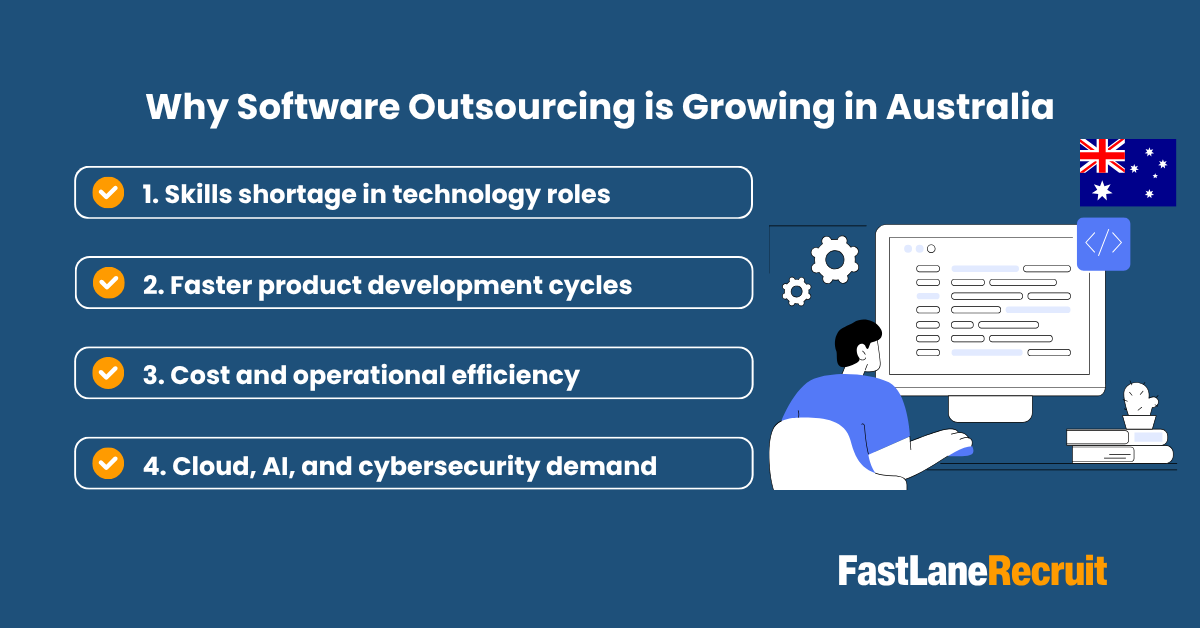
Software outsourcing is expanding in Australia due to a combination of talent demand, rising development costs, and increasing digital transformation needs across industries.
Key drivers include:
1. Skills shortage in technology roles
Many Australian businesses face challenges hiring experienced developers, cloud engineers, and cybersecurity specialists locally, leading to increased reliance on external delivery teams.
2. Faster product development cycles
Companies need to release software faster to remain competitive. External engineering teams help reduce time-to-market.
3. Cost and operational efficiency
Instead of maintaining large internal teams, businesses distribute workloads across external partners to improve resource efficiency and reduce fixed overhead.
4. Cloud, AI, and cybersecurity demand
Advanced technologies require specialised expertise that is not always available internally, making outsourcing a practical solution.
Why Australia is a Strong Software Outsourcing Hub
Australia is not only a consumer of outsourcing services but also a provider of high-quality software development and IT solutions.
Key strengths include:
- Strong technical education system producing skilled developers
- High cybersecurity and compliance standards aligned with global frameworks
- Stable business environment with transparent regulations
- Strong expertise in enterprise software, fintech, and healthcare systems
- Strategic time zone alignment for collaboration with Asia-Pacific and Western markets
Global Software Outsourcing Landscape
Australian companies increasingly operate within a global delivery ecosystem:
| Region | Strength | Typical Advantage |
| Australia | High compliance, enterprise expertise | Trusted delivery, governance-heavy projects |
| India | Large engineering talent pool | Scale and technical depth |
| Philippines | Strong support and operations teams | Customer service and BPO |
| Vietnam | Growing software engineering hub | Balanced cost and quality |
| Malaysia | Multilingual technical workforce | Regional delivery flexibility |
This global structure is often used by Australian businesses to balance quality, speed, and operational efficiency.
Also Read: Top 20 Digital Marketing Companies in Australia
Top 15 Software Outsourcing Companies in Australia
Below is a curated list of leading software outsourcing and IT service providers in Australia based on expertise, delivery capability, industry focus, and market presence.
1. Ontik Technology
Specialisation: Software development, MVP builds, ERP systems, UI/UX, cybersecurity
Ontik Technology operates across Australia and offshore development hubs, offering a hybrid outsourcing model that blends cost efficiency with hands-on collaboration. They are especially popular with startups and SMEs that need to move fast without building large in-house engineering teams.
They cover the full product lifecycle — from idea validation and MVP development to scaling enterprise systems like ERP platforms. Their UI/UX team also plays a strong role in ensuring products are user-focused rather than just technically functional.
What makes them stand out is their ability to handle both early-stage startups and growing enterprises under one flexible delivery model. Clients typically engage them for rapid prototyping, long-term product development, and system modernisation projects.
2. TatvaSoft Australia
Specialisation: Enterprise software, cloud migration, IT consulting
TatvaSoft is a well-established outsourcing partner for enterprise-grade software development. They primarily serve mid-sized to large organisations that require scalable and secure systems.
Their strength lies in building custom enterprise applications, legacy system modernisation, and cloud migration projects. They also provide dedicated development teams, making them suitable for long-term IT partnerships.
Industries they frequently serve include banking, healthcare, logistics, and insurance, where compliance and system reliability are critical.
3. Appello Software
Specialisation: Digital product development, mobile and web applications
Appello Software focuses on building high-quality digital products with a strong emphasis on design and user experience. They are widely used by startups and scale-ups that want polished, market-ready applications.
Their team typically works on mobile apps, SaaS platforms, and custom web applications. They are known for combining product strategy, UI/UX design, and engineering into a single workflow.
Appello is often chosen by founders who need a partner that can take an idea and turn it into a fully functioning digital product quickly.
4. Wipro Australia
Specialisation: IT outsourcing, managed services, enterprise solutions
Wipro is a global IT outsourcing giant with a strong presence in Australia. They work with large enterprises and government organisations that require scalable, secure, and long-term IT operations.
Their services include infrastructure management, cloud transformation, application development, and business process outsourcing. They also run large digital transformation programs that involve multiple systems and teams.
Wipro is particularly strong in handling complex enterprise ecosystems where reliability, compliance, and global delivery capability are essential.
5. Capgemini Australia
Specialisation: Cloud, consulting, cybersecurity, managed IT services
Capgemini combines IT consulting with hands-on engineering delivery, making them a strategic partner for transformation projects.
They work across cloud adoption, cybersecurity strengthening, enterprise application development, and data-driven transformation initiatives.
What differentiates Capgemini is their ability to merge business strategy with technical execution. They are often brought in when companies need both advisory and implementation under one umbrella.
6. Cognizant Australia
Specialisation: Digital engineering, IT outsourcing, enterprise platforms
Cognizant supports enterprise clients across banking, insurance, healthcare, and retail industries. Their Australian operations focus heavily on large-scale IT outsourcing programs.
They specialise in digital engineering, legacy system modernisation, and enterprise platform development. Many of their projects involve long-term support and continuous improvement rather than one-off builds.
They are a preferred choice for organisations that need structured, enterprise-level digital transformation.
7. Deloitte Australia
Specialisation: IT consulting, cloud services, cybersecurity
Deloitte operates at the intersection of consulting and technology delivery. In Australia, they are heavily involved in government and enterprise transformation projects.
Their services include IT strategy, cloud migration, cybersecurity frameworks, and digital transformation consulting. They often lead large-scale programs where governance and compliance are critical.
Unlike pure development firms, Deloitte focuses more on strategic direction combined with technical implementation.
8. Infosys Australia
Specialisation: ERP systems, IT outsourcing, cloud transformation
Infosys is one of the largest global IT outsourcing providers operating in Australia. They are known for handling complex enterprise programs at scale.
Their expertise includes ERP implementation, cloud migration, application development, and managed IT services. They frequently work with large enterprises undergoing digital restructuring.
Infosys is especially strong in industries requiring structured systems such as banking, telecom, and large-scale manufacturing.
9. Accenture Australia
Specialisation: Digital transformation, AI, cloud, IT outsourcing
Accenture is a major player in Australia’s outsourcing and consulting landscape. They deliver end-to-end services from strategy design to full-scale implementation.
Their capabilities include AI integration, cloud transformation, automation, cybersecurity, and enterprise software development. They also lead large outsourcing engagements for multinational companies.
Accenture is often chosen by organisations looking for innovation-driven transformation at scale.
Also Read: Top 20 Medical Billing Companies in Australia
10. DWS (HCL Group)
Specialisation: Software development, staff augmentation
DWS, now part of HCL Technologies, provides flexible software development teams for Australian enterprises.
They focus on staff augmentation, application development, and enterprise system support. Their model allows businesses to quickly scale engineering capacity without long hiring cycles.
They are commonly used for ongoing digital projects and system enhancements.
11. Ranosys Technologies
Specialisation: eCommerce development, Salesforce, digital platforms
Ranosys is a digital commerce-focused outsourcing provider with strong expertise in eCommerce ecosystems.
They specialise in platforms like Magento, Shopify, and Salesforce Commerce Cloud. Their services include storefront development, backend integration, and digital transformation for retail businesses.
They are a strong fit for companies in retail, FMCG, and online marketplace sectors.
12. Experion Technologies
Specialisation: Product engineering, healthcare and finance software
Experion Technologies focuses on building scalable digital platforms with strong product engineering capabilities.
They are widely used in healthcare, financial services, logistics, and education sectors. Their approach combines software engineering with UX-driven product design.
They are particularly strong in building enterprise-grade digital products that require long-term scalability.
13. XAM Consulting
Specialisation: Microsoft technologies, enterprise systems
XAM Consulting is a specialist in Microsoft-based enterprise solutions, including Azure, .NET, and Power Platform.
They help organisations modernise legacy systems and build cloud-native applications using Microsoft technologies.
Their clients are typically mid-sized and enterprise businesses that rely heavily on Microsoft ecosystems.
14. Hyperlink InfoSystem Australia
Specialisation: Mobile apps, AI solutions, digital platforms
Hyperlink InfoSystem is a global outsourcing company with a strong Australian presence. They are known for delivering cost-effective mobile and web development services.
Their expertise includes mobile app development, AI/ML solutions, AR/VR applications, and custom software development.
They are often chosen by startups and SMEs looking for affordable offshore-backed development with local communication support.
15. Dialog Information Technology
Specialisation: Systems integration, managed IT services
Dialog is one of Australia’s longest-running IT service providers, with decades of experience in systems integration and managed services.
They work extensively with government departments, healthcare organisations, and large enterprises.
Their services include enterprise application development, IT outsourcing, infrastructure management, and long-term support contracts.
Dialog is valued for its stability, compliance focus, and deep experience in large-scale IT environments.
How to Choose the Right Software Outsourcing Partner
Choosing a software outsourcing partner isn’t just a procurement decision; it’s more like picking a long-term execution partner for your product or business operations. The cheapest option rarely delivers the best outcome. What really matters is whether the team can understand your goals, execute reliably, and grow with you over time.
A strong outsourcing partner should reduce your workload, not add management stress. That’s why evaluation needs to go beyond pricing and focus on capability, consistency, and long-term fit.
1. Technical expertise in the required technology stack
Start by checking whether the company actually has hands-on experience with the technologies your project needs.
This includes programming languages, frameworks, cloud platforms, and architecture patterns. For example, building a scalable SaaS product requires very different expertise compared to a mobile eCommerce app or an enterprise ERP system.
A reliable partner should be able to:
- Clearly explain how they would approach your project technically
- Show real examples of similar systems they’ve built
- Recommend improvements instead of just taking instructions blindly
If they only say “yes we can do it” without depth, that’s usually a warning sign.
Also Read: Top 15 Business Consulting Firms in Australia
2. Industry experience and domain understanding
Technical skill alone isn’t enough. A good outsourcing partner should understand your industry context as well.
A healthcare platform, for example, requires compliance awareness and data sensitivity, while a fintech product demands strong security, auditability, and integration with financial systems.
When a company has prior industry experience, they:
- Make fewer assumptions
- Build faster with fewer revisions
- Understand user expectations better
- Avoid costly compliance mistakes
This often has a bigger impact on success than pure coding ability.
3. Security and compliance standards
Security is no longer optional, especially for businesses handling user data, payments, or internal systems.
A professional outsourcing company should follow clear security practices such as:
- Secure coding standards
- Role-based access control
- Encrypted data handling
- Compliance with frameworks like GDPR or local privacy regulations
- Regular security audits and monitoring
If your project involves sensitive data, ask how they manage access control, hosting environments, and incident response. A vague answer here is a red flag.
4. Communication and project transparency
Many outsourcing problems don’t come from technical failure, they come from poor communication.
A strong partner should provide:
- Clear project timelines and milestones
- Regular progress updates (weekly or sprint-based)
- Transparent reporting on blockers and risks
- Easy access to project managers or leads
Also, pay attention to how they communicate early on. If communication feels slow or unclear during the sales phase, it usually doesn’t improve later.
5. Ability to scale resources when needed
Your needs won’t stay the same forever. A good outsourcing partner should be able to scale with your growth.
This includes:
- Adding developers quickly when deadlines tighten
- Expanding teams for larger product phases
- Reducing resources when workload decreases without friction
Scalability is especially important for startups and fast-growing companies. You don’t want to re-hire a new vendor every time your project evolves.
6. Delivery process and engineering maturity
Beyond skills and communication, look at how structured their development process is.
A mature outsourcing partner usually follows:
- Agile or sprint-based delivery
- Code reviews and quality assurance processes
- Version control and documentation standards
- Testing before deployment
This ensures that your project doesn’t just get built, it gets built in a way that is maintainable and scalable long term.
7. Cultural fit and working style
This is often overlooked, but it makes a big difference in long-term partnerships.
If your team values speed and iteration, but the outsourcing partner prefers slow, rigid processes, friction will build up quickly.
Good alignment shows up in:
- Responsiveness
- Flexibility in approach
- Willingness to challenge ideas constructively
- Shared understanding of priorities
8. Starting with a pilot project
Many businesses avoid risk by starting small.
Instead of committing to a large contract immediately, they begin with:
- A prototype
- A small feature build
- A limited MVP module
This helps you evaluate:
- Code quality
- Communication style
- Delivery speed
- Problem-solving ability
If the pilot goes well, scaling up becomes much safer and more predictable.
The right outsourcing partner is not just a vendor, it’s an extension of your product team. When chosen well, they accelerate growth, reduce operational pressure, and help you build faster than you could in-house alone.
Also Read: Top 15 HR SaaS Platforms in Australia
Alternative Global Hiring Model: Offshore Teams and EOR
Software outsourcing has evolved a lot from the old “send a project, get it built” model. In 2026, many companies are shifting toward more flexible global hiring structures that blend outsourcing, remote hiring, and workforce expansion. Instead of treating external teams as one-off vendors, businesses now build long-term distributed teams that operate like an extension of their in-house workforce.
This shift is driven by three things: talent shortages in local markets, rising engineering costs, and the need to scale products faster without long hiring cycles.
1. Dedicated offshore teams (extended engineering model)
A dedicated offshore team is essentially your own remote engineering unit based in another country. Instead of outsourcing a project, you are “renting” a fully structured team that works exclusively on your product.
This model is popular with startups and scale-ups that need continuous development rather than one-time delivery.
Typically, a dedicated team may include:
- Frontend and backend developers
- QA engineers
- UI/UX designers
- Project managers or Scrum leads
Key advantages:
- Full focus on your product (not shared across multiple clients)
- Faster iteration cycles compared to traditional outsourcing
- Easier long-term product ownership and continuity
- Scales like an in-house team but at lower cost
This model works best for SaaS platforms, mobile apps, and products that require ongoing feature development.
2. Staff augmentation (on-demand skill expansion)
Staff augmentation is a flexible model where you add external developers or specialists directly into your existing internal team.
Instead of handing over control of a project, you keep full ownership and simply “plug in” extra talent when needed.
This is commonly used when:
- Internal teams are overloaded
- Specific technical skills are missing (e.g., DevOps, AI, mobile development)
- Deadlines are tight and speed is critical
Key advantages:
- Full control remains with your internal team
- Faster hiring compared to local recruitment
- Easy to scale up or down based on workload
- Access to global talent without long-term commitments
It’s especially useful for companies that already have strong in-house leadership but need extra execution capacity.
Also Read: Top 15 Product Development Companies in Australia
3. Employer of Record (EOR) model (global hiring without legal setup)
An Employer of Record (EOR) allows companies to hire international employees without setting up a local legal entity in that country.
In simple terms, the EOR becomes the legal employer on paper, while you manage the employee’s day-to-day work.
The EOR handles:
- Employment contracts
- Payroll processing
- Tax compliance
- Local labour law adherence
- Benefits administration
This model is increasingly popular for companies expanding into regions like Southeast Asia, India, Eastern Europe, and Latin America.
Key advantages:
- No need to register a company in every country
- Faster international hiring process
- Full legal and compliance coverage
- Easier market expansion with lower risk
For example, a company in Australia can hire developers in Vietnam or the Philippines within days instead of going through months of legal setup.
Why these models are growing in popularity
These modern hiring approaches are replacing traditional outsourcing because they offer more control and flexibility.
Companies now want:
- Long-term talent access instead of short-term vendors
- Predictable scaling instead of fixed project contracts
- Global talent without complex legal barriers
- Better integration between internal and external teams
As a result, outsourcing is no longer just about “cost reduction”; it has become a strategic workforce model.
Dedicated offshore teams, staff augmentation, and EOR solutions are reshaping how software companies build and scale products globally. Businesses that combine these models effectively can move faster, hire smarter, and stay competitive without being limited by local talent shortages.
Also Read: Top 15 PR Firms in Australia
Why Many Companies Are Expanding to Malaysia
More companies are shifting parts of their engineering and tech operations to Southeast Asia, and Malaysia in particular has become one of the standout hubs. It’s not just about cost savings anymore, this move is increasingly about access to talent, speed of delivery, and building more flexible global teams.
Several structural advantages are driving this trend:
Strong English proficiency in technical teams
One of the biggest advantages Malaysia offers is strong English communication skills across its tech workforce.
This matters a lot in software development, where clarity in requirements, documentation, and daily communication directly affects project success. Compared to some offshore markets where language barriers can slow down collaboration, Malaysian engineers and product teams often integrate smoothly with Australian, UK, and US-based companies.
This reduces friction in:
- Agile sprint communication
- Product requirement discussions
- Technical documentation
- Client-facing collaboration
Growing and mature software engineering ecosystem
Malaysia has steadily built a strong technology ecosystem over the past decade, with increasing investment in digital infrastructure, startups, and enterprise tech.
You’ll find a growing pool of talent in:
- Full-stack development
- Mobile app engineering
- Cloud and DevOps
- Data engineering and AI/ML
At the same time, many global companies have already established delivery centers there, which helps raise overall industry standards and provides a more experienced talent pipeline.
The result is a market that is no longer “emerging” but increasingly competitive and production-ready.
Flexible engagement models for international companies
Another major reason companies expand into Malaysia is the flexibility of hiring and engagement structures.
Businesses can choose between:
- Dedicated offshore development teams
- Project-based outsourcing
- Staff augmentation models
- Long-term managed service partnerships
This flexibility allows companies to scale up or down based on demand without the overhead of building large in-house teams or committing to rigid contracts.
For startups, this means faster product development. For enterprises, it means cost-efficient scaling without sacrificing quality control.
Time zone compatibility with Australia and APAC markets
Malaysia’s time zone alignment is a major operational advantage, especially for Australian companies.
The overlap in working hours allows for:
- Real-time collaboration during the workday
- Faster feedback cycles in development sprints
- Easier daily stand-ups and product discussions
- Reduced delays compared to offshore regions with large time gaps
This makes Malaysia particularly attractive for companies that want offshore efficiency without losing real-time communication.
Government support and digital economy growth (MDEC and beyond)
Malaysia’s digital transformation has been actively supported by national initiatives such as the Malaysia Digital Economy Corporation (MDEC).
These programs encourage:
- Foreign tech investment
- Startup ecosystem growth
- Digital skill development
- Infrastructure expansion for IT and cloud services
As a result, the country has positioned itself as a regional tech hub in Southeast Asia, attracting both multinational corporations and outsourcing providers.
The bigger picture: distributed engineering as the new standard
When combined, these factors make Malaysia and Southeast Asia ideal for distributed engineering models.
Companies are no longer relying on a single location for talent. Instead, they are building hybrid teams where:
- Strategy may sit in Australia or the US
- Engineering is distributed across Malaysia, Vietnam, or India
- Product support runs across multiple time zones
This setup improves:
- Delivery speed
- Cost efficiency
- Talent access
- Business continuity
Malaysia and Southeast Asia are becoming strategic expansion zones for software and IT companies, not just outsourcing destinations. Businesses that adopt this distributed model early are better positioned to scale faster, reduce hiring pressure, and stay competitive in a global digital economy.
FastLaneRecruit: A Smarter Way to Build Your Engineering Team
Instead of relying only on traditional outsourcing, where work is handed over to a third-party vendor, many companies are now shifting toward more structured global hiring models. This approach gives businesses more control over their engineering talent while still keeping the flexibility and cost advantages of offshore hiring.
FastLaneRecruit sits in this space by helping companies hire and manage international tech talent through an Employer of Record (EOR) model. Rather than outsourcing a project, businesses are effectively building their own distributed teams with full operational support behind the scenes.
What FastLaneRecruit enables
FastLaneRecruit’s EOR model allows companies to hire software engineers and technical professionals in Malaysia and other regions without needing to set up a local legal entity. This removes one of the biggest barriers to global hiring: legal, tax, and compliance complexity.
Through this model, companies can:
- Hire Malaysian software developers and tech talent legally and quickly
- Avoid the time and cost of establishing a local subsidiary
- Stay compliant with local labour laws, payroll systems, and statutory requirements
- Manage HR, contracts, benefits, and onboarding through a single structured system
- Scale engineering teams across multiple countries without administrative overhead
This makes global hiring significantly faster compared to traditional expansion methods, which can take months or even years.
Moving beyond traditional outsourcing
What makes this approach different from standard outsourcing is ownership and integration.
In traditional outsourcing:
- Work is assigned to an external vendor
- Teams may be shared across multiple clients
- Visibility and control over individual contributors is limited
- Long-term product alignment can sometimes be inconsistent
With an EOR-based model like FastLaneRecruit:
- Engineers work as part of your internal team structure
- You manage priorities, workflows, and delivery directly
- Talent is dedicated to your company, not split across projects
- Team integration feels closer to in-house hiring
This creates a hybrid model that sits between full outsourcing and direct employment.
Better control without operational complexity
One of the biggest advantages of this model is control without administrative burden.
Companies can:
- Directly manage engineers and technical staff
- Maintain their own development processes and standards
- Align teams with internal product roadmaps
- Avoid HR, payroll, and compliance management headaches
At the same time, FastLaneRecruit handles the operational backbone, including legal employment structure and cross-border compliance.
Ideal for scaling distributed engineering teams
This model is especially effective for companies that are scaling quickly or building long-term technology products.
It is commonly used by:
- SaaS companies expanding engineering capacity
- Startups moving from MVP to full-scale product development
- SMEs that need senior technical talent but can’t hire locally
- Enterprises building regional development hubs
Instead of relying on short-term outsourcing contracts, businesses can gradually build stable, long-term engineering teams across multiple countries.
Cost efficiency with long-term stability
While cost savings remain a factor, the real value of this model is operational stability.
Companies benefit from:
- Lower hiring friction compared to local recruitment
- Predictable monthly employment costs
- Reduced dependency on expensive local talent markets
- Access to skilled engineers in high-growth regions like Malaysia
This allows businesses to allocate more budget toward product development and innovation rather than recruitment overhead.
FastLaneRecruit represents a shift in how companies think about global hiring. Instead of outsourcing work or building overseas offices from scratch, businesses can now create fully integrated engineering teams across borders with minimal friction.
It’s not just about hiring cheaper talent; it’s about building smarter, scalable, and globally distributed teams that operate as one unified engineering function.
Conclusion
Software outsourcing in Australia has evolved beyond a cost-saving approach. It is now a strategic business model that supports innovation, scalability, and global competitiveness.
The companies listed in this guide represent a mix of enterprise providers, agile development teams, and global delivery partners. Each plays a role in helping businesses accelerate digital transformation.
At the same time, global hiring models such as EOR and offshore team building are becoming increasingly important. Businesses are no longer limited by geography when building high-performing software teams.
FastLaneRecruit supports this shift by enabling companies to hire skilled technical talent across borders in a compliant and efficient way, offering a practical alternative to traditional outsourcing models.
Build Your Global Engineering Team in Malaysia
If you’re exploring software outsourcing or looking to scale your engineering capability beyond local hiring limits, the right model makes all the difference.
Instead of relying on short-term contractors or fragmented outsourcing setups, you can build structured, compliant, and fully integrated offshore teams that grow with your business.
FastLaneRecruit helps companies hire and manage top-tier software developers and technical talent in Malaysia through a seamless Employer of Record (EOR) model, so you can scale faster without the legal and operational complexity.
Start building smarter today
Whether you’re a startup validating your MVP or an enterprise expanding your digital capabilities, you can access global talent while staying fully in control of your product and roadmap.
Let’s help you build a distributed engineering team that actually feels in-house. Contact us a FREE discovery call!