Payroll is one of the most critical yet time-consuming functions in any business. In Singapore, it is also one of the most compliance-sensitive processes, requiring precision in CPF contributions, tax filings, employee classifications, and statutory reporting.
Even a small error can lead to compliance penalties or employee dissatisfaction.
As companies scale, managing payroll internally often becomes inefficient and risky. HR teams spend more time processing salaries than focusing on talent, growth, and workforce strategy.
This is why many businesses are shifting toward Payroll Outsourcing in Singapore as a strategic solution, not just an operational convenience.
In this guide, we break down everything you need to know about payroll outsourcing, including costs, how it works, benefits, and how to choose the right partner for your business.
Content Outline
Key Summary
Payroll Outsourcing In Singapore Improves Compliance And Reduces Admin Burden
Payroll Outsourcing in Singapore helps businesses reduce administrative workload while ensuring strict CPF and IRAS compliance.
Payroll Costs Depend On Business Size And Payroll Complexity
Costs depend on employee count, payroll complexity, and service scope.
Payroll Outsourcing Follows A Structured End-To-End Process
The outsourcing process includes onboarding, payroll processing, compliance filing, and reporting.
Choosing The Right Payroll Provider Impacts Long-Term Scalability And Risk
Choosing the right provider is critical for scalability, accuracy, and regulatory risk reduction.
FastLaneRecruit Offers End-To-End Payroll Outsourcing Solutions
FastLaneRecruit provides end-to-end payroll outsourcing solutions tailored for SMEs and growing enterprises.
What Is Payroll Outsourcing in Singapore?
Payroll Outsourcing refers to delegating payroll processing, statutory compliance, and salary administration to an external specialist provider.
Instead of handling payroll internally, businesses rely on experts to manage:
- Monthly salary computation
- CPF contributions and statutory deductions
- IRAS reporting and tax compliance
- Payslip generation and distribution
- Payroll reporting and audits
In Singapore, payroll outsourcing is widely adopted due to strict labor regulations and evolving compliance requirements under CPF Board and IRAS.
How Payroll Outsourcing Works in Singapore (Step-by-Step Process)
Understanding the workflow helps businesses evaluate providers more effectively.
Step 1: Employee Data Setup and Onboarding
The payroll provider collects employee details such as:
- Salary structure
- Employment type
- Allowances and benefits
- Tax residency status
Step 2: Monthly Payroll Input Collection
HR submits monthly payroll changes including:
- Overtime
- Bonuses and commissions
- Leave deductions
- Expense claims
Step 3: Payroll Processing and Calculation
The provider processes payroll calculations including:
- Gross to net salary
- Employer CPF contributions
- Statutory deductions
- Final payout computation
Step 4: Compliance Filing and Submission
Payroll providers ensure compliance with:
- CPF Board submissions
- IRAS reporting requirements
- Employment statutory obligations
Step 5: Payslip Generation and Distribution
Employees receive structured digital payslips with transparent breakdowns.
Step 6: Reporting and Audit Support
Monthly payroll reports are generated for HR and finance teams, ensuring audit readiness and transparency.
Payroll Outsourcing Costs in Singapore
Payroll outsourcing costs vary depending on business size, complexity, and service scope.
Common Pricing Models
- Per Employee Per Month (PEPM) – most widely used model
- Fixed monthly pricing – for predictable payroll structures
- Custom enterprise pricing – for large or multi-entity organizations
Key Cost Factors
- Number of employees
- Payroll frequency
- Multi-country payroll requirements
- Complexity of compensation structure
- Integration with HR or accounting systems
Market Insight
In general, outsourcing payroll is more cost-effective than maintaining an internal payroll team when compliance risks, software costs, and administrative workload are considered.
Also Read: PEO vs Payroll Outsourcing in Singapore: Key Differences
In-House Payroll vs Payroll Outsourcing
Challenges of In-House Payroll
- High administrative workload
- Constant regulatory updates
- Risk of compliance errors
- Software and training expenses
- Limited scalability
Advantages of Payroll Outsourcing
- Reduced compliance risk
- Lower operational cost
- Access to payroll experts
- Automation and accuracy
- Scalable payroll infrastructure
Payroll outsourcing is particularly beneficial for SMEs and growing companies managing rapid workforce expansion.
Benefits of Payroll Outsourcing in Singapore
1. Strong Compliance Assurance
Ensures adherence to CPF regulations, IRAS tax requirements, and labor laws.
2. Cost Optimization
Reduces HR overhead and eliminates the need for dedicated payroll staff.
3. Operational Efficiency
Frees HR teams to focus on strategic activities like recruitment and employee engagement.
4. Improved Accuracy
Minimizes human error through automated payroll systems and standardized processes.
5. Scalability
Supports business expansion without increasing internal payroll complexity.
6. Data Security
Ensures secure handling of sensitive employee payroll data.
How to Choose the Best Payroll Outsourcing Provider in Singapore
Selecting the right partner is critical for long-term success.
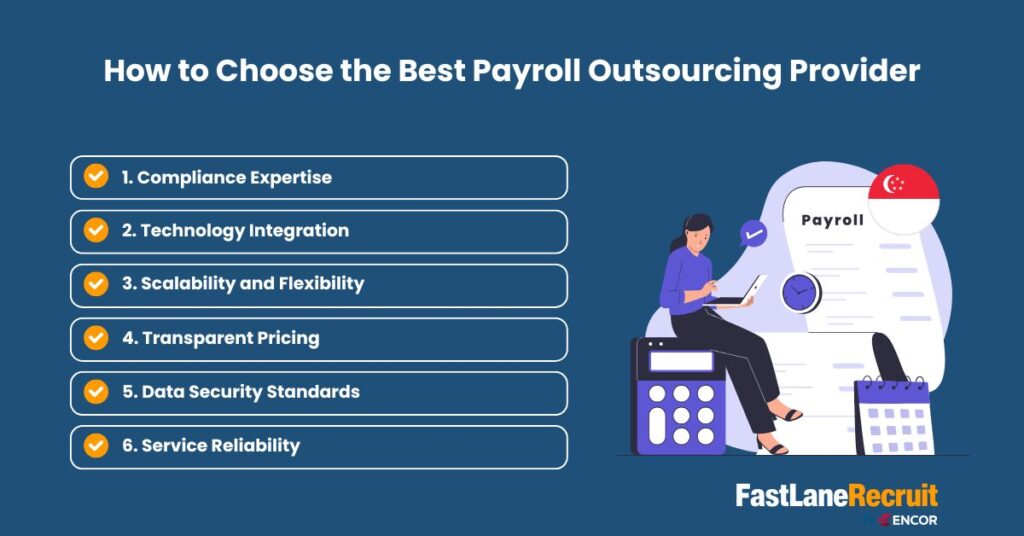
1. Compliance Expertise
The provider must have strong knowledge of Singapore’s CPF and IRAS requirements.
2. Technology Integration
Ensure compatibility with HRIS, accounting systems, and workforce platforms.
3. Scalability and Flexibility
The provider should support business growth across multiple markets or entities.
4. Transparent Pricing
Clear cost structure with no hidden charges.
5. Data Security Standards
Strong cybersecurity frameworks for employee data protection.
6. Service Reliability
Consistent payroll accuracy and responsive support during payroll cycles.
Why You Should Consider Payroll Outsourcing In Malaysia
Expanding payroll operations across Southeast Asia often introduces new layers of compliance, tax structures, and statutory requirements. Malaysia is a strong example where payroll complexity can quickly increase as businesses scale or hire locally.
Payroll Outsourcing in Malaysia helps companies manage these challenges more efficiently while maintaining compliance with local employment laws and statutory contributions such as EPF, SOCSO, and EIS.
Stronger Compliance With Malaysian Employment Regulations
Malaysia has structured statutory requirements that must be calculated and submitted accurately each month. Payroll outsourcing reduces the risk of errors in EPF contributions, SOCSO coverage, and income tax deductions (PCB), ensuring full compliance with regulatory authorities.
Cost Efficiency For Regional Expansion
For companies expanding into Malaysia, building an internal payroll team may be inefficient at early stages. Outsourcing allows businesses to operate with lower fixed costs while still maintaining professional payroll execution and reporting standards.
Faster Market Entry And Operational Setup
Payroll outsourcing enables faster onboarding of employees in Malaysia without needing to establish complex internal payroll systems. This is especially valuable for companies testing market entry or scaling regional teams.
Reduced Administrative Burden Across Multiple Entities
Companies managing both Singapore and Malaysia operations benefit from centralized payroll expertise. Outsourcing helps reduce duplication of HR effort while ensuring each country’s payroll is processed according to local regulations.
Scalable Support For Growing Regional Teams
As workforce size increases, payroll complexity grows. Outsourcing providers can scale processes seamlessly across multiple employee levels and employment structures without requiring additional internal resources.
Also Read:Advantages of Payroll Outsourcing in Malaysia
Why Businesses Choose FastLaneRecruit For Payroll Outsourcing
FastLaneRecruit supports businesses operating in Malaysia, Hong Kong, Singapore, China, Taiwan, and the United Arab Emirates (UAE) with structured Payroll Outsourcing solutions designed to improve compliance accuracy, reduce administrative workload, and streamline workforce management.
FastLaneRecruit helps businesses navigate these obligations with a reliable and compliant payroll system.
How Our Payroll Outsourcing Service Works
FastLaneRecruit follows a structured, end-to-end payroll management process designed for clarity, compliance, and operational efficiency.
Step 1: Payroll Consultation And Setup
We begin by understanding your company structure, employee profiles, and payroll requirements in Malaysia to design a compliant payroll framework.
Step 2: Employee Data Configuration
We organize and validate employee payroll information, including salary structure, allowances, deductions, and statutory registration requirements.
Step 3: Monthly Payroll Processing
Our team manages full payroll execution, including:
- Salary calculations
- Allowance and overtime processing
- Net salary computation
Step 4: Statutory Compliance And Filing
We ensure timely and accurate submissions to regulatory bodies, reducing compliance risk and administrative burden on your internal team.
Step 5: Payroll Reporting And Support
Businesses receive clear payroll reports, documentation, and ongoing support for audits, HR queries, and monthly payroll cycles.
By outsourcing payroll through FastLaneRecruit, businesses can reduce compliance risks, improve payroll accuracy, and focus more on strategic HR and business growth instead of administrative processing.
Conclusion
Payroll management requires precision, compliance expertise, and consistent monitoring of regulatory changes.
For growing businesses, outsourcing payroll is not just a cost-saving measure, it is a strategic decision that improves accuracy, compliance, and scalability.
With FastLaneRecruit, businesses gain a trusted payroll partner that simplifies operations while ensuring full regulatory compliance. Contact us today to know more about the process!
Frequently Asked Questions (FAQs)
What Is Payroll Outsourcing in Singapore?
It is the process of delegating payroll processing and compliance responsibilities to an external provider.
How Much Does Payroll Outsourcing Cost in Singapore?
Costs depend on employee count, complexity, and service scope, typically charged per employee per month.
Is Payroll Outsourcing Legal in Singapore?
Yes, it is fully legal and widely used by SMEs and multinational companies.
Why Do Companies Outsource Payroll?
To reduce compliance risk, save time, and improve operational efficiency.
Who Should Use Payroll Outsourcing Services?
SMEs, startups, and scaling businesses looking to optimize HR operations.
What Are the Risks of Payroll Outsourcing?
Main risks include data security and provider dependency, which can be mitigated by choosing a reputable partner.