Australia offers access to a highly developed economy, skilled professionals, and a strong regional business environment. But for an international company, hiring an employee in Australia can involve far more than finding the right candidate.
Employment contracts, the Fair Work framework, National Employment Standards, payroll, PAYG withholding, superannuation, leave entitlements, workplace health and safety, workers’ compensation, and state or territory requirements all need to be considered.
An Employer of Record (EOR) in Australia provides another route.
Instead of establishing and maintaining your own Australian employing entity before making your first hire, an EOR can act as the legal employer for employment administration while your business continues to direct the employee’s day-to-day work. This can give companies a more practical way to enter the Australian market, hire individual employees, test a market, or build a distributed workforce.
The important question is not simply whether an EOR can hire someone in Australia. It is how to use an EOR effectively while maintaining the right balance between compliance, employee experience, cost, control, and long-term expansion plans.
This guide explains how the model works, what Australian employers need to consider, and how an EOR can fit into an international hiring strategy.
Content Outline
Key Summary
An EOR can help you hire without immediately establishing an Australian entity
An Employer of Record can employ Australian workers on your behalf while managing agreed employment administration, payroll, statutory obligations, and HR processes.
Australian employment compliance requires local knowledge
The National Employment Standards (NES) establish minimum employment entitlements covering areas such as maximum weekly hours, annual leave, parental leave, personal/carer’s leave, public holidays, superannuation, termination notice and redundancy pay. Awards and enterprise agreements can also add requirements depending on the employee and industry.
EOR is different from recruitment or staffing
A recruitment agency helps you find talent. A staffing provider may supply workers under a labour-hire arrangement. An EOR provides the legal employment structure and manages agreed employment administration.
EOR can be useful before committing to an Australian entity
For businesses hiring one or a small number of employees, entering Australia for the first time, or testing commercial opportunities, an EOR can reduce the need to establish an entity before the hiring stage.
Choosing the right EOR matters
Businesses should assess local employment capability, payroll processes, compliance expertise, employee support, data protection, contractual terms, pricing, and the provider’s ability to support future international expansion.
What Is an Employer of Record in Australia?
An Employer of Record Australia service allows a company to employ workers in Australia through a third-party legal employer.
The EOR typically becomes the legal employer for agreed employment purposes and manages responsibilities such as:
- Employment contracts
- Employee onboarding
- Payroll processing
- PAYG withholding administration
- Superannuation administration
- Leave administration
- Statutory employment obligations
- Benefits administration where included
- HR administration
- Offboarding and final payments
Your company generally remains responsible for the employee’s day-to-day work, including their role, objectives, supervision, projects, and performance management, subject to the EOR agreement.
This creates a practical division of responsibilities:
| Responsibility | Client company | EOR |
| Select candidate | Yes | Support if requested |
| Day-to-day work | Yes | No |
| Role and performance management | Yes | Support as agreed |
| Employment contract | Input | Manage/prepare |
| Payroll | Provide information | Manage |
| PAYG withholding | Input/data | Manage as agreed |
| Superannuation | Funding | Administration |
| Leave administration | Approve operationally | Administer |
| Employment compliance | Shared responsibility | Manage agreed employment obligations |
| Employee onboarding | Business-specific | Employment onboarding |
| Termination administration | Initiate/coordinate | Manage employment process |
| Local entity | Not required for EOR structure | EOR provides employing structure |
An EOR therefore does not mean handing over management of your employee. It means outsourcing the legal employment and administrative infrastructure required to employ that person locally.
How to Use an Employer of Record in Australia: Step-by-Step
Using an EOR successfully involves more than signing an agreement and sending a candidate’s details. A structured process helps ensure that the employment arrangement works for both the business and the employee.
Step 1: Determine Whether an EOR Is Right for Your Australian Hiring Plans
Start by identifying what you actually need to accomplish.
An EOR may be appropriate if you:
- Need to hire your first employee in Australia
- Want to test the Australian market
- Need to hire remote employees
- Want to recruit a specialist for an Australian project
- Need to expand an existing international team
- Are not ready to establish an Australian subsidiary
- Want to avoid building an internal Australian payroll function
- Expect to hire across several countries
The more limited or exploratory your Australian hiring plans are, the more attractive an EOR can become.
For a large long-term Australian operation with substantial local infrastructure, however, establishing an entity may eventually make more strategic sense.
Step 2: Identify and Select Your Candidate
Your business can either find the employee independently or work with a recruitment partner to source candidates.
Once you have selected a candidate, the EOR can review the proposed:
- Job title
- Salary
- Working arrangement
- Employment type
- Start date
- Benefits
- Leave arrangements
- Working hours
- Probation terms
- Termination provisions
This stage is important because the employment arrangement needs to work within applicable Australian requirements.
Step 3: Review Australian Employment Requirements
Before the employee starts, the employment structure should be reviewed against applicable Australian requirements.
This can include:
- National Employment Standards
- Modern awards
- Enterprise agreements
- Minimum pay requirements
- Working hours
- Leave entitlements
- Superannuation
- Termination and redundancy requirements
- Workplace health and safety
- Workers’ compensation
- State or territory obligations
The NES are minimum standards and cannot be undercut by an employment contract, award, or enterprise agreement.
This is where local EOR expertise becomes particularly valuable.
Step 4: Prepare the Employment Contract
The EOR prepares or facilitates the locally appropriate employment documentation.
Depending on the arrangement, the contract should clearly address matters such as:
- Employer details
- Employee position
- Start date
- Employment type
- Salary
- Working hours
- Applicable leave
- Benefits
- Notice requirements
- Confidentiality
- Intellectual property
- Privacy
- Applicable workplace instruments
- Termination provisions
The employment documentation should align with applicable Australian law and any relevant award or agreement.
Step 5: Complete Employee Onboarding
Once the contract is accepted, the EOR completes the employment onboarding process.
This may include collecting:
- Identity documentation
- Tax information
- Superannuation details
- Bank information
- Emergency contact details
- Employment declarations
- Other locally required documentation
The employee then begins work under the direction of your company while the EOR manages the agreed employment administration.
Step 6: Run Payroll and Statutory Administration
Once employment begins, the EOR manages the recurring employment processes.
These can include:
- Salary calculation
- Payroll processing
- PAYG withholding
- Payslips
- Superannuation
- Leave balances
- Statutory reporting
- Employment records
- Benefits administration
PAYG withholding applies to certain employee payments and amounts withheld generally need to be reported and paid to the Australian Taxation Office.
Australia’s superannuation requirements are also an important consideration. The super guarantee rate is 12% from 1 July 2025 onward, and current ATO guidance states that Payday Super applies from 1 July 2026, requiring super guarantee contributions to be paid on payday, subject to the applicable rules.
Step 7: Manage the Employee Throughout the Employment Lifecycle
An EOR is not only useful during hiring.
A strong EOR relationship should support the employment lifecycle, including:
Hiring → Onboarding → Payroll → Benefits → Leave → Compliance → HR administration → Offboarding
This ongoing structure is particularly valuable for international companies that do not have their own Australian HR and payroll team.
Why Use an EOR in Australia Instead of Setting Up an Entity?
Establishing an Australian entity can be the right choice for businesses with a substantial and long-term local presence. But it also introduces additional corporate and administrative responsibilities.
A company structure involves registration and ongoing legal, financial and record-keeping responsibilities. Foreign companies carrying on business in Australia may also have registration obligations.
An EOR offers an alternative when the immediate objective is employment rather than full corporate establishment.
| Consideration | EOR in Australia | Own Australian Entity |
| Local entity required by client | No | Yes |
| Initial setup | Generally faster | More involved |
| Corporate administration | EOR-managed employment structure | Client-managed |
| Payroll administration | EOR-managed | Client-managed |
| Local employment compliance | Supported by EOR | Client responsibility |
| Employee hiring | Through EOR | Direct |
| Market testing | Highly suitable | Less flexible |
| One or two employees | Often practical | May be disproportionate |
| Long-term local operation | Can be suitable | Often appropriate |
| Corporate presence | Limited | Full |
| Control over local entity | No | Yes |
| Ongoing administrative burden | Lower | Higher |
The objective is not to suggest that an EOR is always better than establishing an entity.
It is about choosing the structure that matches the stage, size, risk profile, and expansion strategy of your business.
EOR vs Staffing vs Local Entity in Australia
EOR, staffing, recruitment, and entity establishment solve different problems.
| Model | Main purpose | Legal employer | Best for |
| Recruitment agency | Find candidates | Client or hiring employer | Talent acquisition |
| Staffing / labour hire | Supply workers | Depends on arrangement | Flexible workforce requirements |
| EOR | Employ and administer workers locally | EOR | International hiring without own entity |
| Local entity | Establish permanent local operation | Client’s Australian entity | Long-term market presence |
EOR vs Recruitment
Recruitment focuses on finding talent.
An EOR focuses on the employment relationship after the candidate has been selected.
Companies can use both services together when they need assistance finding candidates and then want an EOR to employ them.
EOR vs Staffing
Staffing and labour-hire arrangements have their own legal and regulatory considerations. An EOR is specifically designed around an employment structure in which the EOR acts as the legal employer while the client generally directs the employee’s day-to-day work.
EOR vs Local Entity
A local entity gives the business greater direct control over its Australian corporate structure but requires more setup and ongoing administration.
An EOR provides a faster employment route without requiring the client to establish its own Australian employing entity.
Australian Employment Compliance: What Businesses Need to Know
Australia’s employment environment is highly structured. International companies should understand the major compliance areas before hiring.
National Employment Standards
The NES establish minimum employment entitlements for employees covered by Australia’s national workplace relations system.
They cover areas including:
- Maximum weekly hours
- Flexible working arrangements
- Casual employment
- Parental leave
- Annual leave
- Personal/carer’s leave
- Compassionate leave
- Family and domestic violence leave
- Community service leave
- Long service leave
- Public holidays
- Superannuation
- Notice of termination
- Redundancy pay
- Fair Work information statements
Working Hours
The NES generally limits full-time employees to 38 hours per week, unless additional hours are reasonable. The reasonableness assessment can consider factors such as health and safety, personal circumstances, workplace needs, compensation, and notice.
Applicable awards or agreements can also influence working hours, overtime and penalty rates.
Annual Leave
Annual leave is part of the NES. Employees covered by the relevant provisions receive minimum annual leave entitlements, while awards or agreements may affect how particular conditions operate.
Parental and Other Leave
Australian employment rules include parental leave and related entitlements, personal/carer’s leave, compassionate leave, family and domestic violence leave, community service leave and other statutory entitlements.
The exact entitlement can depend on employee status and applicable rules.
Superannuation
Superannuation is a core employer obligation.
The current super guarantee rate is 12%, and employers need to ensure contributions are calculated and paid according to current requirements. From 1 July 2026, Payday Super changes the timing requirements for super guarantee payments.
Payroll and PAYG Withholding
Employers need to correctly manage payroll deductions and PAYG withholding.
PAYG withholding applies to certain employee payments, and withheld amounts must be reported and paid to the ATO.
Payroll Tax
Payroll tax is a state and territory tax rather than a single nationwide employer tax. Thresholds, rates and rules can differ depending on where the business operates and the applicable state or territory rules.
This is one reason Australia payroll administration can become more complex as a business expands.
Workplace Health and Safety
Work health and safety is another important consideration.
Australian WHS laws are administered across Commonwealth, state and territory frameworks. Businesses have duties to protect workers and others affected by their activities.
Importantly, using an EOR does not mean every workplace health and safety responsibility simply disappears. WHS duties can be shared and are not automatically transferred by contract.
Australian Payroll and Benefits Through an EOR
Payroll is one of the most operationally demanding parts of international employment.
An EOR can centralise processes such as:
| Payroll area | EOR support |
| Salary calculation | Yes |
| Payslips | Yes |
| PAYG withholding | Yes |
| Superannuation administration | Yes |
| Leave tracking | Yes |
| Statutory reporting | As applicable |
| Employee benefits | Where included |
| Final payments | Yes |
| Payroll records | Yes |
For the employee, this creates a more familiar local employment experience.
For the international company, it removes the need to build every Australian payroll process internally before hiring.
How Much Does an Employer of Record Cost in Australia?
There is no universal EOR Australia cost.
Pricing can depend on:
- Number of employees
- Employee salaries
- Employment type
- Benefits
- Payroll requirements
- Onboarding complexity
- Compliance requirements
- Provider pricing model
- Additional HR services
- Currency and payment arrangements
EOR providers may charge a fixed monthly fee, percentage-based fee, setup fee, or a combination depending on their commercial model.
When comparing providers, businesses should therefore evaluate total employment administration cost, not simply the headline EOR fee.
What Are the Benefits of Using an EOR in Australia?
Once the compliance and administrative requirements are considered, the value proposition becomes clearer.
1. Hire Without Immediate Entity Setup
An EOR can allow a company to employ Australian talent without establishing its own local employing entity.
2. Enter the Market Faster
Instead of building an Australian employment infrastructure first, companies can begin with the employment structure they need.
3. Reduce Administrative Work
Payroll, contracts, leave, statutory administration and employment records can be managed through one provider.
4. Improve Compliance Management
Local employment expertise can help businesses navigate requirements that may be unfamiliar to overseas HR teams.
5. Hire a Small Number of Employees
An EOR can make sense when a company wants to hire one employee or a small team without building a full local operation.
6. Test the Australian Market
Companies can use EOR employment as part of a market-entry strategy before deciding whether a permanent entity is justified.
7. Support Remote and Distributed Teams
An EOR can help international companies employ Australian workers while keeping workforce administration centralised.
8. Simplify Multi-Country Expansion
A regional EOR partner can become particularly useful when Australia is one of several markets on the company’s expansion roadmap.
What Are the Challenges of Hiring in Australia?
Australia is an attractive talent market, but international businesses can encounter several challenges.
Regulatory complexity
Australian employment requirements can involve federal standards, awards, agreements, tax requirements and state or territory rules.
Payroll administration
Payroll requires accurate handling of tax withholding, superannuation, leave and reporting.
Employment classification
Choosing the correct employment arrangement matters. Misclassification can create financial and legal exposure.
Employee benefits
Businesses need to understand statutory entitlements as well as the compensation expectations of the Australian talent market.
Termination requirements
Ending employment needs to follow applicable notice, redundancy and other legal requirements.
Lack of local HR knowledge
A company hiring its first employee in Australia may not have internal expertise to manage these processes confidently.
This is where an EOR can turn a complex collection of employment tasks into a more structured workflow.
Risks and Considerations When Using an EOR in Australia
EOR does not eliminate every international employment risk.
Businesses should evaluate the following before selecting a provider.
Employment Misclassification
Incorrectly classifying workers can create tax, employment and statutory risks.
Worker classification should be reviewed carefully rather than assuming that an individual labelled a “contractor” is automatically outside employee obligations.
Compliance Gaps
An EOR should have processes for monitoring relevant Australian employment requirements and keeping contracts, payroll and employment administration aligned.
Employee Experience
Your EOR is part of the employee’s employment experience.
Consider:
- Payroll responsiveness
- Employee support
- Onboarding quality
- Benefits administration
- Communication
- Issue resolution
Data and Intellectual Property
The provider may handle sensitive employee and company information.
Businesses should therefore review:
- Data protection
- Access controls
- Confidentiality
- Intellectual property provisions
- Security processes
- Data retention
Contractual Responsibilities
The EOR agreement should clearly define which responsibilities belong to the EOR and which remain with the client.
This is particularly important for performance management, workplace policies, health and safety, employee direction, expenses, termination decisions and other operational matters.
Industries That Can Benefit From an EOR in Australia
EOR is not limited to one industry.
It can be particularly useful for companies that need specialist employees without immediately establishing a large local operation.
Technology and SaaS
Hire developers, engineers, product specialists, sales professionals and customer success teams.
Financial and Professional Services
Build finance, accounting, consulting, compliance and advisory teams.
Marketing and Creative Services
Employ digital marketers, content specialists, designers and creative professionals.
E-commerce
Build local customer support, operations, sales and digital teams.
Healthcare and Life Sciences
Recruit specialist professionals while evaluating market opportunities and local workforce requirements.
Engineering and Technical Services
Access specialist Australian talent for projects and technical operations.
Startups
Hire an initial Australian employee without immediately taking on the full infrastructure of an Australian entity.
Who Should Use an Employer of Record in Australia?
An EOR can be particularly relevant for:
Companies entering Australia for the first time
You can begin hiring while evaluating whether a larger Australian operation makes sense.
Companies hiring one or a few employees
An EOR can provide employment infrastructure without requiring you to build it internally.
Remote-first companies
Employ Australian remote workers while maintaining a distributed international workforce.
Businesses testing a new market
An EOR can support a lower-commitment market-entry strategy.
Companies expanding across APAC
Australia can be managed as part of a wider Asia-Pacific workforce strategy.
Multinational businesses
A multi-country EOR partner can reduce the need to manage separate employment providers across every jurisdiction.
Common EOR Use Cases in Australia
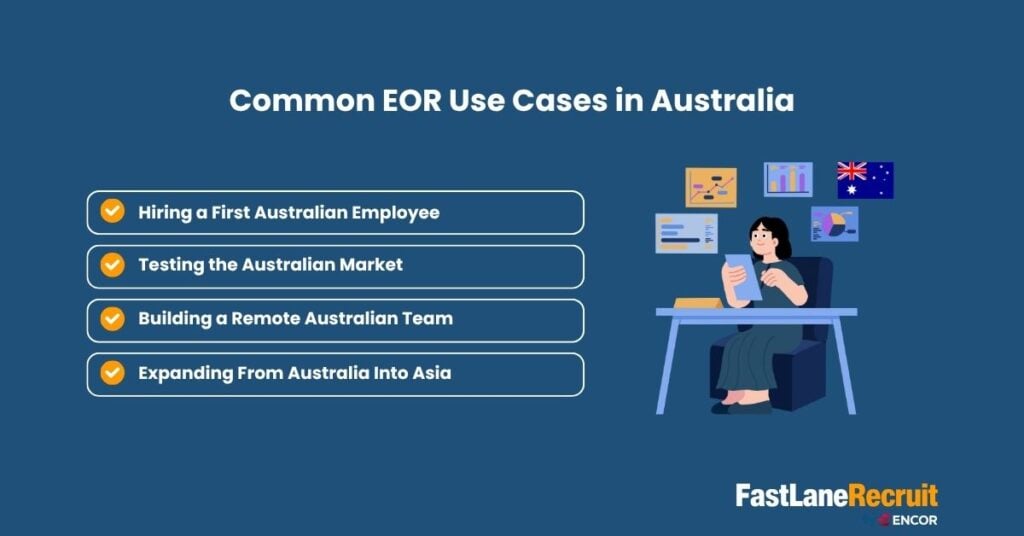
Hiring a First Australian Employee
A company identifies an Australian candidate but does not yet have an Australian entity.
Solution: The EOR provides the employment structure while the company manages the employee’s day-to-day work.
Testing the Australian Market
A company wants to understand local demand before making a major investment.
Solution: Hire a small local team through an EOR while evaluating market performance.
Building a Remote Australian Team
A global company wants access to Australian talent without establishing offices.
Solution: Use EOR employment for remote workers and centralise payroll and employment administration.
Expanding From Australia Into Asia
An Australian company may also need employees across multiple Asian markets.
Solution: Work with a regional EOR partner capable of supporting multiple jurisdictions.
How FastLaneRecruit Can Support Australian Hiring
Once the business case is clear, the next consideration is choosing an EOR partner capable of managing the practical details.
FastLaneRecruit’s Australia EOR service is designed to help businesses hire employees in Australia without immediately establishing their own local company.
The service can support areas including:
- Locally appropriate employment agreements
- Hiring
- Payroll processing
- Salary and payslip administration
- Tax withholding administration
- Managing independent contractors
- Leave administration
- Work Visa and Permits
- Employment Benefits & compliance support
- Termination and final-payment administration
FastLaneRecruit’s Australia EOR service specifically positions the solution around hiring without setting up a local entity and managing employment, payroll, statutory and HR administration.
The broader EOR model also allows companies to retain responsibility for the employee’s day-to-day work while the EOR manages the agreed legal employment and administrative responsibilities.
One EOR Partner for Multi-Country Expansion
Australia is often only one part of an international hiring strategy.
If a company expects to build teams across multiple markets, working with separate providers in every country can create fragmented processes, contracts, payroll systems and HR relationships.
FastLaneRecruit can support businesses exploring EOR and international workforce solutions across markets including:
| Market | Typical expansion requirement |
| Malaysia | Regional and offshore teams |
| Singapore | APAC headquarters and specialist talent |
| Hong Kong | Finance, commercial and regional roles |
| China | Large-scale technical and commercial hiring |
| India | Technology and professional talent |
| Philippines | Support and distributed workforce |
| Taiwan | Technology, engineering and specialist talent |
| Vietnam | Technology and operational teams |
| Australia | Skilled professional and regional talent |
| United Kingdom | European market expansion |
| Switzerland | Specialist European hiring |
| UAE | Middle East regional expansion |
| Saudi Arabia | Middle East market entry |
| Qatar | Regional and project-based hiring |
EOR availability, employing structure and service scope can differ by country and engagement. Businesses should confirm the current service availability and applicable terms with FastLaneRecruit before committing to a particular market.
This multi-market perspective matters because international hiring rarely remains confined to one country.
A company that starts with one Australian employee may later need employees in Singapore, Malaysia, Hong Kong, the UAE, the UK or another market.
Having a single strategic workforce partner can make that expansion easier to coordinate.
How to Choose the Right Employer of Record in Australia
Before selecting an EOR provider, create a practical evaluation checklist.
Local employment capability
Does the provider understand Australian employment requirements?
Payroll expertise
Can it manage payroll, PAYG withholding, superannuation and employee records?
Compliance support
Does the provider monitor regulatory changes and help maintain compliant employment processes?
Employee support
Will Australian employees have access to responsive HR and payroll support?
Transparent pricing
Are monthly fees, setup charges and additional services clearly explained?
Data protection
How does the provider protect employee and company information?
Intellectual property
Does the employment agreement adequately address confidentiality and IP ownership?
Multi-country capability
Can the provider support your next market as well as your current one?
Exit flexibility
Can employees eventually be transferred to your own entity if you establish one?
These considerations help businesses evaluate an EOR based on long-term value rather than price alone.
EOR Australia: A Practical Decision Framework
Use this framework when deciding whether an EOR makes sense for your company.
| Your situation | EOR suitability |
| Hiring one employee in Australia | High |
| Testing the Australian market | High |
| Hiring remote Australian workers | High |
| Entering Australia quickly | High |
| Building a small initial team | High |
| Expanding across APAC | High |
| Hiring temporarily for a project | Potentially high |
| Building a large permanent Australian operation | Compare with entity setup |
| Need a full Australian corporate presence | Local entity may be more suitable |
| Want complete control over local corporate structure | Local entity |
The decision should ultimately depend on your hiring volume, growth plans, required level of local presence, budget, compliance needs and expected duration of the Australian operation.
Build Your Australian Team Without Starting With Entity Setup
Hiring in Australia does not have to begin with building an entire local employment infrastructure.
For a company hiring its first employee, testing the market, building a remote team or expanding across multiple countries, an Employer of Record in Australia can provide a practical bridge between international hiring and full local establishment.
The value of an EOR is not simply avoiding incorporation. It is about bringing together employment contracts, payroll, statutory obligations, benefits, onboarding, HR administration and compliance support into a structured employment model.
That allows your business to concentrate on what matters most: finding the right people, managing their work and growing the operation.
FastLaneRecruit can support this process by providing Australia EOR services designed to help international businesses hire and manage employees while reducing the administrative complexity of local employment.
Ready to Hire in Australia?
If you are planning to hire your first employee in Australia, expand an existing team, or explore opportunities across multiple international markets, an EOR can give you a more practical starting point.
Talk to FastLaneRecruit about your Australian hiring plans and discover how an Employer of Record solution can help you hire, onboard, manage payroll and navigate local employment administration without immediately setting up your own Australian entity.
Book a Free Consultation with FastLaneRecruit.
Frequently Asked Questions About Employer of Record Australia
Can I hire employees in Australia without setting up a company?
Yes. An Employer of Record can provide a legal employment structure that allows a foreign company to hire Australian employees without establishing its own Australian employing entity, subject to the applicable legal and service requirements.
What does an EOR do in Australia?
An EOR can manage employment administration such as employment contracts, onboarding, payroll, statutory contributions, leave administration, benefits and offboarding, depending on the service agreement.
Who manages the employee when using an EOR?
The client company generally manages the employee’s day-to-day work, responsibilities, projects and performance, while the EOR handles the agreed legal employment and administrative functions.
How does an EOR differ from a recruitment agency?
A recruitment agency focuses primarily on sourcing and placing candidates. An EOR provides an employment structure and manages agreed employment administration after the candidate is hired.
How much does an EOR cost in Australia?
There is no single standard EOR Australia price. Costs depend on the provider, number of employees, salaries, benefits, payroll requirements, onboarding and additional services.
Does an EOR handle Australian payroll?
An EOR can manage payroll processing, salary payments, payslips, tax withholding, superannuation administration and related employment administration according to the service agreement.
Is superannuation included in EOR payroll?
Superannuation is an important employer obligation in Australia. The current super guarantee rate is 12%, with specific payment and reporting requirements. From 1 July 2026, Payday Super changes when super guarantee contributions must be paid.
Can an EOR help with employee termination?
Yes. An EOR can support the employment administration associated with termination, including notice, final payments and applicable redundancy requirements. The NES include minimum rules for termination notice and redundancy pay, subject to eligibility and exceptions.
Can I switch from an EOR to my own Australian entity later?
Potentially, yes. Some businesses use EOR as a market-entry solution before establishing their own entity. The transition process should be planned carefully with the EOR and relevant legal and tax advisers.
Is an EOR suitable for long-term Australian employees?
It can be. EOR is not limited to short-term hiring. The right structure depends on the company’s workforce size, business objectives, local presence and long-term expansion strategy.