Hiring in Sweden can give international businesses access to a highly skilled and competitive workforce, but employing people locally also means dealing with Swedish employment contracts, payroll, employer contributions, employee benefits, labor regulations and, in some cases, work permit requirements.
An Employer of Record (EOR) in Sweden provides a way to hire employees locally without requiring your company to establish and operate its own Swedish legal entity. The EOR becomes the formal employer and manages employment administration, payroll and local compliance, while your company retains control over the employee’s day-to-day work and responsibilities.
For companies testing the Swedish market, hiring a small team, expanding internationally or building a distributed workforce, an EOR can offer a more streamlined alternative to establishing a subsidiary from the outset.
This guide explains how to use an Employer of Record in Sweden, what an EOR handles, Swedish employment requirements to consider, the hiring process, costs, benefits, risks and how an EOR compares with other international hiring models.
Content Outline
Key Summary
Hire in Sweden Without Setting Up a Local Entity
An Employer of Record in Sweden allows international companies to hire employees locally without immediately establishing a Swedish subsidiary. The EOR becomes the legal employer while the business retains control over the employee’s day-to-day responsibilities.
Simplify Swedish Payroll and Employment Administration
An EOR can manage payroll, statutory deductions, employer contributions, employment documentation, benefits administration and other ongoing employment processes, reducing the administrative workload for international businesses.
Stay Aligned With Swedish Employment Requirements
Sweden has specific requirements covering employment contracts, working hours, annual leave, parental leave, termination and employer contributions. Working with an EOR can help businesses manage these requirements through a locally structured employment process.
Access Swedish Talent Faster
Companies can use an EOR to start hiring in Sweden without first building a complete local HR, payroll and employment infrastructure. This can be particularly useful when hiring a first employee or building a small team.
Manage Work Permit Requirements
Businesses hiring non-EU/EEA nationals need to consider Swedish immigration requirements. Current work-permit salary thresholds and other conditions should be reviewed before making an international hire.
Compare an EOR With Other Hiring Models
An EOR is not the only way to hire in Sweden. Businesses can also establish a local entity, hire through an existing entity or use staffing arrangements. The right model depends on hiring volume, market strategy, budget and long-term plans.
Reduce the Risks of International Hiring
Incorrect payroll, employee classification, employment contracts, benefits or termination procedures can create compliance risks. An EOR can provide local employment administration and support while the client company remains responsible for managing the employee’s business activities.
Build a More Flexible International Workforce
For companies expanding beyond Sweden, an EOR with multi-country coverage can simplify international workforce management. Instead of establishing a separate employment structure for every new market, businesses can work with one partner across multiple jurisdictions.
What Is an Employer of Record in Sweden?
An Employer of Record is a third-party organization that legally employs a worker on behalf of another company.
Under an EOR arrangement, the EOR generally handles the formal employment relationship, including employment documentation, payroll administration, statutory deductions and other employer responsibilities. The client company continues to direct the employee’s everyday activities, objectives, workload and performance.
This creates a practical separation between legal employment and operational management.
For example, a technology company headquartered in Singapore may want to hire a software engineer who lives and works in Sweden. Rather than immediately establishing a Swedish subsidiary, the company can use an EOR to employ the engineer locally.
The company manages the engineer’s work. The EOR manages the employment administration.
How Does an EOR Work in Sweden?
| Responsibility | Client Company | EOR Provider |
| Day-to-day employee management | Yes | Support as required |
| Job responsibilities | Yes | No |
| Performance management | Yes | Support as required |
| Employment contract administration | Input | Yes |
| Payroll processing | Provides compensation details | Yes |
| Employer contributions | Funded by client | Administered by EOR |
| Local employment compliance | Oversight | Local administration/support |
| Employee onboarding | Operational onboarding | Employment onboarding |
| Statutory deductions | No | Yes |
| Benefits administration | Defines requirements | Administration/support |
| Termination administration | Business decision | Local process support |
The exact division of responsibilities depends on the EOR agreement and the employment arrangement.
Also Read:Employer of Record in the US: Complete Guide to Hiring Without a Legal Entity
How to Use an Employer of Record in Sweden: Step-by-Step
Using an EOR does not need to be complicated, but the process works best when the hiring requirements and local employment conditions are established before an employee starts.
Step 1: Define Your Swedish Hiring Requirements
Start by determining:
- The role and responsibilities
- Candidate location
- Employment type
- Proposed salary
- Start date
- Working arrangement
- Benefits
- Expected working hours
- Whether the employee requires work authorization
- Any special contractual requirements
This gives the EOR enough information to determine the appropriate employment structure and expected employment costs.
Step 2: Select an EOR With Swedish Capabilities
Not every global employment provider offers the same level of local support.
When evaluating an EOR provider in Sweden, consider:
- Local employment expertise
- Payroll capabilities
- Compliance processes
- Benefits administration
- Employee onboarding
- Work permit support where applicable
- Data security
- Pricing transparency
- HR support
- Experience with international companies
A provider’s ability to administer employment locally is particularly important when your internal HR team is unfamiliar with Swedish requirements.
Step 3: Review Employment and Compliance Requirements
Before onboarding, the employment arrangement should be reviewed against applicable Swedish requirements.
A written employment contract is required, and Swedish employment guidance states that the contract should contain information such as the employer’s identity, employment duration, working arrangement, pay, duties and professional title.
Other considerations can include:
- Employment classification
- Working hours
- Annual leave
- Sick leave
- Parental leave
- Compensation
- Employer contributions
- Insurance
- Pension arrangements
- Collective agreements
- Termination requirements
- Work authorization
Step 4: Provide the Employee Information
The company normally provides the EOR with the information needed to prepare employment documentation and complete onboarding.
This can include:
- Employee identification details
- Job title
- Salary
- Start date
- Job description
- Working location
- Benefits
- Working schedule
- Bank and payroll information
- Immigration documentation where relevant
Step 5: Complete Employment Onboarding
The EOR prepares and administers the employment relationship according to the agreed terms.
Once the documentation is completed, the employee can begin working for the client company while the EOR manages the formal employment administration.
Step 6: Manage Payroll and Ongoing Employment
After onboarding, the relationship becomes an ongoing employment process rather than a one-time setup.
The EOR may support:
- Monthly payroll
- Employer contributions
- Tax and statutory administration
- Employee benefits
- Leave administration
- Employment documentation
- HR administration
- Compliance support
- Changes to compensation
- Employee termination processes
This is where the value of an EOR becomes more apparent: the company is not simply outsourcing the initial hiring process but creating a structured way to manage employment in Sweden.
What Does an EOR Handle in Sweden?
An effective EOR arrangement can cover much of the administrative infrastructure required to employ someone locally.
Employment Contracts
Swedish employees are entitled to a written employment contract containing key employment information.
An EOR can help administer the employment agreement based on the role, compensation and applicable local requirements.
Payroll and Employer Contributions
Payroll is one of the most important parts of Swedish employment administration.
The standard employer contribution rate in Sweden is currently 31.42% of gross salary and benefits, although specific reduced rates and exceptions can apply.
For international businesses, correctly calculating and administering these obligations can become difficult when the company does not have an internal Swedish payroll function.
Employee Benefits
Employment costs extend beyond base salary.
Depending on the role and arrangement, employers may need to consider:
- Pension
- Insurance
- Paid leave
- Parental leave
- Other contractual benefits
- Benefits associated with collective agreements
An EOR can help structure and administer the employment package based on local requirements and the agreed terms.
Leave Administration
Swedish employees generally have a statutory entitlement to 25 days of annual leave per year. Additional leave can arise from employment contracts or collective agreements.
Parental leave is also an important part of Sweden’s employment framework, with employees having statutory rights related to parental leave.
Termination Administration
Ending employment requires careful attention to the employment contract, applicable law and, where relevant, collective agreements.
Sweden’s Employment Protection Act establishes statutory notice periods, with a minimum of one month and longer periods based on an employee’s length of service in certain circumstances.
An EOR can help coordinate the administrative and local employment aspects of the process.
Sweden Employment and Compliance Requirements to Know
Sweden has a structured employment framework, making local knowledge important for foreign companies.
Written Employment Contracts
Employment documentation should clearly establish the employment relationship, including pay, duties, employment duration and other relevant terms.
Working Hours
Sweden has legislation governing working time, alongside workplace-specific arrangements and agreements.
Companies should therefore establish the employee’s working schedule and expectations before employment begins.
Annual Leave
Employees are generally entitled to 25 days of annual leave each year. Collective agreements and employment contracts can provide additional leave.
Parental Leave
Parental leave is protected under Swedish law and should be incorporated into employment administration and workforce planning.
Employer Contributions
Employers generally pay social security contributions on compensation for work carried out in Sweden. The full standard rate for 2026 is 31.42%.
Collective Agreements
Collective agreements can affect employment terms and benefits in Sweden. Businesses should determine whether a relevant agreement applies to the position or employment arrangement rather than assuming that statutory minimum requirements are the only considerations.
Work Permits
Immigration compliance deserves particular attention when hiring employees who require authorization to work in Sweden.
From June 1, 2026, applicable work-permit applications are subject to a salary requirement of at least 90% of Sweden’s median salary. As of June 16, 2026, the applicable figure is SEK 34,470 per month. The salary must also meet the level established by applicable collective agreements or common practice in the occupation or industry.
The Swedish Migration Agency also introduced a requirement concerning comprehensive health insurance for applicable work-permit cases.
Because immigration rules can change, employers should verify the requirements applicable to the employee and application date.
Why Use an EOR in Sweden Instead of Setting Up an Entity?
Establishing a Swedish subsidiary can make sense when a company is building a substantial and permanent local operation.
But it may be unnecessary when the immediate objective is simply to hire employees.
An EOR can provide a more flexible starting point.
EOR vs Local Entity in Sweden
| Factor | Employer of Record | Local Swedish Entity |
| Establish local legal entity | No | Yes |
| Initial setup | Generally faster | More involved |
| Local payroll administration | EOR-managed | Company-managed or outsourced |
| Employment administration | EOR-managed | Company responsibility |
| Local compliance | EOR-supported | Company responsibility |
| HR infrastructure | Can be outsourced | Usually needs internal management |
| Best suited for | Market entry and distributed hiring | Established local operations |
| Scalability for small teams | High | May require more infrastructure |
| Long-term control | Operational control remains with client | Full entity control |
| Administrative burden | Lower | Higher |
The decision should depend on the company’s expected scale, long-term plans, regulatory requirements and budget.
An EOR does not necessarily replace an entity permanently. For some companies, it can simply provide a practical way to begin hiring while they evaluate whether establishing a permanent Swedish operation makes commercial sense.
EOR vs Staffing Agency vs Local Entity
These models serve different purposes and should not be treated as interchangeable.
| Model | Main Purpose | Who Employs the Worker? | Best For |
| EOR | International employment | EOR | Companies hiring employees without a local entity |
| Staffing Agency | Recruitment and temporary staffing | Agency, depending on arrangement | Temporary or contingent workforce needs |
| Local Entity | Establishing local operations | Client’s own company | Long-term market presence |
| Direct Local Hiring | Hiring through existing entity | Client | Companies already established in Sweden |
An EOR is particularly relevant when the company wants to retain control over the employee’s work while outsourcing the legal and administrative employment infrastructure.
Benefits of Using an Employer of Record in Sweden
Enter the Swedish Market Faster
Setting up a local entity involves corporate, banking, tax, payroll and administrative considerations.
An EOR can provide an existing employment infrastructure, allowing companies to focus on hiring and operating the team.
Hire Without Establishing a Swedish Entity
For businesses hiring their first employee in Sweden, creating a subsidiary solely for one hire may introduce unnecessary complexity.
An EOR provides an alternative route.
Reduce Administrative Work
Instead of building an internal Swedish payroll and HR process, companies can delegate many employment administration tasks to an EOR.
Support Local Compliance
Swedish employment requirements can be unfamiliar to companies headquartered elsewhere.
An EOR with local expertise can help businesses administer employment according to applicable local requirements.
Improve International Workforce Scalability
Businesses expanding across multiple countries can use EOR services to create a more consistent approach to international employment while adapting the employment administration to each jurisdiction.
Test a Market Before Committing to a Subsidiary
An EOR can be useful for companies that are still evaluating Swedish market potential.
The business can hire and operate locally before deciding whether a permanent entity is justified.
Common Hiring Challenges in Sweden
International companies entering Sweden can encounter several challenges.
Understanding Local Employment Requirements
Employment regulations may differ significantly from the company’s home country.
Managing Swedish Payroll
Employer contributions, statutory deductions and employee compensation create an additional administrative layer.
Providing Competitive Employment Packages
Salary is only one part of the employment proposition. Leave, pension, insurance and other benefits can influence the total employment cost and candidate experience.
Handling Work Authorization
International hiring can involve immigration requirements, salary thresholds and documentation.
Managing Termination Correctly
Termination procedures need to account for Swedish employment law, contracts and potentially collective agreements.
Supporting Employees From Another Country
A foreign company may have strong operational leadership but limited local HR infrastructure. An EOR can provide a local administrative layer between the employee and the overseas headquarters.
Who Should Use an EOR in Sweden?
An Employer of Record can be particularly useful for:
Companies Entering Sweden for the First Time
Businesses can hire locally without immediately creating a Swedish subsidiary.
Startups and Scaleups
Fast-growing companies can test new markets and build international teams without adding substantial local infrastructure at the earliest stage.
Companies Hiring One or a Small Number of Employees
An EOR can make sense when a company needs only a few employees in Sweden and does not yet need a full local entity.
Remote-First Businesses
Companies operating distributed teams can use EOR services to manage employment in countries where they do not have legal entities.
Companies Hiring Specialized Talent
An EOR can help businesses access candidates in Sweden without requiring the company to establish a local HR and payroll structure first.
Multinational Companies Expanding Across Several Markets
Businesses entering multiple countries may benefit from using an EOR partner with broader international coverage rather than managing every market through separate providers.
Industries That Can Benefit From an EOR in Sweden
An EOR can support hiring across a wide range of industries, including:
- Technology and software
- SaaS
- Fintech
- Financial services
- Engineering
- Manufacturing
- Life sciences
- Healthcare
- Professional services
- Consulting
- E-commerce
- Digital marketing
- Research and development
- Renewable energy
- Consumer products
The strongest use case is not necessarily tied to a particular industry. It is often determined by the company’s hiring model, geographic footprint and need for local employment infrastructure.
Sweden EOR Use Cases
Hiring a First Swedish Employee
A company wants to hire a Swedish sales manager but does not yet have a Swedish entity.
EOR solution: The EOR becomes the local employer while the company manages the employee’s sales activities.
Building a Small Swedish Team
A technology business wants to hire five engineers before committing to a permanent Swedish operation.
EOR solution: The company can build the team through an EOR while evaluating long-term expansion.
Hiring International Talent in Sweden
A business has identified a candidate who requires work authorization.
EOR solution: The company can explore an EOR arrangement with appropriate immigration support while ensuring the employment package meets applicable requirements.
Expanding Across Multiple Countries
A company is hiring employees in Sweden, Singapore and Australia at the same time.
EOR solution: A multi-market provider can create a more coordinated international employment process.
Risks and Considerations When Using an EOR in Sweden
An EOR reduces administrative complexity, but businesses should still understand the limitations and responsibilities involved.
Provider Coverage
Confirm that the provider can legally and operationally support employment in Sweden.
Local Compliance Expertise
International employment requires more than payroll software. Evaluate whether the provider has meaningful local employment knowledge.
Pricing
EOR costs generally include more than the employee’s salary. Consider:
- EOR service fees
- Salary
- Employer contributions
- Benefits
- Insurance
- Immigration-related costs
- Additional HR services
Employee Experience
The EOR becomes part of the employee’s employment infrastructure. The provider should therefore offer responsive onboarding, payroll and employee support.
Contractual Responsibilities
Clearly establish which responsibilities remain with the client and which are handled by the EOR.
Data Security
Because EOR providers handle sensitive employee information, businesses should review data protection and security practices before entering into an agreement.
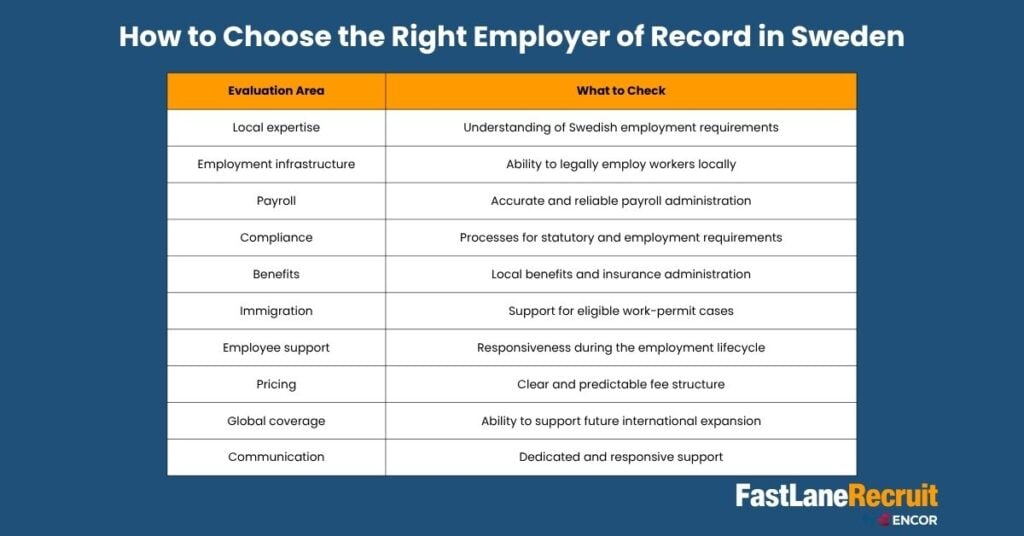
How to Choose the Right Employer of Record in Sweden
The lowest advertised price is not necessarily the best indicator of EOR value.
Before selecting a provider, consider:
| Evaluation Area | What to Check |
| Local expertise | Understanding of Swedish employment requirements |
| Employment infrastructure | Ability to legally employ workers locally |
| Payroll | Accurate and reliable payroll administration |
| Compliance | Processes for statutory and employment requirements |
| Benefits | Local benefits and insurance administration |
| Immigration | Support for eligible work-permit cases |
| Employee support | Responsiveness during the employment lifecycle |
| Pricing | Clear and predictable fee structure |
| Global coverage | Ability to support future international expansion |
| Communication | Dedicated and responsive support |
A good EOR relationship should make international employment easier without removing the client company’s operational control.
Expanding Beyond Sweden With One International EOR Partner
Sweden may be your first international hiring market, but it may not be your last.
As companies expand, managing separate EOR providers in every country can create fragmented contracts, communication channels, payroll processes and reporting.
A broader international EOR partner can provide a more scalable approach.
FastLaneRecruit supports international employment solutions across Malaysia, Singapore, Hong Kong, China, India, Philippines, Taiwan, Vietnam, Australia, United Kingdom, Switzerland, UAE, Saudi Arabia, and Qatar.
This means a company can evaluate Sweden as one part of a broader international hiring strategy rather than treating every new country as a completely separate project.
Country Coverage for International Hiring
| Market | Potential Hiring Use Case | Why It May Matter |
| Sweden | European talent and market entry | Access to Nordic talent |
| United Kingdom | European operations | Established international business hub |
| Switzerland | Specialized and high-value talent | Access to a strong professional workforce |
| Malaysia | Regional teams and offshore operations | Southeast Asian talent hub |
| Singapore | APAC headquarters and specialist hiring | Major regional business centre |
| Hong Kong | Greater China and regional operations | International commercial hub |
| China | Large-scale market and talent access | Significant regional economy |
| India | Technology, engineering and professional services | Large skilled talent pool |
| Philippines | Business support and distributed teams | Strong English-speaking workforce |
| Taiwan | Technology and specialist talent | Advanced technology ecosystem |
| Vietnam | Growing technology and operational teams | Expanding Southeast Asian talent market |
| Australia | APAC expansion | Established developed-market presence |
| UAE | Middle East regional operations | Major international business hub |
| Saudi Arabia | Middle East market expansion | Growing commercial ecosystem |
| Qatar | Regional projects and specialist hiring | Strategic Gulf market |
The objective is not to suggest that one country is universally better than another. The right location depends on the role, talent requirements, operating model, budget and long-term business strategy.
An international EOR partner becomes particularly useful when a company needs the flexibility to compare several markets before deciding where to build a permanent presence.
Why FastLaneRecruit for International EOR Hiring?
International hiring becomes easier when employment administration, local requirements and workforce expansion can be managed through one coordinated partner.
FastLaneRecruit supports businesses that need to hire internationally without immediately building their own employment infrastructure in every market.
For companies considering Sweden, the conversation can begin with the specific hiring requirement:
- How many employees do you want to hire?
- Where will they work?
- What roles are you hiring for?
- What compensation are you considering?
- Do any employees require work authorization?
- Are you testing the market or building a long-term operation?
- Could you need employees in additional countries later?
From there, an EOR solution can be evaluated based on the actual employment situation rather than applying a one-size-fits-all model.
When Is an EOR the Right Choice for Sweden?
An EOR is often worth considering when:
You need to hire quickly: You want to employ a candidate without waiting for your own entity setup.
You are testing the market: You want to validate Swedish demand before committing to a permanent structure.
You are hiring a small team: You need only one or several employees initially.
You operate remotely: Your workforce is distributed across countries.
You lack local HR expertise: Your headquarters does not have a Swedish payroll or employment team.
You are expanding across multiple markets: You want a consistent international employment partner.
Conversely, a local entity may become more appropriate when Sweden develops into a significant, long-term operating market requiring its own corporate infrastructure.
Conclusion: Using an EOR to Hire in Sweden
Hiring in Sweden involves more than finding the right candidate.
Businesses need to consider employment contracts, payroll, employer contributions, employee benefits, leave, working conditions, termination requirements and, for international workers, immigration rules.
An Employer of Record in Sweden can simplify this process by providing the local employment infrastructure needed to hire employees without requiring the client company to establish its own Swedish entity immediately.
The value of an EOR is therefore not simply speed. It is the ability to combine local employment administration with international business flexibility.
For companies entering Sweden for the first time, hiring a small team, testing the market or building a distributed workforce, an EOR can provide a practical bridge between international expansion and permanent local operations.
And if Sweden is only one part of your expansion strategy, working with an EOR provider with coverage across Europe, Asia Pacific and the Middle East can make future hiring decisions easier to coordinate.
Hire in Sweden With an Employer of Record
With the right EOR structure, businesses can explore the Swedish market, hire local talent and manage employment administration while keeping their focus on business operations.
If you are planning to expand your workforce across multiple countries, contact FastLaneRecruit to discuss your hiring requirements and find an international employment solution that fits your expansion plans.
Book a consultation with FastLaneRecruit today and explore how an Employer of Record can support your next international hire.
Frequently Asked Questions About Employer of Record Sweden
What is an Employer of Record in Sweden?
An Employer of Record is a third-party organization that legally employs workers on behalf of a client company. The EOR manages employment administration such as contracts, payroll and statutory requirements, while the client company manages the employee’s day-to-day work.
Can I hire an employee in Sweden without a local entity?
Yes. An EOR can provide a way for an international company to hire an employee in Sweden without establishing its own Swedish legal entity, subject to the specific employment arrangement and applicable requirements.
How does an EOR work in Sweden?
The EOR becomes the formal employer and manages employment administration, while the client company typically controls the employee’s daily responsibilities, performance and business activities.
How much does an Employer of Record cost in Sweden?
EOR costs vary according to the provider, employee salary, benefits, services, immigration requirements and other employment factors. Businesses should evaluate the total employment cost rather than comparing EOR service fees alone.
What does an EOR handle in Sweden?
Depending on the agreement, an EOR can handle employment contracts, payroll, employer contributions, statutory deductions, benefits administration, onboarding, HR administration, compliance support and termination administration.
What are the employer contributions in Sweden?
The standard Swedish employer contribution rate is currently 31.42% of gross salary and taxable benefits, with specific exceptions and reduced rates applying in certain circumstances.
How much annual leave do employees receive in Sweden?
Employees in Sweden generally have a statutory entitlement to 25 days of annual leave per year. Employment contracts and collective agreements may provide additional leave.
Does an EOR handle Swedish payroll?
Payroll administration is a core part of many EOR arrangements. The EOR can calculate and administer payroll, deductions and employer contributions based on the employment terms and applicable Swedish requirements.
Can an EOR help hire foreign workers in Sweden?
An EOR may support eligible international hiring and immigration administration, depending on its services. Work-permit requirements should be assessed for each employee. From June 2026, applicable Swedish work permits are subject to a salary requirement of at least 90% of the national median salary, alongside other requirements.
Is an EOR better than setting up a Swedish company?
It depends on the company’s objectives. An EOR can be more practical for companies hiring a small number of employees, entering Sweden for the first time or testing the market. A local entity may make more sense when the company is establishing a substantial, permanent Swedish operation.
What is the difference between an EOR and a staffing agency?
An EOR is primarily designed to provide a legal employment structure for international hiring, whereas a staffing agency is generally focused on supplying workers or recruitment and temporary staffing services. The precise legal arrangement depends on the provider and engagement.
How do I choose an EOR provider in Sweden?
Look at local employment expertise, payroll capabilities, compliance support, benefits administration, employee experience, immigration capabilities, pricing transparency and international coverage.