Every business generates data, but turning that data into meaningful insights requires more than dashboards and spreadsheets. Whether you’re tracking customer behavior, improving operational efficiency, or forecasting future growth, a skilled Data Analytics Team helps transform raw information into smarter business decisions.
As organizations continue to embrace digital transformation, data analytics has become a strategic function rather than just a technical capability. Businesses of all sizes are investing in analytics professionals to uncover trends, measure performance, reduce risks, and identify new growth opportunities. However, building an in-house analytics team can be expensive, time-consuming, and highly competitive due to the global demand for skilled talent.
This is why many companies are choosing to outsource their Data Analytics Team. By partnering with experienced recruitment and outsourcing providers, businesses gain access to qualified analytics professionals, reduce hiring costs, and scale their capabilities faster without compromising quality.
In this guide, you’ll learn what a Data Analytics Team is, the key roles within the team, common organizational structures, the benefits of outsourcing, and why Malaysia has become a preferred destination for businesses seeking reliable analytics talent.
Content Outline
Key Summary
What Is a Data Analytics Team?
A Data Analytics Team collects, manages, analyzes, and interprets business data to help organizations make informed, data-driven decisions.
Key Roles Drive Better Business Decisions
A successful Data Analytics Team typically includes data analysts, data engineers, business intelligence specialists, data scientists, and analytics managers working together to deliver actionable insights.
Team Structure Depends on Business Needs
Businesses may adopt centralized, decentralized, or hybrid analytics team structures depending on their size, operational complexity, and collaboration requirements.
Outsourcing Reduces Costs and Accelerates Hiring
Outsourcing a Data Analytics Team gives businesses access to specialized talent, lower recruitment costs, faster hiring, and greater scalability compared to building an in-house team.
Malaysia Is a Leading Analytics Outsourcing Hub
Malaysia offers highly skilled analytics professionals, competitive operating costs, strong English proficiency, and a growing digital economy, making it an attractive destination for outsourcing data analytics functions.
What Is a Data Analytics Team?
A Data Analytics Team is a group of professionals responsible for collecting, organizing, analyzing, and interpreting data to help businesses make informed decisions. By transforming raw data into meaningful insights, the team enables organizations to identify trends, improve performance, solve operational challenges, and uncover new opportunities for growth.
Unlike traditional reporting teams that focus primarily on historical data, modern data analytics teams combine technical expertise, business knowledge, and advanced analytical tools to answer complex business questions. Their work supports decision-making across departments such as marketing, finance, sales, operations, human resources, and customer service.
For example, a retail company may rely on a Data Analytics Team to identify its highest-performing products, forecast inventory demand, and understand customer purchasing behavior. Meanwhile, a financial services company may use analytics to detect fraud, assess business risks, or improve customer retention strategies.
As businesses generate increasing amounts of data through digital platforms, cloud applications, and connected devices, the role of a Data Analytics Team has become essential for maintaining a competitive advantage. Rather than relying on intuition alone, organizations can use data-backed insights to make faster, more confident, and more strategic decisions.
What Does a Data Analytics Team Do?
While responsibilities vary by industry and business size, a Data Analytics Team typically focuses on four core functions:
| Function | Purpose |
| Data Collection | Gather data from internal systems, software, databases, websites, and external sources. |
| Data Management | Clean, organize, validate, and maintain high-quality data for analysis. |
| Data Analysis | Identify patterns, trends, opportunities, and business risks using statistical and analytical techniques. |
| Data Visualization & Reporting | Present findings through dashboards, reports, and visualizations that support business decision-making. |
Beyond reporting numbers, today’s Data Analytics Teams help organizations answer critical business questions such as:
- Which products generate the highest profit margins?
- Which marketing campaigns deliver the best return on investment (ROI)?
- Why are customers leaving, and how can retention improve?
- Which markets present the greatest growth opportunities?
- How can operational costs be reduced without affecting performance?
- What future trends can be predicted based on historical data?
These insights allow business leaders to make proactive decisions rather than simply reacting to past performance.
Why Is a Data Analytics Team Important?
A well-structured Data Analytics Team enables businesses to move beyond guesswork and make evidence-based decisions. By providing reliable insights into customer behavior, operational performance, and market trends, the team helps organizations respond more quickly to changing business conditions and identify opportunities that might otherwise be overlooked.
Key benefits include:
- Improving strategic decision-making with accurate data insights
- Enhancing customer experience through behavioral analysis
- Identifying operational inefficiencies and cost-saving opportunities
- Supporting business forecasting and long-term planning
- Measuring business performance using real-time dashboards and KPIs
- Strengthening competitive advantage through data-driven innovation
As artificial intelligence, automation, and predictive analytics become increasingly integrated into business operations, the importance of a skilled Data Analytics Team will continue to grow. Organizations that invest in analytics capabilities are better positioned to adapt to changing market conditions, improve efficiency, and drive sustainable business growth.
Roles In A Data Analytics Team
A successful Data Analytics Team requires a combination of technical specialists, business experts, and strategic leaders who work together to transform data into actionable insights. While the exact team structure depends on the company’s size, industry, and analytics maturity, most organizations need professionals who can collect data, analyze information, build reporting systems, and communicate insights effectively.
A common mistake businesses make is hiring only data analysts while overlooking other critical roles required to maintain a complete analytics ecosystem. A strong Data Analytics Team combines multiple skill sets, ensuring data is accurate, accessible, meaningful, and aligned with business objectives.
Below are the key roles commonly found in a modern Data Analytics Team.
Key Roles And Responsibilities In A Data Analytics Team
| Role | Main Responsibilities | Key Skills |
| Data Analyst | Collects, analyzes, and interprets data to identify trends and provide business insights. Creates reports, dashboards, and performance analysis. | SQL, Excel, data visualization, statistics, reporting tools |
| Business Analyst | Connects business goals with data insights by understanding requirements, analyzing processes, and recommending improvements. | Business strategy, requirement gathering, communication, process analysis |
| Data Engineer | Builds and maintains data infrastructure, pipelines, databases, and systems that allow teams to access reliable data. | Python, SQL, cloud platforms, database management, ETL processes |
| Analytics Engineer | Transforms raw data into structured datasets that are ready for analysis and reporting. Bridges the gap between data engineering and analytics. | SQL, data modeling, analytics tools, data transformation |
| Business Intelligence (BI) Developer | Creates dashboards, reporting systems, and visualization solutions that help stakeholders monitor business performance. | Power BI, Tableau, data visualization, dashboard development |
| Data Scientist | Uses advanced analytics, machine learning, and statistical models to predict future outcomes and solve complex business problems. | Python, machine learning, statistics, predictive modeling |
| Machine Learning Engineer | Develops and deploys AI and machine learning models into business applications. | Machine learning frameworks, programming, model deployment |
| Data Architect | Designs the overall data structure, governance framework, and technology architecture to ensure data scalability and security. | Cloud architecture, databases, data governance, system design |
| Analytics Manager | Leads the analytics function, manages team performance, prioritizes projects, and ensures insights support business goals. | Leadership, analytics strategy, project management, stakeholder management |
Understanding The Core Data Analytics Roles
Data Analysts: Turning Data Into Business Insights
A Data Analyst is often the foundation of a Data Analytics Team. Their main responsibility is to examine data, identify patterns, and create reports that help businesses understand what is happening.
Typical responsibilities include:
- Cleaning and organizing datasets
- Creating dashboards and reports
- Monitoring business KPIs
- Identifying trends and performance gaps
- Providing recommendations based on data findings
For many businesses starting their analytics journey, hiring skilled data analysts is the first step toward becoming a more data-driven organization.
Data Engineers: Building The Foundation For Analytics
Before data can be analyzed, it needs to be collected, stored, and structured properly. This is where Data Engineers play a critical role.
They design and maintain the technical systems that allow organizations to process large amounts of data efficiently.
Their responsibilities often include:
- Developing data pipelines
- Managing databases and cloud storage
- Ensuring data accuracy and availability
- Improving data processing performance
Without reliable data infrastructure, even highly skilled analysts may struggle to deliver accurate insights.
Business Intelligence Specialists: Making Data Easy To Understand
Business Intelligence (BI) professionals help convert complex datasets into easy-to-understand dashboards and reports.
They support decision-makers by presenting information visually, allowing managers and executives to quickly understand business performance.
Common BI responsibilities include:
- Creating interactive dashboards
- Tracking business metrics
- Automating reports
- Improving data accessibility across departments
Tools commonly used include platforms such as Power BI, Tableau, and Looker.
Data Scientists: Creating Predictive Business Solutions
While analysts often focus on understanding current and past performance, Data Scientists use advanced analytics techniques to predict future outcomes.
They may help businesses answer questions such as:
- Which customers are most likely to leave?
- What products will have higher demand next quarter?
- How can companies optimize pricing strategies?
- What risks can be predicted before they happen?
By combining statistics, programming, and machine learning, data scientists support more advanced decision-making.
Analytics Managers: Connecting Data Strategy With Business Goals
An Analytics Manager ensures that the Data Analytics Team focuses on projects that create measurable business value.
Rather than simply managing technical tasks, analytics leaders work closely with executives and departments to define priorities and align analytics initiatives with company objectives.
Their responsibilities include:
- Managing analytics projects
- Setting team goals
- Coordinating with business stakeholders
- Ensuring insights lead to practical actions
How Data Analytics Team Roles Work Together
A high-performing Data Analytics Team operates like an interconnected system. Each role contributes a different capability:
- Data Engineers build the infrastructure
- Analytics Engineers prepare usable datasets
- Data Analysts and BI Developers discover and communicate insights
- Data Scientists develop predictive solutions
- Analytics Managers align everything with business strategy.
This collaboration ensures businesses can move from collecting data to making informed decisions.
How Many People Are Needed In A Data Analytics Team?
The ideal size of a Data Analytics Team depends on business requirements, data complexity, and growth stage.
| Business Size | Typical Data Analytics Team Structure |
| Small Businesses / Startups | 1–3 specialists such as a Data Analyst, BI Specialist, or outsourced analytics professional |
| Growing SMEs | 3–8 professionals covering analytics, engineering, reporting, and business requirements |
| Large Enterprises | Multiple specialized teams including data engineering, analytics, data science, governance, and analytics leadership |
For many SMEs, building a complete in-house Data Analytics Team can be challenging due to recruitment costs, limited talent availability, and the need for specialized expertise. This is why outsourcing has become an increasingly practical solution for accessing experienced analytics professionals without the cost of maintaining a large internal department.
How Is A Data Analytics Team Structured?
The structure of a Data Analytics Team determines how effectively data professionals collaborate with different departments and deliver insights across an organization. There is no single model that works for every business. The right structure depends on factors such as company size, industry, data maturity, business goals, and how closely analytics teams need to work with specific departments.
Most organizations adopt one of three common approaches:
- Centralized Data Analytics Team
- Decentralized Data Analytics Team
- Hybrid (Federated) Data Analytics Team
Understanding the differences between these models helps businesses choose the right approach when building or outsourcing a Data Analytics Team.
Centralized Data Analytics Team Structure
A centralized analytics structure places all data professionals under one dedicated analytics department. The team typically reports to a Chief Data Officer (CDO), Chief Technology Officer (CTO), or another senior business leader.
In this model, data analysts, engineers, scientists, and BI specialists work together as one unified team and provide analytics support across the entire organization.
How A Centralized Analytics Team Works
For example:
- The marketing department requests customer insights.
- The finance department requests forecasting reports.
- The operations team needs efficiency analysis.
- The analytics team prioritizes and delivers projects based on business impact.
All analytics resources are managed through one central function.
Advantages Of A Centralized Data Analytics Team
Consistent Data Standards
A centralized team can maintain common reporting methods, data definitions, and governance practices.
Better Collaboration Between Data Specialists
Analysts, engineers, and data scientists can share knowledge and solve complex problems together.
Improved Data Governance
Central ownership makes it easier to manage data security, accuracy, and compliance.
Efficient Resource Allocation
Businesses can prioritize analytics projects based on overall company objectives.
Challenges Of A Centralized Structure
- May become a bottleneck when many departments request analytics support.
- Team members may have less understanding of specific departmental challenges.
- Business teams may feel disconnected from the analytics function.
Also Read: Data Analytics Team Structure: How to Build a Modern Analytics Team
Decentralized Data Analytics Team Structure
A decentralized analytics structure places data professionals directly within different business departments.
For example:
- Marketing has its own marketing analyst.
- Finance has a financial data analyst.
- Sales has a sales analytics specialist.
- Operations has an operations reporting team.
Each department manages analytics resources based on its own requirements.
How A Decentralized Analytics Team Works
In this model, analytics professionals work closely with their assigned departments and develop specialized knowledge about specific business areas.
For example, a marketing analyst may focus on:
- Customer segmentation
- Campaign performance
- Conversion rates
- Customer acquisition costs
Meanwhile, a finance analyst may focus on:
- Revenue forecasting
- Cost analysis
- Profitability reports
Advantages Of A Decentralized Data Analytics Team
Closer Business Understanding
Analytics professionals develop deeper knowledge of department-specific goals and challenges.
Faster Decision-Making
Teams can access insights quickly without waiting for requests to go through a central department.
Better Department Collaboration
Analysts become embedded partners within business teams.
Challenges Of A Decentralized Structure
- Different departments may use inconsistent data definitions or reporting methods.
- Analytics resources may duplicate similar work across teams.
- Maintaining company-wide data governance becomes more difficult.
Hybrid (Federated) Data Analytics Team Structure
A hybrid or federated analytics structure combines centralized and decentralized approaches.
This model has become increasingly popular among medium and large organizations because it balances flexibility with governance.
Under this structure:
- A central analytics team manages data standards, tools, and governance.
- Embedded analysts work directly with individual departments.
For example:
A company may have:
Central Data Team
- Data Engineers
- Data Architects
- Data Governance Specialists
Department Analytics Teams
- Marketing Analysts
- Sales Analysts
- Finance Analysts
Advantages Of A Hybrid Analytics Structure
Balances Control And Flexibility
Companies maintain consistent data standards while allowing departments to move quickly.
Improves Business Alignment
Embedded analysts understand departmental needs while remaining connected to the wider analytics strategy.
Scales More Easily
The model supports organizations as analytics requirements grow.
Challenges Of A Hybrid Structure
Requires strong communication between central and department teams.
Needs clear ownership of data responsibilities.
May require more advanced management processes.
Centralized vs Decentralized vs Hybrid Data Analytics Team
| Structure | Best For | Advantages | Challenges |
| Centralized Analytics Team | Companies building their first analytics function or organizations requiring strong governance | Consistent standards, better collaboration, easier management | Slower response for individual departments |
| Decentralized Analytics Team | Large organizations with independent business units | Faster decisions, specialized knowledge, closer collaboration | Data inconsistency and duplicated resources |
| Hybrid Analytics Team | Growing companies with complex analytics needs | Combines flexibility with governance, scalable approach | Requires effective communication and leadership |
Which Data Analytics Team Structure Is Right For Your Business?
Choosing the right structure depends on several factors:
Company Size
Small businesses usually benefit from a centralized model because it requires fewer resources and simplifies management.
Growing companies may prefer a hybrid structure as analytics needs expand across departments.
Large enterprises often use hybrid or decentralized approaches because different business units require specialized insights.
Data Maturity Level
Companies that are still developing their data capabilities may need a centralized team to establish:
- Data governance policies
- Reporting standards
- Analytics processes
- Technology frameworks
Organizations with mature analytics operations can adopt more flexible decentralized models.
Business Goals
Companies focused on rapid growth, digital transformation, and operational optimization often require analytics professionals who can work closely with multiple teams.
For businesses that need flexibility without the complexity of building internal structures, outsourcing a Data Analytics Team can provide access to experienced professionals while allowing organizations to scale resources based on demand.
Why Outsourcing A Data Analytics Team Can Be A Flexible Solution
Building any of these structures internally requires significant investment in:
- Recruiting specialized talent
- Training employees
- Managing salaries and benefits
- Investing in analytics technology
- Retaining skilled professionals
For many SMEs, maintaining a complete Data Analytics Team may not be practical.
Outsourcing allows businesses to access professionals with expertise across:
- Data analysis
- Business intelligence
- Data engineering
- Reporting automation
- Data visualization
without needing to build every role internally.
With the right outsourcing partner, businesses can create a scalable analytics capability that matches their current needs while maintaining the flexibility to expand over time.
Benefits Of Outsourcing A Data Analytics Team
Building a strong Data Analytics Team requires more than hiring one or two analysts. Businesses need professionals with different technical skills, industry knowledge, and experience working with complex data systems. However, recruiting and maintaining a complete analytics function internally can be challenging, especially for SMEs facing limited budgets, talent shortages, and increasing competition for skilled professionals.
This is why many companies are choosing to outsource their Data Analytics Team. Outsourcing provides access to experienced analytics professionals while allowing businesses to improve efficiency, control costs, and scale their capabilities based on changing needs.
Whether a company needs temporary analytics support, a dedicated offshore team, or long-term data capabilities, outsourcing offers a flexible approach to building a high-performing analytics function.
Access Specialized Data Analytics Talent Faster
One of the biggest challenges businesses face today is finding qualified data professionals. Skilled candidates such as data engineers, data scientists, BI developers, and analytics specialists are highly competitive and often difficult to recruit.
By outsourcing a Data Analytics Team, businesses gain access to a wider talent pool without spending months searching, interviewing, and onboarding multiple specialists.
An experienced outsourcing partner can help businesses quickly connect with professionals who already have expertise in areas such as:
- Data analysis and reporting
- Business intelligence tools
- SQL and database management
- Data visualization
- Predictive analytics
- Machine learning solutions
This allows companies to start analytics projects faster and respond quickly to business needs.
Reduce Data Analytics Hiring And Operational Costs
Building an in-house analytics department requires significant investment beyond salaries.
Businesses must consider costs related to:
- Recruitment fees
- Employee benefits
- Training and development
- Software licenses
- Technology infrastructure
- Office resources
- Employee retention
For many SMEs, hiring a complete Data Analytics Team internally may not be financially sustainable.
Outsourcing provides a more cost-effective alternative by allowing businesses to access skilled professionals without the full cost of maintaining a permanent internal department.
Companies can invest their resources into business growth while still benefiting from professional analytics capabilities.
Also Read: Data Engineering Salary Guide 2026
Scale Your Analytics Team Based On Business Needs
Business requirements change over time. A company may need additional analytics support during:
- New market expansion
- Digital transformation projects
- Product launches
- Business restructuring
- Data migration projects
Hiring permanent employees for every short-term requirement can create unnecessary costs.
With an outsourced Data Analytics Team, businesses can easily scale resources up or down depending on project requirements.
For example:
- A startup may begin with one outsourced data analyst.
- A growing SME may expand into a full analytics team.
- An enterprise may add specialized data scientists for advanced projects.
This flexibility allows organizations to build analytics capabilities at the right pace.
Improve Business Decision-Making With Data-Driven Insights
The purpose of a Data Analytics Team is not simply to create reports. The real value comes from turning data into actionable business strategies.
An outsourced analytics team can help organizations:
- Identify customer trends
- Improve operational efficiency
- Monitor key performance indicators (KPIs)
- Forecast future business performance
- Identify cost-saving opportunities
- Optimize marketing and sales strategies
For example, businesses can analyze customer purchasing patterns to improve targeting, or use operational data to identify processes that can be automated.
Better insights lead to faster, more confident decisions.
Focus Internal Teams On Core Business Activities
Managing analytics operations requires significant time and resources. When internal teams spend too much time collecting data, creating reports, or maintaining dashboards, they have less time to focus on strategic business activities.
Outsourcing allows companies to delegate analytics responsibilities to specialists while internal teams focus on:
- Business growth
- Customer relationships
- Product development
- Revenue generation
- Strategic planning
This creates a more efficient division of responsibilities across the organization.
Gain Access To Advanced Tools And Analytics Expertise
A professional Data Analytics Team typically has experience working with modern analytics platforms, technologies, and methodologies.
Outsourcing partners can provide expertise in:
- Business intelligence platforms
- Cloud data solutions
- Data visualization tools
- Automated reporting systems
- Data governance practices
- Artificial intelligence and machine learning applications
Instead of investing heavily in technology and training, businesses can leverage existing expertise from experienced professionals.
Improve Data Accuracy And Reporting Efficiency
Poor-quality data can lead to incorrect business decisions. Common challenges include:
- Duplicate data
- Incomplete information
- Manual reporting errors
- Inconsistent metrics across departments
An outsourced analytics team helps establish better data processes by improving:
- Data cleaning
- Data validation
- Reporting accuracy
- Dashboard automation
- Data organization
Reliable data allows leaders to make decisions based on accurate and up-to-date information.
Gain A Competitive Advantage Through Faster Insights
Modern businesses compete based on how quickly they can understand markets, customers, and operational performance.
Companies with strong analytics capabilities can:
- Identify market changes earlier
- Understand customer behavior better
- Optimize business processes
- Predict future opportunities
Outsourcing a Data Analytics Team allows businesses to develop these capabilities faster without waiting years to build an internal analytics department.
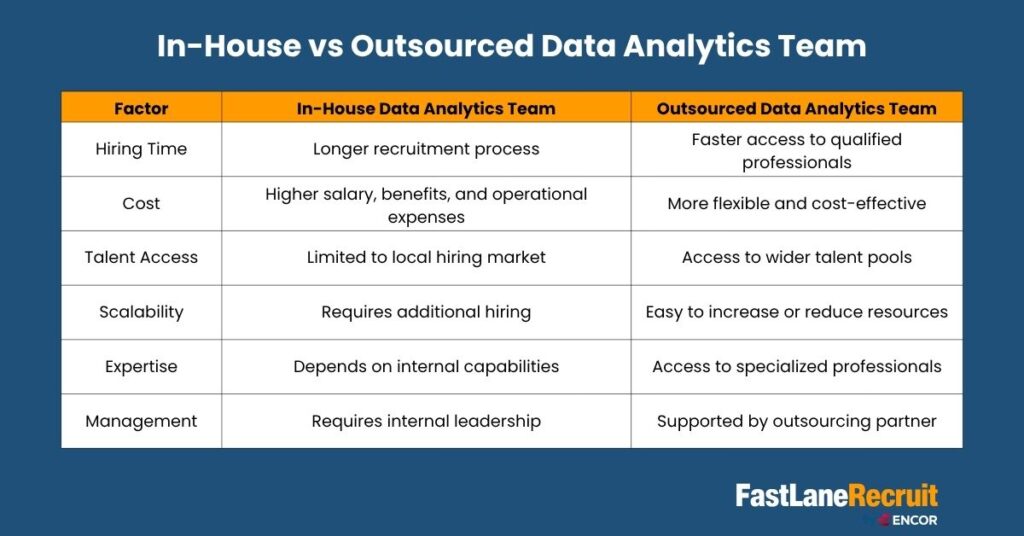
In-House vs Outsourced Data Analytics Team
| Factor | In-House Data Analytics Team | Outsourced Data Analytics Team |
|---|---|---|
| Hiring Time | Longer recruitment process | Faster access to qualified professionals |
| Cost | Higher salary, benefits, and operational expenses | More flexible and cost-effective |
| Talent Access | Limited to local hiring market | Access to wider talent pools |
| Scalability | Requires additional hiring | Easy to increase or reduce resources |
| Expertise | Depends on internal capabilities | Access to specialized professionals |
| Management | Requires internal leadership | Supported by outsourcing partner |
When Should A Business Consider Outsourcing A Data Analytics Team?
Outsourcing may be the right solution if your business:
- Needs analytics expertise but cannot justify a full-time internal team
- Wants to reduce recruitment and operational costs
- Needs to launch analytics projects quickly
- Requires specialized skills such as data engineering or business intelligence
- Is expanding into new markets and needs scalable talent support
- Wants to improve decision-making through better data insights
For businesses looking to build analytics capabilities without the complexity of internal hiring, outsourcing provides a practical path to accessing skilled professionals, improving efficiency, and accelerating growth.
However, choosing the right outsourcing destination is equally important. The location of your outsourced team affects talent quality, communication, cost efficiency, and long-term success.
Why Malaysia Is The Best Destination To Outsource A Data Analytics Team
Choosing the right outsourcing destination plays a major role in the success of your Data Analytics Team. While businesses can access global talent pools, many organizations are increasingly looking at Malaysia as a strategic outsourcing destination due to its skilled workforce, competitive costs, strong technology ecosystem, and business-friendly environment.
For companies looking to build an outsourced analytics function, Malaysia offers a strong balance between talent quality, affordability, communication efficiency, and long-term scalability.
By partnering with a Malaysia-based outsourcing provider, businesses can access experienced data professionals while maintaining operational flexibility and reducing the challenges associated with international hiring.
Access To A Skilled And Growing Data Analytics Talent Pool
Malaysia has developed a strong technology and digital workforce supported by increasing investments in data, artificial intelligence, cloud computing, and digital transformation.
The country produces thousands of graduates in fields related to:
- Data analytics
- Computer science
- Information technology
- Engineering
- Business intelligence
- Statistics
This growing talent pool allows companies to access professionals with technical capabilities across different areas of analytics, including:
- Data analysis
- Data visualization
- Database management
- Business intelligence reporting
- Data engineering
- Machine learning
For businesses that need to build a complete Data Analytics Team, Malaysia provides access to professionals across multiple skill levels, from junior analysts to experienced specialists.
Cost-Effective Alternative To Building An Internal Analytics Team
Hiring analytics professionals in markets such as Singapore, Australia, the United States, or Western Europe can involve significant costs due to high salaries and operational expenses.
Malaysia offers a more cost-effective solution while maintaining access to skilled professionals.
Businesses can reduce expenses related to:
- Recruitment costs
- Employee benefits
- Office infrastructure
- Training expenses
- Technology investments
Outsourcing a Data Analytics Team to Malaysia allows companies to allocate resources more efficiently while still gaining access to qualified talent.
This makes Malaysia particularly attractive for:
- Startups looking to establish analytics capabilities
- SMEs seeking scalable solutions
- Enterprises optimizing operational costs
Strong English Communication And Business Compatibility
Effective analytics outsourcing requires more than technical skills. Data professionals need to communicate findings clearly, understand business objectives, and collaborate with international teams.
Malaysia has a strong English-speaking workforce, making communication smoother between local and international businesses.
English proficiency allows Malaysian analytics professionals to:
- Communicate directly with global stakeholders
- Understand technical documentation
- Present insights clearly
- Collaborate across different time zones
This reduces communication barriers and improves project efficiency.
Strategic Time Zone Advantage For Regional Businesses
Malaysia’s time zone provides convenient collaboration opportunities with businesses across Asia-Pacific, including:
- Singapore
- Hong Kong
- Australia
- Japan
- China
For companies operating in Asia, working with a Malaysia-based Data Analytics Team enables closer real-time collaboration compared with outsourcing to more distant regions.
Teams can easily coordinate:
- Daily meetings
- Project updates
- Data reviews
- Business discussions
This helps maintain productivity and faster decision-making.
Growing Digital Infrastructure And Technology Ecosystem
Malaysia has continued to strengthen its digital economy through investments in technology infrastructure, innovation, and digital transformation initiatives.
The country has a growing ecosystem supporting:
- Cloud technology
- Artificial intelligence
- Data platforms
- Software development
- Business process outsourcing
This environment supports businesses that require modern analytics capabilities and access to professionals familiar with current technologies.
A Malaysia-based Data Analytics Team can support organizations using:
- Business intelligence platforms
- Cloud-based data solutions
- Automated reporting systems
- Data visualization tools
- Advanced analytics technologies
Flexible Outsourcing Models For Different Business Needs
Every business has different analytics requirements. Some companies may need a single data analyst, while others require a complete team covering engineering, reporting, and data science.
Malaysia outsourcing providers can support different engagement models, including:
| Outsourcing Model | Suitable For |
| Dedicated Data Analytics Team | Businesses requiring long-term analytics support |
| Staff Augmentation | Companies needing additional specialists for existing teams |
| Project-Based Analytics Support | Businesses launching specific data projects |
| Offshore Analytics Team | Companies seeking scalable remote talent solutions |
This flexibility allows businesses to choose a model that matches their budget, timeline, and growth objectives.
Also Read: Outsourcing in Malaysia: Why It Leads Southeast Asia in 2026 and How Businesses Benefit
Malaysia vs Other Outsourcing Destinations For Data Analytics Teams
| Factor | Malaysia | Other Outsourcing Markets |
| Talent Quality | Growing pool of technology and analytics professionals | Varies significantly by location |
| Cost Efficiency | Competitive operating costs compared with developed markets | Some markets have higher outsourcing costs |
| Communication | Strong English proficiency | Depends on region |
| Time Zone | Convenient for Asia-Pacific businesses | May create collaboration challenges |
| Business Environment | Stable outsourcing and technology ecosystem | Depends on country regulations |
Why Businesses Choose Malaysia For Data Analytics Outsourcing
Malaysia provides a practical balance between affordability, talent availability, and business compatibility. For companies that want to build a reliable Data Analytics Team without the cost and complexity of internal hiring, outsourcing to Malaysia can provide:
- Faster access to skilled professionals
- Reduced operational expenses
- Flexible team scalability
- Better access to specialized analytics expertise
- Improved business decision-making capabilities
However, successful outsourcing depends on selecting the right partner that understands recruitment, talent matching, and business requirements.
A reliable outsourcing partner helps businesses identify suitable professionals, manage hiring processes, and build analytics teams that align with their long-term goals.
How To Choose The Right Data Analytics Outsourcing Partner
Selecting the right outsourcing partner is one of the most important decisions when building an outsourced Data Analytics Team. The right partner does more than provide candidates; they help businesses identify suitable talent, understand technical requirements, reduce hiring risks, and create a scalable analytics workforce.
A poor outsourcing decision can lead to communication challenges, mismatched skills, delayed projects, and unnecessary costs. Therefore, businesses should evaluate outsourcing providers based on their recruitment expertise, talent network, industry understanding, and ability to support long-term growth.
Below are the key factors to consider when choosing a Data Analytics outsourcing partner.
1. Evaluate Industry Experience And Recruitment Expertise
A reliable outsourcing partner should understand both recruitment and the technical requirements of analytics roles.
Data analytics hiring requires knowledge of different positions, including:
- Data Analysts
- Business Analysts
- Data Engineers
- Business Intelligence Developers
- Data Scientists
- Analytics Managers
Each role requires different technical skills, tools, and experience levels. A general recruitment provider may struggle to identify the right candidates without understanding the analytics field.
Choose a partner with experience in:
- Technology recruitment
- Data and analytics talent sourcing
- Outsourcing solutions
- International hiring support
This ensures businesses receive candidates who match both technical requirements and business objectives.
2. Look For Access To Qualified Data Analytics Talent
The quality of an outsourced Data Analytics Team depends on the quality of available talent.
A strong outsourcing partner should have access to professionals with experience in areas such as:
- SQL and database management
- Data visualization
- Business intelligence tools
- Python and programming languages
- Cloud platforms
- Data modeling
- Statistical analysis
- Machine learning
The provider should have a structured screening process to evaluate:
- Technical capabilities
- Professional experience
- Problem-solving skills
- Communication ability
- Cultural fit
This helps businesses build teams that can deliver meaningful business insights rather than simply complete technical tasks.
3. Understand The Provider’s Hiring And Screening Process
A professional outsourcing partner should have a clear talent evaluation process.
A typical screening process may include:
Requirement Analysis
The provider should first understand:
- Business goals
- Required analytics capabilities
- Team structure
- Project scope
- Technology requirements
Candidate Sourcing
The partner searches for suitable professionals through their talent network, recruitment channels, and industry connections.
Skills Assessment
Candidates should be evaluated based on:
- Technical knowledge
- Previous projects
- Industry experience
- Analytical thinking
Interview And Selection Support
The outsourcing partner should help businesses review candidates and select professionals who best match their requirements.
A structured process improves hiring accuracy and reduces recruitment time.
4. Consider Scalability And Long-Term Support
Business needs change as companies grow. A suitable outsourcing partner should provide flexibility beyond initial hiring.
For example, a company may start by outsourcing:
- One data analyst for reporting
Then later expand into:
- Data engineering support
- Business intelligence development
- Data science capabilities
A strong partner should be able to support future growth by providing additional talent when needed.
Scalability is especially important for businesses undergoing:
- Digital transformation
- Market expansion
- Data infrastructure upgrades
- Business automation projects
5. Review Communication And Collaboration Capabilities
Successful analytics outsourcing requires effective communication between internal teams and outsourced professionals.
Before choosing a partner, businesses should evaluate:
- Communication processes
- Reporting methods
- Project management approach
- Time zone compatibility
- Collaboration tools
A reliable outsourcing provider should ensure smooth coordination between businesses and their outsourced Data Analytics Team.
Clear communication helps teams:
- Understand business objectives
- Deliver accurate insights
- Resolve challenges quickly
- Maintain project alignment
6. Compare Outsourcing Models And Pricing Transparency
Different businesses require different outsourcing arrangements. A trustworthy provider should offer flexible solutions based on business requirements.
Common options include:
| Outsourcing Approach | Best For |
| Dedicated Analytics Team | Companies needing ongoing analytics support |
| Individual Talent Placement | Businesses needing specific specialists |
| Team Expansion Services | Companies with existing analytics departments |
| Project-Based Support | Short-term analytics initiatives |
The outsourcing partner should provide clear information about:
- Service scope
- Recruitment process
- Timeline
- Team structure
- Costs involved
Transparent communication helps businesses make informed decisions.
Checklist For Choosing A Data Analytics Outsourcing Partner
Before selecting a provider, businesses should consider:
| Evaluation Criteria | Questions To Ask |
| Industry Experience | Does the provider understand data analytics recruitment? |
| Talent Network | Can they access qualified analytics professionals? |
| Screening Process | How do they evaluate technical skills? |
| Scalability | Can they support future hiring needs? |
| Communication | How will teams collaborate effectively? |
| Location Expertise | Do they understand the local talent market? |
| Support Services | Do they provide ongoing recruitment and outsourcing support? |
Why Working With A Malaysia-Based Recruitment Partner Matters
For companies choosing Malaysia as an outsourcing destination, working with a local recruitment partner provides additional advantages.
A Malaysia-based partner understands:
- Local talent availability
- Salary expectations
- Recruitment trends
- Employment practices
- Candidate expectations
This local knowledge helps businesses avoid common hiring challenges and identify professionals who are suitable for their specific requirements.
For organizations looking to outsource a Data Analytics Team in Malaysia, partnering with an experienced recruitment provider can simplify the hiring process and provide access to skilled professionals without managing recruitment independently.
Why Choose FastLaneRecruit For Data Analytics Team Outsourcing In Malaysia
Building a successful Data Analytics Team requires access to the right professionals with the technical expertise, industry knowledge, and business understanding needed to turn data into valuable insights. However, finding and hiring qualified analytics talent can be challenging, especially for companies entering new markets or looking to scale quickly.
FastLaneRecruit helps businesses simplify the hiring and outsourcing process by connecting companies with skilled professionals in Malaysia. With expertise in talent acquisition and workforce solutions, FastLaneRecruit supports businesses looking to build flexible and reliable analytics teams without the complexity of managing recruitment alone.
Access Qualified Data Analytics Talent In Malaysia
FastLaneRecruit helps businesses identify suitable professionals for various data-related roles, including:
By understanding each company’s requirements, FastLaneRecruit helps match businesses with candidates who have the right combination of technical capabilities, experience, and business knowledge.
Whether you need a single analytics specialist or a dedicated outsourced team, FastLaneRecruit can support your workforce requirements with Malaysia-based talent.
Reduce The Challenges Of Analytics Recruitment
Hiring a Data Analytics Team internally requires significant time and resources. Businesses often face challenges such as:
- Limited access to qualified candidates
- Lengthy recruitment processes
- High hiring costs
- Difficulty evaluating technical skills
- Competition for experienced professionals
FastLaneRecruit helps businesses overcome these challenges by managing the recruitment process and connecting companies with suitable candidates more efficiently.
This allows businesses to focus on strategic priorities while reducing the complexity of finding specialized analytics talent.
Build Flexible Analytics Teams Based On Business Needs
Every company has different analytics requirements. Some organizations may need additional support for a specific project, while others require long-term analytics capabilities.
FastLaneRecruit provides flexible workforce solutions that allow businesses to scale their Data Analytics Team according to their operational needs.
Businesses can benefit from:
- Access to individual analytics professionals
- Team expansion support
- Long-term outsourcing solutions
- Flexible workforce planning
This flexibility enables companies to adapt their analytics capabilities as business priorities change.
Benefit From Malaysia’s Growing Technology Talent Market
Malaysia has become an attractive destination for companies seeking offshore and outsourced talent due to its skilled workforce, competitive costs, and strong business environment.
Through FastLaneRecruit’s local recruitment expertise, businesses can gain access to Malaysia’s growing pool of professionals in technology and data-related fields.
Companies can benefit from:
- Cost-effective talent solutions
- Access to local expertise
- Faster recruitment processes
- Better understanding of Malaysia’s employment market
This makes Malaysia a practical option for businesses looking to expand their analytics capabilities while maintaining operational efficiency.
A Recruitment Partner That Understands Business Requirements
Successful outsourcing is not only about finding candidates; it is about finding professionals who can contribute to business objectives.
FastLaneRecruit works with businesses to understand:
- Required technical skills
- Team structure
- Business goals
- Project requirements
- Hiring timelines
This approach helps companies build Data Analytics Teams that are aligned with their specific needs rather than simply filling positions.
How FastLaneRecruit Helps Businesses Build Global Teams Across Asia and the UAE
Expanding into international markets requires more than finding talent. Businesses need the right workforce strategy, local expertise, and compliant employment solutions to successfully build and manage teams across different countries.
FastLaneRecruit helps companies hire and manage international employees through Employer of Record (EOR) services across Malaysia, Hong Kong, Singapore, China, Taiwan, and the United Arab Emirates (UAE). Our solutions allow businesses to access qualified professionals in new markets without the need to establish a local legal entity, while ensuring compliance with employment laws, payroll regulations, tax requirements, and statutory obligations.
From employment contracts and employee onboarding to payroll management, benefits administration, and ongoing HR support, FastLaneRecruit handles the complexities of international employment so businesses can focus on their core operations. We work closely with companies to understand their hiring needs, workforce structure, and expansion goals, providing tailored solutions that help them build effective and scalable global teams.
Whether you are hiring your first overseas employee, entering a new market, or expanding your regional workforce, FastLaneRecruit provides the local expertise and infrastructure needed to simplify global hiring and support long-term growth.
Start Building Your Data Analytics Team In Malaysia
Data plays an increasingly important role in business growth, but developing a capable analytics function requires the right people, expertise, and resources.
Outsourcing your Data Analytics Team with the support of FastLaneRecruit allows your business to access skilled professionals, reduce recruitment challenges, and build a scalable analytics capability in Malaysia under its legal employment law.
Whether you are looking to hire data analysts, expand your analytics department, or create an outsourced analytics team, FastLaneRecruit can help you find the right talent solution.
Ready to build your Data Analytics Team in Malaysia? Contact FastLaneRecruit to explore flexible outsourcing and recruitment solutions tailored to your business needs.
Conclusion: Build A Scalable Data Analytics Team With The Right Talent Strategy
Data has become one of the most valuable assets for modern businesses, but turning data into meaningful insights requires the right people, skills, and structure.
A well-organized Data Analytics Team helps companies improve decision-making, optimize operations, understand customers, and identify new growth opportunities. However, building an internal team can be challenging due to hiring costs, talent shortages, and increasing competition for skilled professionals.
Outsourcing provides businesses with a flexible way to access experienced analytics professionals while reducing recruitment challenges. With its skilled workforce, competitive advantages, and strong technology ecosystem, Malaysia has become a strategic destination for companies looking to build reliable analytics teams.
For businesses seeking to hire or outsource data analytics professionals in Malaysia, partnering with an experienced recruitment provider can simplify the process and help create a scalable workforce solution.
FastLaneRecruit supports businesses in connecting with qualified Malaysia-based talent and building teams that match their operational goals.
Frequently Asked Questions About Data Analytics Teams
What Is A Data Analytics Team?
A Data Analytics Team is a group of professionals who collect, analyze, and interpret data to help businesses make informed decisions. The team typically includes data analysts, data engineers, BI specialists, and data scientists.
What Does A Data Analytics Team Do?
A Data Analytics Team helps businesses analyze data, create reports, build dashboards, identify trends, and provide insights that improve decision-making, efficiency, and business growth.
Is Data Analytics A High-Paying Career?
Yes. Data analytics is a high-demand field with competitive salaries due to the growing need for professionals who can analyze data and support business decisions.
How Much Is The Salary Of A Data Analyst?
A data analyst’s salary depends on experience, location, industry, and technical skills. Professionals with expertise in SQL, Python, BI tools, and advanced analytics typically earn higher salaries.
What Is The Salary Of A Data Analyst In Southeast Asia?
Data analyst salaries vary across Southeast Asia. Singapore generally offers higher salaries, while Malaysia provides a strong balance of skilled talent and cost efficiency for businesses hiring analytics professionals.
How Much Does It Cost To Outsource A Data Analytics Team?
The cost depends on team size, required skills, project complexity, and engagement model. Outsourcing allows businesses to access analytics talent without the full cost of building an internal team.
Should SMEs Outsource A Data Analytics Team?
Yes. Outsourcing allows SMEs to access skilled analytics professionals, reduce hiring challenges, and gain data-driven insights without investing heavily in an in-house department.
Why Outsource A Data Analytics Team To Malaysia?
Malaysia offers skilled technology talent, competitive costs, strong English communication, and a growing digital workforce, making it an attractive destination for analytics outsourcing.
How Long Does It Take To Build A Data Analytics Team?
Building an internal team can take months due to recruitment and onboarding processes. Outsourcing can help businesses access qualified analytics professionals faster.
Can Businesses Outsource Only Specific Analytics Roles?
Yes. Companies can outsource individual roles such as data analysts, BI developers, or data engineers, or build a complete outsourced Data Analytics Team based on their needs.