Managing employees becomes considerably more complicated as a company grows. Payroll has to be accurate, employment regulations have to be followed, benefits need to be administered, and HR issues have to be handled properly, often while the business is trying to expand into new markets.
For many small and midsize businesses, a Professional Employer Organization (PEO) can provide the HR infrastructure and expertise needed to manage these responsibilities more efficiently.
But there is an important distinction to understand.
A PEO generally works through a co-employment relationship, while an Employer of Record (EOR) can legally employ workers on behalf of a company in a location where the company does not have its own legal entity. That difference can determine which model is appropriate for your business.
If you’re researching what is PEO, this guide explains what a PEO does, how PEO services work, the benefits and limitations, and when an EOR may be a better option for international hiring.
Content Outline
Key Summary
PEO means Professional Employer Organization
A PEO is a third-party HR provider that works with a business through a co-employment arrangement and can manage functions such as payroll, benefits administration, HR administration, tax-related processes and compliance support.
A PEO does not simply replace your HR department
The PEO typically handles agreed administrative and HR responsibilities while the client business continues to manage its operations, employees’ day-to-day work and business decisions.
Co-employment is the foundation of the PEO model
The PEO and client enter into a contractual relationship that allocates employer responsibilities between the two parties.
PEO and EOR are not the same
A PEO generally works alongside an existing employer and entity. An EOR can become the legal employer for workers in a country where the client does not have its own entity.
If you want to hire internationally without establishing an entity, an EOR may be the more suitable model
This is particularly relevant when entering a new country, testing a market, or hiring a small initial team.
What Is a PEO?
A PEO, or Professional Employer Organization, is a third-party organization that provides businesses with outsourced HR and workforce-management services through a co-employment arrangement.
Depending on the provider and agreement, PEO services can include:
- Payroll processing
- Employee benefits administration
- HR administration
- Employment compliance support
- Tax administration
- Workers’ compensation and risk management
- Employee onboarding
- HR technology
- Workforce reporting and support
The purpose is not simply to outsource payroll. A PEO can provide an integrated HR infrastructure that helps businesses manage employment responsibilities while reducing the administrative workload on their internal teams.
What does PEO stand for?
PEO stands for Professional Employer Organization.
The term describes an organization that provides HR and employment-related services to businesses through a co-employment structure.
In practical terms, the business continues to run the business and manage its workforce, while the PEO takes responsibility for agreed HR and administrative functions.
Also Read: Professional Employer Organization (PEO)
How Does a PEO Work?
The defining characteristic of a PEO is co-employment.
Rather than simply acting as an outsourced payroll vendor, the PEO enters into a contractual employment relationship with the client company.
A simplified PEO process looks like this:
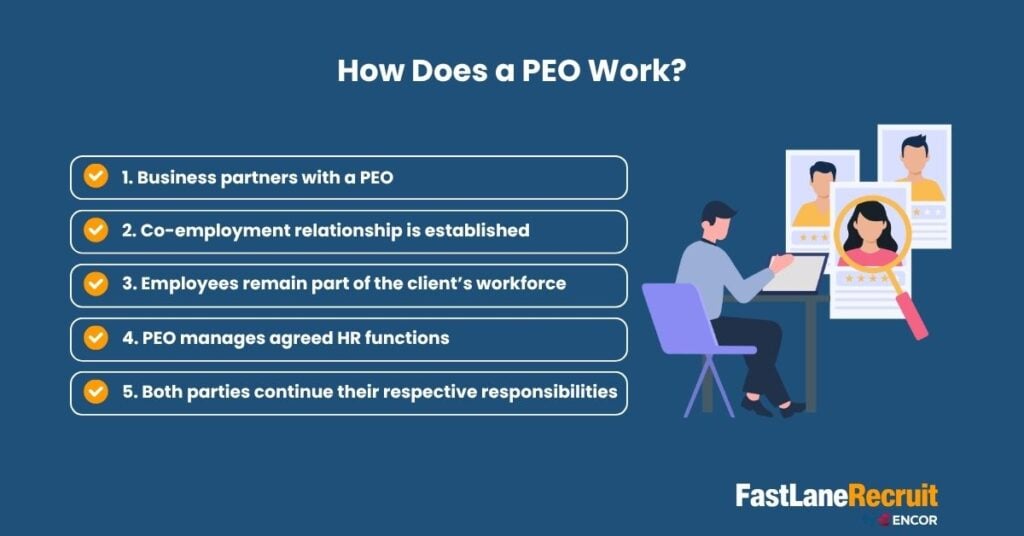
1. Business partners with a PEO
The company signs a PEO service agreement defining responsibilities, services, fees and other terms.
2. Co-employment relationship is established
The PEO becomes responsible for certain employer-related administrative functions according to the agreement.
3. Employees remain part of the client’s workforce
The client generally retains control over day-to-day operations, employee supervision, business strategy and work assignments.
4. PEO manages agreed HR functions
The PEO may administer payroll, benefits, tax-related processes, compliance support and other HR services.
5. Both parties continue their respective responsibilities
The exact division of responsibilities depends on the PEO agreement and applicable laws.
This distinction matters because a PEO is not simply another name for a payroll company or an EOR. The legal and operational structure is different.
What Is PEO Co-Employment?
PEO co-employment means that the business and PEO enter into a contractual relationship in which certain employer responsibilities are shared or allocated between them.
The business generally retains operational control over its employees, including:
- Hiring decisions
- Job responsibilities
- Daily supervision
- Performance management
- Business strategy
- Company culture
- Work allocation
The PEO can manage agreed administrative responsibilities such as:
- Payroll
- Benefits
- HR administration
- Employment-related compliance
- Tax administration
- Risk management
The exact legal treatment of co-employment varies by jurisdiction, so businesses should evaluate the PEO agreement and local employment rules rather than assuming every PEO arrangement operates identically.
What Does a PEO Do?
A PEO can support multiple parts of the employee lifecycle.
1. PEO Payroll Services
Payroll is one of the most common reasons companies work with a PEO.
A PEO may help manage:
- Salary calculations
- Payroll processing
- Payroll records
- Tax-related deductions
- Statutory reporting
- Payslips
- Payroll administration
This can reduce the amount of payroll administration handled internally.
However, businesses should confirm exactly which payroll and tax responsibilities are included in the service agreement.
2. Employee Benefits Administration
PEOs can help businesses administer employee benefits and, depending on the market and provider, may provide access to benefit programs that would otherwise be difficult for smaller companies to manage independently.
Potential benefits can include:
- Health insurance
- Retirement plans
- Employee assistance programs
- Insurance-related benefits
- Other employee benefit programs
The availability and structure of benefits vary significantly by country and provider.
3. HR Administration
PEOs can provide ongoing HR support covering areas such as:
- Employee records
- HR policies
- Onboarding
- Offboarding
- Leave administration
- HR documentation
- Employee support
- HR technology
This can allow internal HR teams to spend more time on strategic priorities rather than repetitive administrative work.
4. Employment Compliance Support
Employment regulations can become increasingly difficult to manage as a business grows.
PEOs may assist with:
- Employment documentation
- Payroll compliance
- Employment taxes
- Workplace requirements
- HR policies
- Regulatory administration
This can be particularly valuable for companies without a large internal HR or legal team.
However, businesses should understand exactly what compliance responsibilities remain with them under the PEO agreement.
5. Risk Management
Some PEOs also provide risk-management and workers’ compensation support.
This may include:
- Workplace safety resources
- Workers’ compensation administration
- Risk-management guidance
- Employment practices support
The objective is to help businesses manage employment-related risks more systematically.
What Are the Benefits of Using a PEO?
The value of a PEO is not simply that another company processes payroll.
The bigger advantage is the ability to access HR infrastructure and expertise without building every function internally.
Reduced HR Administration
A PEO can take recurring administrative tasks away from business owners and HR teams.
This can free internal teams to focus on:
- Recruitment
- Employee engagement
- Workforce planning
- Performance
- Business growth
Access to HR Expertise
Smaller businesses may not have specialists covering payroll, employment compliance, benefits and risk management.
A PEO can provide access to dedicated HR expertise and systems without requiring the company to build every capability internally.
More Efficient Benefits Administration
PEOs may give smaller employers access to broader benefits infrastructure and administration.
This can help businesses compete for talent, although the actual benefit options depend on the PEO, location and employee population.
Better HR Processes
Instead of managing employment administration through multiple disconnected systems, businesses can consolidate several HR functions through one provider.
That can simplify:
- Payroll
- Benefits
- Employee records
- HR administration
- Compliance processes
Scalable HR Support
A PEO can be particularly useful when a company is growing faster than its internal HR infrastructure.
Instead of immediately hiring an entire HR department, the business can outsource selected functions while continuing to focus on growth.
What Are the Limitations of a PEO?
PEOs can be useful, but they are not the right solution for every business.
The most important question is not:
“Is a PEO good?”
It is:
“Does the PEO model match the way my company needs to employ people?”
There are several factors to consider.
Local entity requirements
A conventional PEO arrangement generally assumes the client already has an employing entity in the location where the workers are employed.
This becomes particularly important for international expansion.
If your company wants to hire an employee in another country but does not have a local entity there, a traditional PEO may not solve the underlying problem.
Shared employment responsibilities
Because the PEO model involves co-employment, responsibility is divided between the PEO and client.
Your business should understand:
- Who handles payroll?
- Who manages benefits?
- Who handles employment compliance?
- Who is responsible for employee disputes?
- Who manages termination procedures?
- What responsibilities remain with the client?
These details should be clearly documented before signing an agreement.
Geographic limitations
PEO structures are not universally identical across countries.
A model commonly used in one jurisdiction may not work the same way elsewhere.
This is one reason businesses expanding internationally should carefully distinguish between a PEO and an EOR.
PEO vs EOR: What’s the Difference?
This is one of the most important decisions for companies researching PEO services.
Both PEOs and EORs can support payroll, HR and compliance. The fundamental difference is the employment structure and whether your business already has a legal entity in the hiring country.
| Factor | PEO | EOR |
| Employment model | Co-employment | EOR is legal employer |
| Client’s local entity | Generally required | Generally not required |
| Payroll | Yes | Yes |
| HR administration | Yes | Yes |
| Benefits administration | Often | Often |
| Employment compliance | Shared/allocated | Managed by EOR within agreed scope |
| Day-to-day employee management | Client | Client |
| International market entry | Less suitable where client has no entity | Strong use case |
| Best suited for | Businesses with an established entity | Businesses hiring where they lack an entity |
| Primary objective | Outsource HR/employment administration | Enable compliant hiring without establishing an entity |
The precise legal treatment depends on the jurisdiction and contractual structure, but the entity question is an important practical starting point.
PEO vs EOR: Which One Should You Choose?
Use this simple decision framework.
Choose a PEO if:
- You already have a legal entity in the country.
- You want to outsource HR administration.
- You want payroll and benefits support.
- You want additional HR expertise.
- You want to retain your existing employment structure.
- You have an established workforce and need scalable HR infrastructure.
Consider an EOR if:
- You do not have a local entity.
- You want to hire internationally.
- You are entering a new country.
- You want to test a new market before establishing a subsidiary.
- You need to hire a small initial team overseas.
- You want to avoid the immediate administrative burden of setting up an entity.
- You want local support for employment contracts, payroll and statutory requirements.
This is why PEO vs EOR is less about which service is “better” and more about which employment structure fits your expansion strategy.
Do You Need a Local Entity to Use a PEO?
In a conventional PEO arrangement, yes, the client generally needs an existing legal entity in the jurisdiction where employees are employed.
The PEO then operates alongside the company through the co-employment arrangement.
For example:
Your company → owns local entity → employs employee
PEO → co-employment/HR administration → supports employment
An EOR works differently:
EOR → legal employer → employee
Your company → manages employee’s day-to-day work
This distinction is especially important when expanding internationally.
What If You Want to Hire Internationally Without Setting Up a Company?
This is where an Employer of Record can become the more practical option.
Suppose your company is based in Australia, Singapore, the United States or another market and wants to hire employees in a new country.
You have two broad approaches:
Option 1: Establish your own entity
You may need to deal with:
- Company registration
- Local corporate compliance
- Tax registration
- Payroll
- Employment contracts
- Statutory contributions
- HR administration
- Local reporting
- Ongoing entity maintenance
This can make sense when you’re committed to establishing a substantial long-term presence.
Option 2: Use an EOR
An EOR can employ workers through its local employment structure while your company manages their day-to-day responsibilities.
This can provide a more practical route when you:
- Need your first employee in a country
- Want to test market demand
- Need to build a small team
- Want to enter a market faster
- Don’t want to establish an entity immediately
FastLaneRecruit describes its EOR model as enabling companies to hire without setting up a local entity while handling employment contracts, payroll, statutory compliance and HR administration within the agreed scope.
How Does an EOR Work?
The EOR model can be simplified into five steps.
1. Your company identifies the role
You determine:
- Job title
- Responsibilities
- Salary
- Working arrangement
- Candidate requirements
2. You select the employee
Your company can participate in candidate selection and decide who you want to hire.
3. The EOR handles local employment
The EOR becomes the legal employer under the applicable arrangement and manages the required employment administration.
4. Payroll and compliance are managed locally
The EOR can manage relevant:
- Employment contracts
- Payroll
- Statutory contributions
- Tax-related administration
- Benefits
- HR documentation
5. You manage the employee’s work
Your company retains day-to-day direction over the employee’s work, objectives, workflows and performance, subject to the service agreement.
This separation between legal employment administration and operational management is what makes EOR useful for international hiring.
When Should You Use an EOR Instead of a PEO?
An EOR is often worth considering when your biggest challenge isn’t HR administration, it’s how to legally employ someone in a country where your company has no entity.
Consider an EOR when:
You are testing a new market
You may want to hire one or two employees before investing in a full corporate setup.
You need to hire quickly
Entity establishment can involve multiple registration and compliance steps. An EOR can provide an existing employment framework.
You want to build an international team
Managing separate entities across multiple countries can create additional administrative complexity.
You need local employment expertise
Each country has its own employment, payroll, tax and statutory requirements.
You want to reduce administrative overhead
Instead of building a local HR and payroll infrastructure immediately, you can outsource those employment functions to an EOR.
Why FastLaneRecruit EOR Can Be a Better Fit for International Hiring
Once the PEO vs EOR distinction is clear, the next question becomes:
Who can actually help me hire and manage employees in the countries where I want to expand?
FastLaneRecruit provides Employer of Record services designed to help companies hire internationally without immediately establishing their own local entity.
Its EOR offering covers employment administration such as contracts, payroll, statutory contributions, benefits administration where included, and HR administration, while the client generally retains responsibility for day-to-day employee direction and management.
FastLaneRecruit currently highlights EOR support across markets including Malaysia, Singapore, Hong Kong, China, India, the Philippines, Taiwan and the UAE, with additional international workforce support through its broader network and services.
This can be particularly useful for companies that want to move from:
“We want to hire internationally.”
to:
“We have a compliant employment structure through which we can actually hire.”
Why Businesses Use FastLaneRecruit EOR Services
Hire Without Establishing a Local Entity
An EOR can provide an alternative to immediately establishing your own company in a new market.
This can be valuable for businesses testing market opportunities or hiring their first employees internationally.
FastLaneRecruit’s EOR pages specifically position the service around hiring employees without setting up a local company in supported markets.
Simplify Payroll and Statutory Administration
International payroll involves more than paying salaries.
Depending on the country, businesses may need to manage:
- Tax withholding
- Statutory contributions
- Employment records
- Payslips
- Leave administration
- Local reporting
- Benefits
- Employment documentation
An EOR can centralize these employment administration responsibilities.
Maintain Day-to-Day Management Control
Using an EOR doesn’t mean handing your team over to another company operationally.
Under FastLaneRecruit’s stated EOR model, the client generally retains responsibility for day-to-day work direction, supervision, work scope and performance expectations while FastLaneRecruit handles agreed employment administration.
That makes EOR particularly useful when you want:
your team + your management + local employment infrastructure.
Expand Into New Markets More Efficiently
Instead of immediately creating an entity every time you want to hire internationally, an EOR gives you another expansion route.
This can be especially useful for:
- Startups
- SMEs
- Global companies
- Remote-first companies
- Companies testing new markets
- Businesses building offshore teams
- Companies hiring their first employee in a country
PEO, EOR or Payroll Provider: Which Model Fits?
Not every employment challenge requires a PEO or EOR.
| Your situation | Potentially suitable model |
| You already have an entity and need HR support | PEO |
| You already have an entity and only need payroll | Payroll provider |
| You want to hire in a country where you have no entity | EOR |
| You want to test a foreign market | EOR |
| You want to outsource specific business processes | Outsourcing/BPO |
| You want temporary project-based talent | Staffing/contracting solution |
| You want to build a long-term overseas team | EOR or local entity, depending on strategy |
The right answer depends on your workforce, jurisdiction, long-term plans, risk allocation and the exact services you need.
How to Choose Between a PEO and EOR
Before signing with a provider, ask these questions.
1. Do I already have a legal entity?
If yes, a PEO may be appropriate.
If no, investigate an EOR.
2. Who will be the legal employer?
Don’t rely solely on the provider’s marketing terminology.
Ask exactly how the employment relationship is structured.
3. Who manages payroll?
Confirm whether payroll processing, tax withholding and statutory contributions are included.
4. Who handles compliance?
Understand which responsibilities belong to the provider and which remain with your company.
5. Who manages the employee?
Clarify who controls:
- Hiring
- Daily work
- Performance
- Compensation decisions
- Termination
- Workplace policies
6. Where does the provider have a local employment structure?
This is especially important for international hiring.
7. What happens when you leave?
Ask about:
- Termination
- Employee transfer
- Entity setup
- Contract migration
- Notice periods
- Final payroll
- Data and records
A good provider should make these responsibilities clear before you commit.
Common Mistakes Businesses Make When Choosing a PEO or EOR
Confusing a PEO with an EOR
The terms are sometimes used interchangeably in marketing, but the underlying employment models can differ significantly.
Always ask:
“Do I need my own entity in the country?”
That single question can quickly clarify which model you are actually considering.
Choosing Based Only on Price
The cheapest provider isn’t necessarily the lowest-cost solution.
Consider the total cost of:
- Payroll
- Compliance
- HR support
- Benefits
- Setup
- Entity administration
- Employee transfer
- Termination
- Internal HR resources
Assuming the Provider Takes Every Legal Responsibility
Even when using an EOR or PEO, the client may retain important responsibilities.
Read the service agreement carefully.
Ignoring Country-Specific Employment Rules
International employment isn’t one-size-fits-all.
Employment contracts, statutory benefits, payroll requirements and termination rules can differ significantly between jurisdictions.
A provider should demonstrate genuine local knowledge rather than simply offering a generic global platform.
Ready to Hire Internationally Without the Complexity of Entity Setup?
Understanding what is PEO is only the first step.
If your company already has a local entity and needs HR support, a PEO may be the appropriate solution.
But if your real challenge is:
“How can we legally hire employees in another country without establishing our own entity?”
then an Employer of Record may be the better fit.
FastLaneRecruit’s Employer of Record Services can help businesses navigate international employment through local employment structures, with support covering areas such as contracts, payroll, statutory compliance and HR administration.
Whether you’re hiring your first international employee, building an offshore team, or evaluating a new market, the right approach depends on where you’re hiring, whether you have an entity there, and how much employment administration you want to manage internally.
Book a Free Consultation with FastLaneRecruit to discuss your hiring plans and determine whether an EOR model fits your expansion strategy.
Frequently Asked Questions About PEO
What is a PEO?
A PEO, or Professional Employer Organization, is a third-party HR provider that works with a business through a co-employment arrangement. PEOs can provide payroll, benefits, HR administration, compliance and other workforce services.
What does PEO stand for?
PEO stands for Professional Employer Organization.
What does a PEO do?
A PEO can manage or support payroll, employee benefits, HR administration, employment compliance, tax-related administration and risk-management functions, depending on the service agreement.
How does a PEO work?
A PEO works through a co-employment arrangement. The PEO and client divide certain employment and HR responsibilities under a service agreement, while the client generally retains control over business operations and employees’ day-to-day work.
Is a PEO the same as an EOR?
No. A PEO generally co-employs workers alongside an existing client entity, while an EOR generally becomes the legal employer in a location where the client does not have its own entity.
Do you need a local entity to use a PEO?
Generally, a traditional PEO model requires the client to have an entity in the jurisdiction where employees are employed. An EOR can be used when the client does not have a local entity.
Is a PEO the same as a payroll company?
No. A payroll provider primarily handles payroll-related processes, whereas a PEO can provide a broader package of HR, benefits, compliance and employment administration services.
Is a PEO good for small businesses?
A PEO can be useful for small and midsize businesses that want access to HR infrastructure and expertise without building all those functions internally.
Can a PEO help with international hiring?
It depends on the provider and country. However, businesses should distinguish between a conventional PEO arrangement and an EOR. If you do not have a local entity in the country where you want to hire, an EOR is generally the model worth investigating.
What is better: PEO or EOR?
Neither is universally better. A PEO may be appropriate when you already have an entity and want to outsource HR functions. An EOR may be more suitable when you want to hire employees in a country where you do not have a legal entity.
Can I hire employees without setting up a local company?
In many cases, an EOR can enable this by employing workers through its local employment structure, subject to local law and the provider’s coverage. FastLaneRecruit specifically positions its EOR services as a way to hire employees without immediately establishing a local entity in supported markets.