Hiring people through another company can make workforce expansion easier—but it can also create uncertainty about who is responsible for payroll, employment compliance, taxes, benefits, workplace policies, and other employer obligations.
That is where co-employment becomes important.
For companies expanding internationally, understanding the difference between co-employment, joint employment, a Professional Employer Organization (PEO), and an Employer of Record (EOR) is more than an HR technicality. Choosing the wrong employment model can create unnecessary compliance exposure, administrative complexity, and uncertainty over employer responsibilities.
The good news is that businesses do not always need to establish their own legal entity to hire employees in another country. An EOR can provide a structured alternative by becoming the legal employer for the employment relationship while the client company continues to manage the employee’s day-to-day work.
This guide explains what co-employment means, what co-employment risk looks like, how it differs from an EOR relationship, and when using an EOR may be the more practical option for international hiring.
Content Outline
Key Summary
Co-employment means shared employer responsibilities
Co-employment generally refers to an arrangement in which two organizations share specified employer responsibilities for the same worker. It is particularly associated with PEO arrangements, where the client company continues to operate its business and manage its workforce while the PEO handles designated HR, payroll, benefits, and compliance functions.
Co-employment risk depends on the relationship
The risk is not simply the existence of two companies supporting one employee. It depends on how responsibilities, control, contracts, payments, and employment obligations are structured under applicable law.
An EOR is different from a traditional PEO co-employment model
An EOR generally becomes the legal employer in the country where the employee is hired, while the client company directs the employee’s day-to-day work. This structure is particularly useful when a company wants to hire in a country where it does not have its own legal entity.
Clear responsibilities reduce employment risk
Employment contracts, payroll arrangements, reporting lines, reimbursement procedures, HR processes, and termination responsibilities should be clearly documented.
EOR can simplify international expansion
For businesses entering a new market, an EOR can reduce the need to immediately establish a local entity while providing local employment administration, payroll, statutory compliance, and HR support.
What Is Co-Employment?
Co-employment is an employment arrangement in which two organizations share specified responsibilities relating to the same employee.
The model is most commonly associated with Professional Employer Organizations (PEOs). Under a typical PEO arrangement, the client company remains responsible for running the business and directing employees’ daily work, while the PEO provides services such as payroll administration, benefits administration, employment tax support, workers’ compensation, and HR compliance assistance.
The important point is that co-employment does not necessarily mean the client company gives up control over its employees.
Instead, responsibilities are divided between the parties.
For example:
| Responsibility | Client Company | PEO / HR Provider |
| Business strategy | Yes | No |
| Day-to-day work direction | Yes | No |
| Employee performance management | Usually | Support |
| Payroll administration | No / shared depending on agreement | Yes |
| Benefits administration | No / shared | Yes |
| Employment tax administration | Shared according to arrangement | Yes |
| HR compliance support | Shared | Yes |
| Employment relationship | Shared responsibilities | Shared responsibilities |
The precise allocation depends on the contract and applicable employment laws.
This is why businesses need to understand who actually carries each employer responsibility, rather than assuming that outsourcing HR automatically transfers all employment risk.
Also Read: Professional Employer Organization (PEO)
How Does Co-Employment Work?
A co-employment relationship typically involves three parties:
- The client company — runs the business and manages the employee’s day-to-day activities.
- The PEO or HR provider — assumes specified HR, payroll, benefits, and compliance responsibilities.
- The employee — performs work for the client while receiving employment-related administration through the PEO.
The arrangement allows businesses to outsource complex employment administration without outsourcing their core business operations.
For example, a growing company may want to focus on sales, product development, or customer service while a PEO handles payroll processing, benefits administration, employment tax tasks, and HR support.
This can be valuable when the business already has the appropriate legal presence but wants additional HR infrastructure.
However, the situation becomes more complicated when the business is trying to hire employees in a country where it has no legal entity.
That is where an EOR becomes a different and often more appropriate model.
What Is Co-Employment Risk?
Co-employment risk is the potential legal, financial, tax, and operational exposure that can arise when multiple organizations share or exercise employer responsibilities over the same worker.
The exact legal definition and consequences vary by jurisdiction.
Potential areas of exposure can include:
- Wage and working-time obligations
- Payroll and employment taxes
- Employee benefits
- Social insurance or statutory contributions
- Workplace health and safety
- Employment discrimination claims
- Termination obligations
- Employee classification
- Contractor misclassification
- Employment documentation
- Data and HR administration
- Responsibility for workplace policies
The important distinction is that co-employment risk is not automatically created simply because a business uses an external HR provider.
Risk can increase when the actual working relationship does not match the contractual structure or when the parties are unclear about who is responsible for particular employment obligations.
What Causes Co-Employment Risk?
Understanding the causes is more useful than simply knowing the definition.
1. Unclear employer responsibilities
If a contract does not clearly establish who handles payroll, benefits, employment contracts, disciplinary matters, termination, reimbursements, and other HR responsibilities, disputes can arise.
2. Direct employment arrangements
A company can create unnecessary risk when it directly contracts with or pays an individual who is supposed to be employed through another entity.
For EOR arrangements in particular, maintaining a clear employment relationship between the EOR and employee is an important part of preserving the intended structure.
3. Inconsistent documentation
The employment contract may identify one employer while internal documents, public materials, invoices, or HR communications describe another company as the employee’s employer.
This inconsistency can create confusion over the actual employment relationship.
4. Direct handling of employment matters
Businesses should understand which HR decisions belong to the legal employer and which operational decisions remain with the client company.
For example, day-to-day work direction is generally different from formally changing employment terms, administering disciplinary action, or terminating employment.
5. Contractor misclassification
Using contractors when the actual relationship resembles employment can create separate legal and tax risks.
This becomes particularly important when businesses expand internationally and assume that hiring someone as an independent contractor is automatically simpler than employing them.
6. Cross-border compliance gaps
Employment laws differ from country to country.
A payroll process that works in one jurisdiction may not satisfy another country’s requirements for:
- Tax withholding
- Social security
- Leave
- Working hours
- Employee benefits
- Termination
- Employment contracts
This is one reason international businesses often use local employment specialists.
What Are the Main Co-Employment Risks for Businesses?
The consequences depend on the country, employment model, and facts of the relationship, but businesses should consider several major risk categories.
Legal and employment compliance risk
Employment laws can impose requirements relating to contracts, wages, working hours, leave, benefits, termination, discrimination, and workplace protections.
If responsibilities are unclear, it may become difficult to determine who must respond when an employment issue arises.
Payroll and tax risk
Payroll mistakes can result in incorrect withholding, late filings, unpaid statutory contributions, or employee disputes.
An external provider can reduce administrative burden, but companies should still understand what the provider is contractually responsible for.
Employee classification risk
A worker described as a contractor may legally be considered an employee depending on factors such as control, working arrangements, economic dependence, and applicable local law.
Using an inappropriate employment model can create back-pay, tax, benefits, and penalty exposure.
Benefits and statutory contribution risk
Many jurisdictions require employers to provide statutory benefits or make mandatory contributions.
These obligations may include social insurance, pension contributions, health insurance, paid leave, or other employment-related benefits.
Operational risk
When multiple organizations are involved, employees need to know:
- Who manages them?
- Who approves leave?
- Who pays salary?
- Who handles HR issues?
- Who changes their employment contract?
- Who handles termination?
- Who should they contact when problems arise?
Poorly defined processes can affect both compliance and employee experience.
How Can Businesses Reduce Co-Employment Risk?
Co-employment risk can be managed through a combination of appropriate structure, documentation, governance, and professional support.
1. Define responsibilities clearly
Before hiring, establish who is responsible for:
- Employment contracts
- Payroll
- Taxes
- Statutory contributions
- Benefits
- Employee onboarding
- Performance management
- Disciplinary procedures
- Changes to employment terms
- Termination
- Employee records
A written agreement should clearly establish these responsibilities.
2. Maintain consistent employment documentation
The employment contract, HR records, payroll documentation, and actual working relationship should be aligned.
3. Avoid informal employment arrangements
Do not assume that paying an employee through a third party automatically makes the arrangement compliant.
The underlying relationship matters.
4. Use local employment expertise
International employment compliance is highly jurisdiction-specific. A provider familiar with the local employment framework can help businesses navigate requirements that may be unfamiliar to an overseas employer.
5. Choose the correct employment model
A company with an established local entity may benefit from a PEO or payroll outsourcing arrangement.
A company with no local entity may instead need an EOR.
Choosing the correct structure at the beginning can prevent unnecessary complexity later.
Is an EOR the Same as Co-Employment?
No. An Employer of Record and a traditional PEO co-employment arrangement are different employment models.
This distinction is particularly important for companies hiring internationally.
In a typical EOR structure, the EOR becomes the legal employer of the employee in the relevant jurisdiction. The client company generally retains responsibility for the employee’s day-to-day work, business objectives, and operational management, while the EOR manages the formal employment administration within the scope of the agreement.
FastLaneRecruit’s terms similarly describe its EOR model as one in which the company may act as the legal employer for administrative, payroll, statutory, and HR compliance purposes while the client directs the individual’s day-to-day work.
This distinction matters because the EOR model is specifically designed to support hiring where the client does not have its own local legal entity.
EOR vs PEO: What Is the Difference?
One of the most common questions businesses ask is whether they should use a PEO or EOR.
The answer largely depends on whether the company already has a legal entity in the country.
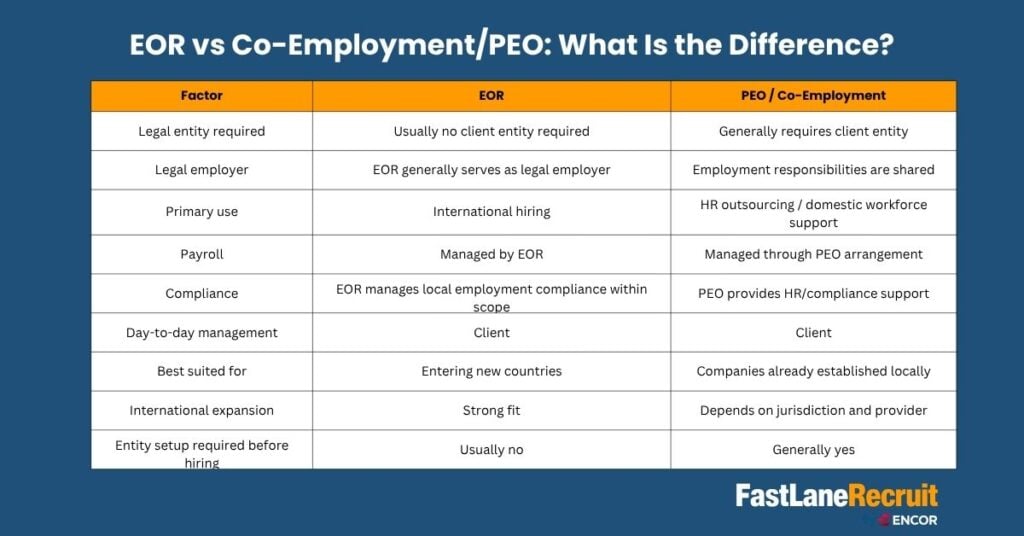
| Factor | EOR | PEO / Co-Employment |
| Legal entity required | Usually no client entity required | Generally requires client entity |
| Legal employer | EOR generally serves as legal employer | Employment responsibilities are shared |
| Primary use | International hiring | HR outsourcing / domestic workforce support |
| Payroll | Managed by EOR | Managed through PEO arrangement |
| Compliance | EOR manages local employment compliance within scope | PEO provides HR/compliance support |
| Day-to-day management | Client | Client |
| Best suited for | Entering new countries | Companies already established locally |
| International expansion | Strong fit | Depends on jurisdiction and provider |
| Entity setup required before hiring | Usually no | Generally yes |
The exact legal structure varies by jurisdiction and service agreement, so businesses should verify how a provider operates in the specific country.
When Should You Choose an EOR?
An EOR is often worth considering when:
- You want to hire internationally without establishing an entity.
- You are hiring your first employee in a new market.
- You are testing a market before incorporating.
- You need local payroll and employment administration.
- You want to reduce the administrative burden of international employment.
- You need local support for employment compliance.
- You expect to expand across multiple countries.
When Might a PEO Be More Appropriate?
A PEO may be more suitable when:
- Your company already has a legal entity in the country.
- You want to outsource HR administration.
- You need payroll and benefits support.
- You want additional HR infrastructure while retaining the existing employment structure.
The key decision question is simple:
Do you already have a legal entity where you want to hire?
If the answer is no, an EOR is often the more relevant model to investigate.
Also Read:Hiring Globally: PEO, EOR, and Global Talent
Co-Employment vs EOR: Which Model Is Better for International Hiring?
There is no universal answer because the right structure depends on your business, workforce, and jurisdiction.
However, for international expansion, an EOR can offer a simpler route when establishing a local entity would be disproportionate to your immediate hiring needs.
Consider this example.
A technology company wants to hire three employees in a new country.
Option 1: Establish a local entity
The company may need to handle:
- Company registration
- Local legal requirements
- Banking
- Payroll infrastructure
- Tax registrations
- Employment compliance
- HR administration
- Ongoing corporate compliance
This can make sense when the company expects substantial, long-term operations in that country.
Option 2: Use an EOR
The company can instead work with an EOR that provides the local employment infrastructure.
The EOR can handle relevant employment administration, while the company manages the employees’ daily work.
For a small initial team or market-entry project, this can be a more flexible approach.
Decision rule
Use an EOR when speed, flexibility, and avoiding immediate entity setup are priorities.
Consider establishing your own entity when your local operation becomes substantial enough to justify the additional infrastructure and compliance responsibilities.
How Does an EOR Help Reduce Co-Employment Risk?
An EOR is not a magic solution that eliminates every employment risk.
However, a properly structured EOR relationship can create a clearer separation between:
Legal employment responsibilities
and
Day-to-day business management.
The EOR can manage areas such as:
- Local employment contracts
- Payroll processing
- Tax withholding
- Statutory contributions
- Employee benefits administration
- Employment documentation
- Local HR administration
- Employment compliance
Meanwhile, the client company generally manages:
- Business objectives
- Daily work
- Project assignments
- Performance expectations
- Team collaboration
- Operational priorities
FastLaneRecruit describes its EOR service around this same division: the EOR handles employment administration and compliance while the client directs the employee’s day-to-day work.
The precise allocation of responsibilities should always be confirmed in the applicable service agreement and under local law.
What Should You Look for in an EOR Provider?
Choosing an EOR based only on price can be a mistake.
A strong EOR relationship should be evaluated on several factors.
1. Local employment expertise
Ask whether the provider understands the employment laws, payroll requirements, statutory contributions, and HR practices of the specific country.
2. Clear legal structure
The provider should explain exactly:
- Who employs the worker?
- Who signs the employment contract?
- Who runs payroll?
- Who handles taxes?
- Who manages statutory benefits?
- Who handles termination?
If these answers are unclear, ask for clarification before signing.
3. Local infrastructure
Find out whether the provider operates through its own local entities, partners, or another model.
FastLaneRecruit operates through local entities across strategic markets across Malaysia, Singapore, Hong Kong, China, India, Philippines, Taiwan, Vietnam, Australia, United Kingdom, Switzerland, UAE, Saudi Arabia, and Qatar and provides local employment, payroll, and compliance support.
4. Payroll and compliance capabilities
The provider should have processes for accurate payroll, statutory contributions, tax administration, benefits, and employment documentation.
5. Transparent pricing
Ask what the monthly EOR fee includes and whether there are additional charges for:
- Onboarding
- Payroll
- Benefits
- Visa support
- Termination
- Currency conversion
- Special compliance requests
6. Employee support
An EOR is not only a compliance vendor. It becomes part of the employee’s employment infrastructure.
The quality of onboarding, HR communication, payroll support, and issue resolution matters.
7. Multi-country capabilities
If international expansion is part of your long-term strategy, working with a provider that supports multiple markets can reduce the need to manage different employment partners in every country.
Why Use FastLaneRecruit for EOR Services?
For businesses expanding across Asia and other international markets, FastLaneRecruit provides EOR services designed to simplify international hiring without requiring the client to immediately establish a local entity.
Its EOR offering includes employment contracts, payroll processing, tax administration, statutory contributions, employee benefits, onboarding, and ongoing compliance support, depending on the applicable country and service agreement.
Local employment infrastructure
FastLaneRecruit operates through local entities across strategic Asian, Europe,Middle East & Africa markets rather than relying exclusively on partner networks. This can provide businesses with a more direct local employment infrastructure.
Recruitment + EOR in one workflow
For businesses that still need to find talent, combining recruitment and EOR can simplify the process.
FastLaneRecruit provides both recruitment and EOR services, allowing businesses to source talent and then employ successful candidates through its EOR structure.
Payroll and statutory administration
FastLaneRecruit manages employment administration such as payroll, tax, statutory contributions, and benefits within the scope of its EOR services.
Faster market entry
Instead of immediately establishing a local company, businesses can use an EOR to begin hiring in supported markets while evaluating their long-term expansion strategy.
Multi-country support
FastLaneRecruit’s current EOR materials highlight support across markets including Malaysia, Singapore, Hong Kong, China, India, Philippines, Taiwan, Vietnam, Australia, United Kingdom, Switzerland, UAE, Saudi Arabia, and Qatar, with broader international coverage subject to the applicable service arrangement.
For businesses planning regional expansion, this can make an EOR relationship more scalable than managing multiple unrelated employment providers.
How FastLaneRecruit EOR Works
The process is designed to keep the responsibilities straightforward.
Step 1: Identify the employee
You select the candidate you want to hire.
Step 2: Review the employment arrangement
FastLaneRecruit helps establish the applicable employment structure and documentation for the relevant country.
Step 3: Prepare the employment contract
The employee receives an employment agreement that reflects the applicable local employment requirements.
Step 4: Complete onboarding
FastLaneRecruit manages the employment onboarding process and required documentation.
Step 5: Run payroll
The EOR manages salary processing and applicable tax and statutory requirements.
Step 6: Manage ongoing employment administration
Throughout the employment lifecycle, FastLaneRecruit supports relevant payroll, HR administration, benefits, and compliance requirements.
Step 7: You manage the employee’s daily work
Your company remains focused on the work itself: responsibilities, projects, objectives, collaboration, and performance.
This division is central to understanding how an EOR can simplify international employment.
When Should Your Business Use an EOR?
An EOR may be a strong fit if your business answers “yes” to several of these questions:
- Are you hiring in a country where you do not have a legal entity?
- Do you want to hire one or a small number of employees?
- Are you testing a new market?
- Do you want to avoid immediate entity setup?
- Do you need local payroll support?
- Are you concerned about unfamiliar employment regulations?
- Do you want local HR and compliance support?
- Are you expanding across multiple countries?
- Do you want to move quickly while deciding your long-term market strategy?
If most answers are yes, an EOR deserves serious consideration.
When Is an EOR Not the Right Solution?
An EOR is not automatically the best choice for every company.
You may want to consider establishing your own entity if:
- You have a large and growing local workforce.
- You plan to maintain a substantial permanent operation.
- You need complete control over your local corporate infrastructure.
- You expect long-term commercial operations in the market.
- The economics of entity ownership become more attractive at your scale.
The best approach may also change over time.
Some companies use an EOR during the early stages of market entry and later transition employees to their own entity once the local operation becomes large enough to justify incorporation.
Co-Employment Risk Checklist for International Employers
Before engaging an external employment provider, ask:
- Who is the legal employer?
- Who signs the employment contract?
- Who pays the employee?
- Who handles employment taxes?
- Who manages statutory contributions?
- Who provides statutory benefits?
- Who handles changes to employment terms?
- Who manages formal disciplinary procedures?
- Who handles termination?
- Who manages the employee’s day-to-day work?
- Are the responsibilities documented?
- Does the actual working relationship match the contract?
- Does the provider have local employment expertise?
- Does the provider have local infrastructure?
- Are fees and additional costs clearly explained?
If you cannot answer these questions confidently, your employment structure may need further review.
The Bottom Line: Is an EOR Worth Considering?
Co-employment is not simply an HR buzzword. It describes an important distinction in how employer responsibilities are allocated between businesses and external workforce providers.
For companies using a PEO, understanding co-employment responsibilities is essential.
For companies expanding internationally without local entities, the more important question may be:
Should we use an EOR instead of trying to manage foreign employment ourselves?
If you need to hire internationally, an EOR can provide a practical middle ground between direct international employment and establishing a full local entity.
The right provider should offer more than payroll processing. You need a clear legal structure, local employment expertise, reliable compliance processes, transparent pricing, and a practical way to manage the employee lifecycle.
FastLaneRecruit provides EOR and recruitment solutions designed to help businesses hire and manage employees across multiple international markets without immediately establishing their own local entity. Its services include employment administration, payroll, statutory compliance, benefits administration, and ongoing HR support, depending on the country and service arrangement.
Ready to Reduce the Complexity of International Hiring?
If you are evaluating an EOR, hiring your first employee overseas, or expanding into a new market, speak with an EOR specialist before committing to an employment structure.
Talk to FastLaneRecruit about your hiring plans and find out whether an EOR is the right fit for your business.
Whether you need to hire one employee or build a regional team, FastLaneRecruit can help you evaluate the employment structure, local requirements, and next steps before you commit.
Frequently Asked Questions About Co-Employment Risk
Is co-employment illegal?
No. Co-employment itself is not inherently illegal. It can be a legitimate employment structure, particularly in PEO relationships. The important issue is whether the arrangement complies with applicable employment, tax, and labor laws and whether responsibilities are properly defined.
What is the biggest co-employment risk?
There is no single universal risk. Potential exposure can include employment compliance, payroll and tax obligations, employee classification, benefits, workplace responsibilities, and unclear allocation of employer duties.
The specific risk depends on the employment model and jurisdiction.
Is an EOR a co-employer?
Not necessarily.
A traditional PEO operates through a co-employment model, while an EOR generally becomes the legal employer for the worker in the relevant country.
Because terminology varies between providers and jurisdictions, businesses should ask exactly who will be the legal employer and what responsibilities each party retains.
What is the difference between co-employment and an EOR?
In a typical co-employment arrangement, the business and PEO share specified employer responsibilities.
With an EOR arrangement, the EOR generally becomes the legal employer in the relevant jurisdiction, while the client company manages the employee’s day-to-day work.
Does using an EOR eliminate co-employment risk?
No.
An EOR can create a clearer employment structure and help manage local employment obligations, but it does not eliminate every legal or operational risk.
The client company must still follow the agreed operating model and comply with applicable laws.
Can I control an employee hired through an EOR?
Yes, generally you can manage the employee’s day-to-day work, including assigning projects, setting objectives, managing workflows, and evaluating performance, subject to the EOR agreement and applicable local law.
However, formal employment matters should be handled according to the agreed EOR structure.
Can I hire internationally without establishing a company?
In many cases, yes.
An EOR can allow a company to hire employees in a country where the company does not have its own legal entity. The EOR becomes the local legal employer and handles relevant employment administration.
Is an EOR better than a PEO?
It depends on your situation.
If you already have a local entity and primarily need HR outsourcing, a PEO may be appropriate.
If you do not have a local entity and want to hire internationally, an EOR is generally the more relevant model.
How does an EOR reduce hiring risk?
An EOR can help centralize local employment administration, including employment contracts, payroll, statutory contributions, benefits, and compliance support.
The benefit is not that all risk disappears; rather, the company can rely on local employment infrastructure instead of managing every requirement independently.
How much does an EOR cost?
EOR pricing varies by provider, country, employee, benefits, payroll requirements, currency, and additional services.
A reliable comparison should look beyond the headline monthly fee and consider onboarding, payroll, benefits, compliance support, termination costs, and other potential charges.
Can an EOR hire just one employee?
Yes. EOR services are often useful for companies hiring their first employee in a new country or building a small initial team.
FastLaneRecruit states that its EOR service can support businesses hiring one employee or building a larger team.
Can I eventually move employees from an EOR to my own company?
Potentially, yes.
Many businesses use an EOR as an initial market-entry solution and later establish their own entity when their local workforce and operations justify it.
The transition should be planned carefully to comply with local employment and tax requirements.