Expanding into Finland can open the door to highly skilled talent and a stable European market, but international hiring also means navigating local employment contracts, payroll, taxes, statutory benefits, pension obligations, and employment regulations.
An Employer of Record (EOR) in Finland provides a practical way for companies to hire employees without immediately establishing their own Finnish legal entity. The EOR becomes the local legal employer while the client company manages the employee’s day-to-day work, responsibilities, and performance.
For businesses testing the Finnish market, hiring a small team, or expanding internationally without setting up a subsidiary, an EOR can reduce the administrative burden associated with entering a new employment market.
This guide explains how to use an Employer of Record in Finland, how the hiring process works, key Finnish employment considerations, EOR costs and benefits, and when an EOR may be a better option than establishing a local entity.
Content Outline
Key Summary
An EOR can simplify hiring in Finland
An Employer of Record can employ workers locally on behalf of an overseas business, helping manage employment administration, payroll, statutory requirements, and other local obligations.
You may not need to establish a Finnish entity immediately
Companies can use an EOR when they want to hire employees in Finland without first creating and operating their own local employing entity, subject to the applicable legal and employment requirements.
Finland has country-specific employment requirements
Businesses hiring in Finland need to consider employment contracts, working conditions, payroll, tax withholding, pension insurance, statutory contributions, annual leave, sick leave, collective agreements, and termination requirements.
EORs can support faster international expansion
Instead of building an internal HR and payroll infrastructure before making the first hire, companies can use an EOR’s existing local employment framework.
EOR is not suitable for every expansion strategy
Businesses planning a substantial, permanent Finnish operation may eventually benefit from establishing their own entity. The right structure depends on workforce size, business objectives, operating model, and long-term plans.
What Is an Employer of Record in Finland?
An Employer of Record in Finland is a third-party organization that legally employs workers on behalf of another company.
The EOR handles the formal employment relationship and associated administrative responsibilities, while the client company retains control over the employee’s daily activities.
For example, a company headquartered in Hong Kong wants to hire a software developer who lives in Finland. Rather than immediately establishing a Finnish subsidiary, the company can work with an EOR provider.
The general structure looks like this:
Client company → EOR → Employee
The EOR may manage:
- Employment documentation
- Local employment contracts
- Payroll processing
- Tax withholding
- Statutory contributions
- Pension-related administration
- Employee onboarding
- Benefits administration
- Leave administration
- Employment compliance
- Offboarding and termination administration
The client company generally remains responsible for the employee’s role, workload, objectives, supervision, and day-to-day management.
This makes the EOR model particularly useful for companies that need to hire employees in Finland without immediately building a local HR infrastructure.
How Does an EOR in Finland Work?
The EOR model separates legal employment administration from operational management.
| Responsibility | EOR | Client Company |
| Legal employment | ✓ | |
| Employment contract | ✓ | Review/approve |
| Payroll administration | ✓ | |
| Tax and statutory administration | ✓ | |
| Employee onboarding | ✓ | Support |
| Daily management | ✓ | |
| Work assignments | ✓ | |
| Performance management | ✓ | |
| Salary decisions | Supports administration | ✓ |
| Business strategy | ✓ | |
| Offboarding administration | ✓ | ✓ |
The exact division of responsibilities depends on the EOR agreement and the nature of the employment arrangement.
Why Use an EOR in Finland?
Setting up a new country operation involves more than finding an employee.
A company establishing a Finnish presence may need to consider entity formation, banking, payroll infrastructure, employment administration, accounting, tax obligations, HR processes, and ongoing compliance.
For companies making only a few hires, this infrastructure can create unnecessary cost and complexity.
An EOR provides an alternative.
Hire before establishing a local entity
An EOR can allow a business to employ Finnish-based talent without making entity formation the first step in its expansion process.
Reduce administrative workload
Instead of building internal expertise in Finnish payroll and employment administration, businesses can rely on an EOR’s local infrastructure.
Support international expansion
Companies entering several markets can use EOR arrangements as part of a broader international workforce strategy.
Test the Finnish market
An EOR can be useful when a company wants to establish an initial workforce before deciding whether a permanent Finnish entity makes commercial sense.
Centralize workforce administration
A global business can potentially manage employees across different countries through a coordinated international employment model.
Hiring Challenges in Finland for International Companies
Finland is an attractive market for international employers, but overseas businesses need to understand the local employment environment before hiring.
Some of the main challenges include:
Understanding Finnish employment law
Employment relationships are governed by Finnish legislation and, depending on the sector, applicable collective agreements.
Managing payroll correctly
Payroll involves salary calculations, tax withholding, employer obligations, and statutory reporting requirements.
Pension and social insurance obligations
Employers may have obligations relating to employee pension insurance and other statutory insurance and contributions.
Collective agreements
Collective agreements can play an important role in determining employment conditions in Finland. Companies should establish whether a relevant collective agreement applies to the employee’s role or industry.
Employee benefits and leave
Businesses need to account for statutory leave and other employment-related entitlements.
Termination requirements
Ending an employment relationship requires attention to applicable Finnish rules, contractual terms, and potentially collective agreement provisions.
An EOR can help businesses coordinate these requirements within the local employment structure.
Finland-Specific EOR and Employment Insights
Finland’s employment environment has several country-specific considerations that international employers should understand.
Employment Contracts in Finland
Employment terms should be documented appropriately and provide employees with the information required under Finnish employment rules.
Depending on the role and arrangement, relevant terms can include:
- Position and responsibilities
- Salary
- Working hours
- Start date
- Place of work
- Annual leave
- Applicable collective agreement
- Notice provisions
- Other employment conditions
An EOR can support the preparation and administration of locally compliant employment documentation.
Collective Agreements in Finland
Collective agreements are particularly important in Finnish employment.
Depending on the industry and role, an applicable collective agreement may establish minimum employment conditions covering areas such as:
- Pay
- Working hours
- Overtime
- Leave
- Other employment terms
International employers should determine whether a collective agreement applies before finalizing employment terms.
Payroll and Tax Administration
Finnish payroll requires employers to account for applicable employee taxes and employer obligations.
An EOR can coordinate payroll processing and related local administration, reducing the need for an overseas business to develop its own Finnish payroll operation.
Employee Pension Insurance
Finland has a statutory employee pension system, commonly associated with TyEL for employees working under the applicable employment arrangements.
Pension insurance is therefore an important consideration when employing staff in Finland.
An EOR can help coordinate applicable pension-related administration as part of the employment process.
Occupational Healthcare
Finnish employers also need to consider occupational health requirements.
This is another area where a local employment partner can help international businesses understand and administer country-specific employment obligations.
Finland EOR Compliance Checklist
| Area | What International Employers Should Consider |
| Employment contract | Local employment terms and required documentation |
| Collective agreements | Whether an applicable agreement covers the role |
| Payroll | Salary, deductions, and payroll administration |
| Tax | Employee tax withholding and reporting |
| Pension | Applicable employee pension insurance |
| Social contributions | Relevant employer statutory obligations |
| Annual leave | Finnish statutory requirements |
| Sick leave | Applicable statutory and employment terms |
| Working hours | Finnish working-time requirements |
| Occupational healthcare | Applicable employer responsibilities |
| Termination | Local notice and termination requirements |
| Reporting | Required employment and payroll reporting |
Employment rules can vary according to the employee’s circumstances, sector, collective agreement, and other factors. Companies should obtain professional advice for specific employment situations.
How to Hire Employees in Finland Through an EOR
The EOR hiring process can be broken down into several stages.
Step 1: Identify the role and employee
The client company determines:
- Position
- Salary
- Responsibilities
- Working arrangement
- Start date
- Benefits
- Location
Step 2: Assess Finnish employment requirements
The EOR reviews the proposed employment arrangement against applicable Finnish requirements.
This can include reviewing:
- Employment terms
- Collective agreement considerations
- Payroll requirements
- Statutory contributions
- Benefits
- Leave
- Pension obligations
Step 3: Prepare the employment agreement
The EOR prepares the appropriate local employment documentation based on the agreed terms.
The employee reviews and signs the agreement.
Step 4: Complete onboarding
The EOR manages the administrative side of onboarding, while the client company handles role-specific onboarding such as:
- Team introduction
- Systems access
- Training
- Project information
- Performance expectations
Step 5: Run payroll
The EOR processes payroll based on the employee’s salary, applicable deductions, benefits, and statutory requirements.
Step 6: Manage ongoing employment
During employment, the EOR can support:
- Payroll
- Leave administration
- Benefits
- Employment documentation
- Statutory requirements
- Employee changes
- Compliance administration
Step 7: Manage offboarding
If the employment relationship ends, the EOR can coordinate the administrative and payroll aspects of offboarding in accordance with applicable requirements.
EOR vs Staffing Agency vs Local Entity in Finland
These models serve different purposes and should not be treated as interchangeable.
| Factor | EOR | Staffing Agency | Local Entity |
| Legal employer | EOR | Usually staffing agency | Client company |
| Client manages employee’s daily work | Usually | Usually | Yes |
| Local entity required by client | Generally no | Generally no | Yes |
| Payroll administration | EOR | Agency | Client |
| Local employment administration | EOR | Agency | Client |
| Recruitment | May be included or separate | Core service | Client/agency |
| Best for | International hiring | Temporary/agency staffing | Long-term local operations |
| Setup complexity | Lower | Lower | Higher |
| Long-term control | Moderate | Moderate | High |
An EOR is particularly useful when the primary requirement is legal employment and local employment administration, while a staffing agency is generally focused on supplying workers and recruitment or temporary staffing arrangements.
A local entity offers greater direct control but requires the business to establish and maintain its own local infrastructure.
EOR vs Setting Up a Local Entity in Finland
The biggest strategic question for many international companies is whether to use an EOR or establish a Finnish entity.
| Consideration | EOR in Finland | Finnish Local Entity |
| Initial setup | Generally faster | More complex |
| Entity formation | Not required by the client for the EOR arrangement | Required |
| Payroll infrastructure | EOR manages | Company manages |
| HR administration | EOR supports | Company manages |
| Compliance responsibility | Shared according to agreement | Company bears direct responsibility |
| Initial investment | Generally lower | Generally higher |
| Small teams | Well suited | May be excessive |
| Market testing | Useful | Less flexible |
| Long-term local operation | May be suitable depending on scale | Often more appropriate |
| Direct employment control | Lower | Higher |
Why use an EOR instead of setting up an entity?
An EOR may be more appropriate when:
- You need to hire only a small number of employees.
- You want to enter Finland quickly.
- You are testing market demand.
- You don’t yet know the size of your Finnish workforce.
- You want to avoid establishing local payroll infrastructure.
- Your primary objective is hiring rather than establishing a full business operation.
A local entity may make more sense when Finland is becoming a significant, permanent market with substantial operations and a larger workforce.
Also Read: What Is an Employer of Record (EOR)?
Benefits of Using an Employer of Record in Finland
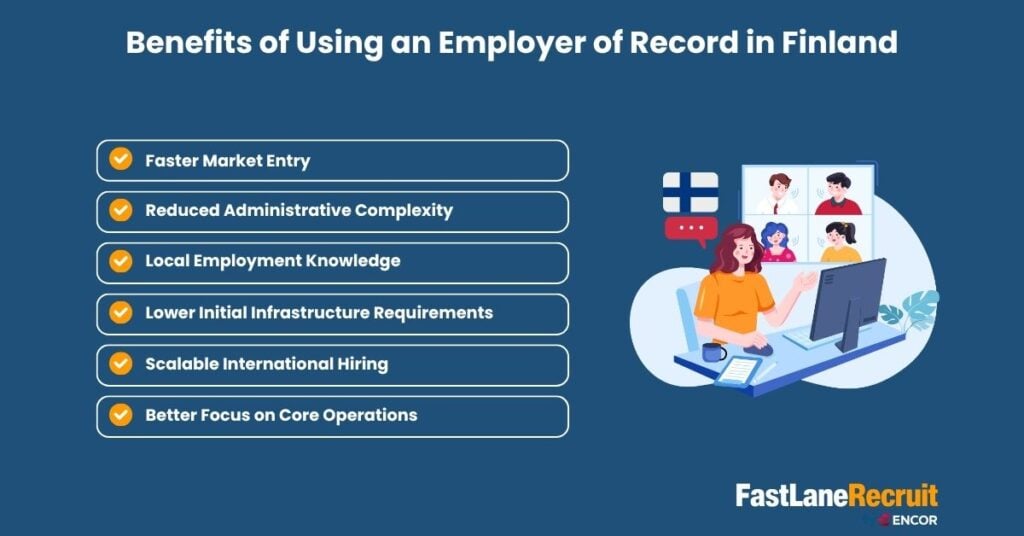
Faster Market Entry
An EOR can provide an existing employment framework, allowing companies to focus on hiring rather than building local employment infrastructure from scratch.
Reduced Administrative Complexity
Payroll, employment documentation, statutory administration, and other processes can be coordinated through the EOR.
Local Employment Knowledge
A Finland EOR provider can help businesses navigate country-specific employment requirements and practices.
Lower Initial Infrastructure Requirements
Companies may avoid the initial costs and administrative work associated with establishing their own Finnish employing entity.
Scalable International Hiring
Businesses expanding into multiple countries can use EOR services as part of a broader global workforce strategy.
Better Focus on Core Operations
By outsourcing employment administration, internal teams can spend more time on recruitment, business development, operations, and employee management.
How Much Does an EOR in Finland Cost?
The cost of an Employer of Record in Finland depends on the employee’s compensation, statutory employer costs, benefits, and the EOR provider’s service fees.
Typical cost components may include:
- Employee salary
- Employer statutory contributions
- Pension-related costs
- Required benefits
- Insurance
- EOR service fee
- Additional HR services
- Onboarding or offboarding fees, where applicable
Instead of looking only at the EOR service fee, businesses should consider the total cost of employment.
The right comparison is therefore:
EOR cost vs. the total cost and administrative commitment of establishing and maintaining a Finnish employment infrastructure.
Who Benefits Most From an EOR in Finland?
An EOR can be particularly useful for:
Startups
Startups can hire Finnish talent without committing immediately to a full local entity structure.
SMEs Expanding Internationally
Small and medium-sized businesses can enter Finland without building an extensive local HR and payroll operation.
Multinational Companies
Large organizations can use EOR services when they need to hire in Finland while coordinating employees across multiple markets.
Companies Testing Finland
Businesses exploring Finland as a potential market can establish an initial workforce before making a long-term entity decision.
Remote-First Companies
Companies that recruit talent regardless of location can use EOR services to employ workers in countries where they don’t maintain their own entities.
Industries That Can Benefit From EOR Services in Finland
EOR services can support companies across many industries, particularly those that rely on specialized international talent.
Technology and SaaS
Companies can hire software engineers, developers, product managers, and technical specialists.
Financial Services
Businesses can recruit finance, accounting, compliance, and specialist professionals.
Professional Services
Consulting and professional-services businesses can establish teams without immediately creating local infrastructure.
Manufacturing and Engineering
Companies can hire engineering and technical professionals while evaluating their long-term Finnish operations.
Life Sciences
International healthcare, pharmaceutical, and research companies can use EOR arrangements for specialized talent.
Digital and Creative Businesses
Remote-first organizations can build distributed teams while centralizing employment administration.
Common EOR Use Cases in Finland
Hiring Your First Finnish Employee
Instead of creating a local entity for one employee, a company can use an EOR to establish the employment relationship.
Testing the Finnish Market
A company can recruit a small team before deciding whether to create a permanent Finnish operation.
Expanding a Remote Team
Businesses can employ Finnish-based workers as part of an international remote workforce.
Acquiring Talent Through International Recruitment
Companies can recruit specialized Finnish talent without waiting for a local entity setup.
Short-Term Market Expansion
An EOR can provide an employment structure for companies with temporary or exploratory international hiring needs, subject to applicable legal requirements.
Risks and Considerations When Using an EOR in Finland
An EOR is not a substitute for understanding your business’s legal and operational requirements.
Choose a provider with local expertise
Employment regulations differ between countries. A provider should have the capability to manage Finnish employment requirements.
Understand the pricing structure
Review what is included in the EOR fee and which services incur additional charges.
Clarify responsibilities
The agreement should clearly define what the EOR handles and what remains the client’s responsibility.
Review employee classification
The employment structure should reflect the actual working relationship.
Consider collective agreements
The applicable collective agreement can affect employment conditions and should be assessed where relevant.
Think beyond the first hire
If you expect your Finnish operation to grow substantially, assess whether an EOR remains the right long-term structure.
How to Choose an EOR Provider in Finland
Before selecting an EOR provider, businesses should evaluate:
Local employment expertise
Can the provider manage Finland-specific employment and payroll requirements?
International coverage
Can the provider support you as your workforce expands into additional countries?
Payroll capabilities
Does the provider have a structured process for local payroll and statutory administration?
Transparent pricing
Are service fees and additional costs clearly explained?
Employee support
Can the provider support employees throughout onboarding, employment, and offboarding?
Compliance processes
Does the provider have processes for monitoring changing employment requirements?
Customer support
Can you reach a knowledgeable team when employment or payroll issues arise?
All-in-One EOR Partner for Global Expansion
Finland may be your next hiring market, but international expansion rarely stops at one country.
Businesses building distributed teams often need to manage employees across multiple jurisdictions, each with different employment, payroll, tax, and compliance requirements.
FastLaneRecruit supports international employment solutions across multiple markets, including Malaysia, Singapore, Hong Kong, China, India, Philippines, Taiwan, Vietnam, Australia, United Kingdom, Switzerland, UAE, Saudi Arabia,and Qatar.
This allows businesses to consider a more coordinated international hiring strategy rather than managing a different employment partner for every market.
Global EOR Coverage
| Region | Countries Supported |
| Asia Pacific | Malaysia, Singapore, Hong Kong, China, India, Philippines, Taiwan, Vietnam, Australia |
| Europe | United Kingdom, Switzerland |
| Middle East & Africa | UAE, Saudi Arabia, Qatar |
Why Businesses Choose FastLaneRecruit for International Hiring
FastLaneRecruit helps businesses simplify international workforce management by providing employment and recruitment support across multiple markets.
Depending on the country and service required, support can help businesses manage:
- International employee hiring
- Employer of Record Solutions
- Payroll administration
- Employee onboarding
- Employment documentation
- Statutory employment administration
- International workforce expansion
- Recruitment support
- Contractor-related workforce needs
For businesses expanding across several markets, working with a provider that understands different employment environments can reduce the need to coordinate multiple local partners.
Conclusion: Simplify Your Finland Hiring Strategy With an EOR
Hiring in Finland involves more than finding the right candidate. International employers need to consider employment contracts, payroll, tax administration, pension insurance, collective agreements, statutory contributions, employee benefits, leave, and other local requirements.
An Employer of Record in Finland can provide a practical employment structure for businesses that want to hire Finnish talent without immediately establishing their own local entity.
For companies making their first international hire, testing the Finnish market, or building distributed teams, an EOR can reduce administrative complexity while providing a framework for compliant local employment.
However, choosing the right employment model depends on your workforce size, business objectives, expected duration of operations, and long-term expansion plans.
Ready to Build an International Team?
Whether you’re hiring your first overseas employee or expanding across multiple markets, FastLaneRecruit can help you explore international hiring and workforce solutions suited to your expansion plans.
Talk to FastLaneRecruit about your international hiring requirements and find the right employment solution for your next market.
Book a Free Consultation to discuss your workforce expansion plans.
Frequently Asked Questions About Employer of Record Finland
What is an Employer of Record in Finland?
An Employer of Record in Finland is a third-party organization that legally employs a worker on behalf of a client company. The EOR manages the formal employment relationship and related administration, while the client generally manages the employee’s day-to-day work.
Can a foreign company hire employees in Finland without a local entity?
An EOR may allow an overseas company to employ workers in Finland without establishing its own Finnish employing entity, subject to the applicable legal requirements and the EOR’s service availability.
How does EOR hiring work in Finland?
The client selects the employee and agrees on employment terms. The EOR then establishes the local employment relationship, manages required documentation and payroll administration, and supports ongoing employment processes.
What does an EOR handle in Finland?
Depending on the provider and agreement, an EOR may manage employment contracts, payroll, tax and statutory administration, pension-related processes, benefits, onboarding, leave administration, and offboarding.
Is an EOR the same as a staffing agency?
No. An EOR primarily provides a legal employment structure and employment administration, whereas a staffing agency generally focuses on supplying workers, recruitment, or temporary staffing.
Is an EOR better than setting up a company in Finland?
It depends on the business’s objectives. An EOR may be more suitable for companies hiring a small number of employees or testing the Finnish market. A local entity may be more appropriate for businesses planning substantial, long-term operations in Finland.
How much does an EOR in Finland cost?
EOR costs vary according to employee salary, statutory employer costs, benefits, insurance, and the provider’s service fees. Businesses should compare the total EOR cost with the cost and administrative requirements of establishing their own Finnish employment infrastructure.
Does Finland have a minimum wage?
Finland does not operate a single statutory national minimum wage in the same way as some countries. Minimum employment terms may be influenced by applicable collective agreements and the circumstances of the employment relationship.
What is TyEL in Finland?
TyEL refers to Finland’s statutory employee pension insurance system. Employers need to account for applicable pension insurance obligations when employing eligible workers in Finland.
Do collective agreements matter when hiring in Finland?
Yes. Collective agreements can establish employment conditions in different sectors and should be considered when determining the appropriate terms for an employee.
Can an EOR manage payroll in Finland?
Yes. Payroll administration is one of the core functions commonly provided under an EOR arrangement, including the calculation and administration of applicable salary deductions and statutory obligations.
How quickly can I hire an employee in Finland through an EOR?
The timeline depends on the employee, required documentation, employment terms, compliance checks, and provider processes. An EOR can generally reduce the setup work associated with establishing a new local employment infrastructure.