The Philippines has become one of Southeast Asia’s most attractive destinations for technology services, digital operations, and skilled IT talent. While the country is widely known for its business process services sector, it is now also gaining recognition for software development, cloud services, cybersecurity, AI solutions, fintech, and enterprise technology support.
For global companies looking to expand, build remote teams, modernize systems, or work with trusted technology providers, the Philippines offers a strong combination of English-speaking professionals, technical capability, and business-friendly collaboration.
In this guide, we highlight the Top 15 IT Companies in the Philippines based on market presence, reputation, service capability, employer strength, and relevance to international businesses.
Content Outline
Key Summary
Philippines as a Growing IT Hub
The Philippines is becoming a key destination in Southeast Asia for IT services, software development, and digital transformation, supported by a young and skilled workforce.
Strong Talent and Communication Advantage
English proficiency and a service-oriented work culture make collaboration easier for global companies working with Philippine IT providers.
Wide Range of IT Capabilities
From enterprise software and cloud systems to AI, cybersecurity, and fintech solutions, Philippine IT companies serve diverse technology needs.
Presence of Global Technology Leaders
Companies such as Accenture, IBM, Oracle, and DXC Technology have strong operations in the Philippines, supporting large-scale enterprise projects.
Strong Local IT Ecosystem
Homegrown firms like Pointwest, Exist Software Labs, and Alliance Software contribute significantly to custom software and product engineering services.
Flexible Team Scaling Options
Businesses can scale teams up or down easily, making the Philippines suitable for startups, SMEs, and enterprise-level digital expansion.
Strategic Location for Global Operations
With strong connectivity across Asia-Pacific, Europe, and North America, the Philippines supports distributed teams and global business operations effectively.
Why Global Companies Choose IT Companies in the Philippines
The Philippines has become one of the top choices for international companies looking for reliable IT support, software development, and digital business services. Over the past few years, the country’s technology sector has continued to expand through digital transformation programs, growing private investment, and a young workforce that is comfortable with modern technology.
The Department of Information and Communications Technology has also introduced initiatives that support better internet infrastructure, digital innovation, and future-ready skills. This helps create a stronger environment for both local and global businesses.
For companies that want to grow efficiently, build remote teams, or launch projects in Asia, the Philippines offers several practical advantages.
Key Advantages of Working with IT Companies in the Philippines
| Advantage | Why It Matters |
| Strong English Proficiency | The Philippines is known for high English fluency, making communication smoother for international clients. This helps reduce misunderstandings, speed up meetings, and improve collaboration. |
| Skilled Talent Pool | The country has many trained professionals including software developers, IT engineers, UI/UX designers, cybersecurity specialists, analysts, and project managers. |
| Time Zone Flexibility | Teams in the Philippines often support businesses across Asia-Pacific, Europe, and North America through flexible working hours and shift coverage. |
| Growing Tech Ecosystem | The local market includes startups, enterprise IT firms, fintech companies, telecom providers, and digital agencies. This gives businesses many partnership options. |
| Scalable Workforce Options | Companies can start with a small team and expand as needed. This is useful for short-term projects, dedicated teams, or long-term growth plans. |
Additional Reasons Businesses Prefer the Philippines
1. Strong Service Culture
Filipino professionals are widely known for being responsive, collaborative, and customer-focused. This is especially valuable in client-facing IT roles and managed services.
2. Competitive Business Value
Many companies choose the Philippines because they can access quality talent while managing budgets efficiently. This helps businesses invest more into growth, product development, or market expansion.
3. Experience with International Clients
Many IT companies in the Philippines already work with clients from the United States, United Kingdom, Australia, Singapore, and other major markets. This means they are familiar with international expectations and workflows.
4. Easy Remote Collaboration
With modern communication tools, cloud systems, and remote work experience, Philippine IT teams can work smoothly with overseas companies.
Best Fit for These Businesses
The Philippines is often a smart choice for:
- Startups needing developers quickly
- SMEs looking to build remote teams
- Enterprises needing IT support or digital transformation
- E-commerce brands needing web and app development
- Global companies expanding into Asia
For businesses looking for dependable IT partners, skilled professionals, and flexible hiring solutions, the Philippines remains one of the strongest options in Southeast Asia. It combines talent, communication strength, and business readiness in one market.
Also Read: BPO Outsourcing in the Philippines
Top 15 IT Companies in the Philippines
The Philippines is home to a diverse technology ecosystem that includes global enterprise firms, telecom leaders, software engineering specialists, HR tech innovators, and digital infrastructure providers. Whether you are a multinational company seeking large-scale transformation or a growing business looking for a reliable development partner, the country offers many strong options.
Below is a closer look at some of the top IT companies in the Philippines and what they are best known for.
1. Accenture
Accenture is one of the largest technology and consulting employers in the Philippines, with major delivery centers serving both local and international clients. The company has strong expertise in digital transformation, cloud migration, cybersecurity, AI, analytics, and enterprise software solutions.
Many Fortune 500 companies work with Accenture for complex business transformation projects and large-scale system integration.
Core Services:
- Cloud transformation
- Cybersecurity
- AI and automation
- Enterprise software implementation
- IT consulting
Best for: Large-scale enterprise projects, multinational operations, and global delivery support.
2. IBM
IBM is a trusted global technology provider with a long-standing presence in the country. IBM supports businesses through cloud platforms, artificial intelligence, data analytics, automation, and IT consulting.
Its enterprise-grade solutions are popular with banks, healthcare organizations, governments, and large corporations.
Core Services:
- Hybrid cloud solutions
- AI tools
- Data management
- IT automation
- Security services
Best for: Enterprise modernization, digital innovation, and advanced IT solutions.
3. Oracle
Oracle is well known for database technology, ERP systems, HR software, and cloud applications. Many medium and large companies use Oracle to manage finance, supply chain, workforce planning, and customer operations.
Oracle remains a strong option for businesses looking for stable and scalable systems.
Core Services:
- Database management
- ERP software
- HR management systems
- Cloud infrastructure
- Business applications
Best for: Finance systems, HR platforms, and enterprise business systems.
4. DXC Technology
DXC Technology provides IT outsourcing support, digital transformation services, and managed enterprise technology solutions. The company works with organizations that need to modernize legacy systems or improve internal IT performance.
DXC is often chosen for long-term support partnerships.
Core Services:
- Managed IT services
- Cloud migration
- Infrastructure support
- Application modernization
- IT consulting
Best for: Managed IT operations and legacy system upgrades.
5. Globe Telecom
Globe Telecom is one of the Philippines’ leading telecom companies and has expanded strongly into digital services for businesses. It supports connectivity, cloud tools, digital payments, cybersecurity, and enterprise mobility.
Many SMEs and corporations rely on Globe for business technology solutions.
Core Services:
- Internet and connectivity
- Cloud business tools
- Cybersecurity
- IoT solutions
- Digital communications
Best for: Connectivity, cloud solutions, and digital business tools.
6. PLDT
PLDT is a major telecom and enterprise technology group offering strong infrastructure and network services across the country. Through its enterprise units, PLDT supports companies with secure connectivity, cloud hosting, and cybersecurity.
Core Services:
- Enterprise networking
- Data centers
- Cybersecurity
- Managed services
- Cloud connectivity
Best for: Network services, cybersecurity, and enterprise connectivity.
7. Pointwest
Pointwest is a homegrown Philippine IT company known for custom application development, testing services, and digital transformation support. It has built a reputation for reliable software delivery and strong engineering talent.
Core Services:
- Custom software development
- QA and testing
- Application support
- Digital transformation
- Managed delivery teams
Best for: Mid-sized enterprise software projects.
8. Exist Software Labs
Exist Software Labs focuses on custom software development, agile engineering, mobile apps, and enterprise systems. The company is often selected by businesses that need modern platforms tailored to their workflows.
Core Services:
- Web app development
- Mobile applications
- Agile product development
- API integration
- Enterprise platforms
Best for: Custom platforms and software products.
9. Azeus Systems
Azeus Systems is recognized for enterprise software and secure digital governance solutions. Its products are used by boards, executives, and organizations that need secure document access and digital meeting systems.
Core Services:
- Board management software
- Secure collaboration tools
- Enterprise software
- Workflow systems
Best for: Governance platforms and secure enterprise tools.
10. Alliance Software
Alliance Software is a respected software engineering company that works with overseas clients across multiple industries. It is known for providing dedicated teams and long-term engineering support.
Core Services:
- Product engineering
- Custom software
- Dedicated developers
- Maintenance support
- QA services
Best for: Dedicated development teams and product engineering.
Also Read: Top 10 In-Demand Jobs in the Philippines 2026
11. Kalibrr
Kalibrr is one of the best-known HR technology platforms in the Philippines. It helps employers streamline recruitment through smart matching, digital hiring workflows, and employer branding tools.
Core Services:
- Recruitment software
- Talent sourcing
- Employer branding
- Applicant tracking
- Hiring analytics
Best for: Hiring technology and recruitment systems.
12. Infor
Infor provides enterprise software for industries such as manufacturing, hospitality, retail, and healthcare. It is known for industry-specific ERP systems and cloud business solutions.
Core Services:
- ERP systems
- Supply chain software
- Hospitality solutions
- Healthcare systems
- Cloud applications
Best for: Industry-specific ERP and cloud software.
13. CGI
CGI is a global consulting and IT services company with strong enterprise delivery capabilities. It supports government agencies, banks, and corporations with large-scale transformation projects.
Core Services:
- IT consulting
- Business transformation
- Systems integration
- Application services
- Managed operations
Best for: Public sector, finance, and enterprise transformation.
14. Trends Group
Trends Group specializes in networking, infrastructure, communications, and enterprise technology integration. It helps organizations improve internal systems and digital readiness.
Core Services:
- IT networking
- Infrastructure setup
- Unified communications
- Security systems
- Enterprise integration
Best for: Infrastructure modernization and business systems.
15. KMC Solutions
KMC Solutions provides workforce solutions, managed teams, office solutions, and business expansion support. It is popular with overseas companies entering the Philippine market.
Core Services:
- Managed teams
- Flexible staffing
- Office solutions
- Market entry support
- Remote workforce setup
Best for: Companies building remote or hybrid teams.
Final Tip for Global Businesses
When selecting an IT company in the Philippines, match your provider to your actual goal:
| Business Goal | Best Fit |
| Enterprise transformation | Accenture, IBM, Oracle |
| Software development | Pointwest, Exist, Alliance |
| Connectivity & infrastructure | Globe, PLDT, Trends Group |
| Hiring & workforce expansion | Kalibrr, KMC Solutions |
| Industry software systems | Infor, CGI |
Choosing the right partner depends on your budget, timeline, industry needs, and growth plans.
Best IT Hubs in the Philippines
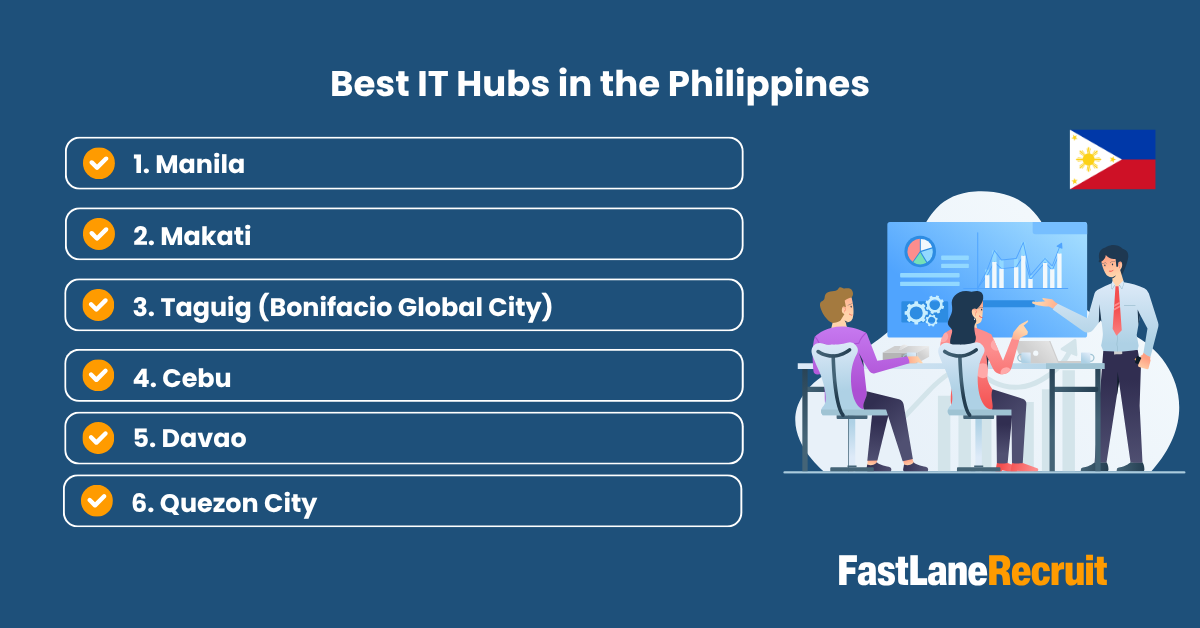
The Philippines has developed a strong and diverse technology landscape spread across multiple cities. Each location plays a unique role in supporting the country’s IT industry, from global enterprise operations and financial technology to software development, outsourcing services, and startup growth.
For international companies, understanding these hubs helps in choosing the right location for hiring, building teams, or setting up long-term operations.
Manila
Why Manila Matters as an IT Hub
Manila, the capital of the Philippines, is the country’s primary business and technology center. It is where many government offices, multinational companies, and large IT service providers are located. Because of this, Manila plays a central role in shaping the country’s digital economy.
Also Read: Top 40 BPO Companies in the Philippines
Key Strengths of Manila
1. Central Business and Technology Hub
Manila hosts a large number of enterprise IT companies, consulting firms, and digital service providers. Many global organizations operate regional offices here.
2. Strong Talent Availability
The city attracts graduates and professionals from across the country, creating a deep pool of IT talent including developers, engineers, analysts, and project managers.
3. Government and Regulatory Access
Being the capital city, Manila provides direct access to key government agencies, making it easier for businesses to operate and comply with regulations.
4. Active Startup and Tech Ecosystem
Startups in fintech, e-commerce, logistics, and SaaS continue to grow in Manila, supported by incubators and private investment.
Best Suited For
- Large enterprise IT operations
- Regional headquarters
- Digital transformation projects
Makati
Why Makati Is a Financial Technology Hub
Makati is widely known as the financial district of the Philippines. It is home to banks, investment firms, corporate headquarters, and high-value technology service providers.
Key Strengths of Makati
1. Finance and Corporate Technology Center
Many banking institutions and financial service companies operate here, making it a key hub for fintech and enterprise systems.
2. Strong Corporate IT Ecosystem
Makati has a high concentration of consulting firms, IT service providers, and software companies focused on enterprise clients.
3. High-Quality Business Infrastructure
Modern office buildings, reliable connectivity, and professional business environments make Makati ideal for corporate operations.
4. Skilled Professional Workforce
The city attracts experienced professionals in finance, IT consulting, and enterprise software development.
Best Suited For
- Fintech companies
- Enterprise software providers
- Corporate IT services
Taguig (Bonifacio Global City)
Why Taguig Is a Fast-Growing Tech District
Taguig, especially Bonifacio Global City (BGC), is one of the most modern and rapidly developing business districts in the Philippines. It has become a preferred location for global companies and tech-driven organizations.
Key Strengths of Taguig
1. Modern Business Environment
BGC offers world-class infrastructure, smart office spaces, and a highly organized business district.
2. Growing Technology Ecosystem
Many startups, digital companies, and multinational tech firms are establishing offices in the area.
3. Strong Innovation Culture
The district encourages innovation, collaboration, and digital transformation across industries.
4. Expanding Talent Pool
Young professionals and tech graduates are increasingly choosing Taguig for career opportunities.
Best Suited For
- Tech startups
- Innovation labs
- Digital-first companies
Cebu
Why Cebu Is a Leading Regional IT Hub
Cebu is one of the strongest IT and outsourcing hubs outside Metro Manila. It has built a solid reputation for providing reliable IT services and customer support operations.
Key Strengths of Cebu
1. Established Outsourcing Hub
Cebu is known for business process services, software development, and IT support operations.
2. Strong English Communication Skills
The workforce in Cebu is widely recognized for clear communication and strong client interaction abilities.
3. Cost-Effective Business Environment
Companies often choose Cebu for team expansion due to its balanced operational setup.
4. Strong Educational Institutions
Local universities continuously supply skilled graduates in IT and engineering fields.
Best Suited For
- IT outsourcing teams
- Software development centers
- Customer support operations
Davao
Why Davao Is an Emerging IT Location
Davao is a growing regional center in Mindanao that is gradually becoming part of the Philippines’ digital transformation journey.
Key Strengths of Davao
1. Emerging Tech Talent Base
More IT graduates are entering the workforce from local universities and training institutions.
2. Stable Business Environment
Davao is known for its structured and business-friendly environment, supporting long-term operations.
3. Expanding IT Services Sector
More companies are setting up support teams, software development units, and digital service operations.
4. Less Competitive Hiring Market
Compared to Metro Manila, businesses may find a less crowded hiring environment.
Best Suited For
- Regional support teams
- Customer service operations
- Growing IT service units
Quezon City
Why Quezon City Is a Talent-Rich IT Hub
Quezon City is one of the largest cities in Metro Manila and is known for its strong academic environment and large working population.
Key Strengths of Quezon City
1. Strong Academic Pipeline
The city has many universities producing graduates in IT, engineering, and computer science.
2. Large Workforce Availability
Companies can access a wide range of entry-level and mid-level professionals.
3. Growing Startup Activity
More digital startups and tech initiatives are emerging in the city.
4. Expanding IT Infrastructure
Business parks and office developments continue to support tech industry growth.
Best Suited For
- Startups
- Entry-level hiring pipelines
- Growing IT support teams
The Philippines offers multiple IT hubs, each with its own strengths. Metro Manila (Manila, Makati, Taguig, Quezon City) is ideal for enterprise and innovation-driven companies, while Cebu and Davao provide strong regional expansion opportunities with growing talent availability.
For global businesses, choosing the right location depends on team size, budget structure, and long-term growth strategy in Southeast Asia.
Also Read: Labor Laws in the Philippines for Employers
How to Choose the Right IT Company in the Philippines
Selecting the right IT company is an important decision for any business planning to outsource development, build digital products, or expand technical capabilities. The Philippines offers many capable providers, but choosing the right partner depends on your industry needs, project goals, and long-term strategy.
Below are key factors to help you make a more informed decision.
1. Check Industry Experience
Why It Matters
Not all IT companies serve the same industries. A provider with experience in your specific sector will already understand your business challenges, compliance needs, and customer expectations. This reduces onboarding time and improves project quality.
What to Look For
- Proven experience in your industry (fintech, healthcare, retail, logistics, SaaS, etc.)
- Case studies or past client projects
- Familiarity with industry tools and platforms
- Understanding of regulatory requirements in your sector
Practical Tip
If you are in fintech or healthcare, choose a provider that has already worked with regulated environments. This helps avoid delays and ensures smoother delivery.
2. Review Security Standards
Why It Matters
Data security is critical when working with external IT teams. A reliable provider should follow strong security practices to protect sensitive business and customer information.
What to Check
- Data protection policies and protocols
- Access control systems (role-based access, encryption, etc.)
- Compliance with international standards (such as ISO or GDPR where applicable)
- Secure software development practices
Practical Tip
Ask for documentation on how they handle data security and how they manage client access to systems and code.
3. Evaluate Communication Quality
Why It Matters
Clear communication is essential for successful project delivery. Miscommunication can lead to delays, misunderstandings, and rework.
What to Look For
- Strong English proficiency across the team
- Structured communication processes (meetings, reporting, updates)
- Use of collaboration tools (Slack, Jira, Teams, etc.)
- Responsiveness and clarity in discussions
Practical Tip
Test communication early during the proposal stage. A quick response time often reflects how the team will perform during the project.
4. Confirm Scalability and Flexibility
Why It Matters
Business needs can change quickly. You may need to expand your team, speed up delivery, or add new capabilities over time. A flexible IT partner can support this growth without delays.
What to Check
- Ability to scale teams up or down quickly
- Availability of multiple skill sets (developers, QA, UI/UX, DevOps, etc.)
- Experience handling long-term and short-term projects
- Resource allocation process
Practical Tip
Choose a provider that can support both small pilot projects and larger enterprise-scale operations. This gives your business room to grow without switching vendors.
5. Understand the Pricing Model Clearly
Why It Matters
Transparent pricing helps you plan budgets better and avoid unexpected costs. IT companies in the Philippines may offer different pricing structures depending on the engagement model.
Common Pricing Models
- Fixed project pricing (clear scope and deliverables)
- Monthly dedicated team model (long-term resource allocation)
- Hourly billing (flexible but variable cost)
What to Review
- What is included in the pricing package
- Additional costs (maintenance, support, revisions)
- Payment terms and billing cycles
- Contract flexibility for scaling or adjustments
Practical Tip
Choose a model that matches your project type. For long-term development, a dedicated team model is often more stable and predictable.
Choosing the right IT company in the Philippines goes beyond cost considerations. It is about finding a reliable long-term partner that understands your industry, communicates clearly, protects your data, and grows with your business needs.
A well-matched IT partner can significantly improve your product quality, speed up delivery, and support your overall digital growth strategy.
Also Read: Top 15 Medical Billing Companies in the Philippines
Philippines vs Malaysia for Hiring IT Talent
Many companies compare the Philippines with Malaysia when expanding teams in Asia.
| Factor | Philippines | Malaysia |
| English Talent | Strong | Strong |
| Tech Hiring Market | Large | Strong regional hub |
| Multilingual Hiring | Moderate | Excellent |
| ASEAN Expansion Base | Good | Excellent |
| Shared Services Growth | Strong | Strong |
For businesses needing multilingual support, regional management, or ASEAN market expansion, Malaysia is often a strategic option.
IT Talent Comparison: Philippines vs Malaysia
| Country | Average IT Specialist Salary (USD/year) | English Proficiency Ranking (EF EPI 2024) | Key Advantage |
| Philippines | $12,000 – $18,000 | High | English-speaking workforce, strong service culture, scalable tech talent pool |
| Malaysia | $15,000 – $20,000 | Very High | Multilingual professionals, strong digital infrastructure, government-backed tech growth initiatives |
Alternative to Vendor Contracting: Hire Your Own Team Through EOR
Many global companies exploring the Philippines for IT services eventually reach a point where they want more control, consistency, and long-term ownership of their teams. Instead of working only with third-party vendors or outsourcing providers, a growing number of businesses are choosing a more flexible model: hiring their own dedicated employees overseas through an Employer of Record (EOR).
An Employer of Record (EOR) is a legal employment solution that allows companies to hire talent in another country without needing to set up a local entity. The EOR becomes the legal employer, while you manage the day-to-day work of your team.
This approach gives businesses a simpler and faster way to expand internationally while staying compliant with local employment laws.
How EOR Hiring Works
1. Legal Employment Made Simple
The EOR handles all formal employment responsibilities such as contracts, payroll, taxes, and statutory compliance in the local country.
2. You Manage the Team
Although the EOR handles legal administration, your company still manages the employee’s tasks, performance, and workflow.
3. Faster Market Entry
You can hire talent in a new country without waiting months to register a local company or entity.
Also Read: Top 15 IT Consulting Companies in the Philippines
Key Benefits of Using EOR for Global Hiring
1. Hire Employees Without Setting Up a Local Entity
You can expand into new markets quickly without the cost and time of establishing a legal business presence.
2. Maintain Direct Operational Control
Unlike traditional outsourcing, your hired team works directly for you, fully aligned with your company goals, processes, and culture.
3. Simplified Payroll and Compliance
The EOR takes care of employment regulations, payroll processing, tax filings, and statutory contributions, reducing administrative burden.
4. Faster and Flexible Scaling
You can quickly scale your team up or down depending on project needs, market demand, or business growth strategy.
5. Reduced Administrative Complexity
Your internal team can focus on core business operations instead of managing legal employment requirements in multiple countries.
Why Consider Malaysia?
While the Philippines is a strong destination for IT outsourcing and software development services, many companies also look at Malaysia as a strategic location for building their own dedicated regional teams through EOR models.
1. Strong and Skilled Workforce
Malaysia offers a highly educated and multilingual talent pool, especially in IT, engineering, finance, and digital services.
2. Strategic Location in Southeast Asia
Malaysia is centrally located within ASEAN, making it a strong base for companies managing regional operations across Asia-Pacific markets.
3. Well-Developed Business Infrastructure
The country has modern digital infrastructure, stable regulations, and strong government support for foreign investment and technology growth.
4. Regional Business Connectivity
Malaysia provides excellent connectivity to Singapore, Thailand, Indonesia, and other key ASEAN markets, making it ideal for regional expansion.
5. Strong Fit for Remote and Hybrid Teams
Many global companies use Malaysia as a hub for building remote-first or hybrid teams that support regional and global operations.
For companies evaluating IT companies in the Philippines, vendor partnerships are a great starting point. However, if your long-term goal is to build your own team, maintain operational control, and scale across Asia, the EOR model offers a more strategic approach.
It allows you to combine the flexibility of global hiring with the stability of compliant local employment, without the complexity of setting up multiple entities.
This makes it a powerful alternative for businesses planning sustainable expansion in Southeast Asia.
Also Read: Top 10 Software Outsourcing Companies in the Philippines
How FastLaneRecruit Can Help You Hire in Asia
Expanding into new markets or building offshore teams can be complex, especially when it comes to legal employment, payroll management, and compliance in different countries. This is where FastLaneRecruit supports international businesses with a simpler and more structured hiring approach across Asia.
With FastLaneRecruit’s Employer of Record (EOR) service, companies can hire talent in Malaysia quickly and compliantly, without the need to establish a local entity. This allows businesses to focus on managing their teams and growing operations, while the administrative and legal responsibilities are handled by an experienced local partner.
Instead of dealing with complex registration processes or setting up a full subsidiary, companies can immediately access skilled professionals and build teams that are fully aligned with their business goals.
What FastLaneRecruit EOR Service Enables
1. Faster Hiring in Malaysia
You can onboard qualified Malaysian professionals quickly without waiting for company incorporation or legal setup procedures.
2. Full Employment Compliance
Employment contracts, payroll processing, tax contributions, and statutory requirements are managed locally, reducing compliance risks.
3. Direct Team Management
Your hired employees work directly under your management structure, ensuring alignment with your workflows, tools, and company culture.
4. Scalable Workforce Model
Whether you need one specialist or an entire team, the EOR model allows you to scale your workforce up or down based on business needs.
5. Simplified Regional Expansion
Companies can test new markets or expand operations in Southeast Asia without long-term structural commitments.
Ideal Roles to Hire in Malaysia Through EOR
Malaysia offers a strong talent pool across both technical and business functions. Through FastLaneRecruit’s EOR solution, companies commonly hire for the following roles:
Software Development & Engineering
Design & Product
- UI/UX Designers
- Product Designers
- Web Designers
Marketing & Growth
- Digital Marketers
- SEO Specialists
- Performance Marketing Executives
Business & Operations
- Finance and Accounting Teams
- Customer Support Specialists
- Regional Operations Staff
- Administrative Support Roles
Conclusion
The Philippines continues to strengthen its position as a leading technology destination in Southeast Asia. Whether you need enterprise consulting, software development, infrastructure support, or digital growth services, the country offers many reliable IT companies.
At the same time, if your strategy is to build your own long-term team in Asia, Malaysia can be a smart next step.
With FastLaneRecruit, you can build your Malaysian team without setting up a local entity, manage your workforce directly, and scale your operations confidently across the region.
Let’s Get Started
Whether you are:
- Expanding your tech team
- Building a regional operations hub
- Hiring remote developers or designers
- Or entering the Southeast Asian market
FastLaneRecruit is ready to support your hiring journey.
Contact FastLaneRecruit today to explore EOR hiring solutions and start building your Malaysia-based team with ease.