

Hiring an international independent contractor allows US companies to access global skills, reduce operational costs, and scale teams quickly without establishing foreign entities.
However, cross-border hiring introduces significant legal and tax risks, particularly around IRS classification rules, employment misclassification, and permanent establishment exposure.
This guide explains how US companies can structure international contractor relationships legally, reduce compliance risks, and implement safe global hiring practices.
Content Outline
Key Summary
International Independent Contractors Enable Scalable Global Hiring
They allow companies to access global talent without establishing foreign legal entities
Worker Misclassification Is a Major Legal Risk for US Companies
Incorrectly classifying contractors can trigger IRS penalties, back taxes, and compliance issues.
Permanent Establishment Risk Can Create Tax Exposure Abroad
Engaging contractors improperly may unintentionally create taxable presence in foreign jurisdictions
Strong Contract Design Is Essential for Compliance
Clear contractual terms and properly structured working relationships are critical to reduce legal risk.
Payment Platforms Do Not Guarantee Legal Compliance
Even if payments are handled correctly, classification and labor law compliance risks may still exist
Global Hiring Compliance Requires Cross-Border Expertise
Working with specialists or compliance partners helps reduce regulatory complexity across multiple countries.
What Is an International Independent Contractor?
An international independent contractor is a self-employed individual or registered business entity located outside the United States that provides services to a US-based company under a commercial agreement.
Core Characteristics
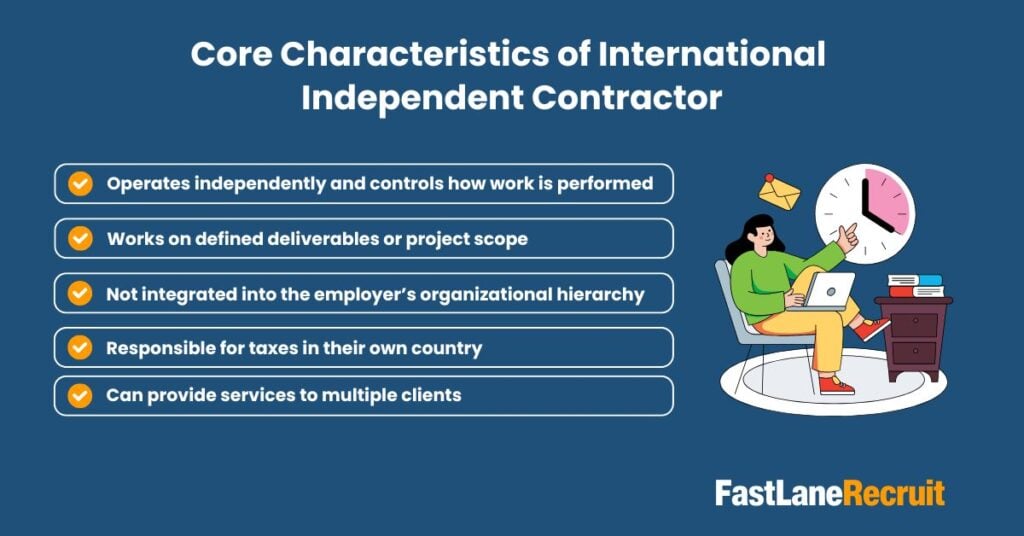
Legal Principle Under US Standards
US authorities primarily assess whether:
- The company controls the result of the work (contractor model), or
- The company controls the process of work (employment model)
This distinction is central to IRS classification frameworks.
Why US Companies Hire International Independent Contractors
Hiring international contractors has become a standard global workforce strategy, particularly for startups, SMEs, and scaling enterprises.
Access to Global Talent
Companies can hire specialized professionals in:
- Software engineering and DevOps
- Digital marketing and SEO
- Accounting and finance
- Design, video production, and creative services
- Customer support and operations
Cost Optimization
Hiring outside the US often reduces labor costs while maintaining access to experienced professionals.
Faster Market Expansion
Companies can test new regions without:
- Setting up foreign subsidiaries
- Establishing local payroll systems
- Navigating complex employment laws initially
Operational Flexibility
Contract-based hiring allows businesses to:
- Scale teams based on workload
- Engage short-term expertise
- Avoid long-term fixed payroll commitments
Time Zone Coverage
Global contractors enable near-continuous operational coverage across different time zones.
Key Legal Risk: Contractor Misclassification (IRS Compliance Risk)
One of the most critical legal risks in hiring an international independent contractor is worker misclassification.
What Is Misclassification?
Misclassification occurs when a contractor is treated like an employee in practice, even if the contract states otherwise.
High-Risk Behavioral Indicators
US companies increase risk when they:
- Set fixed working hours or schedules
- Require full-time availability
- Control daily workflows or task execution methods
- Include contractors in internal employee structures
- Provide company tools as a requirement
- Maintain long-term, indefinite working relationships
Potential Consequences
If misclassification is identified, companies may face:
- IRS back taxes and penalties
- Liability for unpaid payroll taxes
- Legal disputes and retroactive employment claims
- Reclassification of the working relationship
Regulators evaluate the actual working relationship, not just the contract wording.
Permanent Establishment (PE) Risk in Cross-Border Hiring
Beyond US tax exposure, international hiring may create Permanent Establishment (PE) risk in foreign jurisdictions.
What PE Means
A Permanent Establishment occurs when a foreign tax authority determines that a company has a taxable presence in their country due to local activities.
When PE Risk Occurs
PE risk may arise when contractors:
- Act as dependent representatives of the US company
- Regularly conclude business on behalf of the company
- Operate in a way that resembles a local branch
Business Impact
If triggered, PE classification may result in:
- Corporate tax obligations in foreign countries
- Compliance with local employment regulations
- Unexpected financial and legal liabilities
How to Hire an International Independent Contractor Legally
1: Define a Clear Scope of Work
A compliant engagement begins with clearly defined deliverables:
- Project-based structure
- Specific outputs or milestones
- No ambiguous role definitions
2: Draft a Legally Sound Contractor Agreement
A strong agreement should include:
- Independent contractor classification clause
- Defined payment terms (milestone or project-based)
- Intellectual property ownership terms
- No exclusivity requirement
- Termination conditions
- Jurisdiction and governing law clauses
3: Validate Contractor Independence
Ensure the contractor:
- Operates as a business or freelancer in their country
- Has other clients or commercial activity
- Maintains independent control over work execution
4: Establish Payment Infrastructure
Common payment methods include:
- International bank transfers (SWIFT)
- Global payment platforms (Wise, Payoneer, PayPal)
- Contractor management systems
5: Maintain Compliance Documentation
Companies should retain:
- Signed contracts
- Contractor invoices
- Proof of payments
- Scope of work documentation
- Communication records related to deliverables
How to Pay International Independent Contractors
Payment structure must align with compliance requirements.
Bank Transfers
Reliable but may involve:
- High transfer fees
- FX conversion costs
- Slower settlement times
Digital Payment Platforms
Offer:
- Faster transfers
- Reduced transaction fees
- Easier global accessibility
Contractor Management Platforms
Provide integrated solutions for:
- Payments
- Compliance tracking
- Contract management
- Multi-country contractor administration
International Independent Contractor vs Employee
| Category | Independent Contractor | Employee |
| Work control | Output-based | Process-controlled |
| Tax handling | Self-managed | Employer-managed |
| Benefits | Not provided | Legally required |
| Work structure | Flexible | Fixed and supervised |
| Legal risk | Lower if compliant | High if misclassified |
The primary legal test is control over work execution, not job title.
Best Practices for US Companies Hiring Global Contractors
To reduce legal and operational risk, companies should:
- Avoid managing contractors like employees
- Keep engagements project-based and time-limited
- Separate contractors from internal HR systems
- Avoid exclusivity agreements
- Standardize global contractor contracts
- Regularly audit contractor relationships for compliance
These practices reduce both IRS and foreign regulatory exposure.
When US Companies Should Use a Hiring Partner
Managing international contractors becomes complex when:
- Hiring across multiple jurisdictions
- Scaling global teams quickly
- Facing uncertainty around compliance laws
- Expanding into regulated labor markets
In these cases, companies often require structured global hiring solutions such as Employer of Record (EOR) services or compliance-first recruitment support.
Also Read: Hiring in Malaysia: Costs, Process, and Compliance
Conclusion
Hiring an international independent contractor allows US companies to access global talent, scale quickly, and reduce operational costs without setting up foreign entities. It is a flexible hiring model widely used by growing and global businesses. However, companies must manage key compliance risks, especially IRS worker misclassification and permanent establishment (PE) exposure. These risks depend on how the working relationship is structured, not just what is written in the contract.
To stay compliant, businesses should use clear agreements, maintain project-based arrangements, and avoid treating contractors like employees. With the right structure in place, international hiring can be both efficient and legally safe.
For companies expanding globally, working with experts like FastLaneRecruit can help simplify compliance and support secure international hiring at scale.
How FastLaneRecruit Helps US Companies Hire International Contractors
Hiring international independent contractors safely requires legal structuring, compliance oversight, and global workforce management expertise.
FastLaneRecruit supports US companies by providing:
- Strategic hiring solutions in Malaysia
- Employer of Record (EOR) support
- Cross-border compliance structuring
- Global payroll coordination and management
- Recruitment and talent sourcing support
FastLaneRecruit enables companies to scale globally while maintaining compliance and reducing legal exposure. Contact us today to start hiring in Malaysia.
FAQ: International Independent Contractor
Can US companies legally hire international independent contractors?
Yes. US companies can hire international contractors if classification rules and contractual structures are properly followed.
What is the biggest risk when hiring foreign contractors?
Misclassification, which can lead to IRS penalties, back taxes, and legal disputes.
Do international independent contractors pay US taxes?
Generally no. They are responsible for taxes in their own country unless specific US-source income rules apply.
Do I need a foreign entity to hire international contractors?
No. US companies can hire contractors directly, but must ensure compliance.
How should US companies pay international contractors?
Through bank transfers, global payment platforms, or contractor management systems.
What is the difference between a contractor and an employee?
Contractors control how work is done; employees are controlled by the employer in both process and execution.
What is permanent establishment risk?
It is when foreign authorities determine that a company has created a taxable presence in their country through contractor activity.
How can companies reduce misclassification risk?
By using clear contracts, avoiding control over work processes, and maintaining project-based engagements.