Modern businesses are increasingly rethinking how they build teams. The debate around contract labor vs full-time employees is no longer just an HR topic. It is a strategic business decision that impacts cost, agility, productivity, and long-term growth.
If you are likely trying to decide the best workforce model for your company, this guide breaks down both hiring types using a practical approach to choose the right structure for your business.
Content Outline
Key Summary
Contract Labor and Full-Time Employment Serve Different Needs
Contract labor is typically project-based and flexible, while full-time employees are long-term hires integrated into the organization.
Level of Control Differs Between Both Models
Contractors operate independently with minimal supervision, whereas employees work under direct management and structured workflows.
Cost Structures Impact Hiring Decisions
Contract labor can reduce overhead costs and long-term commitments, while full-time employees involve salaries, benefits, and statutory obligations.
Contract Labor Is Best for Short-Term or Specialized Needs
It is ideal for rapid scaling, specialized skill gaps, and time-bound projects requiring external expertise
Full-Time Employees Support Stability and Core Operations
They are better suited for business-critical roles, long-term strategy execution, and organizational continuity.
Worker Misclassification Carries Legal and Tax Risks
Incorrectly categorizing contractors and employees can result in penalties, compliance issues, and financial liabilities.
Strategic Hiring Partners Improve Talent Acquisition Efficiency
Recruitment partners like FastLaneRecruit help businesses hire suitable talent faster while improving workforce planning and scalability.
What Is Contract Labor?
Contract labor refers to professionals or workers hired for a specific project, task, or fixed duration under a contractual agreement instead of permanent employment.
In most cases, contract workers:
- Operate as independent professionals or agencies
- Work on defined deliverables or project scopes
- Manage their own taxes and insurance
- Use their own tools and methods
- Serve multiple clients at the same time
In simple terms: It is “hiring a service,” not hiring a permanent employee.
This model is widely used in:
- IT and software development
- Marketing and creative projects
- Accounting and finance support
- Seasonal or short-term business demands
What Is a Full-Time Employee?
A full-time employee is a worker formally integrated into a company under an employment contract, typically placed on payroll.
Full-time employees:
- Work under company direction and supervision
- Follow set working hours and internal policies
- Receive salary and statutory benefits
- Have taxes managed through employer payroll systems
- Are part of long-term workforce planning
In short notes: employees are “hired people” who become part of your organization.
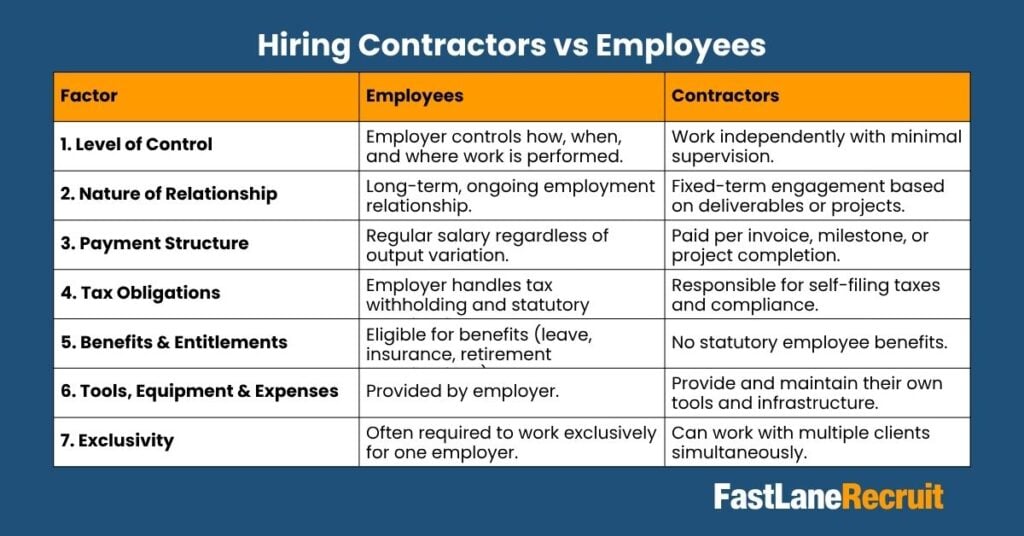
Contract Labor vs Full-Time Employees: Key Differences
Understanding the difference is essential for compliance, budgeting, and operational planning.
When Should You Hire Contract Labor?
This option is ideal when your business needs:
1. Fast Scaling
When workload spikes and you need immediate support.
2. Specialized Skills
For niche expertise like design, software engineering, or financial consulting.
3. Project-Based Work
When work has clear start and end dates.
4. Cost Optimization
When avoiding long-term employment costs is a priority.
When Should You Hire Full-Time Employees?
Full-time employees are more suitable when:
1. Core Business Functions
Roles that are essential to daily operations.
2. Long-Term Growth
When building internal expertise and leadership.
3. Company Culture Development
When alignment with company values and long-term engagement matters.
4. Continuous Workload
When tasks are ongoing and not project-based.
Risks of Misclassifying Contract Labor
One of the most important considerations is worker classification compliance.
Incorrect classification can lead to:
- Tax penalties
- Legal disputes
- Back pay liabilities
- Government audits
- Employment law violations
A common risk occurs when contract workers are treated like employees (fixed hours, direct supervision, exclusivity), which may lead to misclassification issues.
Business Insight: Why Companies Use a Hybrid Workforce Model
Many modern companies now combine both models:
- Full-time employees handle core business operations
- Contract labor supports flexibility, speed, and specialized needs
This hybrid approach allows businesses to:
- Reduce operational costs
- Improve agility
- Access global talent
- Scale efficiently during growth phases
Across HR and workforce research, the consensus is clear:
- There is no “one-size-fits-all” hiring model
- Contract-labor improves agility and specialization
- Full-time employees ensure stability and long-term control
- The best companies strategically balance both
This is why workforce planning is now a core part of business strategy—not just HR administration.
Also Read: Hybrid And Remote Work Trends in Malaysia
How FastLaneRecruit Helps You Hire Smarter
Choosing between contract labor and full-time employees can be complex—especially when compliance, speed, and talent quality matter.
FastLaneRecruit helps businesses:
- Source qualified contract workers quickly
- Build flexible workforce solutions
- Reduce hiring time and recruitment costs
- Ensure proper workforce classification
- Match talent based on skill and project needs
Whether you need contract labor for short-term projects or specialized professionals for scaling your business, FastLaneRecruit provides tailored recruitment solutions and EOR services designed for SMEs and growing companies.
Build Your Flexible Workforce Today
If your business is considering contract labor or struggling to hire the right talent quickly, FastLaneRecruit can help you build a scalable and efficient workforce model.
Conclusion
Choosing between contract-labor and full-time employees is ultimately a decision about how your business balances flexibility, cost efficiency, control, and long-term stability. Both models serve important but different purposes within a modern workforce strategy.
Contract labor is best suited for businesses that need speed, specialized expertise, and short-term scalability without long-term commitments. It allows organizations to stay agile and responsive to changing project demands. However, it also requires careful management to avoid compliance risks and ensure proper worker classification.
Full-time employees, on the other hand, form the backbone of a company’s long-term operations. They provide consistency, deeper organizational alignment, and sustained contribution to business growth. While they come with higher fixed costs, they also enable stronger culture-building and operational continuity.
In today’s global and hybrid work environment, most companies no longer rely on a single hiring model. Instead, they adopt a blended workforce strategy, combining full-time employees for core functions with contract labor for flexibility and specialized needs. This hybrid approach helps businesses scale more efficiently while maintaining operational resilience.
However, as businesses expand—especially across borders—employment classification and compliance become increasingly complex. Choosing the wrong model or misclassifying workers can lead to legal, financial, and reputational risks.
That is why workforce planning has become a critical part of modern business strategy rather than just an HR function. Companies that evaluate their hiring needs carefully and structure their workforce intentionally are better positioned for sustainable growth.
Ultimately, there is no universal “best” hiring model. The right choice depends on your business goals, operational needs, and growth stage—but a thoughtful combination of both models often delivers the strongest results.
FAQs: Contract Labor vs Full-Time Employees
What is contract labor in simple terms?
Contract labor refers to hiring independent workers for specific projects or time periods under a contract.
Is contract labor cheaper than full-time employees?
Often yes, because employers do not pay benefits, payroll taxes, or long-term compensation costs.
What is the main difference between contract workers and employees?
Contract workers are independent and project-based, while employees are permanent and part of the company payroll.
Can a contract worker become a full-time employee?
Yes, many companies convert high-performing contractors into permanent employees.
What industries use contract labor the most?
IT, marketing, finance, creative industries, and seasonal businesses frequently use contract labor.
What are the risks of hiring contract labor?
The main risks include misclassification, compliance issues, and lack of long-term workforce stability.
When should a business choose contract labor?
When flexibility, speed, cost savings, or specialized skills are required for short-term needs.