If you’re looking to scale your business efficiently while controlling costs, business process outsourcing (BPO) is no longer just an option; it’s a strategic advantage. The Philippines has firmly established itself as one of the world’s leading outsourcing destinations. With over $40 billion in industry revenue, a workforce exceeding 1.8 million professionals, and cost savings of up to 70%, it continues to attract global businesses seeking high-quality, cost-effective solutions.
This guide covers everything you need to know, from understanding BPO to choosing the right partner, along with a curated list of the top BPO companies in the Philippines in 2026.
Content Outline
Key Summary
What is BPO?
Business Process Outsourcing (BPO) lets companies delegate non-core tasks like customer support, payroll, and IT to specialized providers.
Why the Philippines is a Global Hub
The Philippines offers cost efficiency, skilled English-speaking professionals, and strong infrastructure, generating $40B+ in annual BPO revenue.
Key Benefits of BPO
Outsourcing improves efficiency, reduces costs by up to 70%, provides access to specialized talent, and allows businesses to focus on core functions.
Types of BPO Services
Philippine and Malaysian BPO services include customer support, IT, back-office operations, finance, e-commerce support, and specialized sectors like healthcare and legal.
Industries That Benefit Most
E-commerce, finance, healthcare, IT/SaaS, real estate, startups, and SMEs all gain from scalable, flexible, and cost-effective outsourcing.
Choosing the Right BPO Partner
Consider service expertise, industry experience, scalability, technology standards, proven track record, and cultural alignment to ensure successful partnerships.
FastLaneRecruit EOR for Malaysia
FastLaneRecruit enables legal hiring in Malaysia without a local entity, handling compliance, payroll, HR, and scaling your workforce efficiently for rapid expansion.
What is Business Process Outsourcing?
Business Process Outsourcing, commonly called BPO, is when a company hires an external company to handle certain business tasks or operations. These tasks are usually non-core activities, the things that are important for the business to run but are not part of its main focus. Examples include:
- Customer support and call center services
- Data entry and record keeping
- Payroll management and accounting
- IT support and software maintenance
Instead of creating and managing internal teams for every task, businesses delegate these functions to specialized providers. Often, these providers are located in other countries (offshore outsourcing), which allows companies to access skilled professionals at a lower cost.
The main goals of BPO are to:
- Save time and resources – Companies don’t have to recruit, train, or manage large teams for non-core tasks.
- Reduce operational costs – Outsourcing can be significantly cheaper than hiring full-time staff in-house.
- Improve efficiency and quality – BPO companies specialize in certain functions, so they often deliver faster and more accurate results.
- Focus on core business growth – By letting experts handle non-core tasks, the company can concentrate on what it does best, such as developing products, serving customers, or expanding markets.
In simple terms, BPO allows a business to get more done with less effort by letting other companies handle tasks they excel at while the business focuses on its main objectives.
Also Read: Top 10 In-Demand Jobs in the Philippines 2026
What Are BPO Companies?
BPO companies are specialized service providers that take on certain business functions for other organizations. Instead of a company doing everything in-house, these providers handle specific tasks efficiently, often at a lower cost and with expert knowledge.
Typically, BPO companies manage a wide range of services, including:
- Customer Service and Technical Support: Handling inquiries, complaints, and troubleshooting for clients through call centers, emails, or chat.
- Back-Office Operations: Performing tasks like data entry, bookkeeping, accounting, and other administrative processes.
- Human Resources and Payroll: Managing employee records, salaries, benefits, and recruitment processes.
- IT Services and Software Support: Providing technical assistance, software maintenance, and system monitoring.
BPO companies not only bring in skilled talent but also provide the necessary technology, infrastructure, and management systems. This allows businesses to focus on their core goals, like developing products, marketing, or expanding operations, without the burden of building these capabilities in-house.
In essence, a BPO company acts as an extension of your business, handling specialized tasks efficiently so you can concentrate on growth and strategy.
An Overview of Business Process Outsourcing in the Philippines
Over the past two decades, the Philippines has become a global leader in business process outsourcing. What started in the early 2000s as mainly call center services has evolved into a full-fledged industry offering high-value, knowledge-based services.
Some key highlights of the Philippine BPO sector today include:
- Revenue: The industry generates over $40 billion annually, showing steady growth and international demand.
- Employment: It provides jobs to more than 1.8 million skilled professionals, giving opportunities to graduates and experienced workers alike.
- Economic Contribution: The sector contributes approximately 8–10% of the country’s GDP, making it a vital part of the national economy.
- Major Hubs: Metro Manila, Cebu, and Davao serve as the main outsourcing centers, equipped with reliable infrastructure, modern office spaces, and tech-ready environments.
Several factors contribute to the Philippines’ strong position in the global BPO market:
- English Proficiency: Filipinos speak English fluently, making communication with international clients smooth and professional.
- Cultural Alignment: The country’s familiarity with Western culture, especially American, allows for seamless customer interactions and reduces misunderstandings.
- Cost Competitiveness: Businesses can access high-quality services at significantly lower costs compared to Western countries.
- Government Support: Incentives, tax breaks, and business-friendly policies create a stable environment for outsourcing companies.
- Skilled Workforce: A continuous stream of graduates ensures a ready supply of trained professionals for various BPO services.
This combination of talent, infrastructure, and supportive policies continues to drive the Philippines’ leadership in the global outsourcing industry.
What’s The Biggest Benefit of Business Process Outsourcing?
The primary advantage of business process outsourcing (BPO) is cost efficiency without compromising quality.
By outsourcing tasks to the Philippines, businesses can reduce operational costs by 50–70% compared to maintaining the same operations in their home country. This is achieved without lowering service standards because the Philippines offers a highly skilled and professional workforce.
But cost savings are just the beginning. Other key benefits of BPO include:
- Access to Specialized Talent and Expertise
BPO companies employ professionals trained in specific areas such as customer service, IT support, finance, or digital marketing. This gives your business instant access to expertise you might not have in-house. - Increased Operational Efficiency
By delegating non-core tasks to experts, your internal teams can focus on what they do best. This leads to smoother workflows, fewer errors, and faster completion of essential tasks. - Scalability and Flexibility
BPO services can scale according to your business needs. Whether you experience seasonal spikes in demand or rapid growth, outsourcing allows you to quickly adjust the size of your team without the long-term commitments of hiring full-time employees. - Faster Turnaround Times
With dedicated teams working on your processes, tasks can be completed more quickly. Many BPO companies operate around the clock, which is especially helpful for global businesses needing 24/7 support. - Ability to Focus on Core Business Functions
By outsourcing administrative, technical, or repetitive tasks, your company can concentrate on strategy, innovation, and customer growth. This improves overall business performance and long-term profitability.
For many companies, BPO becomes more than a cost-cutting strategy. It acts as a growth enabler, allowing businesses to expand efficiently, enter new markets, and stay competitive without overextending internal resources.
Also Read: Top 40 BPO Companies in the Philippines
Types of BPO Services Offered in the Philippines
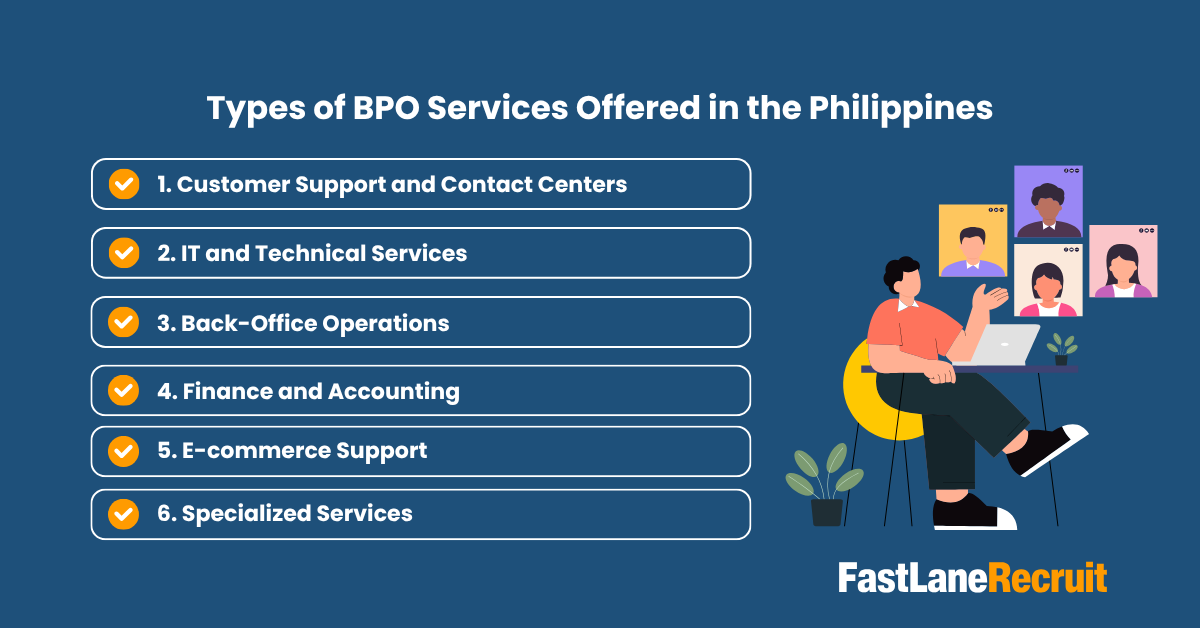
The Philippines has become a global hub for business process outsourcing because it offers a wide variety of services across both front-office and back-office functions. Companies can find solutions for almost every business need, making the country a true one-stop outsourcing destination. Here’s a closer look at the main types of BPO services available:
1. Customer Support and Contact Centers
These are among the most common BPO services and focus on maintaining excellent customer experiences. Services include:
- Voice and Non-Voice Customer Service: Handling calls, emails, live chats, and social media queries.
- Technical Support: Assisting customers with product or service issues, troubleshooting, and resolving technical problems.
- Telemarketing and Sales: Conducting outbound calls to promote products, generate leads, or close sales.
2. IT and Technical Services
Businesses can outsource technical operations to highly skilled professionals, including:
- Help Desk Support: Providing real-time assistance to end-users or employees.
- Software Development: Creating custom applications, mobile apps, and web solutions.
- Network and System Management: Monitoring, maintaining, and securing IT infrastructure.
3. Back-Office Operations
Back-office BPO focuses on essential tasks that support core business functions but do not directly interact with customers:
- Data Entry and Processing: Managing databases, inputting information, and maintaining accurate records.
- Content Moderation: Reviewing user-generated content to ensure compliance with company policies.
- Administrative Support: Scheduling, document management, email handling, and general office support.
4. Finance and Accounting
Outsourcing financial functions helps businesses maintain accuracy and compliance while reducing costs:
- Bookkeeping: Recording daily financial transactions and maintaining ledgers.
- Payroll Processing: Managing employee salaries, benefits, and tax deductions.
- Tax Preparation and Compliance: Ensuring all taxes are calculated correctly and submitted on time.
5. E-commerce Support
The Philippines is a popular destination for e-commerce outsourcing, including:
- Order Processing: Handling sales orders from confirmation to delivery.
- Inventory Management: Tracking stock levels, updating product listings, and managing warehouses.
- Customer Service: Resolving customer inquiries related to orders, returns, and refunds.
6. Specialized Services
Some BPO companies offer niche services that require industry-specific expertise:
- Healthcare Outsourcing: Services like medical billing, claims processing, and patient support.
- Legal Process Outsourcing (LPO): Legal research, contract review, and document preparation.
- AI Data Annotation and Analytics: Preparing and analyzing data for machine learning and AI applications.
This diversity of services ensures that businesses from any industry can leverage the Philippines’ outsourcing capabilities to improve efficiency, reduce costs, and scale operations effectively.
Which Industries Can Benefit From Business Process Outsourcing?
Business Process Outsourcing (BPO) isn’t limited to any single industry. Companies across various sectors use outsourcing to streamline operations, reduce costs, and scale efficiently. Here’s a closer look at industries that benefit the most:
1. E-commerce and Retail
Online stores and retail chains often rely on BPO to manage high volumes of operations:
- Customer Service: Handling inquiries, returns, and complaints across multiple channels.
- Order Fulfillment: Processing orders, tracking shipments, and coordinating logistics.
- Product Data Management: Maintaining accurate product listings, pricing, and inventory updates.
2. Finance and Accounting
Financial operations require accuracy, compliance, and timely reporting. BPO helps businesses achieve these goals efficiently:
- Bookkeeping: Recording daily transactions and maintaining financial records.
- Financial Reporting: Preparing monthly, quarterly, and annual financial statements.
- Compliance and Tax Services: Ensuring adherence to local and international regulations.
3. Healthcare
Healthcare providers use BPO to reduce administrative burdens and improve patient care:
- Medical Billing: Processing claims accurately for insurance and patient payments.
- Claims Processing: Managing insurance claims and follow-ups efficiently.
- Patient Data Management: Maintaining secure and organized patient records.
4. IT and SaaS
Tech companies leverage BPO for operational support and quality assurance:
- Technical Support: Assisting end-users with software and hardware issues.
- Quality Assurance (QA) Testing: Ensuring software products are error-free before release.
- Help Desk Services: Providing timely guidance and troubleshooting for clients.
5. Real Estate
Real estate firms can outsource tasks to enhance operational efficiency:
- Lead Generation: Identifying and qualifying potential buyers or tenants.
- Property Management Support: Handling tenant communications, scheduling maintenance, and managing documents.
6. Startups and SMEs
Small and medium enterprises often face resource constraints. BPO allows them to access talent and infrastructure without heavy upfront costs:
- Virtual Assistants: Handling administrative tasks and daily operations.
- Customer Support: Managing queries and improving client satisfaction.
- Administrative Operations: Scheduling, documentation, and data management.
Key Takeaway: The flexibility of outsourcing allows businesses of all sizes and industries to scale operations efficiently, adapt to market demands, and focus on core competencies without heavy upfront investments.
Also Read: How to Hire Employees in the Philippines
The Importance of the BPO Industry in the Philippines
The BPO industry has become a cornerstone of the Philippine economy and a major player in the global outsourcing landscape. Its impact goes beyond direct business services:
1. Employment Generation
BPO is one of the largest employment sectors in the Philippines, providing jobs for over 1.8 million Filipinos directly and millions more indirectly.
2. Contribution to GDP
The industry contributes 8–10% of the country’s GDP, making it a significant driver of economic growth.
3. Attraction of Foreign Investment
Many global companies establish operations in the Philippines because of its skilled workforce, cost advantages, and mature outsourcing ecosystem, fueling foreign direct investment.
4. Catalyst for Digital Transformation
BPO companies adopt new technologies like AI, automation, and cloud services, pushing digital innovation in both the Philippines and their client markets worldwide.
5. Workforce Upskilling
The industry invests heavily in training, upskilling, and professional development, ensuring employees are ready to handle advanced and specialized tasks.
6. Support for Indirect Jobs
From logistics and real estate to telecommunications and food services, BPO indirectly supports millions of additional jobs across the economy.
Global Perspective: For international businesses, this means access to a mature, reliable, and future-ready outsourcing ecosystem capable of handling complex operations while staying cost-efficient.
Top 10 BPO Companies in the Philippines (2026)
The Philippines hosts some of the world’s most reliable BPO providers, offering services ranging from customer support to advanced technical solutions. Here’s a detailed look at the top 10 companies you should consider:
1. Outsourced Staff
Best for: Custom offshore teams
Outsourced Staff has quickly gained a reputation for providing tailored offshore staffing solutions. They build highly skilled teams for businesses across tech, marketing, customer service, and back-office operations. With offices worldwide and a strong focus on recruitment and training, Outsourced Staff ensures that each team is custom-fit to clients’ specific business needs, helping companies scale efficiently without compromising quality.
2. Accenture
Best for: Enterprise outsourcing and digital transformation
Accenture is a global consulting and outsourcing powerhouse. Established in the Philippines in 1985, it now operates in major cities like Manila, Cebu, and Ilocos. The company provides IT services, digital solutions, cloud computing, cybersecurity, and large-scale outsourcing projects. Its deep industry expertise allows it to handle complex enterprise-level operations for multinational clients, making it a top choice for companies seeking innovation-driven outsourcing solutions.
3. Teleperformance
Best for: Customer experience outsourcing
Teleperformance, a French multinational, is a leader in customer experience management. With over 20 centers across the Philippines, it provides voice and non-voice customer support, technical assistance, sales, and back-office functions. Teleperformance leverages AI and digital tools to enhance customer interactions, helping global brands improve satisfaction and operational efficiency.
Also Read: Labor Laws in the Philippines for Employers
4. Foundever
Best for: Omnichannel support
Born from the merger of Sitel and Sykes, Foundever is a major player in global CX solutions. The company provides comprehensive customer engagement services, technical support, sales, and back-office operations. Known for its highly trained workforce, Foundever delivers consistent results across multiple channels, making it ideal for businesses seeking seamless, omnichannel customer interactions.
5. Concentrix
Best for: Tech-enabled outsourcing
Concentrix specializes in digital transformation and analytics-driven outsourcing. With offices across the Philippines, it focuses on customer experience strategy, data analytics, automation, and digital engineering. Its tech-enabled approach allows businesses to optimize processes, improve operational efficiency, and implement scalable solutions for global markets.
6. Sutherland
Best for: Integrated business and technology services
Sutherland has been a veteran in business process services for over 35 years. Its Philippine operations span Metro Manila, Clark, and Davao. The company offers a mix of customer engagement, finance and accounting outsourcing, and digital transformation services. Sutherland is recognized for combining traditional BPO capabilities with innovative technology solutions to support complex business needs.
7. Cloudstaff
Best for: Remote staffing solutions
Cloudstaff is known for providing flexible offshore teams through cloud-based workforce management. Originally an Australian software company, it transitioned into the Philippine outsourcing market in 2010. Cloudstaff offers IT support, software development, digital marketing, and administrative services, making it a versatile partner for businesses looking for cost-effective and scalable remote teams.
8. Acquire BPO
Best for: Cost-effective outsourcing
Founded in 2005, Acquire BPO delivers efficient and budget-friendly solutions across customer service, sales, technical support, and back-office operations. With a strong Philippine presence, the company serves clients in telecommunications, banking, and retail, providing dependable outsourcing without the high cost of enterprise-level providers.
9. TaskUs
Best for: Tech startups and high-growth companies
TaskUs specializes in next-generation digital customer experiences, partnering with high-growth tech firms and innovative brands. Services include AI operations, digital CX, content moderation, and consulting. With a focus on agility and innovation, TaskUs is particularly well-suited for companies seeking flexible, tech-driven outsourcing solutions in fast-moving markets.
10. SixEleven
Best for: Affordable outsourcing solutions
SixEleven, founded in Davao in 2005, is one of the pioneering locally-owned BPO firms in the Philippines. It offers customer service, lead generation, technical support, and back-office operations for a global clientele. With a solution-oriented approach and focus on affordability, SixEleven is ideal for small and medium businesses looking for reliable outsourcing without breaking the budget.
Also Read: Top 15 Medical Billing Companies in the Philippines
How to Choose the Right BPO Partner
Selecting the right BPO provider is one of the most important decisions your business can make when outsourcing operations. A good partner can help you scale efficiently, improve service quality, and reduce costs, while the wrong choice can lead to operational headaches and lost opportunities. Here’s a deeper look at the key factors to consider:
1. Service Specialization and Expertise
Not all BPO companies offer the same capabilities. Some excel at customer service, while others focus on IT, finance, or back-office operations. Before choosing a provider, identify your business needs clearly and match them with a company that has proven expertise in those areas. Ask for case studies, client examples, and specific outcomes they’ve achieved for similar businesses.
2. Industry Experience
Experience in your specific industry can make a huge difference. A provider that understands the nuances of your sector, whether healthcare, fintech, e-commerce, or real estate, can handle complex tasks more effectively. They’ll also be better equipped to comply with regulations, follow industry best practices, and anticipate challenges.
3. Scalability and Flexibility
Your business may grow, shrink, or experience seasonal demand fluctuations. The right BPO partner should offer flexible solutions that can scale up or down quickly without compromising quality. This includes the ability to add more staff, extend hours of operation, or integrate new technologies as your business evolves.
4. Technology and Data Security Standards
A BPO provider’s tech infrastructure is critical for smooth operations and data protection. Check the tools they use for communication, workflow management, and performance monitoring. Data security is especially important; look for companies that follow international security standards and comply with local laws, such as the Philippines’ Data Privacy Act of 2012.
5. Proven Track Record and Client Reviews
Past performance is often the best indicator of future results. Look for providers with a solid track record of client satisfaction. Platforms like Clutch, G2, or verified testimonials can give you insight into the provider’s reliability, professionalism, and problem-solving capabilities. Long-term client relationships are a positive signal that the company consistently delivers quality services.
6. Cultural Alignment and Communication
Communication style and cultural compatibility are often overlooked but can impact your partnership significantly. A team familiar with your market and cultural expectations, particularly for customer-facing roles, reduces misunderstandings and ensures smoother collaboration.
7. Cost vs. Value
While cost efficiency is a major driver for outsourcing, it shouldn’t come at the expense of quality. Evaluate the overall value the provider delivers, expertise, speed, technology, and flexibility, rather than just the lowest price. Remember, the right partner can help your business grow and innovate, making the investment worthwhile.
Choosing the right BPO partner requires careful research and alignment with your business goals. By assessing specialization, industry knowledge, scalability, technology, track record, and cultural fit, you’ll maximize the chances of a successful, long-term outsourcing relationship that drives growth and operational efficiency.
Also Read: Top 15 IT Consulting Companies in the Philippines
BPO Outsourcing in Malaysia
Why Malaysia for BPO?
Malaysia has emerged as a strong outsourcing destination in Southeast Asia, offering a combination of skilled talent, cost efficiency, and business-friendly regulations. While it may not yet match the scale of the Philippines, Malaysia is rapidly gaining traction for companies looking to expand their operations in the region.
Key advantages include:
- Highly Educated Workforce: Malaysia produces a steady pipeline of graduates in IT, finance, engineering, and business-related fields, many of whom are fluent in English.
- Cost-Effective Operations: Outsourcing to Malaysia allows businesses to reduce operational costs without compromising on service quality, with competitive labor rates compared to Western countries.
- Government Support: Malaysia offers tax incentives, investment-friendly policies, and dedicated economic zones for business process outsourcing, supporting both domestic and international firms.
- Strategic Location: With proximity to major Asian markets and strong infrastructure, Malaysia is well-positioned for regional BPO operations, especially for ASEAN-focused business expansion.
Types of BPO Services in Malaysia
Much like the Philippines, Malaysian BPO companies cover a wide range of services, including:
- Customer Service and Contact Centers – Multilingual support, technical assistance, and telemarketing.
- IT and Technical Services – Software development, help desk support, network management.
- Back-Office Operations – Data entry, document processing, administrative support.
- Finance and Accounting – Bookkeeping, payroll, taxation support.
- Specialized Services – Legal process outsourcing, HR management, healthcare billing, and AI-related services.
Industries Benefiting from Malaysian BPO
Companies across various sectors leverage Malaysia for outsourcing:
- E-commerce & Retail: Customer service, order management, and logistics support.
- Finance & Accounting: Payroll, compliance, and reporting services.
- IT & SaaS: Technical support, QA testing, and help desk services.
- Healthcare: Billing, claims processing, and patient data management.
- Startups & SMEs: Flexible virtual assistant and administrative support services.
Also Read: Top 10 Software Outsourcing Companies in the Philippines
FastLaneRecruit’s EOR Solution for Malaysian Employees
What is an Employer of Record (EOR)?
FastLaneRecruit’s Employer of Record (EOR) service allows companies to hire and manage employees in Malaysia without setting up a local entity. This means businesses can legally employ talent in Malaysia while FastLaneRecruit handles compliance, payroll, taxes, and labor regulations.
Key Benefits of Using FastLaneRecruit’s EOR
- Compliance Made Easy – FastLaneRecruit ensures your Malaysian employees are fully compliant with local labor laws, statutory contributions, and tax regulations.
- Faster Market Entry – You can hire Malaysian talent immediately without waiting to establish a local company, accelerating expansion.
- Simplified Payroll and HR – All payroll, benefits, and employee management tasks are handled centrally, reducing administrative burden.
- Scalable Workforce – Whether hiring one employee or a full team, FastLaneRecruit’s EOR scales with your business needs.
- Cost Efficiency – Avoid entity setup costs, ongoing compliance expenses, and administrative overhead while accessing skilled Malaysian professionals.
Ideal Use Cases for Malaysian EOR
- Remote Teams: Employ Malaysian professionals for customer service, IT, marketing, or finance roles.
- Regional Expansion: Test new markets in Southeast Asia without committing to a local office.
- Special Projects: Quickly deploy talent for time-limited initiatives or seasonal operations.
Why Choose FastLaneRecruit
FastLaneRecruit combines local expertise, compliance assurance, and global operational support, making it easier for businesses to grow in Malaysia with minimal risk. Companies can focus on core activities while knowing their workforce is managed professionally and legally.
Also Read: Top 20 Product Development Companies in the Philippines
Conclusion
Business process outsourcing in the Philippines offers a powerful combination of cost savings, skilled talent, and operational efficiency.
Whether you’re a startup, SME, or enterprise, outsourcing to the Philippines can help you scale faster, improve service quality, and stay competitive in a global market.
The key is to align your business needs with the right outsourcing partner, one that understands your goals and can grow with you.
Ready to Scale Your Business in Southeast Asia?
Don’t let administrative hurdles or compliance worries slow you down. Hire Malaysian talent through FastLaneRecruit’s EOR. We make expansion simple, legal, and cost-effective.
Take the Next Step:
- Build a skilled offshore team without setting up a local entity
- Access top-tier BPO services tailored to your industry
- Focus on growing your business while we handle the rest
Start Today – Connect with our experts and discover how FastLaneRecruit can help you expand across Southeast Asia seamlessly. Get Started Now!