
Japanese companies have steadily expanded their operations in the Philippines over the last two decades. What started as a cost-saving outsourcing strategy has evolved into long-term business expansion across manufacturing, IT, BPO, logistics, engineering, and shared services.
Today, many Japanese companies in the Philippines rely on Filipino professionals for:
- customer support,
- software development,
- accounting and finance,
- HR operations,
- engineering support,
- manufacturing,
- multilingual services,
- and business process outsourcing (BPO).
As Japan faces labor shortages, rising operational costs, and increasing pressure to scale globally, the Philippines continues to emerge as one of the most strategic hiring destinations in Southeast Asia.
Content Outline
Key Summary
The Philippines Is a Key Expansion Hub for Japanese Companies
The country has become a major destination for outsourcing, offshoring, and regional business expansion by Japanese firms.
Multiple High-Growth Industries Drive Japanese Investment
Strong Japanese presence is seen in automotive, electronics, IT services, infrastructure, and logistics sectors.
Filipino Talent Plays a Critical Role in Operations
Japanese companies increasingly depend on Filipino professionals for both technical expertise and day-to-day operational functions.
Recruitment Challenges Impact Expansion Speed
Common challenges include intense talent competition, compliance complexity, and difficulties in scaling teams quickly.
Employer of Record (EOR) and Recruitment Solutions Enable Faster Hiring
Providers like FastLaneRecruit support international companies by accelerating hiring and enabling compliant workforce expansion through recruitment and EOR services.
Why Japanese Companies Choose the Philippines
Highly Skilled English-Speaking Workforce
The Philippines remains one of Asia’s largest English-speaking talent markets. This makes it attractive for Japanese companies handling:
- international customer support,
- global shared services,
- IT outsourcing,
- and regional operations.
Filipino professionals are widely recognized for:
- strong communication skills,
- adaptability,
- hospitality-oriented service culture,
- and experience working with international companies.
Cost-Efficient Hiring and Operations
Compared to Japan, hiring costs in the Philippines are significantly lower while maintaining high workforce quality.
Japanese businesses can reduce expenses related to:
- recruitment,
- office operations,
- labor costs,
- and business support functions.
This enables companies to scale operations more efficiently without compromising productivity.
Growing Japanese Business Ecosystem
The Philippines already hosts thousands of Japanese businesses across industries such as:
- automotive,
- electronics,
- manufacturing,
- logistics,
- retail,
- finance,
- and technology.
Japanese business districts, industrial zones, and economic partnerships continue to strengthen bilateral trade and investment.
Strategic ASEAN Expansion Hub
Many Japanese companies use the Philippines as a regional hub for Southeast Asian operations.
The country offers:
- access to ASEAN markets,
- a young workforce,
- growing digital infrastructure,
- and investment-friendly economic zones.
This is especially important as Japanese firms diversify supply chains outside China.
Top Japanese Company in the Philippines
Toyota Motor Philippines
Industry: Automotive Manufacturing
Toyota is one of the largest Japanese companies in the Philippines. Its operations include:
- vehicle manufacturing,
- dealership networks,
- supply chain management,
- and after-sales support.
Toyota also supports large-scale employment across manufacturing and corporate functions.
Nissan Philippines
Industry: Automotive
Nissan uses the Philippines for:
- assembly operations,
- distribution,
- technical support,
- and regional business operations.
The company continues expanding workforce requirements in engineering, sales, and customer support.
Hitachi
Industry: Technology and Infrastructure
Hitachi operates across:
- IT services,
- infrastructure solutions,
- industrial systems,
- and engineering support.
The Philippines supports both technical and operational functions for regional projects.
Fujifilm Philippines
Industry: Imaging and Technology
Fujifilm has expanded beyond imaging products into:
- healthcare technology,
- business solutions,
- and digital services.
The company benefits from the Philippines’ growing pool of skilled technical professionals.
Murata Manufacturing
Industry: Electronics and Semiconductors
Murata is one of the most significant Japanese electronics manufacturers operating in the Philippines.
The company supports:
- semiconductor production,
- electronics manufacturing,
- and engineering operations.
As global semiconductor demand rises, companies like Murata continue increasing investment in Southeast Asia.
Mitsubishi Corporation
Industry: Conglomerate and Infrastructure
Mitsubishi has investments in:
- infrastructure,
- energy,
- transportation,
- and industrial development.
Its presence reflects Japan’s long-term economic commitment to the Philippines.
Sumitomo Corporation
Industry: Trading and Industrial Development
Sumitomo participates in:
- infrastructure projects,
- industrial parks,
- transportation systems,
- and regional investment initiatives.
Sojitz Corporation
Industry: Trading and Manufacturing
Sojitz operates in sectors including:
- automotive,
- industrial development,
- and infrastructure investment.
The company continues exploring growth opportunities in the Philippines.
What Are the Major Japanese Industries With Presence in the Philippines?
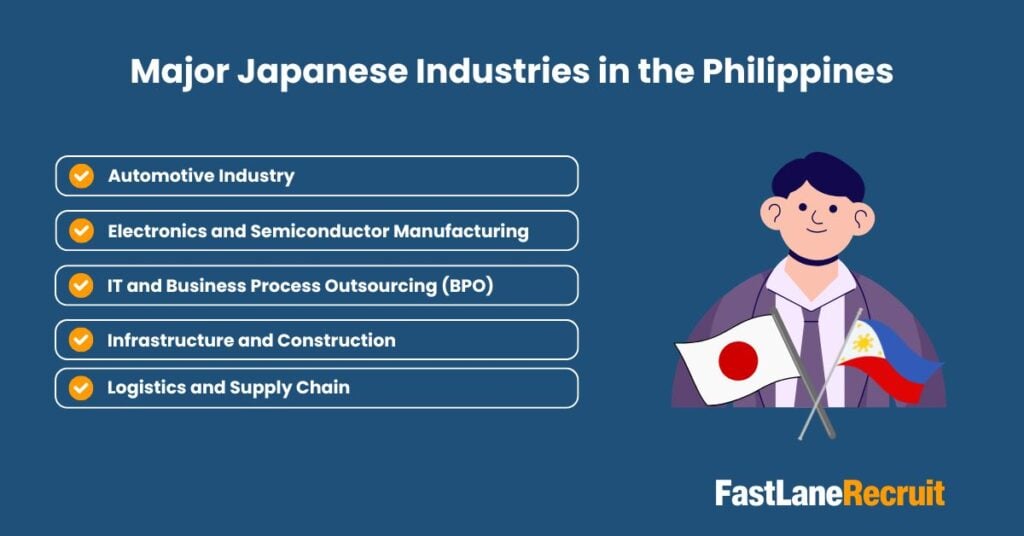
Automotive Industry
Major Japanese automotive brands dominate the Philippine vehicle market.
Key areas include:
- manufacturing,
- parts supply,
- logistics,
- dealership operations,
- and technical support.
Electronics and Semiconductor Manufacturing
Japanese electronics companies continue investing heavily in:
- semiconductor assembly,
- electronics manufacturing,
- and precision engineering.
This sector is becoming increasingly important as global tech supply chains diversify.
IT and Business Process Outsourcing (BPO)
Japanese companies increasingly outsource:
- customer support,
- software development,
- accounting,
- HR,
- and back-office operations.
The Philippines is now viewed as more than a traditional call center destination. It is becoming a strategic operations and talent hub.
Infrastructure and Construction
Japanese firms actively participate in:
- rail projects,
- transportation systems,
- urban development,
- and energy infrastructure.
Logistics and Supply Chain
As regional trade grows, Japanese companies continue expanding logistics and warehousing operations in the Philippines.
What Are the Big 5 Japanese Companies?
Globally, some of the largest and most influential Japanese corporations include:
- Toyota
- Mitsubishi
- Sony
- Hitachi
- SoftBank
These companies operate across industries such as:
- automotive,
- electronics,
- telecommunications,
- finance,
- and technology.
Several of them also maintain operations or partnerships in the Philippines.
What Are the Top Japanese Companies in the Philippines?
Some of the most recognized Japanese companies operating in the Philippines include:
- Toyota
- Nissan
- Hitachi
- Fujifilm
- Murata Manufacturing
- Mitsubishi Corporation
- Sumitomo Corporation
- Panasonic
- Canon
- Yamaha
These companies contribute significantly to:
- employment,
- foreign direct investment,
- industrial development,
- and technology transfer.
What Are the Big 3 Companies in the Philippines?
The “Big 3” in the Philippines can vary depending on the industry.
In telecommunications:
- PLDT
- Globe Telecom
- DITO Telecommunity
In banking:
- BDO
- BPI
- Metrobank
Many Japanese investors and corporations collaborate with major Philippine companies through partnerships and infrastructure projects.
What Does JICA Do in the Philippines?
The Japan International Cooperation Agency (JICA) supports economic and infrastructure development in the Philippines.
JICA contributes to:
- transportation projects,
- flood control systems,
- railway infrastructure,
- disaster risk management,
- and economic development initiatives.
JICA plays a major role in strengthening economic cooperation between Japan and the Philippines.
Recruitment Challenges Japanese Companies Face in the Philippines
Although the Philippines offers strong hiring opportunities, Japanese companies still face several challenges:
Competition for Skilled Talent
Demand is rising for:
- bilingual professionals,
- engineers,
- software developers,
- finance specialists,
- and experienced BPO talent.
Hiring Compliance and Labor Regulations
Foreign companies must navigate:
- employment regulations,
- payroll compliance,
- taxation,
- and workforce management.
Speed of Hiring
Fast-growing companies often struggle with:
- sourcing qualified candidates,
- reducing hiring timelines,
- and maintaining candidate quality.
Also Read: Understanding the Recruitment Process: Strategies for Success
How FastLaneRecruit Helps Japanese Companies Scale Faster
FastLaneRecruit helps international businesses hire skilled professionals in Malaysia through tailored recruitment and workforce solutions.
For Japanese companies expanding into Malaysia, FastLaneRecruit supports:
- talent sourcing,
- recruitment process outsourcing,
- offshore hiring,
- workforce expansion,
- and Employer of Record (EOR) solutions.
Companies can scale teams faster while reducing administrative complexity and compliance risks. Contact us today to get started with your business.
Why Choose Malaysia?
Malaysia is an increasingly attractive destination for global companies due to its strategic location in Southeast Asia, competitive hiring costs, and strong pool of English-speaking talent. The country also offers a stable business environment, well-developed infrastructure, and a growing digital economy, making it ideal for companies looking to expand efficiently across the region.
By hiring in Malaysia, companies can access skilled professionals while maintaining cost efficiency and operational flexibility.
With FastLaneRecruit’s local expertise, companies can scale teams faster while reducing administrative complexity and compliance risks.
Contact us today to get started with your hiring needs in Malaysia.
Why More Japanese Companies Will Continue Expanding in the Philippines
Several trends continue driving Japanese investment into the Philippines:
- labor shortages in Japan,
- rising operating costs,
- ASEAN market expansion,
- semiconductor demand,
- and supply chain diversification.
The Philippines offers a combination of:
- skilled talent,
- competitive labor costs,
- strong English proficiency,
- and strategic geographic positioning.
As a result, more Japanese companies are expected to expand hiring, outsourcing, and investment activities across the country in the coming years.
FAQ Section
Why do Japanese companies outsource to the Philippines?
Japanese companies outsource to the Philippines because of:
- lower operational costs,
- strong English proficiency,
- skilled workforce availability,
- and scalable outsourcing infrastructure.
What industries do Japanese companies invest in within the Philippines?
Major industries include:
- automotive,
- electronics,
- semiconductors,
- BPO,
- IT services,
- logistics,
- infrastructure,
- and manufacturing.
Are Japanese companies hiring in the Philippines?
Yes. Many Japanese companies actively hire Filipino professionals for:
- customer support,
- engineering,
- IT,
- finance,
- HR,
- and operations roles.
What is the role of recruitment agencies for Japanese companies?
Recruitment agencies help Japanese businesses:
- source qualified talent,
- reduce hiring time,
- ensure compliance,
- and scale teams efficiently.
How can foreign companies legally hire employees in Southeast Asia?
Foreign businesses can use Employer of Record (EOR) services to hire employees legally without establishing a local entity.