
Malaysia continues to position itself as a regional hub for foreign professionals and global employers, particularly in high-growth industries such as technology, finance, and digital services. To support foreign talent mobility, Malaysia offers structured immigration pathways primarily through two authorities: the Expatriate Services Division (ESD) and the Malaysia Digital Economy Corporation (MDEC).
Both frameworks facilitate the Employment Pass under Malaysia’s working visa system, but they differ significantly in terms of eligibility, industry focus, processing structure, and strategic advantages. Understanding the distinction between MDEC vs ESD working visa pathways is essential for employers hiring international talent and professionals seeking long-term opportunities in Malaysia’s evolving economy.
Content Outline
Key Summary
Malaysia’s Main Work Visa Is the Employment Pass (EP)
Foreign professionals working in Malaysia typically require an Employment Pass processed through either MDEC or ESD.
MDEC and ESD Serve Different Industries
MDEC focuses on digital and technology-driven companies, while ESD supports traditional and non-digital industries.
MDEC Is Built for Tech and Innovation Companies
Companies with Malaysia Digital (MD) Status can benefit from faster processing and digital economy initiatives under MDEC.
ESD Covers Most General Business Sectors
Manufacturing, retail, finance, education, and other conventional industries usually apply through ESD.
Both Pathways Lead to the Same Employment Pass
Although the processing systems differ, both MDEC and ESD ultimately issue the same Malaysian Employment Pass.
Eligibility Requirements Differ Between Systems
Approval criteria, company qualifications, and documentation requirements vary depending on the chosen pathway.
Choosing the Correct Pathway Improves Hiring Efficiency
Selecting the right system helps employers achieve smoother compliance, faster approvals, and better expatriate workforce planning.
Understanding Malaysia’s Working Visa System (Employment Pass Overview)
Malaysia’s primary working visa for foreign professionals is the Employment Pass (EP), which allows skilled expatriates to legally work for a Malaysian company.
The EP application is not directly applied by individuals but is sponsored by the employing company through one of two government-linked systems:
- Expatriate Services Division (ESD) under the Immigration Department of Malaysia
- Malaysia Digital Economy Corporation (MDEC) for approved digital economy companies
The choice between these two pathways depends entirely on the employer’s industry classification and operational status in Malaysia.
What is the Expatriate Services Division (ESD)?
The Expatriate Services Division (ESD) is Malaysia’s centralized platform for managing expatriate Employment Pass applications across general industries. It is overseen by the Immigration Department of Malaysia and serves as the primary gateway for most traditional businesses hiring foreign professionals.
Industries Covered Under ESD
ESD supports a broad range of sectors, including:
- Manufacturing
- Oil and gas
- Finance and banking
- Retail and trading
- Education and training
- Corporate and professional services
Key Features of ESD Working Visa Pathway
- Applicable to most Malaysian-registered companies
- Standard Employment Pass processing system
- Suitable for general expatriate hiring needs
- Employment Pass validity typically up to 5 years (based on category and contract)
Advantages of ESD
- Broad industry coverage across Malaysia’s economy
- Flexible for non-tech and traditional businesses
- Established regulatory framework under Immigration Malaysia
Limitations of ESD
- Standardized processing may result in longer approval timelines
- Less specialized support compared to digital-focused pathways
- No targeted incentives for tech or digital companies
What is Malaysia Digital Economy Corporation (MDEC)?
The Malaysia Digital Economy Corporation (MDEC) is a government agency dedicated to accelerating Malaysia’s digital economy. It manages Employment Pass applications specifically for companies that hold Malaysia Digital (MD) Status.
MDEC is designed to attract global digital talent and support the growth of technology-driven businesses in Malaysia.
Industries Covered Under MDEC
MDEC primarily supports:
- Software development companies
- IT and cloud service providers
- Digital marketing agencies
- E-commerce platforms
- Global Business Services (GBS) and tech hubs
- AI, fintech, and data-driven companies
Key Features of MDEC Working Visa Pathway
- Dedicated system for digital economy companies
- Requires Malaysia Digital (MD) Status approval
- Faster Employment Pass processing in most cases
- Access to specialized support through MDEC’s eXpats system
Additional Visa Programs Under MDEC
MDEC also supports specialized talent initiatives such as:
- DE Rantau Nomad Pass (for digital nomads and remote workers)
- Malaysia Tech Entrepreneur Programme (MTEP)
Advantages of MDEC
- Faster and more streamlined processing for eligible companies
- Dedicated support for tech and digital employers
- Incentives aligned with Malaysia’s digital transformation agenda
- Strong ecosystem for scaling tech operations
Limitations of MDEC
- Restricted to digital and technology-related industries
- Only available to companies with MD Status approval
- Less suitable for traditional or non-digital sectors
Key Differences: MDEC vs ESD Working Visa Pathways
Although both systems ultimately issue the Employment Pass, their purpose and structure differ significantly.
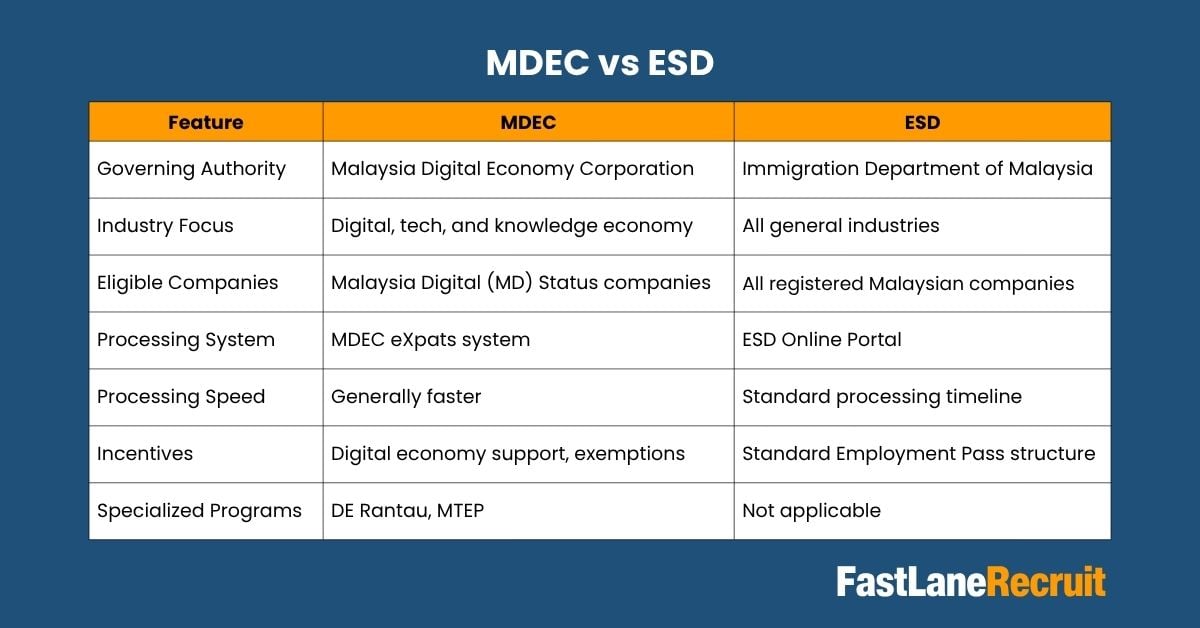
In summary, MDEC is a specialized digital pathway, while ESD serves as the universal employment visa framework.
Paid-Up Capital and Eligibility Requirements
Both MDEC and ESD require employers to meet specific regulatory and financial requirements before hiring foreign talent.
Common Requirements Include:
- Minimum paid-up capital (varies by industry and ownership structure)
- Proper company incorporation in Malaysia
- Valid business registration and operational presence
- Compliance with relevant regulatory bodies
Additional Considerations:
- Industry-specific licensing requirements (e.g., finance, healthcare)
- Salary thresholds for expatriate positions
- Job role justification for foreign hiring
Meeting these requirements is critical for Employment Pass approval under both MDEC and ESD systems.
MDEC vs ESD: Which Working Visa Should Employers Choose?
Choosing the correct Malaysia working visa pathway depends primarily on the company’s industry and hiring objectives.
Choose MDEC If:
- Your company operates in the digital or tech sector
- You are hiring software engineers, developers, or digital specialists
- You require faster onboarding of global tech talent
- Your business is applying for or already holds MD Status
Choose ESD If:
- Your business operates in traditional industries
- You are hiring across multiple non-tech roles
- Your company requires broad expatriate hiring flexibility
- You are a manufacturing, finance, retail, or service-based organization
Long-Term Benefits for Foreign Professionals
Both pathways contribute to long-term career development opportunities in Malaysia.
Key Benefits Include:
- Access to growing Southeast Asian job markets
- Opportunities in multinational and regional headquarters
- Potential pathways to long-term employment stability
- Exposure to Malaysia’s expanding digital economy (especially via MDEC)
For tech professionals, MDEC offers stronger alignment with Malaysia’s innovation-driven economy, while ESD provides broader access across traditional industries.
Common Challenges in the Working Visa Process
Employers and applicants may encounter several challenges during the Employment Pass application process:
- Incomplete or inconsistent documentation
- Delays in company eligibility approval
- Misalignment between job role and visa category
- Regulatory compliance issues
- Changing immigration policies
Working with experienced visa consultants can significantly reduce processing delays and improve approval success rates.
How Professional Visa Support Can Help
Navigating Malaysia’s working visa system (MDEC vs ESD) can be complex, especially for foreign companies entering the market.
Professional support can assist with:
- Employment Pass application submission
- Company eligibility assessment
- MD Status application (for MDEC)
- Documentation review and compliance checks
- End-to-end expatriate hiring support
Need Help Hiring Foreign or Tech Talent in Malaysia?
Navigating Malaysia’s working visa process—whether through MDEC or ESD—can be complex, especially when you need to move fast on hiring the right talent. From eligibility checks and Employment Pass applications to documentation and compliance, every step needs to be handled accurately to avoid delays or rejections.
At FastLane Recruit, we help businesses simplify cross-border hiring in Malaysia by providing end-to-end recruitment and work visa support. Whether you’re building a tech team under MDEC or hiring across traditional sectors via ESD, our team ensures a smooth, compliant, and efficient process from start to finish.
Get expert support for:
- Foreign talent recruitment in Malaysia
- Employment Pass (EP) applications
- MDEC and ESD work visa guidance
- Employer eligibility and documentation support
Build your team in Malaysia with confidence. Let FastLane Recruit handle the complexity while you focus on growth. Get in touch with us today!
FAQ: MDEC vs ESD Malaysia Working Visa
1. What is the difference between MDEC and ESD in Malaysia?
MDEC and ESD are two different authorities that process Malaysia’s Employment Pass (EP). MDEC is designed for digital and tech companies with Malaysia Digital (MD) Status, while ESD covers general industries such as manufacturing, finance, retail, and education.
2. Is MDEC part of the Employment Pass system?
Yes. MDEC is an authorized channel for Employment Pass applications, but only for companies approved under Malaysia Digital (MD) Status in the digital economy sector.
3. Which is faster: MDEC or ESD?
In most cases, MDEC is faster because it uses a dedicated processing system for digital economy companies, while ESD handles a wider range of industries, which can result in longer processing timelines.
4. Who should apply through ESD in Malaysia?
ESD is suitable for companies in traditional sectors such as manufacturing, oil and gas, finance, retail, logistics, and education that need to hire foreign professionals.
5. Can non-tech companies apply through MDEC?
No. MDEC is strictly limited to digital, technology, and knowledge-based companies that have been granted Malaysia Digital (MD) Status.
6. What is Malaysia Digital (MD) Status?
Malaysia Digital (MD) Status is a recognition granted to qualifying tech and digital companies, allowing them to access MDEC services, including streamlined Employment Pass applications and other digital economy incentives.
7. Do both MDEC and ESD lead to the same visa type?
Yes. Both pathways ultimately issue the Employment Pass (EP), but the application process, eligibility requirements, and supporting benefits differ.
8. Which option is better for hiring foreign tech talent in Malaysia?
For tech roles such as software engineers, developers, and digital specialists, MDEC is generally the preferred option due to faster processing and digital-focused support.