
Expanding into Taiwan can give businesses access to skilled talent, but hiring locally comes with employment contracts, payroll, tax, social insurance, benefits and labor compliance requirements. For companies that do not yet have a Taiwan entity, managing these obligations can create unnecessary administrative complexity.
An Employer of Record (EOR) in Taiwan provides an alternative. An EOR becomes the legal employer of your Taiwan-based employees while your company continues to manage their daily work, responsibilities and performance.
This allows businesses to hire in Taiwan without immediately establishing a local entity and building their own payroll and HR infrastructure.
In this guide, we explain how to use an Employer of Record in Taiwan, what an EOR handles, how Taiwan payroll and social insurance work, when an EOR makes more sense than setting up an entity, and how to choose the right EOR partner.
Content Outline
Key Summary
An EOR allows you to hire in Taiwan without setting up a local entity
A Taiwan EOR can employ workers locally on your behalf, helping companies enter the market without immediately creating their own subsidiary or branch.
The EOR handles local employment administration
Depending on the service arrangement, an EOR can manage employment contracts, payroll, tax administration, statutory contributions, benefits administration, onboarding and other HR compliance requirements.
Your company still manages the employee
Using an EOR does not mean giving up operational control. Your company normally remains responsible for the employee’s daily work, objectives, supervision and performance.
Taiwan-specific compliance matters
Businesses hiring in Taiwan need to consider employment regulations, payroll taxes, labor insurance, health insurance, pension contributions, working conditions and statutory employee rights.
EOR can be useful for international expansion
Companies hiring their first Taiwan employee, testing the market, building a remote team or expanding across multiple countries can use an EOR to reduce the administrative burden of establishing local employment infrastructure.
What Is an Employer of Record in Taiwan?
An Employer of Record Taiwan service allows a company to employ workers in Taiwan through a local employment structure without establishing its own legal entity there.
The EOR becomes the employee’s formal or legal employer for employment administration. It takes responsibility for local employment obligations while the client company directs the employee’s actual work.
The relationship can be simplified as:
Your company → manages the employee’s work
Taiwan EOR → manages local employment administration
This separation allows international companies to build a Taiwan-based workforce while relying on a local partner for employment-related administration and compliance.
What Does an EOR Do in Taiwan?
A Taiwan EOR may support:
- Employment contracts
- Employee onboarding
- Payroll processing
- Salary administration
- Tax withholding and administration
- Labor and health insurance administration
- Pension-related obligations
- Statutory benefits
- Leave administration
- HR documentation
- Employment compliance
- Offboarding and termination administration
The exact scope depends on the EOR provider and service agreement.
Also Read: What Is an Employer of Record (EOR)?
How Does an Employer of Record Work in Taiwan?
The EOR model is relatively straightforward.
Your company identifies the candidate it wants to employ in Taiwan. The EOR then employs that individual under a locally compliant employment arrangement.
Your company remains responsible for the employee’s business activities, while the EOR manages the employment administration required in Taiwan.
EOR Relationship Structure
| Responsibility | Your Company | EOR Provider |
| Select candidate | ✓ | Support |
| Define role | ✓ | — |
| Daily management | ✓ | — |
| Performance management | ✓ | Support |
| Employment contract | Input | ✓ |
| Local employment administration | — | ✓ |
| Payroll | — | ✓ |
| Tax administration | — | ✓ |
| Statutory contributions | — | ✓ |
| Employee onboarding | Input | ✓ |
| Benefits administration | Input | ✓ |
| Local HR compliance | — | ✓ |
| Termination administration | Input | ✓ |
The important distinction is that the EOR handles the employment relationship from a local compliance and administrative perspective, while your company remains in control of the employee’s day-to-day work.
How to Use an Employer of Record in Taiwan: Step-by-Step
Using an EOR in Taiwan can simplify the hiring process into several key stages.
1. Determine Whether You Need an EOR
Start by identifying why you want to hire in Taiwan.
An EOR may be appropriate if you:
- Do not have a Taiwan legal entity
- Need to hire one or several employees
- Want to test the Taiwan market
- Need to hire quickly
- Want to avoid building local payroll infrastructure
- Are expanding your remote workforce
- Need support with local employment compliance
If you already operate a substantial business in Taiwan, establishing your own entity may eventually make sense. An EOR can nevertheless provide a practical route while you evaluate the market.
2. Choose an EOR Provider
Evaluate providers based on:
- Taiwan employment capabilities
- Local compliance expertise
- Payroll capabilities
- Benefits administration
- Onboarding process
- Employee support
- International coverage
- Pricing transparency
- Contract flexibility
- Customer support
For businesses expanding across several markets, having one EOR partner with multi-country coverage can also reduce the complexity of managing different providers.
3. Select Your Taiwan Employee
Your company can identify the candidate it wants to hire.
You remain responsible for deciding:
- Who to hire
- The employee’s role
- Salary expectations
- Job responsibilities
- Reporting structure
- Performance objectives
The EOR then helps translate these requirements into a locally compliant employment arrangement.
4. Prepare the Employment Contract
The EOR prepares or facilitates an employment agreement that reflects applicable Taiwan employment requirements.
This is important because employment terms should account for local requirements rather than simply translating a foreign employment contract into Chinese.
5. Complete Employee Onboarding
The employee provides the necessary information and documentation required for employment.
The EOR coordinates relevant onboarding and employment administration, including applicable registrations and statutory requirements.
6. Run Payroll and Statutory Administration
Once the employee is onboarded, the EOR manages recurring employment administration.
This can include:
- Payroll processing
- Salary payments
- Tax withholding
- Labor insurance
- National health insurance-related administration
- Pension contributions
- Leave administration
- Benefits administration
7. Manage the Employee’s Day-to-Day Work
Your company continues managing the employee operationally.
This includes:
- Assigning work
- Managing projects
- Setting KPIs
- Conducting performance reviews
- Providing training
- Managing communication
- Building the employee into your team
8. Manage Changes or Offboarding
If the employee’s salary, role, benefits or employment status changes, the EOR helps administer the change according to the applicable employment requirements.
When employment ends, the EOR can also support the required offboarding and termination process.
Taiwan Employment and Legal Framework: What Employers Need to Know
Hiring employees in Taiwan requires attention to local employment regulations.
The Labor Standards Act is a major component of Taiwan’s employment framework and covers areas such as employment conditions, working hours, leave, wages and termination.
Businesses also need to consider statutory social insurance and pension requirements.
For international companies, the challenge is not simply understanding the law. It is applying the requirements correctly to an actual employee throughout the employment lifecycle.
Key areas to consider include:
- Employment contracts
- Minimum employment standards
- Working hours
- Overtime
- Rest days and leave
- Wages
- Employment termination
- Labor insurance
- National health insurance
- Labor pension
- Tax withholding
- Employee protections
An EOR can help companies manage these obligations through a local employment infrastructure rather than requiring the company to build every process itself.
Also Read: Employee’s Benefits and Compensation in Taiwan
Payroll, Taxes and Social Insurance in Taiwan
Payroll is one of the areas where international hiring can become complicated.
A Taiwan employee’s payroll can involve salary calculation, tax withholding and statutory contributions.
Taiwan Payroll
A compliant payroll process needs to account for the employee’s contractual salary, applicable deductions, statutory contributions, leave and other employment-related items.
An EOR can centralize these processes and provide the employer with a regular payroll administration process.
Taiwan Employment Tax
Employees in Taiwan may be subject to individual income tax obligations, while employers have responsibilities relating to payroll withholding and reporting.
The precise treatment depends on the employee’s circumstances, compensation and tax status.
For international businesses, relying on a local payroll process can reduce the risk of overlooking country-specific requirements.
Labor Insurance
Eligible employees may need to be covered under Taiwan’s labor insurance system.
The applicable contribution structure depends on the employee’s circumstances and the relevant regulations.
National Health Insurance
Taiwan has a national health insurance system, and eligible employees generally need to be enrolled according to applicable requirements.
Labor Pension
Employers may also have obligations under Taiwan’s labor pension system.
Why This Matters for International Employers
Payroll compliance is not a one-time task.
It continues every month throughout employment.
That is why an EOR can be particularly valuable for companies that have the business need to hire in Taiwan but do not have the local HR, payroll and compliance infrastructure to manage these processes themselves.
Also Read: Payroll Services in Taiwan
Why Use an EOR in Taiwan Instead of Setting Up an Entity?
Establishing a legal entity can make sense for companies planning substantial and long-term operations in Taiwan.
However, not every company needs that infrastructure immediately.
If your immediate requirement is simply to employ a small number of people, an EOR can provide a faster and more flexible route to market.
EOR vs. Taiwan Legal Entity
| Factor | Employer of Record | Local Entity |
| Establish separate entity | Not normally required | Required |
| Initial setup | Generally simpler | More complex |
| Local payroll infrastructure | EOR provides | Company builds/manages |
| HR administration | Outsourced | Internal |
| Compliance administration | EOR supports | Company responsible |
| Hiring flexibility | High | Depends on setup |
| Suitable for testing market | Yes | Less suitable |
| Long-term local operation | Can work | Often appropriate |
| Administrative responsibility | Shared with EOR | Primarily company |
| Expansion speed | Generally faster | Usually slower |
When an EOR Can Be the Better Option
An EOR may be suitable when:
- You need to hire before establishing an entity
- You are testing Taiwan as a market
- You have a small initial team
- You need to hire remote employees
- You want to minimize administrative overhead
- You need local employment support
- You are expanding into multiple countries simultaneously
An EOR does not necessarily replace an entity forever. For some businesses, it can function as a market-entry strategy while they evaluate whether establishing their own Taiwan operation makes commercial sense.
EOR vs PEO vs Staffing vs Local Entity in Taiwan
EOR is not the only model available for international hiring.
Understanding the differences helps businesses choose the right structure.
| Model | Legal Employer | Employee Day-to-Day Management | Entity Required by Client | Best For |
| EOR | EOR | Client | Usually no | Hiring without a local entity |
| PEO | Usually shared/co-employment structure | Client | Often yes, depending on arrangement | Companies with existing local infrastructure |
| Staffing Agency | Staffing provider | Client | Usually no | Temporary/contract staffing |
| Local Entity | Client’s company | Client | Yes | Long-term established operations |
EOR vs PEO
A PEO arrangement can differ from an EOR because the client company may need its own local entity and may share employment responsibilities with the PEO.
An EOR is generally more suitable when the company does not yet have a local entity.
EOR vs Staffing
Staffing focuses primarily on supplying workers.
An EOR is designed around the legal employment and HR administration of employees working for the client company.
EOR vs Local Entity
A local entity provides greater direct control over the company’s local employment infrastructure, but it also comes with additional setup and ongoing administrative responsibilities.
The right option depends on the company’s long-term plans, workforce size and operating model.
Benefits of Using an Employer of Record in Taiwan
1. Hire Without Establishing a Local Entity
An EOR can allow companies to employ Taiwan-based workers without immediately creating their own local employment entity.
2. Simplify Local Compliance
The EOR manages employment administration according to the applicable local requirements.
3. Speed Up Market Entry
Instead of building payroll and HR infrastructure first, companies can focus on finding and managing talent.
4. Reduce Administrative Work
Payroll, statutory contributions, employment documentation and HR administration can be handled through one provider.
5. Improve Hiring Flexibility
Companies can start with a small team and determine whether a larger Taiwan operation makes sense later.
6. Support Remote and Distributed Teams
An EOR makes it easier to employ workers who are located in Taiwan while the company’s management remains elsewhere.
7. Access Local Expertise
A knowledgeable EOR partner can help international companies navigate country-specific employment requirements.
8. Simplify Multi-Country Expansion
Companies expanding across Asia-Pacific and other regions can use an EOR partner to centralize international employment administration.
Common Hiring Challenges in Taiwan
Hiring in Taiwan can be attractive, but international employers may encounter several challenges.
Understanding Local Employment Requirements
Foreign companies may be unfamiliar with Taiwan’s labor and employment framework.
Managing Payroll
Payroll requires accurate handling of salary, tax and statutory contributions.
Administering Social Insurance
Labor insurance, health insurance and pension requirements create additional administrative responsibilities.
Employment Documentation
Contracts and employment terms need to reflect applicable local requirements.
Hiring Without an Entity
Companies may find that their existing corporate structure is not designed for directly employing Taiwan-based workers.
Managing Termination Correctly
Employment termination can involve specific procedural and legal considerations.
An EOR addresses these challenges by providing an existing employment and HR administration framework.
Who Should Use an Employer of Record in Taiwan?
An EOR is particularly useful for companies that need Taiwan talent but are not ready to establish a full local operation.
Startups Expanding Into Taiwan
Startups can test the market and hire initial employees without committing immediately to a permanent local structure.
SMEs Hiring Internationally
Small and medium-sized businesses can access Taiwan talent without building a dedicated local HR and payroll team.
Companies Hiring Remote Employees
Businesses can employ Taiwan-based remote workers while maintaining their existing headquarters elsewhere.
Companies Testing a New Market
An EOR can provide a lower-commitment route for evaluating Taiwan before establishing a permanent operation.
Multinational Companies
Larger organizations can use EOR services to simplify employment across multiple countries or fill temporary gaps in local infrastructure.
Industries That Can Benefit From EOR Services in Taiwan
EOR services can be useful across industries where companies need specialized talent without immediately establishing a local operation.
Technology and Software
Useful for hiring developers, engineers, product managers, IT specialists and other technical professionals.
Financial Services
Companies can hire finance, accounting, compliance and operational professionals while maintaining centralized management.
E-commerce
E-commerce companies expanding into Taiwan can build local commercial, marketing and customer support teams.
Professional Services
Consulting, accounting, legal-support and business-service companies can use EOR for specialized local hiring.
Manufacturing and Engineering
Companies can access engineering, technical and operational talent without immediately building a complete local HR structure.
Marketing and Creative Services
Businesses can build local marketing, content, design and creative teams while managing them from another country.
Practical Taiwan EOR Use Cases
Hiring Your First Employee in Taiwan
Instead of establishing a complete entity for one employee, a company can use an EOR to manage the employment relationship.
Building a Small Taiwan Team
Companies can gradually hire several employees while evaluating the market.
Testing Taiwan Before Market Entry
An EOR can allow businesses to establish an initial workforce before committing to a larger investment.
Hiring Specialized Taiwan Talent
Companies can hire skilled professionals even when the company’s legal entity is located elsewhere.
Supporting a Regional Expansion
Businesses expanding across Asia can use one EOR partner to manage employment in multiple markets.
Risks and Considerations When Using an EOR in Taiwan
EOR services can simplify international employment, but businesses should still perform due diligence.
Check Local Coverage
Make sure the provider can legally and operationally support employment in Taiwan.
Understand the Pricing Structure
Ask what is included in the service fee and what may create additional charges.
Review Employment Contracts
Understand the proposed employment terms before the employee signs.
Clarify Responsibilities
Know exactly which responsibilities belong to the EOR and which remain with your company.
Check Employee Support
The employee’s experience matters. A good EOR should provide responsive local HR support.
Consider Long-Term Plans
If you eventually expect to build a substantial Taiwan operation, review whether an EOR remains the best structure as your business grows.
How to Choose an Employer of Record in Taiwan
Choosing an EOR is not simply about finding the lowest monthly fee.
Look for a provider that can combine local expertise, compliance support, payroll administration and international scalability.
Key evaluation criteria include:
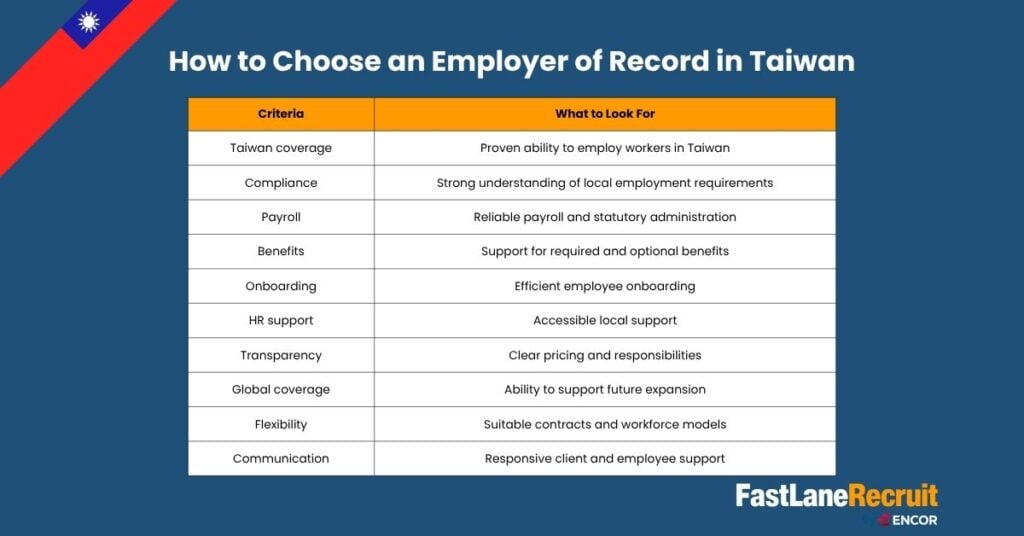
| Criteria | What to Look For |
| Taiwan coverage | Proven ability to employ workers in Taiwan |
| Compliance | Strong understanding of local employment requirements |
| Payroll | Reliable payroll and statutory administration |
| Benefits | Support for required and optional benefits |
| Onboarding | Efficient employee onboarding |
| HR support | Accessible local support |
| Transparency | Clear pricing and responsibilities |
| Global coverage | Ability to support future expansion |
| Flexibility | Suitable contracts and workforce models |
| Communication | Responsive client and employee support |
The best provider should not only help you hire an employee. It should help you manage the employment relationship throughout its lifecycle.
One EOR Partner for Taiwan and Global Expansion
Taiwan may be only one part of your international hiring strategy.
A company that starts by hiring one employee in Taiwan may later need teams in Singapore, Malaysia, Hong Kong, Australia or other markets.
Working with different EOR providers in every country can create fragmented payroll, contracts, HR communication and reporting.
FastLaneRecruit provides EOR support across multiple international markets, including:
| Region | Countries |
| Asia-Pacific | Malaysia, Singapore, Hong Kong, China, India, Philippines, Taiwan, Vietnam, Australia, |
| Europe | United Kingdom, Switzerland |
| Middle East | UAE, Saudi Arabia, Qatar |
This multi-country model allows businesses to consider Taiwan hiring as part of a broader international workforce strategy rather than managing each market independently.
For companies planning expansion across several countries, this can mean fewer provider relationships, more consistent processes and a more centralized approach to international employment.
Why Consider FastLaneRecruit for EOR in Taiwan?
Hiring internationally becomes easier when the EOR provider understands that your objective is not simply to process payroll.
You need to:
Find the right talent → employ them compliantly → manage payroll → support the employee → scale the team.
FastLaneRecruit can support this broader process by providing Taiwan EOR infrastructure for companies hiring in Taiwan while also supporting expansion across multiple international markets.
This is particularly useful for companies that want to:
- Hire Taiwan-based employees without establishing an entity
- Simplify Taiwan employment administration
- Manage payroll and statutory requirements
- Manage work visa and work permit
- Recruit resourceful independent contractor
- Expand into additional Asian markets
- Build distributed international teams
- Work with one partner across multiple countries
The goal is to make international employment easier while allowing your internal team to focus on its core business and employees.
Conclusion: Is an EOR in Taiwan Right for Your Business?
An Employer of Record in Taiwan can provide a practical solution for companies that want to hire local talent without immediately establishing their own legal entity.
Instead of building a Taiwan payroll and HR infrastructure from scratch, businesses can use an EOR to support employment contracts, onboarding, payroll, tax administration, social insurance, benefits and other local employment requirements.
The model is particularly useful for companies hiring their first Taiwan employee, testing the market, building a remote team or expanding across multiple countries.
The key is choosing an EOR provider that combines Taiwan-specific employment expertise with reliable payroll, compliance support and international coverage.
For companies planning to hire in Taiwan and potentially expand into other markets, FastLaneRecruit provides a multi-country EOR solution designed to simplify international employment.
Ready to Hire in Taiwan?
Expanding your workforce should not require you to build an entire HR and payroll infrastructure before you can hire your first employee.
FastLaneRecruit helps businesses hire and employ talent in Taiwan through EOR services while simplifying local employment administration, payroll and compliance.
Whether you are hiring one employee in Taiwan or building teams across multiple countries, our multi-market EOR coverage can provide a more streamlined approach to international employment.
Talk to FastLaneRecruit about your Taiwan hiring plans and find the right EOR solution for your business.
Frequently Asked Questions About Employer of Record Taiwan
What is an Employer of Record in Taiwan?
An Employer of Record in Taiwan is a service that allows a company to employ Taiwan-based workers through an EOR’s local employment structure without necessarily establishing its own Taiwan entity. The EOR manages employment administration while the client company manages the employee’s day-to-day work.
Can I hire employees in Taiwan without a local entity?
An EOR may allow an international company to employ Taiwan-based workers without establishing its own local entity, subject to the applicable legal and employment requirements.
How does a Taiwan EOR work?
The EOR becomes the legal employer for employment administration, while the client company generally controls the employee’s daily work, responsibilities and performance. The EOR can manage payroll, tax administration, statutory contributions, benefits and other HR processes.
What does an EOR handle in Taiwan?
Depending on the provider, an EOR can handle employment contracts, onboarding, payroll, tax administration, labor and health insurance administration, pension-related obligations, benefits, HR documentation and offboarding.
How much does an EOR in Taiwan cost?
EOR pricing varies according to the provider, employee salary, benefits, service scope, workforce size and other factors. Companies should compare the complete cost rather than looking only at the provider’s monthly service fee.
Is EOR better than setting up a company in Taiwan?
It depends on your expansion plans. An EOR can be more practical for companies that need to hire quickly, have a small initial team or want to test the Taiwan market. A local entity may become more appropriate for companies planning substantial, long-term operations.
What is the difference between an EOR and a PEO in Taiwan?
An EOR generally provides a legal employment structure for companies that do not have a local entity. A PEO arrangement can involve shared employment responsibilities and may require the client to maintain its own local entity, depending on the structure.
Can an EOR manage Taiwan payroll?
Yes. Taiwan EOR providers can manage payroll administration and applicable statutory requirements as part of their service, depending on the provider and agreement.
Can I manage my employee directly when using an EOR?
Yes. The client company generally remains responsible for the employee’s daily work, objectives, projects, supervision and performance, while the EOR manages the formal employment administration.
When should I use an EOR in Taiwan?
An EOR can be useful when you need to hire in Taiwan but do not want to establish a local entity yet, are testing the market, need to hire a small team, or want to simplify international employment administration.